Lt. Dunn's "World Alive" Documents Armenian Atrocities
U.S. Naval officer Lieutenant Robert Steed Dunn was the intelligence officer (Dunn spent 20 years in Naval Intelligence) of Rear Admiral Mark L. Bristol, the American High Commissioner in the beaten Ottoman Empire, beginning in 1919, and later serving as a de facto American ambassador. Dunn, who became a well-known mountain climber. trained as a newspaper reporter under Lincoln Steffans, and was a correspondent in five wars.
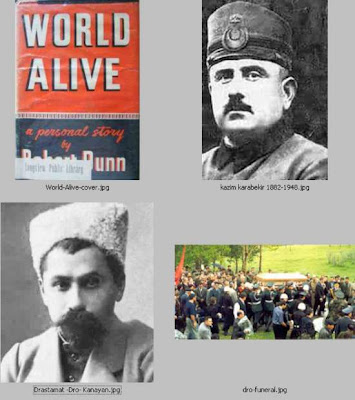
Cover of World Alive, by Robert Dunn
Lieutenant Dunn traveled extensively with Dro and his army in the region, which makes the book that he wrote, World Alive, A Personal Story (Crown Publishers, Inc., New York, 1952 or 1956, published shortly after Dunn's death). of tremendous importance — given that it was the rare Westerner who served as direct eyewitness to the Armenians' crimes of systematic extermination.
Because Dunn's testimony is so damaging to the Armenians' "Myth of Innocence,"and given that Armenians have so rarely let the cat out of the bag as far as their extremists' murderous behavior, soldiers for Hai Tahd naturally strike back in the way they know best — through smear campaigns. Thus, Richard Hovannisian attempted to discredit Dunn, for example, by making all kinds of wild claims (such as Dunn's being a Muslim, which was, of course, ridiculous; Hovannisian hoped to benefit through the implication that all Muslims must dutifully lie for anything involving Muslims, thinking perhaps that all other groups must subscribe to the extremist-Armenian rule book) .
Quotes from Dunn's book have circulated for years, but the Turks who put them up have editorialized some of the lines; there is nothing like going to the original source if accuracy is our goal. Many thanks to reader Adil, who was also dismayed by the distorted version of Dunn's Internet-available writings, and who provided the real thing for TAT readers.
(p. 294)
Under the Treaty of Brest-Litovsk, the Russians had given Germany all Transcaucasia. When the surrender at Compiègne tore that, Britain was willing to occupy Batum, one gate toward India and the end of the Nobel oil pipeline from Baku. And now Versailles, to block Lenin across the highest peaks in Europe, had carved three states south of the Caucasus range. Georgia, Armenia and Tatar Azerbaidzhan. In their short lives, none was independent, each brawled with its neighbors, and in Constantinople we called them the "jazz republics" of the Caucasus.
From its birth on May 28, 1918, the Allies flattered, promised, and "recognized" the small Armenian republic, although England alone gave concrete aid. Erevan, the capital, and the territory it claimed were included in the British occupation of the Caucasus which began in September, 1918, at Baku. The army on the spot — troops which have traversed Persia — was honest and sincere, though inadequate to the difficulties. But all the Allies were to find a conflict between the needs of the Near East and their own plans for its commercial exploitation. England here was hampered by home vacillation and by the nightmare specters of pan-Islam to the south and mad Ivan to the north. Conflicting "home" and "Indian" policies raised religious issues, and aid to the White generals took men and supplies.
So the British had solved none of the complex vendetta of race and religion in the Trancaucasus. They failed to establish order among Armenians, Kurds and Tartars although, as a report to me summed up:
Tartars and Armenians alike are amenable to reason, especially quick to appreciate fairness and a disinterested attitude. The principal handicap under which the British labored in the Transcaucasus, and of which they still bear
(p. 295)
the odium, was the fact that they were not disinterested, and that both Tartars and Armenians were aware of it.
Thus both sides distorted and took advantage of British promises, and made reprisals upon one another. Soon, under Armenian occupation of the railway to Tabriz, there were thirty thousand helpless and starving Tartar refugees in the region. But the Tartars won back and held the Nakhichevan area, fortifying the Beuk Vedi mountain within sight of the capital, and the Armenians were never able to recapture it. Both sides declared the British had deceived them. Unless he traveled under the American flag— the relief workers were there — no Englishman's life was safe.
But the British wanted a buffer between their aspirations in Mesopotamia and Persia, and the Russian power in the north. They well knew that some day Russia would come back with all her old aggression, the pan-Slavism of the past. They wanted no jealous European nation intriguing and blocking them on the strategic land strip in the Transcaucasus that had been Russian Armenia. And so throughout 1919 British propaganda joined the pleas of Armenian absentees to wish on Armenia such a white elephant as would have made blood boil in the United States had the truth been known.
You cannot blame the British, bred in the old European diplomacy. Events that year were acute for them, or seemed so. General Denikin's defeat was foreseen, not despite but largely because of British military aid. Victorious Bolshevism was pressing into Persia and Afghanistan, toward India. British interests played desperately for Mosul oil and exclusive control of Persia. Mmore, misinformed by their native intelligence agents, or for political effect, they hauled out the old pan-Islam and pan-Turanian bogies, with the false charge that the Turkish nationalist movement was a continuation of the vile Young Turk party. Meanwhile, London checked expenditures, the pound fell, troops were withdrawn from the Near East, and the deadlock in Cilicia alienated France.
So, America to the rescue! Logic pointed to the sentimental, friendly United States, already in Armenia with aid.
(P. 309, unconfirmed: . . . Next I was drinking Scotch with British `I' officers in Erzurum, in what had been an American mission school for girls. Now it housed Colonel Toby Rawlinson from Donsterville's hush-hush army. They put me up and I heard, in Oxford English, more stories of Armenians murdering Turks when the czarist troops fled north. My hosts told me of their duty here: to keep tab on brigands, Turkish troop shifts, hidden arms, spies — Christian, Red or Tartar — coming in from Transcaucasus...)
(p. 310)
Then they spoke of the hell that would break loose if Versailles were to put, as threatened, the six "Armenian" vilayets of Turkey under the control of Erevan.
"We sit on the edge of a volcano, Dunn," said Rawlinson. And the sun-and-booze-dried brother of the Whitehall chief-of-staff (their father had solved cuneiform) talked on like the blunt, keen, braggart soldier his juniors had sketched to me.
"So you want us to take a mandate over it all," I said, "as a buffer to your Iraq."
"America'd never be so mad. I've been in America. Your people are too damned level-headed."
"If the President's behind it—"
"An Armenia without Armenians! Turks under Christian rule?" His lips smacked in irony under the droopy red mustache. "That's bloodshed — just Smyrna over again on a bigger scale. If you touch that business you're bigger fools than I've ever taken you for."
The fight at Smyrna had stirred Moslems even here. Until bedtime we chewed over the stock of all Anatolia. In the morning, while agents in tattered czarist uniforms and beards reported to Rawlinson, I went out with my small black O.N.J. field code-book and ciphered word to Constantinople. The telegraph office alone was intact on a burnt-out street. But lilacs bloomed over Erzurum's famous blue mosque, its porcelain dome ringed in acanthus leaves, raised minarets slim and red against the mountain snow. A donkey train packed in white chunks of snow, used to sweeten colored driniks in the bazaar.
A Russian Tartar "mining-engineer" in leather breeches, met on the street with our Armenian colonel, brought the first word of a secret Turkish society, the Hokkuk Milli, "For Defense of National Rights," which he said would meet here in Erzurum on July 10. Forty members from each of Turkey's six eastern vilayets would talk force against the loss of sovereignty begun at Smyrna. They had arms and the backing of every class from chetties ("patriot" bandits) to the regular army.
"Also General Mustapha Kemal Pasha will be here from Stamboul," the Tartar added. This was the first time I'd heard
(p. 311)
the name of the victor at Gallipoli. "But all is yet under cover."
When I told Rawlinson of this meeting, "Oh, the army's not in that Hokkuk Milli," he said. "The Third Corps, west of here, at Sivas, is making some trouble but we're clearing that up."
I dropped the matter, feeling him wiser than he wanted to appear. Only afterwards I learned how they were "clearing up" at Sivas — the British had sent Mustapha Kemal there to quell the reported rebellion. He made the best of his opportunity to place himself at the head of the Nationalist movement previously started at the capital. Thus the British created the Kemalist movement.
Karabekir
In the Erzurum barracks, General Kiazim Karabekir Pasha, wartime commander-in-chief of eastern Turkey, also looked blank — cleverly, I thought — at mention of the Hukkuk Milli. Politics, he said, was out — "I am a soldier."
So I told him of hearing in Baku that his old war chief, Enver Pasha, now in flight, was leading a band of Kurds in Persian Azerbaidzhan.
"So the Pasha lives as he did when young!"
"Well," I said, "if I were a Turk these days I'd be a brigand. And in Russia a Bolshevik."
He laughed, so I spoke of the unrest west of us. Kiazim's eyes bored me through.
"Sivas rests quiet. All is peace and order there. I should wish for you to see that, and prove true to my words." He spoke softly. weighing them. "I offer you and officer and armed men to our Third Army. It's a long journey on horseback. I ask you to accept the escort."
"Thank you, sir!" I said at the luck. I was to see Kiazim again, farther east, and he was a friend for years on.
Rawlinson later described my start for Sivas, "mounted on a native pony, with a Kurdish saddle ... and wearing blue cloth naval uniform and trousers, than which it would be hard to conceive a more unsuitable costume for such an arduous journey."*
*Adventures in the Near East," A. Rawlinson, C.M.G., London, 1925.
(p. 347; Chapter 21.)
Plunder worked both ways. Our reports informed me the American government that "Constant appeals are received to protect Armenians from massacre, while ... the continual provocation given the Moslems by the Armenians in extending their political control, in driving Moslems into exile and destroying their villages, are facts not told our people." This we knew from observation; I confirmed it by experience when I joined the campaign of Armenia's General Dro.
That was the summer Trotsky stepped out and the Eleventh Soviet Army walked south into Baku, erasing jazz republic Azerbaidzhan. Jitters shook the Menshevik presidents of Georgia and Armenia and also, it appeared, Allied High Commissioner Haskell, a West Point colonel with no U.S. authority — he was responsible solely to Versailles. But now he sent an order to all American reliefers and missionaries to quit their posts and hit for the coast "at night and by untraveled roads." Horse laughs went up from a score of posts: "The retreat from Moscow!" Never one obeyed, although Haskell's top aide, a genial colonel handy at taming tribal Tartars and pretty Georgian princesses, fled from Tiflis to Batum. He left for good after a Russian general's daughter yelled "Rape!" but not before, in Haskell's absence, his aide got a bleary o.k. on a wire to Washington which read in effect, Rush to Batum immediately 5,000 U.S. Marines.
(p. 348)
Now that the admiral sent me there, forty thousand Georgians, Adjars and Turks were waiting to fight back when Lenin should turn the heat on Georgia. But any foreign citizen was safe, whether in the wilds or under the oil port's mandarin orange trees. I bunked in an officers' rest-house, ate at the Armenian club, and bargained for rare overprint stamps. Only the British, branded by Moscow as "capitalist" and "imperialist," were unloved — and the Orthodox church objected when Tommies married local girls.
While Whitehall wobbled, the Soviet advance was slow but sure — like a glacier. On the Kobuleti "front" Georgian troops opened fire on Britain's General Milne, while up-coast at Gagri, as at Odessa, H.M.S. Caradoc flung shells at the Reds. And all the Robin Hoods of Asia Minor skulked or hunted over a no man's land that stretched down to Persia.
On top in Armenia was the secret Dashnatz Society, terrorist and black hand. As late as 1935 its long arm would murder a bishop at his altar in New York. Its Tartar foe called Mussovat ran Baku, under the blood satrap Sultanov. Enver Pasha and his close kin Halil and Nouri were in hiding. These "Young Turks," under death sentence for murdering Armenians, were forefunners of the Nazis convicted of genocide and had been won by a slick German ambassador at Constantinople to fight in '14. But to appease the Moslems the British had winked at Halil's and Nouri's escape from a Batum jail; and when last year in the Caspian Karabakh an Indian army subaltern had pinched Enver, headquarters wired, "Let him go."
At Batum now, placards in the Orient Hotel windows still promised "Blinis Sevoydna," pancakes today. But you saw more tow-heads with fanatic eyes under the bloody star on gray flannel caps. Head of the Moscow mission was that Kirov whose murder in 1934 signaled the purge. The British high commissioner, raising a stink over the attack on Milne, prepared to get out, and the British mission burned all "secret" papers. Americans were calmer, both the oil buzzard I lodged with and the consulate worried over a cargo of contraband rugs. But the British still talked of "the retreat from Moscow." Limey official
(p. 349)
reports read: "A panic was caused in Tiflis by the Americans' running away."
At dinner in the American headquarters palace, Haskell's transport officer promised me a lower to Erevan. But on the station platform, scene of last year's Ghurka murder, he said, "There's no accommodation for you."
"Hey?" The train was ready, Nicholas's posh car in the rear.
"Colonel Haskell forbids you to enter Armenia."
It was my turn to blow up. "I'm traveling in uniform, under orders, understand?"
"He's traveling to Erevan today, himself."
"Yeah, saving face. You tell him this is interference with an officer carrying out his duty. I can have him arrested, and by God, I will!"
The aide gave me a sheepish look and walked away. A limey officer who stood near had heard and his eyes twinkled.
"I'll manage it, we have a spare place," he said, and helped load on my junk.
At Alexandropol, where last week's riot had jailed and then shot Kerensky's brother-in-law, Haskell and I paced the platform. We went through peaks and gorges spread to a snowy Turkish horizon, past stone huts pocked in Tartar raids, to Etchmiadzin where Armenia's St. Gregory made the first mass Christian conversion. At every stop Haskell and I got off, walked, cross-trampled miles, our elbows brushing, and passed one another without saying one word, nod, or batted eye.
Now we saw one sky-high dead volcano — old Noah's white Ararat. At last came Erevan's 'dobe houses, blue-pinkish walls thick yet crumbling along the vineyards; and while a muddy Ford jounced Haskell away, I walked up the wide main street. Ragged old women sat on the curbs carding wool. Sidewalks of dusty lava, worn concave, led to the mission where Annie Allen had told me to stay.
There the ground floor was rented to reliefers, and upstairs voices on the balcony outside my room talked of stolen calico. Later the young man in charge told me sardonic yarns of local politics and charity. Armenians, waiting in groups to be fed along a highway, would cut down the shade trees and sell cord
(p. 350)
wood. The grandpas I heard hawking on the streets offered splinters of the Ark, five rubles each — "A dime, for strangers like you." When we motored to Igdir, past an orphanage, I heard it held few under sixty. "They'd swear both parents were dead. So we put an age limit. Now, no matter who died, there's not an orphan in Armenia over twelve."
All during my stay, the backyard shooting crackled across a hazy score of miles to Ararat. Armenian and Tartar skirmishes seemed right at our balcony. But to see a real one I had first to meet in the Erevan "I" office, a staff captain in Armenian uniform.
"I am Merrimanov, aide to General Dro," he smiled at me. "Tomorrow with dispatches we return to our Army of the Karabakh. I invite you to accompany me."
Dro was national patriot, army chief, legendary guerilla, Assassin of Russia's viceroy in that cockeyed 1905 revolution, by '15 he was kissed and decorated by Grand Duke Nicholas for taking Erzurum. Today on the world-end uplands of southeast Transcaucasia, he kept Lenin's boys out of Persia. My sixth sense said go with Dro.
Merrimanov looked like a flax-banged, blue-eyed Russian, and had trained in the Petrograd cavalry school, he told me. We jammed aboard an army lorry like a prairie-schooner except for the motor. For the journey north to Lake Sevang it was already filled with peasants, babies, bedding, wine-skins, and cherry-baskets.
At our right were alpine snowfields which, as in Alaska, trickled down to lush greenery. Here the meadows were blue or yellow with cornflowers or roses. At noon we ate mutton cooked over charcoal, in a thatched mud village where kids fought dogs for the bones we tossed away. At sunset, sixty miles of lake opened in the east, with the village of Eleankova beside it, six thousand feet above the sea. Grass grew on the roofs, and a blond giant mowed oats on the one we went under to an army ration post. "Bolshevik," my host shrugged as soldiers coming in grabbed bread. One harangued his officer, in a foul linen tunic, who barked back.
(p. 351)
We dunked our bread in chai and turned in on the mud floor of the hut, but got no wink of sleep. Hide thongs from the huge beams held a cradle; mama quit stoking her samovar to kiss tiny toes, but baby wailed and cats miaowed, and twenty snorers made me finally burst outside to sleep by the weedy lake shore. Here, dawn etched a sloop with a sail like burlap. I washed near it. "Boom!" went the brass one-pounder on her bow. Smoke curled around her grinning skipper, barefoot and capless like his crew but all in naval uniform of sorts. He'd spied mine, so, shoving off to bombard Tartars under the white hazy ranges across Sevang, the Armenian navy saluted me!
Now heading south, below emerald pastures cropped by black sheep, we passed huts that Merrimanov said were the cradle of his race. Everywhere rose graveyards with high tombs bearing the Bagratid cross, its ends split and curving under orange lichen.
"Here, Turks," the captain said with a laugh of others who'd been ruined. "Tchik!" — cutting a finger across his neck. "Ecrasés."
At road's end in a dusty village, Novo-Bayazid, the camion went back. An old priest, waist dangling silver tassels, brought me his foundered sorrel pony and Merrimanov got a husky bay stallion. Horsemen in dirty czarist tunics, with rifles and side-arms, joined us.
Hot at the noon halt, I stripped and swam out toward boats with lateen sails, like Chinese junks. "Bravo!" shouted Merrimanov, and his whole troop drew up and watched till their cheers set me stunting. "Diable! But none of us can do that," they said as I came ashore. "Before, we never see a man swim."
After bread daubed with condensed milk from relief supplies — as ever, the military hook was into them — we went on till dusk brought us to a crumbling barracks. None but natives, said Merrimanov, had ever gone beyond Lake Sevang, southeast of Erevan with high snow teeth between.
Now forget-me-nots blued the meadows to the snow-line, but more villages were rubble heaps — "All massacred," the captain gloated. Buzzards soared above ridges to the west, where look-outs manned the black pinnacles. At our pass, looking down
(p. 352)
took your breath away. Beyond was a low, thick-walled temple of gray stone that I'd swear Assyrians built as they came down on the fold. Sheep had dunged its insides, under a flat roof with two vents. Outside over the door, a bull in high relief at the right, a winged lamb at the left. Script between looked Arabic; later I learned it was the Vannic cuneiform. Lower, came linear moldings like bedsprings counter-twined, with tri-petaled bosses — three wee bananas bunched at the top. Roman arches on five-sided pillars were let into the walls of a small room attached, a sort of Byzantine dog-house.
We switchbacked up a canyon where large oriental poppies, at home here, danced in flame up the sides. Walnut leaves glinted, mistletoe fogged the willows, wheat ripened in saffron quilts, and hungry boys gathered orchard apricots to eat green. A moon rose, dark silver; water ran loud; mosquitoes bit — the lower Araks valley was a world plague spot of malaria. Its beauty breathed a blight of violence, its people were toothless and dirt-poor. Children at field work chanted with an Eastern sadness no Rimski-Korsakov has got. And at treeline and twilight, the nightingales were singing — how they sang!
Near the summit, tents of felty black were ribbed out around their poles like melons. We heard savage barking, curses, and a woman rushed out yelling in terror. "She fears Moslem attack," the captain said. "This is a summer village without name. Their fighting men are higher with the sheep." Here was a timeless feud that stretched as far as India. The shepherd left his lowland parching in summer's heat and drove upward, then down in autumn. Aliens in creed and race mingled flocks and claimed the pasture that the same snow gave, with bloodshed as one passed another.
Inside an old man's house, granddads filed in to sit on old rugs, and brandy for General Dro came out of the saddlebags. Crones bought milk and queer roots, boiled and tasteless. You were back in a Cree teepee; our world had given these primitives less than Eskimos, only cooking gear and needles.
But they were the captain's own people. "Ah, please do not," he said as on leaving I took out baksheesh for the host. "None here have ever seen or know what money is." Armenians without
(p. 353)
an itching palm? But rarest to me was their civilized brother Merrimanov, who'd shown them no condescension.
Past a cold volcanic cone and a glimpse of Ararat, due west, we came to scrub oak that led down to a Molokan — "Milker" — village. From Russia, orthodoxy had banished and spread wide this Slavic folk who, like Quakers, had no priests. None drank, smoked, fought, or shaved. Even the young men looked like Rip van Winkles. The sect raised grain and meat to sell to any side at war, and thus these true pacifists kept the bloodshed going.
This noon the Molokan houses, limited white inside and out, gave us cheese and two kinds of roots with red wine. Merrimanov slept as I found more eight-pointed Bagratid crosses, one carved with an ancient man-faced sheep, cruder than Aztec stuff. Then a short pass and a river ford led us into Zangezour province, where crowds jammed the one wide street. A man with a hammer-and-sickle badge, suspicious of a strange uniform, grabbed at my bridle until the captain struck out with his quirt.
"Commissar!" growled Merrimanov, explaining that the Bolo seep-in was easy here, for Molokans owned all in common anyhow. But I paid rubles for eggs.
Now only twenty versts more took us to Angelaoot, its hovels swarming with peasants and soldiers in Russian hand-me-downs — Dro's headquarters. We unsaddled and lunched on fried lamb liver while Merrimanov talked Armenian with an adjutant in gold prince-nez. Then they led me to an inner room, its windows giving on the usual cemetery. There a stocky man in black knee boots, olive breeches, and a belted shirt with the tails out sat in a broken chair between tumbled bedding and a table of field telegraph sounders. Flies clustered over teh samovar and a bucket of clabbered milk.
Puzzled, I touched my cap to an arresting dark, round face, with heavy brown mustache and near Vandyke beard. The man got up, returning my salute, and in the doorway a third officer addressed him, "Dro."
"Is he the general?" I asked Merrimanov.
[p. 354]
"Yes, but you must not call him that. He is just 'mister,' or better, to us just 'Dro.' "
He wore no sleeve or shoulder marks, nothing to show him an officer at all. He looked about forty. Eyes of the black of tourmaline were now soft, next stony. At their outer corners, nets of tiny lines curved upward to show he’d smiled and enjoyed life more than he’d snarled or grieved.
I eyed the holster strapped to the chief’s waist. No gun was in it. He caught my eye and laughed.
“Eh? You see I have not side arms,” he roared in Russian.
“I fear to lose temper and shoot an aide-de-camp.”
“Like me, Dro. Look.” My case was empty, the admiral’s Colt forgotten and left at Tiflis.
He raised an arm and slapped me on the back. “We are the only unarmed officers in the Army of the Karabakh!”
Dro’s staff billeted me in a room with a mud floor and a window with iron bars but no glass, to sleep on gunny sacks with a saddle for pillow. Cattle, sheep, and goats came home at sunset, and their rnoos and reek kept me awake, then roused me early when the wolf-tailed dogs raged too.
At morning tea, Dro and his officers spread out a map of this
whole high region called the Karabakh. Deep in tactics, they spoke Russian, but I got their contempt for Allied “neutral”
zones and ‘heir distrust of promises made by tribal chiefs. A campaign shaped; note raids on Moslem villages. it was as if in
'16 I’d been with Villa instead of Pershing. "Dro’s force, mainly cavalry, moves in units of about sixty.” my report to the admiral would read.
Angelaoot was on a main Baku-Nakhichevan road, by which
the Bolsheviks aimed their sweep into Iran. For the moment this had stalled because many Tartars still resisted. Also Nouri Pasha, brother-in-law of Turkey’s Enver, waited to see how fast Marxism would convert.
“First the Milkers,” said. a major with glasses. “With no Christian church, they are infidels, too."
"When we secure the frontiers,” said Dro with a a wink, "I shall make them serve in the Armenian army.”
[p. 355]
>It was a lie, they said, that Trotsky had ordered Azerbaidzhan to
stop attacking Armenia. Two days ago twelve of his agents had been seized near here. Lately they'd stolen cows at Kushi. Now the reprisal would be a Tartar village called Djul.
‘That afternoon a loaded pack-train pulled out, southwest. Its horses were good and strong, and their saddles had metal clamps for attaching mountain guns. The telephone kept ringing. “Allo. Karaklissa—Zangebazar," you heard. "Batteria pignatzit" (Russian for fifteenth battery). A Morse sounder clicked. Mounted couriers dashed up, deIivering chits, and the dust dimmed a single wire that led east on sapling poles. Dro's communications beat Pershing’s on the Chihuahua front.
After mess a crowd gathered and Dro settled disputes among his shepherd and peasant henchmen. All flashed to attention as the guerrilla chief swaggered about; eyes followed as he questioned kindly, or stopped one brawl with a slash of his riding crop. Back in his headquarters he told me, in French, "I have fought for twenty years without pause. My body is a colander of wounds,’’ His hand touched thigh, body, chest. "This bullet I got at Lake Van, that in Kars. Here the heathen at Sarikamish—” clapping a leg—‘‘put in one that still pains.”
After the supper of pilaff and shashlik, there were countless
toasts in cognac to country and patriots, and, mellowed, the crowd fixed on America. All l knew well enough that U.S. military aid to Armenia was hogwash, and they spared me reproach on Wilson's Fourteen Points as well as thanks for feeding their people. But they felt some envy.
"I should like to ride on a fast train of the United States,” said the major.
In the morning, as we broke camp, Dro's orderly saddled his black Arab stallion, a high whipsnorter named Archo. The whole headquarters troop stood by its mounts, all stallions. My mare was nowhere in sight, but I caught the word for her—kobil— as Merrimanov, chuckling with his chief, came over.
"Today Dro offers that you ride Archo," he said.
At this honor I could only bow and thank him, grit my teeth, and climb aloft on the quivering sable back. Archo was quite a
[p. 356]
handful and took up all my attention; so I missed, I realized
later, the expectant nudges exchanged by the others.
We set off in standard cavalry style, our “poInt” of four
outriders ahead with the lance fIag—three faded stripes of red, blue, and yellow, the Armenian colors, Dro, on Archo’s twin,
dropped back beside me as we left town, to point to a large
house.
‘‘Three Bolsheviks have settled,’ he said, “They want the Milkers’ grain, but I forbid that, though we are friends."
Now, Merrimanov sidled closer. Lord, but Archo was pulling my anus out of their sockets; he was willful as a raw bronco his long gait killing at a trot. We’d headed east through the gloomy canyon toward Bazarchai, but now turned south across green pastures.
"Don,” Dro shouted, “you want to be at the fight?’’
I bothered with no language, my nod was clear. Could I miss riding to battle with a freebooter national hero, in his own saddle? Dro halted and harangued everyone along the track. “Where are you going?” BulI-cart or buffalo driver took off a shaggy cap and twisted it, muttering. Dro turned every outfit back, A soldier riding from one cross-track gave him a paper, pointed to unshod hoofprints.
“Last night Tartars,” said the captain.
“Archo!" voices called. We two were getting on fine now, perhaps too well in cavalry eyes, for a sailor on horseback. Ahead to the right striped cattle grazed, a red bull with his head up. rutting. The column hugged that side of the road officer reined in tightly, away from a left-hand meadow. There, too late to curb my stallion, I spotted mares.
Archo bolted, snorting. The bridIle in my hands might have been two bits of thread, He galIoped for the mares in a gale of whinnies— his own, theirs —and behind, rising as the distance grew, Armenian laughter. We took one ditch like a steeple-chase; I stuck but freed my feet from the stirrups and leaned far back, against pitching off between his ears at a halt. That
worked until his forehoofs struck upward, clipping a filly's haunch, and back-somersaulted me a’sprawl into the grass.
Dro rode over as I got to my feet, trying to out-laugh him.
[p. 357]
He dismounted and with one hand tight on his curb bit, with the other lashed Archo, shivering and wilted, to all-fours.
"That swim of yours:" Merrimanov, close behind on foot, explained between chuckles. Well, the score was even, though it wasn't in me right then to congratulate them. The captain and I walked to where an orderly held a sorrel gelding—sexless, thank God.
Soon we reached a town, Zangebazar of the telephone calls, larger and livelier than Angelaoot. In the main street men stacked rifles, handled machine guns. From the jutting ridges pole of headquarters hung a cloth bag of fresh cheese; cows caught its drip on their tongues. Inside, cook-pots and haversacks crowded the crowfoot batteries that were the heart of Dro's communications.
"I kill that sheep," Dro called to a shepherd leading past a young black ram, as Hank Allen in Mexico had commandeered a Hearst steer. "Ba-a-ah!" cried our supper as it was led away to knife and fire, a lieutenant at his horns. No money passed, only a slap of the chief's hand of the grinning shepherd's back.
Drastamat "Dro" Kanayan
And as a group gathered, Dro gave a sort of pep-talk, to hairy Slav faces — none Molokans. "Cristos" kept coming in his words, he seemed to be playing on their religion for a stand against their Red brothers in the north and the Moslems southward. Here Armenian and Tartar had long borne with one another, but a hero had to act in character, make a demagogic appeal to race and nation like ours to "democracy."
"My troops have freed forty-five infidel villages in Zangezour," he said loudly, in the Russian I caught. Next he launched into Bolshevism as a "heathen curse," while rapt faces looked into space.
"Dro, you're up against it, bucking Red propaganda." I told him afterwards. "They're fanatics too."
"Well, then, so I must be," he said with a shrug and a grin that simplified things, and threw himself on a horsehair sofa to snore. But the clicking Morse sounder roused him; this man never stayed put. He detailed a captain of the local garrison, then strolled among his ranks in dusty, homespun uniform.
"A health to you," he cried, passing squads at ease. Heels
[p. 358]
clicked, arms lifted in salute. ‘‘To you, a thousand healths!" came back massed voices in sing-song.
Then Dro led Merrimanov, me, and a srnall, leather-skinned
code clerk to the town steam bath. Water from the black rocks
was so hot we flung open the door and faces gathered in the dusk to watch as we slapped our bodies with green birch fronds, a marvel at this dry treeline, Molokan girls in kerchiefs giggled through the vapor at warrior nakedness.
A pack-train next morning brought mail, and as in any army, officers passed around family snapshots. But scouts dashed up; Dro, yawning, dictated orders—a subaltern in the saddle all night must rope his guns up cliffs to new positions. The town called Djul was on every tongue.
“It will he three hours to take,” Dro told me. We’d close in on three sides.
“The men on foot will not shoot, but use only the bayonets,”
Merrimanov said, jabbing a rifle in durnbshow.
‘“That is for morale,” Dro put in, “We must keep the Moslems in terror that our cruelty beats theirs."
“Soldiers or civilians?” I asked.
“l’here is no difference," said Dro." All are armed, in uniform or not."
“But the women and children?”
“Will fly with the others as best they may.”
Just then a rider in peasant dress drew up outside, and Merrimanov translated his excited Armenian, “He found a peasant dead at the ford, the body still warm. Tartars killed him, but they got away before we saw them.”
Now the peasant, as though feeling his word doubted, flung himself to the ground and lay prone a moment, an act that drew angry murmurs from the troops. Other "witnesses" turned up, though none had seen any killer, and at last a snub-nosed lad put the murder spot eight versts from the river.
But others brought a tale of twelve Tartars raiding a village called Kushi, killing many and taking away two girls. More
tales flew around, no story convincing, and I wondered how much of it Dro’s smart "I" boys might be contributing. Whatever the fact, our force was imbued with the spirit wanted; the
[p. 359]
end was won, as by Dro's appeal to race and faith: "responsibility" for slaughter was fixed at just the right emotional moment.
Only the Molokans held aloof, and hadn't supplied a levy of horses. So Merrimanov and I went to their barnlike meeting house, painted bright blue. But we got no horses. A hymn-sing was on, and men's gruff bass supported sweet songs from girls in salmon pink skirts and white coifs. All was so religious that as I took a book from an old man's hand he nodded for me to keep it — a New Testament that would help my Russian.
"But you say these people aren't Christian," I said, "because they have no priests to tell them what to believe."
"So their faith is false," Merrimanov nodded.
"And that makes yours true? Is it not really because your race has them in military power?"
"If you want," the captain shrugged.
"No men are fit to rule others on such a ground," I said. "You throw away the best of winning them — to forget blood and creed."
He gaped and nodded, but I saw the idea could not penetrate the hard armor of tradition and ritual. His heritage was to keep up the old feuds, to exploit and oppress all other partisans.
If you hadn't these Tartars on your neck," my last shot was, "quick enough you'd pick a row even with Milkers." I added thanks that we weren't mixed up in it, and that Merrimanov got, a wistful smirk told me.
Off in the dark Dro's voice was raised in a final harangue to the ranks — no playing up Christ now, or even patriotism, but primordial greed. He was mixing Armenian and Russian in sheer outlaw talk. The word plunder, gradesh, kept coming. "Tomorrow the road will be open —" Back of church, home, and nation, I grasped, man had exact, hard urges, more freshly. Dro was playing on these, as here an eye glittered, there lips were licked.
Dro's voice was the first heard in next day's darkness before the early June dawn. At the water pail each man filled his
[p. 360]
mouth from the dipper, squirted water noisily on hands, and rubbed his face. I took out my last clean cap cover.
Fog blanketed the world as the squad got off in single file. The trail kept rising, rockier at every step. At last we groped through black cloud into pallid day. Dro upon Archo was just ahead of me, while before him walked a Molokan guide in long sheepskins, bearded, his belt dangling silvery tassels.
By six o'clock the mists whipped away. From behind, with the ring of hooves, I'd heard light metal clinking; now the slant sunlight pricked out, down our line of some hundred horsemen, the many weapons, tunics and headgears of Transcaucasia. Stuff hidden till now, displayed only at fighting time? Soft hues of fur, silk, even; turbans (for disguise?) and sashes; chased girdles hung with an inlaid saber or the curved blade of a yataghan on chains. Fantastic; yet stranger to this band must be my measly chevrons and olive drab.
"Boom!" came over the crest ahead — a mountain gun. We came out on level ledges that I guessed were 8,000 feet above the sea. At the rim fluttered the national flag, its blue stripe one with the sky so only the red and yellow showed. We dismounted by two stubby brass six-pounders that let go toward cliffs below us — "To cut off the way south," Merrimanov said. The breech-plates caught my eye: these were guns of the czarist army sent through Vladivostok — from Utica, N.Y.!
The ridges circled a wide expanse, its floors still hidden. Hundreds of feet down, the fog held, solid as cotton flock. "Djul lies under that," said Dro, pointing. "Our men also attack Muslims from the other sides."
Then, 'Whee-ee!' — his whistle lined up all at the rock edge.
Bayonets clicked upon carbines. Over plunged Archo, his black haunches rippling; then followed the staff, the horde — nose to tail, bellies taking the spur. Armenia in action seemed more like a pageant than war, even though I heard our Utica brass roar.
As I watched from the height, it took ages for Djul to show clear. A tsing of machine-gun fire took over from the thumping batteries; cattle lowed, dogs barked, invisible, while I ate a hunk of cheese and drank from a snow puddle. Mist at last
[p. 361]
folded upward as men shouted, at first heard faintly. Then came a shrill wailing.
Now among the cloud-streaks rose darker wisps — smoke. Red glimmered about house walls of stone or wattle, into dry weeds on roofs. A mosque stood in a clump of trees, thick and green. Through crooked alleys on fire, horsemen were galloping after figures both mounted and on foot.
"Tartarski!" shouted the Armenian gunner by me. Others pantomimed them in escape over the rocks, while one twisted a bronze shell-nose, loaded, and yanked breech-cord, firing again and again. Shots wasted, I thought, when by afternoon I looked in vain for fallen branch or body. But these shots and the white bursts of shrapnel in the gullies drowned the women's cries.
At length all shooting petered out. I got on my horse and rode down toward Djul. It burned still but little flame showed now. The way was steep and tough, through dense scrub. Finally on flatter ground I came out suddenly, through alders, on smoldering houses. Across trampled wheat my brothers-in-arms were leading off animals, several calves and a lamb.
Corpses came next, the first a pretty child with straight black hair, large eyes. She looked about twelve years old. She lay in some stubble where meal lay scattered from the sack she'd been toting. The bayonet had gone through her back, I judged, for blood around was scant. Between the breasts one clot, too small for a bullet wound, crusted her homespun dress.
The next was a boy of ten or less, in rawhide jacket and
knee-pants. He lay face down in the path by several huts. One arm reached out to the pewter bowl he'd carried, now upset upon its dough. Steel had jabbed just below his neck, into the spine.
There were grownups, too, I saw as I led the sorrel around. Djul was empty of the living till I looked up to see beside me Dro's German-speaking colonel. He said all Muslims who had not escaped were dead.
"The most are inside houses. Come you and look."
"No, dammit! My stomach isn't—"
"One is a Turkish officer in uniform. Him you must see."
We were under those trees by the mosque, in an open space.
[p. 362]
Lint and wool flakes blew about, over the reddish cobbles; they came from bedding slashed to bits for hoarded coins or women's gewgaws, and had a smell of sweat and char.
"I don't believe you," I said, but followed to a nail-studded door. The man pushed it ajar, then spurred away, leaving me to check on the corpse. I thought I should, this charge was so constant, so gritted my teeth and went inside.
The place was cool but reeked of sodden ashes, and was dark
at first, for its stone walls had only window slits. Rags strewed the mud floor around an iron tripod over embers that vented their smoke through roof beams black with soot. All looked bare and empty, but in an inner room flies buzzed. As the door swung shut behind me I saw they came from a man's body lying face up, naked but for its grimy turban. He was about fifty years old by what was left of his face — a rifle butt had bashed an eye. The one left slanted, as with Tartars rather than with Turks. Any uniform once on him was gone, so I'd no proof which he was, and quickly went out, gagging at the mess of his slashed genitals.
I spread my blanket in a lane between wheatfields. Nearby lay a young lieutenant wearing czarist chevrons, his round Russian face cheerful but unsmiling.
"Hello! American navy?" he asked in English. "This life you like?" Only it came "lark," and before I could answer he added, "I do not."
"Yet you stay with them," I said.
"One must live. In this country is no other way for me but fighting."
"Why not with General Wrangel?"
"One cannot get across to him from Djul."
[p. 363]
"How many people lived there?"
"Oh, about eight hundred." He yawned.
"Did you see any Turk officers?"
"No, sir. I was in at dawn. All were Tartar civilians in mufti."
The lieutenant dozed off, then I, but in the small hours a voice woke me — Dro's. He stood in the starlight bawling out an officer. Anyone keelhauled so long and furiously I'd never heard. Then abruptly Dro broke into laughter, quick and simple as a child's. Both were a cover for his sense of guilt, I thought, or hoped. For somehow, despite my boast of irreligion, Christians massacring "infidels" was more horrible than the reverse would have been.
From daybreak on, Armenian villagers poured in from miles around. Men drove off cattle and sheep, some limping from the crossfire. The women plundered happily, chattering like ravens as they picked over the carcass of Djul. They hauled out every hovel's chattels, the last scrap of food or cloth, and staggered away, packing pots, saddlebags, looms, even spinning-wheels.
"Thank you for a lot, Dro," I said to him back in camp. "But now I
must leave."
His onyx-brown eyes looked through me as if he understood how I felt. But he smiled and stroked a sleeve of the trench coat I'd taken over from a friend on H.M.S. Caradoc.
"What did this cost you? Sell it to me, Don!"
"No," said I. The Army of the Karabakh had loot enough.
Merrimanov came up as Dro said "Alors, there is a trail direct to Kishkishkend. "The Milker knows it well and will take you."
We shook hands, the captain said "À bientôt, mon camarade." And for hours the old Molokan scout and I plodded north across parching plains. Like Lot's wife I looked back once to see smoke bathing all, doubtless in a sack of other Moslem villages up to the line of snow that was Iran.
Dro's remains were transported to Armenia years after his death in
the USA, and at great cost. He was given a hero's ceremony,
with Armenia's president and patriarch in attendance.
The period Dunn wrote about concerned postwar WWI, when the Dashnak Armenians embarked on ethnically cleansing Armenia of undesirable Turks and Muslims, in similar fashion to how they went about wiping out the Ottoman Turkish/Muslim/Jewish population of Eastern Anatolia, during times the Armenians were the occupiers, with and without their Russian allies. (As well as their French allies in postwar Cilicia/Adana.) Of this period, a writer in "The Jewish Times” wrote (June 21, 1990):
"An appropriate analogy with the Jewish Holocaust might be the systematic extermination of the entire Muslim population of the independent republic of Armenia which consisted of at least 30-40 percent of the population of that republic. The memoirs of an Armenian army officer who participated in and eye-witnessed these atrocities was published in the U.S. in 1926 with the title 'Men Are Like That.' Other references abound."
Even Richard Hovannisian paid a small and reluctant nod to the, in his word, "atrocities" his countrymen committed during the postwar period. (According to the Great Soviet Encyclopedia of 1926, Azeris and other Muslims constituted over 38% of the population of Armenia, in 1918. Today, Armenia is some 98% "pure.") Unfortunately, the hypocritical, dishonest and largely Armenian-supported genocide industry has never, to my knowledge, paid any note to these vast crimes of the Armenians.
We owe Lt. Dunn great gratitude for his putting on record the misdeeds of this great secret society, masterful in the art of propaganda, and succeeding in preserving the image of Armenian "martyrology." Especially valuable was his documentation of the unstable personality of the mass murdering Dro. One of the most revealing passages from the excerpts above demonstrated the usual Dashnak technique of stressing Christianity and patriotism, in order to influence the Armenian masses, a technique fully in force today. But such a corrupt organization cannot hide its true character, exemplified by "its opportunism, its internal corruption and terroristic methods," as K. S. Papazian nicely put it in page 66 of his book. And Dro personifies this Dashnak philosophy, after trying to rouse his band of killers with talk of nobility, only to get down and dirty to the real nitty-gritty [p. 359]:
Off in the dark Dro's voice was raised in a final harangue to the ranks — no playing up Christ now, or even patriotism, but primordial greed. He was mixing Armenian and Russian in sheer outlaw talk. The word plunder, gradesh, kept coming. "Tomorrow the road will be open —" Back of church, home, and nation, I grasped, man had exact, hard urges, more freshly. Dro was playing on these, as here an eye glittered, there lips were licked.
On p. 348, Dunn accepts that the Young Turks were guilty of genocide, a now-familiar word given that Dunn wrote his book after the United Nations had come up with its 1948 genocide convention. (Much as the "death sentence[s] for murdering Armenians" laid upon Enver and company were irrelevant, given that they were the findings of a corrupt Ottoman court that even the British rejected, in preparation for their Malta Tribunal. The referred-to Halil and Nouri were in line to be tried for this "Nuremberg" of the British, before they escaped, which means they were not tried and sentenced to death. Only Enver, among the three Dunn listed, was condemned by the 1919-20 kangaroo courts.) It is interesting that Dunn gave these "death sentences" such weight, along with his agreement on a genocide perpetrated against the Armenians. He can't be faulted much, as he was a Westerner and such was the consensus of opinion, given the massive propaganda the West had been bombarded with. What is curious is that Dunn formed a conclusion based on hearsay and forgeries, but did not point out the irony of a real genocide having been ignored, one that he had personally eyewitnessed in the making.
© Holdwater
The source site of this article gets revised often, as better information comes along. For the most up-to-date version, links and the related photos, the reader may consider reviewing the direct link as follows:
www.tallarmeniantale.com/Dunn.htm
.
26.10.08
2628) Lt. Dunn's "World Alive" Documents Armenian Atrocities
20.2.08
2350) The Ravin' and Rantin' of Gregory Stanton
There is an overall censorship in place in U.S. media and academia, regarding the contra-genocide perspective of the Armenian story. Yet the rare times a contra-genocide speaker has been invited to speak at a university in recent times, the new president (as of June 2007, replacing Israel Charny) of the "International Association of Genocide Scholars" (or the IAGS, self-described as "a global, interdisciplinary, non-partisan organization that seeks to further research and teaching about the nature, causes, and consequences of genocide"; let's keep in mind that jaw-dropping term, "non-partisan"), Dr. Gregory Stanton has sent letters of protest to university and related personnel.
Dr. Stanton protested the appearance of Gunduz Aktan at Indiana University, in a letter dated January 30, 2008. The same basic letter was sent to the University of Florida, protesting a lecture by Prof. Justin McCarthy, a "notorious genocide denier," on February 6th. The letter handily exposes Dr. Stanton's reliance on total propaganda, and his hopes of making the Turks "the worst being on earth," to use the words of U.S. war correspondent George Schreiner, as he accused Ambassador Morgenthau of doing the same. (Morgenthau, unsurprisingly, is one of the sources Dr. Stanton amateurishly cites.) Dr. Stanton even libels Dr. McCarthy, actually claiming that McCarthy "represents" the Turkish government, in the second of his letters, which will be examined below.
Dr. Stanton either cannot separate fact from fiction (in the form of propaganda, and sometimes outright fiction), or feels a little fiction is entirely justifiable, since he is representing such a noble cause, that of preventing genocide. Some might say it has become all too apparent, over half a century since the appearance of the U.N. Convention on Genocide, that one cannot prevent genocides, or episodes that resemble genocide, any more than one can prevent murder; that is, once a criminal makes up his mind to commit either an individual murder or mass murder, all the laws and "morals" on the books will miserably fail as a preventative measure. But this is the "pious shield" that those as Dr. Stanton like to hide behind, while feeling free to spread their own brand of racism and hatred.
Dr. Gregory Stanton, at a 2005 genocide
conference in Yerevan, Armenia.
Gregory Stanton is the "James Farmer Professor of Human Rights" at the University of Mary Washington. Now let's keep that in mind, ladies and gentlemen, as we proceed with the discussion below. Such serves as a wonderful weapon for Dr. Stanton to shove his sanctimony and falsehoods down the throats of the unwary, compliant or cowed, because he protects humans, and he is an "expert" on human rights. Of course, those he addresses (in Western culture) generally share the same prejudices regarding Western history's heroes and villains, and not many are going to stop and think about what "human rights" really means. (In case you are wondering, "human rights" loses all meaning the moment one chooses to value one group of humans as worthier than another. Once one chooses to tell us who is "good" and who is "bad," such a person would be better classified not as a "human rights champion," but as a "racist.")
Dr. Stanton is, according to his Internet-omnipresent biography, also "the founder (1999) and president of Genocide Watch (www.genocidewatch.org), the founder (1981) and director of the Cambodian Genocide Project, and is the founder (1999) and Chair of the International Campaign to End Genocide." Let's make no bones about it; "genocide" is Dr. Stanton's claim to fame.
As for his academic background: Dr. Stanton has a degree from Yale Law School, which probably came in handy as Dr. Stanton served as "a Law Professor at Washington and Lee and American Universities and the University of Swaziland"; let's make a note of that as well — he is also an expert on "law." This accomplished man also received degrees from Oberlin College, Harvard Divinity School, and his Ph.D. was in Cultural Anthropology from the University of Chicago.
Let's make one more note, while examining his credentials; nowhere, it seems, does he have a degree in history.
And while we're making notes, let's take a closer look at his degree from "Harvard Divinity School." He earned a master of theological studies (MTS), which the Harvard web site describes as a "two-year program for those beginning careers as scholars and educators in religion, or combining religion with other fields such as journalism, law, or medicine." While "Today its students and faculty come from a variety of religious backgrounds," as the web site stresses, this separate institution of the Divinity School (established in 1816), "the oldest graduate school of theology in the United States," was, for most of its history, "unofficially associated with the Unitarian church."
Since Dr. Stanton is no spring chicken, at the time he earned his degree at the Harvard Divinity School, the emphasis must have strongly been on Christianity. So Dr. Stanton has done such devout believers as Lord Bryce and Arnold Toynbee one better, by actually devoting part of his education in the fulfillment of his Christian faith. Finally, then, let's make one minor note of what a "believer" Dr. Stanton was, and in all likelihood, still is. This is important, not only because Dr. Stanton has overwhelmingly chosen the "Christian" side of the Armenian equation, but because the genocide scholar is a religious creature to begin with, preferring "faith" over the "facts." Imagine how lost-in-the-woods a genocide scholar can potentially be if he or she has a background in "faith" to begin with.
Let's take a look at the second letter (as mentioned above) Dr. Stanton has written, in order to get a picture of how much he values the real facts, before moving on to other examples of Stanton's phantom evidence and scholarship.
6 February 2008
Dr. J. Bernard Machen
President of the University of Florida
Dear President Machen:
We write to urge you to supplement an appearance on your campus by a notorious genocide denier, Justin McCarthy [1], with a showing of the PBS documentary film on the Armenian Genocide. [2] Mr. McCarthy represents the state-sponsored campaign of the Turkish government to deny the truth about the Armenian Genocide. [3] His writings and speeches blame the victims and attempt to rehabilitate the perpetrators. [4] The denial of the Armenian Genocide is no different than the denial of the Holocaust. [5] Both genocides are so well documented that providing a forum for those who deny them only aids and abets ultra-nationalist and racist propaganda campaigns,which use claims of "free speech" as their cover. [6] We urge you to immediately precede or follow his speech with a showing of the PBS documentary, "The Armenian Genocide," which presents the facts about the genocide [7] and examines why the Turkish government continues to deny it. You probably already have a copy of the documentary in your film library. If you do not, the International Association of Genocide Scholars would be happy to Express Mail one to you, with permission from its copyright holder to hold a public showing. [8]
Writing about denialism and education, the leading scholar of this issue, Professor Deborah Lipstadt wrote:
Denial of genocide —whether that of the Turks against the Armenians, or the Nazis against the Jews —is not an act of historical reinterpretation. Rather, the deniers sow confusion by appearing to be engaged in a genuine scholarly effort. The abundance of documents and testimonies that confirm the genocide are dismissed as contrived, coerced, or forgeries and falsehoods. The deniers aim at convincing innocent third parties that there is “another side of the story.” Free speech does not guarantee the deniers the right to be treated as the “other side of a legitimate debate,” when there is no credible “other side ”; nor does it guarantee the deniers space in the classroom or curriculum, or in any other forum.
Genocide denial is an insidious form of intellectual and moral degradation and a violation of what a university represents.[9]
The Turkish government that Mr. McCarthy represents [10] still has laws repressing intellectual freedom and prohibiting acknowledgement of the Armenian genocide. [11] On January 23, 2008, the European Court of Human Rights announced that in 2007, Turkey was the worst European offender of human rights, found guilty in 319 cases; Russia followed with 175 [12]. In the past year, Turkey has continued to prosecute those who "insult Turkishness," even threatening Nobel Prize winner Orhan Pamuk, Turkey ’s greatest living writer [13], because he openly acknowledges the truth of the Armenian genocide. A publisher who had the courage to publish a newspaper that speaks the truth about the Armenian genocide, Hrant Dink, was murdered one year ago. Now the government is prosecuting his son. [14] Another researcher on the Ottoman genocide of Assyrians was murdered in Sweden only months ago. [15] This week, on January 28, 2008, a Turkish academic, Prof. Attila Yayla, was given a 15-month jail sentence for his statement that the Turkish republic has not been as progressive as official textbooks portray it. Over the past three decades Turkey has imprisoned more teachers, journalists, and writers than any other non-communist country in the world, according to PEN International. For scholars to support a state with a record of this kind raises profound questions about their professional ethics. [16]
On April 24, 1915, under cover of World War I, the Young Turk government of the Ottoman Empire began a systematic, well-planned and organized genocide of its Armenian citizens – an unarmed Christian minority population. More than a million Armenians were exterminated through direct killing, starvation, torture, and forced death marches. The rest of the Armenian population fled into permanent exile. Thus an ancient civilization was expunged from its homeland of 2,500 years. [17]
Scholars who deny the facts of this genocide in the face of the overwhelming scholarly evidence [18] are not engaging in historical debate, but have another agenda. In the case of the Armenian Genocide, the agenda is to absolve Turkey of responsibility for the planned extermination of the Armenians — an agenda of every Turkish ruling party since the time of the Genocide in 1915. [19] Scholars who assert that the massacres in the Ottoman Empire in 1915 did not constitute genocide blatantly ignore the overwhelming historical and scholarly evidence. [20] Most recently, this is the case with the works of Mr. Justin McCarthy, whose books engage in selective scholarship that grossly distorts history. [21]
As scholars Roger Smith,Eric Markusen,and Robert Jay Lifton noted in their article ?Professional Ethics and the Denial of the Armenian Genocide ? ((Holocaust and Genocide Studies,Spring ’95),scholars who engage in denying genocide are motivated by various factors, including careerism, financial support for their departments (direct or indirect) by the Turkish government, and access to Turkish sources. [22]
Whatever the agendas or tactics are of Justin McCarthy and the few other non-Turkish historians who support the Turkish government ’s version of history, their claims are the same:1) all the documents that scholars have used for decades to write about the Armenian Genocide are forgeries or otherwise unreliable; [23] 2) the Young Turk regime did not intend to destroy the Armenian population – the massive deaths were a result of war, not genocide; [24] 3) these were hard times for the Ottoman Empire and many Turkish people, especially soldiers, died, as did Armenian civilians, from famine, disease, or wartime chaos, not from systematic slaughter; [25] 4) the Armenians are to blame for their fate because they were a Fifth Column allied with Turkey’s enemy, the Russians, who were fighting against the Ottoman Empire in World War I, somehow even justifying the massacre of Armenian women and children. [26]
The documentation on the Armenian Genocide is abundant and overwhelming. [27] The Armenian Genocide was the most well-known human rights issue of its time and was reported regularly in newspapers across the United States and Europe. The Armenian Genocide is abundantly documented by thousands of official records of the United States [28] and nations around the world including Turkey ’s wartime allies Germany,Austria,and Hungary [29]; by Ottoman court martial records [30]; by eyewitness accounts of missionaries and diplomats [31]; by the testimony of survivors [32]; and by decades of historical scholarship [33]. There are over four thousand U. S. State Department reports in the National Archives, written by neutral American diplomats, confirming what U.S.Ambassador Henry Morgenthau called "a campaign of race extermination." [34] Additional evidence is in the British Parliamentary Blue Book,"The Treatment of the Armenians in the Ottoman Empire 1915-16," compiled by Lord Bryce and Arnold Toynbee [35]; in Austrian and German foreign office records (Turkey ’s wartime allies), now available as books [36]; and in the Ottoman Parliamentary Gazette which recorded the confessions of government and military officials during the Constantinople war-crimes tribunal held after World War I. (Mr. Lewy claims the Gazette records are fakes, even though their authenticity has been validated by numerous scholars.) [37] Add to this overwhelming body of official evidence, thousands of pages of eyewitness accounts from relief workers, missionaries, and survivors, and it is indisputable that the Armenian Genocide is a proven history. [38]
The Armenian Genocide is corroborated by the international scholarly, legal, and human rights community:
1) Polish jurist Raphael Lemkin, when he coined the term genocide in 1944, cited the Turkish extermination of the Armenians and the Nazi extermination of the Jews as defining examples of what he meant by genocide. [39]
2) The killings of the Armenians is genocide as defined by the 1948 United Nations Convention on the Prevention and Punishment of the Crime of Genocide. [40]
3) In 1997 the International Association of Genocide Scholars,an organization of the world ’s foremost experts on genocide, unanimously passed a formal resolution affirming the fact of the Armenian Genocide.
4) The Institute on the Holocaust and Genocide (Jerusalem), and the Institute for the Study of Genocide (NYC), have affirmed the historical fact of the Armenian Genocide. [41]
5) 126 leading scholars of the Holocaust including Elie Wiesel and Yehuda Bauer placed a statement in the New York Times in June 2000 declaring the "incontestable fact of the Armenian Genocide" and urging western democracies to acknowledge it. [42]
6) Every book on comparative genocide in the English language contains a segment on the Armenian Genocide. Leading texts in the international law of genocide such as William A.Schabas ’s Genocide in International Law (Cambridge University Press, 2000) cite the Armenian Genocide as a precursor to the Holocaust and as a precedent for the law on crimes against humanity. [43]
Roger Smith, Eric Markusen,and Robert Jay Lifton wrote in "Professional Ethics and the Denial of the Armenian Genocide" (Holocaust and Genocide Studies): "Where scholars deny genocide in the face of decisive evidence . . . they contribute to false consciousness that can have the most dire reverberations. Their message, in effect, is . . . mass murder requires no confrontation, but should be ignored, glossed over. In this way scholars lend their considerable authority to the acceptance of this ultimate crime." [44]
Sincerely,
G.H.Stanton
Professor Gregory Stanton
President The International Association of Genocide Scholars
President, Genocide Watch
James Farmer Professor in Human Rights
The University of Mary Washington, Fredericksburg, Virginia
CC
Beth Boone, Executive Assistant to the President & Calendar
Donna Stricker, Commencement & Event Coordinator
Steven Blank, ACCENT Chairman
Altan Ozler, President, Turkish Student Association
Nihal Tumer, PhD, Faculty Advisor
1. Dr. Stanton should be particularly ashamed for stooping to such immature tactics with his disgraceful name-calling. Yes, those as Peter Balakian have likened McCarthy to a "white supremacist," but that is the mentality of extremist Armenians such as Peter Balakian with an overriding interest in Hai Tahd, or the Armenian Cause. One would hope somebody like Dr. Stanton would try and be a little more "neutral" (particularly if he is the President of a genocide association that claims to be "non-partisan"); yet, here he is, trying to make Prof. McCarthy, as legitimate as a historian can possibly get (following the rules of honest history), as though he were the Imperial Wizard of the Ku Klux Klan. It is truly inexcusable. (Stanton used the exact same phrase, "notorious genocide denier" for Gunduz Aktan, in Stanton's previous letter, rudely adding that Aktan was a "nationalist Turkish MP," as though Aktan was a mindless flag-waver, instead of a true intellectual who has conducted responsible research. Stanton must have liked the term, and left it to describe McCarthy, since Stanton is on record for abhorring "revisionism." By the way, the dictionary defines "notorious" as "known widely and regarded unfavorably." It is only the dishonest genocide world that regards those as McCarthy and Aktan unfavorably, and poor souls who have lost touch with reality need to be reminded that the world of genocide far from equals the world of reality.) Once these foolish genocide scholars choose to get personal, and in an unethically defamatory fashion no less, they admit what losers they really are. A true scholar would let the facts, and only the facts, do the talking.
2. If poor Dr. Stanton actually believes that the Armenian-financed PBS propaganda film represents anything resembling factual evidence for "genocide," then he is truly living in a world of his own.
3. The only thing Justin McCarthy represents is the truth. (Here is his own account as to how he came to find the truth; before he knew any better, he, too, accepted the Armenian claims, because the obsessed Armenians and the apathetic Turks, along with intense anti-Turkish prejudice in the West, made sure only the Armenian perspective kept getting heard.) Since Dr. Stanton is supposed to be a legal expert, you'd think he'd be very careful before making such libelous statements as "Mr. McCarthy represents... the Turkish government." (What exactly is Dr. Stanton insinuating that McCarthy ... and note Stanton's contempt, addressing McCarthy as "mister," and not as a fellow "doctor"... is receiving for this representation? Mind you, again, this was the wording Stanton used for Aktan, which would bear greater relevance, since Aktan is a representative of the Turkish government, much as Aktan is obviously representing his own beliefs on the matter; Stanton either sloppily or purposely decided to allow the same defamatory description to remain for McCarthy.)
4. Do you think Dr. Stanton actually read anything written by Dr. McCarthy? I am beginning to wonder; it sounds as though he relied strictly on the works of those such as Vahakn Dadrian. Dr. McCarthy knows that the Armenians committed mass murder on a hideous scale, and he knows this from sources that would be the last to want to defend the Turks, such as the Armenians' wartime allies, as well as Armenian-sympathizing Americans. In other words, McCarthy has based his findings on real scholarship, apparently a foreign concept for the faithful Gregory Stanton. Similarly, McCarthy is not trying to "rehabilitate" the Turks; when Turks have committed wrongs, McCarthy has never shied away from reporting these wrongs, when relevant. The only thing McCarthy knows is that no evidence exists for a systematic plan for extermination on the part of the Ottomans, and as a responsible historian, not to mention an honorable man, McCarthy fulfills his duty to report the truth. Why would McCarthy wish to "rehabilitate" the Turks, anyway? What would be in it for McCarthy? What is Dr. Stanton trying to tell us? (Note, by the way, that the definition for "rehabilitate," in the sense that Stanton is going for, is: "to restore the good name of." That is an honest word Stanton has chosen, because he appears intent on retaining the "bad name" of the Turks. Why would such a "non-partisan" do such a harmful thing?)
5. Except that one is a real and proven genocide, and the other is a myth based on hearsay and forgeries. The differences are, indeed, overwhelming. As Prof. Bernard Lewis put it (see last link): "Anybody who has a minimum concept of the historical evidence will admit that these analogies have no validity. The Armenians are proud of their struggle for an independent Armenia against the Ottoman regime. It was a national liberation movement, and they fought with great courage. But what happened to the Armenians has no similarity to what happened to the Jews in cold-blooded bureaucracy."
6. Here is a great example of how "faith" supersedes all else in the genocide-frenzied mind of Dr. Stanton. First of all, there is no evidence for the Armenian story; he'll get a crack at providing such evidence later in his letter, and he laughably presents works as the Blue Book, Morgenthau's Story, and newspaper accounts of the postwar puppet Ottoman government. No less importantly, if something is not true, of course it would be the duty of honorable parties to straighten out the record, particularly if harmful claims (such as equating Turks with Nazis) lead to hatred and racism. And then it would be the duty of dishonorable parties to try and shut these voices up, by charging them with "ultra-nationalism" or "racism." If the Armenian genocide is a lie, pointing out that lie has nothing to do with hating Armenians, nor does it mean one is a mindless flag-waver for Turkey. It is appalling for anyone to even suggest such a thing, and Dr. Stanton goes one better by attempting to pooh-pooh "free speech." (The only time he criticizes the lack of free speech is when bad-boy Turkey is the culprit, as he will make sure to point out later in this letter.) He should be careful about knocking free speech, much as free speech can cause harm by giving hate-mongers free reign to spread such harmful propaganda. If he doesn't like what is being said, instead of blaming free speech, he should use his own free speech to challenge the facts of what he dislikes, with better facts of his own. Naturally, the problem for Armenian genocide-fanciers as Dr. Stanton is that he does not have the facts, as he so graciously proves with this letter of his.
7. Again, where were the "facts" in this propagandistic PBS program? Again, here is the link to a highly in-depth look at this film, ignoring none of its significant claims. Personal opinions of biased missionaries and other Turk-disliking Westerners who were not directly on the scene (of massacres; some witnessed suffering, but suffering is not genocide), and who mainly got word from deceitful Armenians (who almost exclusively served as interpreters for the foreigners of the Ottoman Empire) cannot count as factual evidence. Meanwhile, honest truth-seekers must pay serious attention to the rare first-hand accounts of Westerners with no incentive to defend Turks, as the aforementioned George Schreiner, along with others such as H. J. Pravitz, and even the "Anne Frank" style diary of a relocated Armenian, that tell us there was no genocide.
8. "Permission" nicely pre-arranged, with pockets deep enough to spring for Express Mail, on the house. What a racket.
9. Yet Lipstadt herself wrote, in her early work "Denying the Holocaust," that the Armenian story "...was terrible and caused horrendous suffering but it was not part of a process of total annihilation of an entire people." She had to become more pronounced in her views in later years (for example, she signed her name to a 1998 ad proclaiming "a systematic, premeditated genocide of the Armenian people" with "more than a million" who were "exterminated"), probably because one cannot maintain membership in the dishonest "genocide club" without agreeing that there was an Armenian genocide. Yet, she ought to be ashamed of herself for attacking free speech; the next voice to be stifled could be hers, once freedom of speech is chipped away. If she disagrees with a "denier," she ought to not fear going head-to-head with the opposite camp, particularly if her opponent is an established scholar, such as the now cartoonized David Irving. (Irving had established himself as a historian previously, on non-genocide topics.) Surely it must have given Lipstadt great pleasure when her court clash with Irving resulted in Irving's acknowledgement that there was indeed a Holocaust; such is the only way for a real scholar to prove herself, not with character assassination, but with better facts. (Of course, if the opponent is a hateful crackpot, such a clash would be futile; a clash would only be welcomed if the opponent is responsible, reasonable and rational.) If Lipstadt were to go go head-to-head with a scholar such as Justin McCarthy or Guenter Lewy regarding the Armenian tale, in an honestly conducted debate or courtroom (meaning, not like this debate nor this courtroom), she would emerge a laughing-stock, presenting the kinds of "facts" Stanton will go on to offer. She should have been much more careful before writing her haughty words, because such words have encouraged the current fearful and/or righteous environment resulting in the imprisonment of David Irving, in Austria. This sets a highly dangerous precedent, and we have these "moralists" to thank for a setting Stalin would have been proud of. (It is these pretentious moralists who insist, of course, that conflicts they have characterized as genocides must be accepted without question, one reason why they regard "genocide denial" as a high crime; rare is the clean, black-and-white example of the Holocaust as applied to other possible cases, and any conflict can be made to appear as a genocide if critical information is omitted by unscrupulous or emotional parties.)
10. And there is Dr. Stanton, law professor, on record for clearly libeling Justin McCarthy. Once again, what is Stanton basing his conclusion on? Why would Prof. McCarthy be representing Turkey? Is McCarthy "on the take"? What is the evidence for this? Peter Balakian tried to sell us on McCarthy's being an "agent of the Turkish government" without offering proof, and why is Dr. Stanton trying to do the same? If someone were to accuse Dr. Stanton of spreading propaganda for a foreign government, would Dr. Stanton appreciate such an attack on his scholarly reputation? What would Dr. Stanton think of the morality of such an accuser?
11. The "301" law in question targets anti-Turkishness; there is no law "prohibiting acknowledgement of the Armenian genocide." That is an outright falsehood by the fact-disrespecting "scholar," Dr. Stanton. Granted, the 301 law is a foolish law, but with so many powerful forces within and without Turkey trying to weaken Turkey, such a desperate law may be a necessary evil. If Turkey were a more stable nation such as France and Switzerland, with no worrisome enemies trying to destablilize those nations, Turkey might be able to better afford doing without such a dumb law. Of course, these more "civilized" nations, such as France, Austria, Belgium and Switzerland, have "laws repressing intellectual freedom," with some prohibiting telling the truth about the politicized Armenian genocide. Yet Dr. Stanton, with his selective preference for "free speech," does not appear to dole out criticism against countries as these. (His hypocrisy does not end there; first he criticizes Turkey for what he alleges as a lack of free speech, and then condemns the university for practicing free speech, crying about McCarthy's appearance, justified by "claims of 'free speech' as their cover.")
12. Could it be that these "Human Rights" people have an axe to grind against Turkey, and go after the Turks with a vengeance, no differently than Human Rights man Gregory Stanton? Putin's government in Russia is widely acknowledged as being most undemocratic, and it could be the bigoted people involved don't screen Russia and the other nations as carefully.
13. In whose opinion has Orhan Pamuk become Turkey's greatest living writer? Did anyone outside Turkey even hear about Orhan Pamuk, before he befriended the genocide crowd, as so many other opportunistic Turks?
14. What's the connection here, that the Turkish government was behind Hrant Dink's murder? It was awful that a nut committed this terrible crime, but Turkey is as responsible for Dink's murder as the USA should be blamed for, say, the murder of John Lennon. Beyond Stanton's "low blow" and nonsensical point, since Stanton has been at the "human rights" game for many years, has this "non-partisan" ever griped about the Armenian nuts who murdered and maimed so many innocent Turks and others during the terror spree of the 1970s-80s, in the hopes of spreading recognition of their genocide myth?
15. What were the circumstances, and who was the murderer? Is Stanton attempting to give the impression that the Turkish government ordered a hit? And who says there was an "Assyrian genocide"?
16. What does any of this have to do with the facts regarding whether a genocide occurred or not? Why is this man going out of his way to try and demonstrate that the nation of Turkey is so bad it deserves to be hated? His pathetic justification is "For scholars to support a state with a record of this kind raises profound questions about their professional ethics." The only responsibility a scholar has is to the truth, not to whether a nation is rotten or not. We can come up with plenty of examples as to how the USA has abused its authority and has committed injustices against its own citizens. Does the fact that the USA is not always an angel mean that a historian should think twice before specializing in U.S. history?
17. Here we go! The familiar propaganda once again. According to Dr. Stanton, these events took place in a vacuum, and the bankrupt Ottoman Turks suddenly embarked on a costly genocide when every man was needed to defend the homeland against three superpowers anxious to render the Turkish nation extinct, through secret treaties. Yes, that sure makes a lot of sense. Of course, April 24 did not mark the beginning of the "genocide," the pro-Armenians' synonym for the resettlement policy of the Armenians, all but over by early 1916, according even to Vahakn Dadrian. The relocation was put into effect in late May-early June. The planning of the Armenian rebellion has been documented by leaders such as Vahan Papazian, a rebellion begun even before the war had gotten underway and immediately after Russia had declared war, and April 24 marked the arrest of some of the rebellion's ringleaders. Claiming a "systematic, well-planned and organized genocide" is highly unethical when no proof can be offered; the British desperately attempted to find such proof in the precursor to Nuremberg, the Malta Tribunal (1919-21), and all the British found was evidence on how much the Ottoman government attempted to safeguard the Armenians and their properties. The canard that follows regards the Armenians as being "unarmed." (Armenians were stashing their arms for years in preparation for treachery; there are plenty of photographs proving the weapons seized by Ottoman authorities. As many as 100,000 Ottoman-Armenian men joined the enemy in active rebellion, some taking their arms with them after they deserted their nation's army.)
It is interesting that this "non-partisan" who attended Harvard Divinity School would stress his preferred victims as happening to be "Christian." (Is he implying the Armenians were killed because of their religion, when they were allowed to prosper for centuries? If so, what is his proof? If he doesn't have the proof, what is his motive — is he trying to get the university personnel on his side by appealing to their "us vs. them" prejudices?)
Dr. Stanton then proceeds to mislead with: "More than a million Armenians were exterminated through direct killing, starvation, torture, and forced death marches. The rest of the Armenian population fled into permanent exile." Out of an original population of some 1.5 million (Dr. Stanton almost certainly is going along with the propagandistic 2 million+ figure as the original pre-war population, since even the worst genocide advocates, as Vahakn Dadrian, vouch for one million Armenian survivors; such a count is out of line with the Western consensus of the period), some half-million died of mostly non-murderous methods (starvation does not count as a method for genocide if everyone else is similarly starving). In 1977, the not-Turk friendly French newspaper Le Figaro investigated in response to the Armenian terrorism raging during that period, and concluded only 15,000 were killed from all causes of the march (not just massacres). Furthermore, every Armenian (some 400,000 of whom had left on his/her own accord; none were deported, unlike the cases of the WWI British and Russians, who had deported a portion of their entirely innocent Germans) was free to return via the stipulations of the Gumru and Lausanne Treaties; if Armenians chose to leave, that does not count as "exile." The real migration began in the 1920s; the Armenian Patriarch calculated 644,900 Armenians still remained in what was left of the empire, in 1921.) The propagandist professor, Richard Hovannisian, wrote in his 1967 book that some 150,000 Armenians died of famine and disease after the Russian retreats. (Thousands similarly died during the French retreats, after the war.) Note this figure represents one-third to one-quarter of the entire Armenian mortality, the Turks were not even around, and yet these Armenians must also be added to Dr. Stanton's "exterminated" toll.
18. In other words, what Stanton offered in the previous paragraph represented "facts"? And where is this "overwhelming scholarly evidence"? What we have is overwhelming propaganda, and those who rely on propaganda are anything but "scholarly." The correct word to describe them would be "propagandists."
19. The agenda of the Turks has been to tell the historical truth in the face of such vicious propaganda, based on anti-Turkish prejudice, which mindless and bigoted genocide scholars keep perpetuating. (They are the ones with the real "agenda.")
20. Where is this "overwhelming historical and scholarly evidence"? Is it the Blue Book? Ambassador Morgenthau's Story? The newspapers of the puppet postwar Ottoman government, under enemy occupation? Why is Dr. Stanton making it so easy to demonstrate what a non-scholar he is?
21. Has he even read a book of Justin McCarthy's? (Has he read anything besides Armenian propaganda?) If he has actually read a book of McCarthy's, can he show how the man he calls a "notorious genocide denier" has engaged in "selective scholarship that grossly distorts history"? McCarthy does not ignore anything, yet only relies on sources of which the veracity appear to be reliable. This may be a foreign concept to someone who stresses dishonest propaganda.
22. Does Dr. Stanton actually believe referring to this embarrassing and highly biased article will make his case stronger? The only ones whose "Professional Ethics" came under question were the article's authors, one of whom (Roger Smith) subsequently going on to join the impossibly partisan and wealthy Zoryan Institute. These three attempted to assassinate the character of Prof. Heath Lowry, simply because Lowry attempted to demonstrate Lifton's poor scholarship (Lifton mindlessly concluded some Ottoman doctors — as if the Ottomans had that many doctors — were Mengeles in disguise, strictly on the say-so of Vahakn Dadrian.) Lowry did so (he was the Director of the Institute of Turkish Studies at the time) upon the request of the Turkish ambassador. (The ambassador needed a specialist, since the ambassador was not a historian. Who was he going to ask for help?) The three authors dishonestly wrote that Lowry's report was included "inadvertently" when it was obvious the ambassador had enclosed the report deliberately (and naively, unaware of the ruthlessness of these genocide scholars), and Lowry was thrown to the wolves once those as Peter Balakian directed a vicious smear campaign, ultimately knocking Lowry out of the genocide debate. (Once again, since they don't have the facts, the idea for these unscrupulous genocide scholars is to stifle debate.) Naturally, since Turkey is depicted as the worst nation on earth by these bigots (as Dr. Stanton has done a good job in trying to demonstrate with his letter), anyone associated with Turkey is represented as similarly "evil." Thus, far from enhancing "careerism," genuine historians who tell the truth about WWI's Armenians are in danger of ad hominem attacks (just as Dr. Stanton has attempted to smear Justin McCarthy and, later, Guenter Lewy in this letter), which can only serve to harm their careers. In reality, it is the opportunists who join the genocide bandwagon who find doors, career and otherwise, opening, those as Taner Akcam, Orhan Pamuk, Elif Shafak, Samantha Power, Margaret Lavinia Anderson, and so many others. (By the way, here is how Stanton's IAGS predecessor attempted to prove how genuine historians stand to financially gain from the Turkish government.)
23. He's got the order wrong; most are unreliable, emanating from those with a conflict-of-interest, and/or coming secondhand through Armenians and missionaries (these are what we would call "hearsay" reports, which any honorable law professor would agree would be inadmissible in a legitimate courtroom); the forgeries are comparatively few. If Dr. Stanton can come up with rock-solid evidence proving his genocide, he is welcome to do so. But we are talking about a "scholar" who places value upon Wellington House's Blue Book, Ambassador Morgenthau's Story and the newspapers of the puppet postwar Ottoman government, under enemy occupation.
24. Check. As any honorable law professor would agree, if there is no evidence, there is no crime. Furthermore, if there was intent to destroy the Armenian population, two-thirds could not have possibly survived, particularly those under Ottoman control. Talat Pasha would not have ordered the relocation (i.e., "genocide") to come to a halt in August of 1915, and Vahakn Dadrian would surely not have told us the "genocide had all but run its course" by early 1916. Furthermore, the fact behind the Armenian tragedy resulting from war is supported by the Armenian leaders of the period, as Katchaznouni, Nubar and Pasdermadjian. (The latter tells us in no uncertain terms that Armenians would not have been open to the perils of massacre had the Armenians remained loyal.)
25. Absolutely true; in fact, more soldiers died from causes such as famine and disease rather than combat. If everyone is dying in droves of such causes, it would be ridiculous to conclude that the bulk of Armenians, who died from these very non-murderous causes, were subjected to "slaughter." Why is this such a hard concept for Gregory Stanton to grasp? Is it because the "James Farmer Professor in Human Rights" can't stomach that others besides his preferred victims similarly suffered so awfully?
26. The Armenians were not only allied with the Russians, but with the British and the French, as well. They were the Entente Powers' "Seventh Ally." as worded by a British newspaper in September of 1915. We don't need to look far to realize the bulk of Ottoman-Armenians were rooting for the enemies of their nation. Leon Surmelian wrote in his book, for example, that Russian POWs would even be applauded by Armenians in the streets! And if Armenian women and children were massacred, the pertinent question to ask would be who massacred them. When Vietnamese women and children were massacred by U.S. soldiers who had gone off the deep end, as with My Lai, should we stupidly conclude that the U.S. government was guilty of "systematic slaughter"? (Furthermore, why doesn't Gregory Stanton cry over the many thousands of Turkish women and children who were viciously slaughtered by Armenians, quite undoubtedly in systematic fashion? Is it because these victims were not "Christian," for our "non-partisan" "scholar"?
27. Finally, the man offers truth. Yet simply because something is "abundant and overwhelming" does not make it true. Not long ago, the "abundant and overwhelming" consensus in the USA was that Iraq possessed weapons of mass destruction. When forces are powerful, obsessed and wealthy enough to force their point-of-view down our throats, only the weak-minded would accept their version as the truth.
28. The British looked through the cream of these American documents in July of 1921 and concluded that they boiled down to "personal opinions," which means "hearsay." The U.S. State Department permitted the Brits to take a look on condition the source not be identified, embarrassed as they were about the quality of this obviously propagandistic material.
29. The reports of the Christian-sympathetic German and Austrian consuls and diplomats were based on secondhand sources, mainly Armenians and missionaries, which means "hearsay."
30. Even the British rejected the findings of these kangaroo courts, in preparation for the Malta Tribunal.
31. No missionary or diplomat ever eyewitnessed a massacre in the making, unlike Russian officers (and at least one American officer after the war, Lt. Dunn, who tagged along with the murderous Dro. Prof. Richard Hovannisian, unsurprisingly, tried to discredit Dunn) who saw with their own eyes the terrible crimes the Armenians were committing. (Possibly only U.S. Consul Leslie Davis saw the aftermath of a massacre, and he could only speculate on the perpetrators, likely Kurdish tribes.) The missionaries and diplomats, when they related horror stories, relied solely on the word of Armenians, whose lack of honesty was widely recognized even by these missionaries and diplomats (For example, even Leslie Davis wrote, "... lying and trickery... are besetting sins of almost all... Absolute truthfulness is almost unknown among the members of this race.") If the missionaries and diplomats saw anything, it was suffering. (That is, Christian suffering; they mainly closed their eyes to Muslim suffering, a tradition Dr. Stanton appears to be proudly upholding.) Suffering is not genocide.
32. No serious historian would accept such testimony at face value, particularly given the political nature of Hai Tahd. Not that this testimony is always worthless; quite often, we get the idea that what took place was not genocide, but war.
33. What the often non-historian genocide scholars produce is not scholarship. How many have researched the Ottoman archives, for example? Could the history of a nation recorded only by the enemies of that nation constitute valid history? Simply from his letter, this current President of the International Association of Genocide Scholars gives us an excellent idea that what genocide scholars engage in is propaganda, which is the antithesis of scholarship.
34. After receiving the British Embassy's famous "I regret to inform your Lordship" letter of July 13, 1921 dismissing the worth of the American archival documents, a member of the British Foreign Office, Mr. W. S. Edmonds, minuted: "It never seemed quite likely that we should be able to obtain evidence from Washington." In other words, if these 4,000+ U.S. reports confirmed Morgenthau's "campaign of race extermination" conclusion that his Armenian assistants whispered in his ear (and that the Armenian assistants of the consuls whispered in their ears) what we've got is "hearsay," which any honorable law professor would be quick to concede is no substitute for "satisfactory incriminating evidence." (As Washington's British Embassy worded what they were at a loss to find.) Did you catch, by the way, Dr. Stanton's appraisal of these American diplomats as being "neutral"? Yes, they were indeed as unbiased in the same manner that Dr. Stanton, the great "non-partisan," himself is "neutral."
35. The most energetic cheerleader of this vicious war propaganda was the book's devout author, Arnold Toynbee himself, and he implored critic Marmaduke Pickthall to consult this "Treatment" work to find the evidence for "race extermination," which, in Toynbee's mind, was clearly present even late into his life; the exchange was published in the pages of The New Age (see the Dec. 16, 1915 entry of this link). Pickthall responded: "I have had no opportunity of examining the evidence, and I know not where it is to be found; but I have read Mr. Toynbee’s book, and can find there nothing serious in support of his contention that the Turkish Government ordered ‘the extermination of the Armenian race.’" But we don't need Pickthall to tell us the worthlessness of this Wellington House propaganda. Any objective party who examines the missionary and Armenian provided hearsay of this book will realize there is nothing resembling actual evidence. (Here is a closer look.) The Blue Books (at least those involving the Germans; as low men on the totem pole, the Turks did not count) were thoroughly discredited after the war, and anyone who points to these vile works (the aim of which was demonization of the enemy) as valid history in this day and age, shows his true dishonorable colors.
36. The fact that the secondhand testimony from "Turkey's wartime allies" (if Stanton wrote about the Soviet Union, would he similarly be calling that nation "Russia"?) is now available in book form has nothing to do with the worth of this information, provided by Armenians and missionaries to bigoted Germans, Dadrian luminaries such as “Friend of Lepsius” Consul Walter Rössler, and the utterly foolish Ambassador Paul Count von Wolff-Mettemich. What counts are the firsthand accounts of German officers, particularly provided after the war, when the need to defend potential falsehoods and uphold war propaganda no longer existed.
37. Dr. Stanton outdoes himself by presenting two prevarications in one sentence. The obsolete language of Ottoman is very complex, and few scholars are able to decipher it accurately. (For example, Taner Akcam's knowledge of Ottoman is next-to-nonexistent, at best.) So who are these "numerous scholars" who have gone through the tedious work of going through old Ottoman newspapers? The only one who has, to my knowledge, is Vahakn Dadrian, and Vahakn Dadrian is a propagandist par excellence, not a "scholar"; time and again, like his Turkish protégé, Dadrian has willfully mistranslated, distorted, taken things out of context and otherwise manipulated source materials, in weaseling service to Hai Tahd. (Knowing full well that no one was going to look over his greasy shoulder, at least regarding his Ottoman research; a real scholar who knows German, Guenter Lewy, did check some of Dadrian's German research, and exposed a few of the times Dadrian proved himself fraudulent.) Every Dadrian-provided Ottoman source that Armenian propaganda has made such good use of needs to be checked, and re-checked. "Numerous scholars" have certainly not "validated" the "authenticity" of these old Ottoman newspapers. Secondly, as far as Stanton's "Lewy claims the Gazette records are fakes" (note Stanton neglected to identify who this "Lewy" was, to the University of Florida president; this was a sloppy revision of his original letter, where Stanton had responsibly spelled out Lewy's identity), one wonders if Stanton read Lewy's book (in all likelihood, the non-scholarly Stanton did not, much as he can't bear reading anything but what his propaganda network provides), Stanton was being inaccurate once again. (His aim was to discredit Lewy, and Stanton did so on false grounds.) Lewy pointed out not that the records were fakes, but that they are missing, and all that survives are excerpts in the newspapers, which certainly cannot be relied upon as scholarly evidence — particularly since the postwar newspapers in enemy-occupied Istanbul were beholden to the puppet Ottoman government, whether official government newspapers, or not. (Here is where to lock in, regarding what Lewy had to say on the subject, beginning with "Probably the most serious problem affecting the probative value of the 1919-20 military court proceedings is the loss of all the documentation of these trials.")
38. The words of either a desperate propagandist, or a hopelessly faithful pharisee who cannot drum up the slightest sense of objectivity. Everything Stanton has offered boils down to hearsay and forgeries, and no honorable scholar devoted to the truth can regard any of these offerings as factual evidence. The person who concludes "it is indisputable that the Armenian Genocide is a proven history" on the basis of such total propaganda is conveniently handing over the rope with which he may be hanged, in the eyes of honest academia.
39. Much as Lemkin gets the credit for coining the word, it appears the word "genocide" happened to be in prior existence. More importantly, simply because Lemkin served as the fanatical mold for genocide scholars and enjoys an image of "morality" has nothing to do with whether Lemkin had the ability or desire to research history in reliable fashion. Lemkin was very much like Stanton in that they both served as professors of law (Lemkin taught at Yale Law School, where Stanton earned a law degree), much as Lemkin was, and Stanton is, completely in the dark as to properly apply genocide law as it pertains to the Armenian issue. ("Intent": not proven. "Political groups": disallowed.) Furthermore, the emotional Lemkin based his opinion purely on the anti-Turkish propaganda he was exposed to, in his primarily Christian nation of Poland. Stanton has less of an excuse, as these days much more information is available than in Lemkin's time, that would help the truth-seeker in forming an honest conclusion. The real point here, however, is why should we take the word of Raphael Lemkin, a law professor, in regards to what really took place in history?
40. Why is Dr. Stanton going out of his way to drive home the point that we can't take his word on anything? What he has written is absolutely untrue. United Nations spokesmen have told us in no uncertain terms that the U.N. has not recognized the Armenian episode as a genocide, a fact that is most telling, given that the U.N. has written the rules of genocide. Furthermore, as the landmark decision undertaken by the International Court of Justice at the Hague (ICJ) made clear in relation to the requirements of the 1948 Genocide Convention (while ruling on Bosnia vs. Serbia), the acts must be committed purposefully, and secondly, one must establish the "intent to destroy, in whole or in part, . . . [the protected] group, as such." Intent has not been proven in the case of the Armenians, much as Dr. Stanton chooses to embarrass himself by pointing to such corrupt sources as the Blue Book, Ambassador Morgenthau's Story, and newspapers of a puppet Ottoman government as desperate pseudo-evidence. If there is no evidence, there is no crime, as any honorable law professor would be the first to tell us. In addition, the Secretary General of the U.N. at the time of the Convention's ratification emphasized that the Convention does not protect "political groups" — those merely sharing political goals. As covered above, primary Armenian leaders have made clear that the Ottoman-Armenians joined their nation's enemies in the world war against their nation. Here is a look at how the law applies (or, more correctly, does not apply) to the Armenian matter, in a publication that even "Mr. Human Rights" Stanton cannot fault, the International Journal of Human Rights.
41. If the President of this organization serves as an example, these people are "scholars" in name only. A real scholar looks at all the relevant information in order to arrive at a dispassionate conclusion. These agenda-ridden people begin with the conclusion first, and are not averse in using the most corrupt sources to affirm their dishonest conclusion. (Sources such as, oh, the Blue Book, Ambassador Morgenthau's Story, and newspapers of an enemy-occupied Ottoman government.) These people are propagandists, and why should we listen to them, in our quest for truth?
42. It is a pity that such a humanitarian as Elie Wiesel has joined forces with this unethical, hate-mongering crowd, motivated as he must have been by his own passion for genocide. Many Jewish scholars of the Holocaust back up the Armenian story, in an irrational fear that telling the truth about the Armenians would lead people to question the Holocaust, which certainly does not help with their own credibility. Moreover, by equating a false genocide with a real one, these Holocaust specialists are paying a huge disrespect to the millions of Jewish victims. cheapening their tragedy.
43. It's a club! They are all in it together, and have the tremendous deep pockets to support their agenda and obsession. In order to belong to this profitable club, one must agree there was an Armenian genocide, because a good chunk of the financiers of this industry are clever and wealthy Armenians — and as we have seen time and again, this propagandistic club cannot tolerate debate, and those who question their claims will not be challenged on the facts in honorable and scholarly fashion, but leave themselves open to personal attack. Of course, all of these genocide books are going to be in agreement. What's far more damaging is that the hatred of this bunch has permeated the school boards across the United States and other nations, and every schoolchild exposed to their chicanery is being taught to hate the "Nazi" Turks. (A prejudice all the more poisonous, since previous propaganda has made certain Turk-hatred was already in existence.) As a minor point, I have not read William Schabas’s Genocide in International Law, but the odds are that Schabas is a member of the genocide club, and if he has fit the facts with the pre-arranged conclusion (as that other "international law" specialist, Alfred de Zayas), then Schabas has proven himself to be as reliable a "law expert" as is Dr. Gregory Stanton.
44. Translation: it's "My way or the highway" with the false scholars of genocide, and their claims must be held sacred, and what they tell us is "decisive evidence" must never be questioned. It is sickening, is it not? A real scholar certain of the facts would relish the opportunity to prove the critics of their version of events to be wrong. These genocide scholars do not dare, knowing as they do that they are skating on such thin and propagandistic ice. Their specialty is the murder of reputation, or Rufmord: not only leveled against genuine scholars who challenge their claims, but also against the people they have labeled as genocide perpetrators and as Nazis, hatred against whom the genocide scholars help to perpetuate.
More Stanton Rantin': Letter with Balakian
That letter of Dr. Stanton's was really something, wasn't it? A falsehood at every turn, and spewing hatred against scholars who differ in views, and hatred against Ottoman Turks, as well as modern Turks. Turkey is a nation that simply can't do right, and must come across as the embodiment of evil, in Dr. Stanton's fevered mind. Dr. Stanton is a very prototypical genocide scholar, and much as those of us who know the real historical truths must suspend our disbelief each time we run into such a dogmatic and prejudiced pharisee, think about it: the way such a "professor" operates is really pretty unbelievable. Here we have an obviously educated man, and he simply can't break himself out of the rut of seeing his genocide world in black and white. Those as Dr. Stanton are troublingly the flip side of those neo-Nazi cranks that the world has come to stereotype as the classic "denier." You know what I mean; the stereotype of the anti-Jewish Holocaust denier whose views are fueled by hatred, and if you try to reason with such a person, his prejudices will usually be too deep for you to even hope to get through. (At least, however, that neo-Nazi crank does not hide where he stands; he does not pretend to defend "human rights.")
Much as we already have a pretty good idea as far as Dr. Stanton's preference for propaganda and his inability to abide by the rules of honest scholarship, let's throw in a few more bits and pieces to further our acquaintance with the man. He co-wrote, for example, along with Peter Balakian, an editorial that appeared in the Armenian mouthpiece, The Boston Globe, entitled "Massachusetts and Genocide" (December 4, 2005.)
Dr. Stanton was outraged that "the Assembly of Turkish American Associations, a student, and two teachers" had challenged the Massachusetts Board of Education, accusing the board of "censoring history and denying freedom of speech" — on the basis that the board "removed reference to a Turkish government website that denies the historical reality of the Armenian Genocide of 1915." No doubt the Massachusetts Board of Education is guilty of far greater allegiance to propaganda than a simple web site removal, beholden as they are to the Armenians in their midst. Dr. Stanton felt "Massachusetts citizens would be justifiably outraged" if the board were to "endorse websites denying the reality of the Holocaust," in his response. Listing a source in the furtherance of education has nothing to do with endorsing the source, of course, and Dr. Stanton once again displays great ignorance and mindless genocide exuberance by comparing a proven genocide with a politicized and mythological one. Moreover, he once again makes clear his preference for an Orwellian state by siding with the forces of censorship. (Evidently, as stated above, he is only for freedom of speech when his "bad boy," the Turkish government, places a limit on freedom of speech.) If this "Turkish government website" was on the level of a Holocaust denial site prepared by neo-Nazi cranks with the emphasis on racial prejudice, then Dr. Stanton might have a point. But of course, this site (especially if operated by a diplomacy-conscious government) would have stressed real history, determined by sources lacking conflict-of-interest for the side being favored, and that is something Dr. Stanton cannot stomach: the truth. (Incidentally, any contra-genocide web site on the Armenians is accused of having the Turkish government behind it, including this one. It is open to question whether the site squawked over was really an official Turkish government site or not.)
Dr. Stanton offers the all-too-familiar blather about genocide scholars being in agreement over the truism of the Armenian Genocide, "in which the Ottoman Turkish government exterminated over one million Armenians, eliminating almost all of the Armenians in Turkey." Co-author Balakian vouches for a million survivors, a figure Stanton evidently agrees with, given the numbers he provided in his letter from above. So if a million survived and about a million died, how would that arithmetic lead to an elimination? (Of course, the normal propagandistic follow-up to the line above would be that another million "fled into exile," but the way it's worded is that the Armenians were "eliminated" strictly through the process of "extermination." How thoroughly dishonest.)
And the dishonesty continues: "The Board of Education's decision to drop Turkish websites from a curriculum aimed at teaching about genocide was a corrective to an egregious situation in which a foreign government managed to intervene (with the help of the ATAA) to insert historical falsehoods in a Massachusetts curriculum." Now, you get that, folks? Dr. Stanton is telling us that the Turkish government stuck its nose into the affairs of Massachusetts. Unless he is saying that the relatively poor Turkish-American association (the Assembly of Turkish American Associations, or ATAA), the purpose of which is to represent Americans of Turkish descent, is synonymous with the Turkish government, what is his proof? Of course, there is none; he is also ignoring the others involved with the suit, who have nothing to do with either the ATAA or the Turkish government. (And how did we get from the removal of one governmental web site to "websites" in the plural form? Doesn't Dr. Stanton care about the facts at all?)
"Finally, this is not a First Amendment issue," Dr. Stanton continues. "Freedom and educational ethics are at stake here." Can the reader believe his shameful audacity? (What is the First Amendment about? It's about "freedom," isn't it? Yet by opposing a First Amendment right, Dr. Stanton is trying to come across as though he is for freedom. It's unbelievable! (Moreover, how dare he even breathe the words "educational ethics" when the man is totally committed to painful propaganda.)
He then offers the same Lipstadt quote that he presented in his letter above, ending with: "The issue, Lipstadt demonstrates, is not about free speech, but about endorsing a foreign government's propaganda. The Turkish government and its supporters are free to express their thoughts, but it does not follow that their genocide denial websites are entitled to endorsement in Massachusetts classrooms." It's thoroughly disgusting. Let's put aside the attempt to equate a Turkish-American association as being directed by a foreign government (is the Turkish government actually going to be savvy enough to investigate the goings-on of an American state? This is a Turkish-American concern, because we are living in America, and the racist propaganda supported by the Massachusetts Board of Education leads to hatred affecting all Turkish-Americans). But the ATAA is not the only ones who brought up this lawsuit. There are several other concerned Americans involved, none of whom have anything to do with the Turkish government. (I briefly communicated with one of the teachers once, and he seemed to be equally brainwashed in regards to the usual genocide claims; what motivated him to get involved was the censorship issue.) How dare Dr. Stanton make it seem as though these Americans, of Turkish descent as well as those of non-Turkish descent, are associated with, or somehow controlled by, the often-typically clueless Turkish government.
Dr. Stanton drives home his dishonesty with the follow-up, "The First Amendment permits us to express anything, but it does not enable a foreign government's falsification of history to be taught in our public schools." The Turkish government did not create what this man calls a "falsification of history." This truthful history may be demonstrated entirely by what the enemies of the Turks had to say, particularly the Armenian leaders of the period, as we have seen repeatedly in the rebuttal to Dr. Stanton's propaganda on this very page.
Dr. Stanton finishes the editorial with his coup de grace: "When Elie Wiesel wrote to the governor of Massachusetts in 1999 urging the state to drop the Turkish denial website from resources recommended in the genocide curriculum, he said: 'Nothing that is in any way related to genocide must be distorted or diminished. No human rights curriculum sponsored by the state should be teaching the untruths put forth by the perpetrator. Our dignity as human beings is at stake.'" Of course, when Wiesel himself is behind such inanity, then what is being claimed truly must not come under question. Unfortunately, Wiesel has been blinded by his emotions, and hoodwinked by unscrupulous genocidists, as Franz Werfel once was. I would like to believe that the good man Wiesel is, if he can only be clear-headed about the matter, can see that our "dignity as human beings" becomes truly endangered when we allow lies to substitute for the facts, and especially when such dishonesty creates an environment for racist hatred.
Dr. Stanton's Genocide Principles
In his Genocide Watch web site, Dr. Stanton has written an essay entitled "The Seven Stages of Genocide." He tries to broaden the definition of the 1948 Convention (which is already broad enough) in various ways, so that he can fit in conflicts of his choosing more easily, and widen the scope of his genocide passion. For example, he writes, "The Genocide Convention specifically includes the intentional killing of part of a group as genocide." Intent is not a mere inclusion, but lies at the very heart of genocide.
"Those who shrink from applying the term 'genocide' usually ignore the 'in part,'" Stanton continues. "The intent of the act of genocide does not have to be part of a plan to kill a whole group. If a mass killing is part of a genocidal massacre, where victims are killed because of their ethnic identity, it is an act of genocide even if only a part of a group (the intellectuals, officers, leaders) is targeted." In this way, Dr. Stanton can apply his genocide definition to almost any homicidal situation. Yet according to fellow genocide scholar Samantha Power's book ("A Problem From Hell"), when this "in part" stipulation was argued at the United Nations, it was asked what "in part" means. For example, if there are 200,000 people that make up an ethnic group, how many would need to be killed in order to fulfill this "in part" part, perhaps 100,001, more than half? The agreement then was for enough members of a group to be killed that would threaten the survival of the group. So if a handful are killed, whether they are intellectuals or not, that would not signify genocide. (As an example, Armenian propaganda tells us that the 235 Istanbul Armenians arrested on April 24 [Vahakn Dadrian says 2,345] were all murdered, even though a good number were released, and the rest tried, resulting in imprisonment or execution for treason. Dr. Stanton will likely opt for the "all murdered" claim, propaganda proponent that he is, and because of Dr. Stanton's own interpretation of the genocide rules, even if no other Armenian was harmed throughout WWI and its aftermath, the murder of these 235 would constitute a "genocide.")
Under the section entitled "PUNISHMENT," Stanton wrote:
"When Adolph Hitler was asked if his planned invasion of Poland was a violation of international law, he scoffed, 'Who ever heard of the extermination of the Armenians?'"
Dr. Stanton's disrespect for the facts is twofold in this example. Not only did Hitler never make that statement, given that this line (among others) was added to the embellished "Lochner version" of the four different versions of Htler's 1939 speech (that is, the one the Nuremberg authorities rejected), but the fabricated line is, as said, from a speech that Hitler gave to his generals. In other words, Hitler was not "asked." This 1996 paper of Dr. Stanton's was "widely circulated within the U.S. government"; congressmen usually pointed to this fake Hitler quote in support of the many Armenian genocide resolutions through the years, and those who have read this paper may have been swayed to its authenticity.
In another essay appearing in genocideeducation.org ("For Teachers"), Dr. Stanton has corrected himself as far as the setting of this quote ("Hitler stated to his commanding generals"), much as he still repeated the quote as an authentic one. The fakery of this quote was exposed a good ten years before Dr. Stanton wrote these words, by scholars such as Dr. Heath Lowry and Dr. Robert John, the latter happening to be of Armenian heritage. If Dr. Stanton was unaware of the unreliability of this quote, that makes him one sorry scholar. If Dr. Stanton was aware, but still chose to present the quote as an outright fact (because any corrupt information will suffice, as long as "genocide" keeps getting affirmed), he becomes worse than simply incompetent.
In this particular paper, Dr. Stanton went on to write, "the Nazis went on to annihilate 6 million Jews." Yet the Holocaust Memorial Museum in Washington (not to say it is always trustworthy, since it also upholds the Hitler quote) has revised the mortality figure to a median of 5.25 million. It is possible Dr. Stanton wrote this particular essay before the museum's revision, but it's not unusual for the typically fact-disrespecting genocide scholar to regard such facts as an inconvenience. Dr. Stanton also went on to classify "Bosnia/Herzegovina" as a genocide, which everyone was doing mindlessly (including me), but the U.N. Court in the Hague determined that its own genocide rules (save for Srebrenica) did not apply. The rest of us may be excused for not knowing any better, but Dr. Gregrory Stanton is a "genocide scholar." Yet he is perhaps quicker than the rest of us to break the rules of genocide, giving weight to the reality that a genocide scholar is often no scholar at all.
In another of his papers entitled "12 WAYS TO DENY A GENOCIDE: Genocide Emergency: Darfur, Sudan" featured on his Genocide Watch site, Dr. Stanton wrote:
"Were the victims chosen because of their ethnic and racial identity? Yes. Fur, Masseleit, and Zaghawa black African villages were destroyed. Arab villages nearby were left untouched. The State Department report concludes, the “primary cleavage is ethnic: Arabs against Africans.' Is this the intentional destruction, in part, of ethnic and racial groups? Yes. This, in short, is genocide."
Is that true? I don't want to get too much into the "Darfur" discussion, because like most people, I have not investigated the ins and the outs, and we are mainly hearing what the genocide world is telling us (much as we can all agree terrible atrocities have been committed).
However, I have seen a documentary on Darfur mainly prepared by the genocide crowd (starring Samantha Power), entitled "Sand and Sorrow." (It claimed there were 6 million killed Jews, and either 1.8 million or 2 million killed Armenians.) When the film showed footage of the victims and of the perpetrators, the first thought that came to mind was, what's the difference? (In other words, the perpetrators did not look at all like the usual "Semitic" type of Arabs we are accustomed to seeing.)
One of the talking heads of the program, Dr. Gerard Prunier, elaborated: "(One) should not think there is not a great racial opposition between the so-called Arabs and the so-called black Africans. They're (all?) black, practically everyone speaks Arabic, but the difference is, do you speak it as your mother tongue, or do you speak it as a second language." A Sudanese man (Ahmed Ali, "Darfur Political Exile, Musalit Tribe") added: "They call us (Zuga). (Zuga) is meaning black. The funniest thing, the Arab word, some of them (look) black more than I do. It's not what you look (like), it's what you want to be."
So if the only distinction is basically the language, was it honest of Dr. Stanton to stress the "ethnic and racial identity" distinction, just so he could fit Darfur into his genocide mold?
Dr. Stanton then goes on to write, "Mass murder by starvation has been a method of genocide for centuries, perfected by the Turks in Armenia in 1915 and by Stalin in 1933 Ukraine." It may have been true for the Ukraine (I have not studied the matter, but the Ukraine is another specialty of Dr. Stanton's; one of his bios stated: "Stanton was a legal advisor to RUKH, the Ukrainian independence movement, work for which he was named the Ukrainian Congress Committee of America's 1992 Man of the Year"), but it is a lie as far as the "Turks." (Note that he tells us this method of extermination was not only used by the "Nazi" Turks, but "perfected" by them.) One of Dr. Stanton's favorite genocide sources, Ambassador Morgenthau himself, wrote in his "Story" book that thousands of Turks were dying daily from starvation (he felt an entire quarter of the Turkish population had lost their lives, with this reason as a driving factor), as few were left to till the fields. (Other reasons for famine prevailed, as plagues and a British naval blockade.) Armenians who starved to death (remember, they were not penned up behind barbed wire; most were dispersed throughout villages) cannot be said to have been murdered by starvation if everyone else was starving. (The bulk of the 2.7 million other Ottomans who died lost their lives through famine and disease.) It is utterly immoral to make such ruinous charges as Dr. Stanton is ready to make, if there are no facts to back up the charge.
Dr. Stanton provides Israel Charny's "tactics of denial," including "Question and minimize the statistics," "Attack the motivations of the truth-tellers," "Claim that the deaths were inadvertent, as a result of famine, migration, or disease," and so on. Isn't it ridiculous? What if the genocide-advocating "truth-tellers" happen to be pursuing an agenda, and regard the real facts as a nuisance — which Dr. Stanton provides such a shining example of? What this crowd is really trying to tell us is that they are far too high and mighty to even be questioned.
The Genocide Watch site elaborates on the genocide rules:
The law protects four groups — national, ethnical, racial or religious groups. A national group means a set of individuals whose identity is defined by a common country of nationality or national origin. An ethnical group is a set of individuals whose identity is defined by common cultural traditions, language or heritage. A racial group means a set of individuals whose identity is defined by physical characteristics. A religious group is a set of individuals whose identity is defined by common religious creeds, beliefs, doctrines, practices, or rituals.
Now, Cambodia was an awful example of "genocide" in its own right, but if we want to get technical about it, how would any of these four categories apply to distinguish the victims from the perpetrators?
Dr. Stanton, an "expert" on Cambodia (From a bio: "He wrote the State Department options paper on ways to bring the Khmer Rouge to justice in Cambodia."), offered this distinction in his 1996 paper:
"The Khmer Rouge forced people from the Eastern Zone to wear a blue-checked scarf, marking them for forced relocation and elimination."
The genocide enthusiast's motto is: "Viam inveniam aut faciam" ("I shall find a way or create one.") Of course, this is no laughing matter. Genocide is the worst crime against humanity, and an honorable party must pause seriously before leveling such a destructive charge. An honorable party would not want to encourage hatred against those in the "Nazi" role, particularly if the accused were nothing like the Nazis.
© Holdwater
The source site of this article gets revised often, as better information comes along. For the most up-to-date version, links and the related photos, the reader may consider reviewing the direct link as follows:
www.tallarmeniantale.com/GS-Stanton.htm 
Labels: Holdwater, Lt Dunn, Pasdermadjian, Peter Balakian