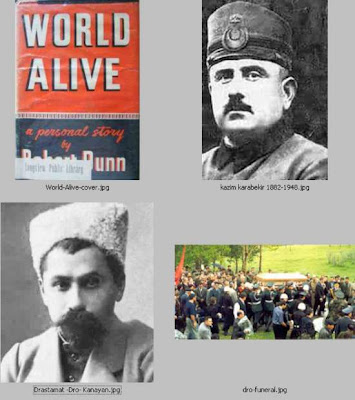
Dr. Dennis Papazian released a couple of early April 2008 communications warning the world that there is evil afoot... and the name of this demon incarnate was Hilmar Kaiser. Perhaps a motivation for the professor in charge of the University of Michigan-Dearborn's Armenian Research Center was guilt, as he, like the similarly unleashing Pandora, was responsible for giving Kaiser his first big break to spread Armenian propaganda, as Papazian also did with Taner Akcam. However, unlike the well-compensated Akcam (through the Zoryan Institute and the Cafesjian Foundation), a man who will gladly wag his tail in whatever fashion Akcam's benefactors require, Hilmar Kaiser has proved to be a bit of a loose cannon. Kaiser, for example, has called Vahakn Dadrian, the "foremost authority on the Armenian genocide," on Dadrian's dishonesty. There can be no greater sacrilege than that! . .
Any move that is seen to be out of step of Hai Tahd, or the Armenian Cause, even in the slightest way, provides grounds for ostracism and worse, by the Dashnak-minded extremists governing the genocide industry. If you are a part of this industry, you are not allowed to deviate from the Biblically established propaganda (or as Kaiser nicely worded it in an interview cited below: "All these concepts about the Armenian genocide are developed on generalization of a very narrow source basis. We have developed a lot of Holy Grail items that we hear over and over again"), and you are certainly not allowed to criticize a fellow propagandist in any shape, manner, or form. For example, when Vincent Lima found fault with Richard Hovannisian's intolerance, even though this criticism was expressed in a tiny little footnote, Levon Marashlian was all over poor Mr. Lima, with the implication that Lima actually might be a secret agent for the Turkish government. ("Vincent Lima's less than professional tactics include destructive manipulation—apparently driven by irresponsible arrogance and some unannounced agenda which appears to have little to do with defending the truth ...")
When Ara Sarafian, Lima's former co-editor of Armenian Forum, dared to challenge the Blue Book propaganda of the drownings in Trabzon, as well as the familiar "genocide map," Dr. Rouben Adalian of the Armenian National Institute (ANI) angrily accused Mr. Sarafian of having "ulterior motives," which implies Sarafian actually might be a secret agent for the Turkish government.
Dr, Dennis Papazian
In his message entitled, "Hilmar Kaiser Warning!!! From Dr. Dennis Papazian" (likely by the one who posted this message, without Dr. Papazian's permission, at a Yahoo group) and "sub"titled (probably by Papazian himself), "Danger of Hilmar Kaiser: A Warrning!", we learn that Adrienne McOmber (whom Dr. Papazian would identify in a later communication as "an Armenian woman," "active in the community," and "a very successful lawyer") phoned Dr. Papazian with the news that she and her husband, Richard, attended a Rutgers University talk with Kaiser, reporting that Kaiser "badmouthed and denigrated just about all Armenian genocide scholars in the US and Europe, including Vahakn Dadrian and Taner Akcam, and put into question the very reality of a genocide sponsored by the Young Turk government against the Armenians in 1915-1923."
(Note that line comes from someone who calls himself a "professor" versed in "1915" history, and he still appears unaware that the "Young Turk government" basically ceased to exist as an independent entity by 1918's end, once the British occupied the devastated empire, initially with one million soldiers, as accounted for by Peter Balakian in The Burning Tigris. It would be very difficult to conduct a state-sponsored genocide campaign, particularly for five long years until 1923, when there is no real state.)
Papazian believed there were "apparently high-ranking Turks who smiled and nodded throughout the lecture." The report clamed that Kaiser was invited to dinner by these nasty Turks, speaking to Kaiser in Turkish, but there was a Turkish speaking spy (who was there thanks to "we," as Papazian put it) "who understood what was going on."
Cloak and ARF Dagger
Did this spy trail our villains to the restaurant? This sounds like a real cloak-and-dagger adventure. The information Papazian received led him to conclude that Kaiser is "attempting to put into question all the valuable scholarship produced by Armenians and their cohorts regarding the Armenian genocide and thus deny that the genocide was sponsored by the Turkish central authorities, making it only a series of massacres carried out on the local level. This is subversive activity at its worse."
Can it be? Can Kaiser actually have been recruited by the Turks, and is now an "agent for the Turkish government"?
"[A]n important Armenian patriotic organization," continued Dr. Papazian, "had unwittingly sent Hilmar on a speaking tour around the United State[s] a couple of year[s] ago," where Kaiser was similarly not sticking with the program. Papazian then "asked people to record his 'lectures'" (Dr. Papazian curiously chose to put the word "lectures" in quotation marks; if the content changed from what Dr. Papazian preferred to hear, does that make a lecture any less of a lecture?) in order to have proof of Kaiser's deviltries.
Papazian wrote that he finally had to contact some "higher ups" who made sure Kaiser got the warning that if Armenian genocide scholars should be criticized (such a transgression, as we know, cannot be permitted), that would spell the end of Kaiser's tour.
This would be akin to the scene in the original "Frankenstein" movie, where the doctor brings his creation to life, and when the creature develops a mind of his own, the doctor has to find a way to control the creature. (Will it be through fire? Dissection? Will Kaiser be chased atop a windmill, by Dr. Papazian's huge network of "people" wielding torches and pitchforks?)
Dr. Papazian sounded very worried that Kaiser, not unlike Willy Nelson, is "on the road again," speaking to "Armenian student organizations," those whose genocide-obsessed minds might well be corrupted, at least theoretically. Kaiser, Papazian wrote, represented "a clear and present danger." Should "the work of our best genocide scholars" come under doubt, "then the Turks have a natural and effective ally against us." (Dr. Papazian really believes the "Turks" would be that organized and determined; at one time, he thought the operator of this site — that would be me — was an agent of the Turkish government, as well. When his boy, Taner Akcam, came up with what he thought was the operator's identity, I wonder if Dr. Papazian — naturally believing whatever his Turkish agent would say — realized he couldn't have been more wrong. Then again, unfortunately, Dr. Papazian does not dwell on the many times he has been mistaken; what one should really wonder about is that if the Turks were so determined, how could the genocide situation have degenerated to the pitiful state it's in today, where Dr. Papazian's "people" have so wildly succeeded in conning practically everyone?)
Kaiser, Dr. Papazian added, worked for Papazian years ago, and Papazian had to fire his new recruit for Kaiser's "dishonesty." He then issued the call: Kaiser must not be sponsored by Armenians, but if his lectures do slip through (this time "lectures" had no quotation marks), they should be recorded, with a copy sent to Dr. Papazian, so that "our genocide scholars" may be defended "against his false accusations."
If the University of Michigan-Dearborn, which houses Dr. Papazian's Armenian Research Center, pays Dr. Papazian's salary, what are they paying for? Dr. Papazian's research and scholarship, or for his politics and intrigue? For a "genocide scholar" to be intolerant of views not in complete agreement with the pious genocide industry is nothing new, of course; but this kind of "shut him down" strategy is hardly an academic approach, let alone a gentlemanly one. Why, it's exactly the kind of approach a propagandist would undertake.
A March 29 dated communication by Dr. Papazian, which was a follow-up to "Danger of Hilmar Kaiser: A Warrning!" (meaning the previous one's April 2nd date probably indicated when it was posted, and not when written), voices his concern that Kaiser's talk is not a matter of historical opinion, but of "radical revisionism which leans toward accepting the official Turkish position on the Armenian genocide, and without clear evidence." (I think we can all agree Kaiser isn't creating things from the air, but backs up his findings through what he presents as evidence. Whether right or wrong, of course that would fall under the category of "historical opinion." Even the shameless conclusions of Vahakn Dadrian would technically be considered in the realm of "historical opinion," particularly since, in Dadrian's case, we would rarely be talking about "historical fact.")
Dr. Papazian accuses Kaiser of "poisoning the well." Does he mean in the manner that the retreating Armenians of 1918 performed, by filling up the wells of Eastern Anatolia with the bodies of their Muslim victims? No, what he is getting at is that Kaiser is guilty of "lies, half-truths, innuendos, and snide remarks to demean other scholars." Papazian has based his conclusion on the information provided from his people "all over the United States, including many members of the Dashnak Party, whose veracity I do not doubt."
(That last reference is too scary for words, beyond Papazian's admission for choice of friends. Indeed, if duplicitous Dashnaks are famous for anything, it would have to be their "veracity.")
(While it remains to be seen whether Papazian will get warm and fuzzy about the following, Kaiser appears to enjoy chumming it up with Dashnaks as well. According to the interview that will be cited below, Garabed Moumdjian, the only other Armenian besides Ara Sarafian to have hit the Turkish Archives [according to Kaiser], accompanied Kaiser for two weeks in 2006 — one week short of the time Taner Akcam spent, by the way, as Kaiser also mentioned — and with Mr. Moumdjian's perfect knowledge of Turkish and Ottoman, "sent shock waves through the whole establishment." Kaiser got tickled pink, as "The idea of the ARF, fanatic, blood-drinking killer and so on got a devastating blow." Of course there are very nice people in the Dashnak Party who do not dwell on the beloved dagger, much as there were nice people in the Nazi Party, too. Since Mr. Moumdjian sounds like a great guy, does that mean we can now discard what lies at the criminal heart of the ARF?)
(We do, however, need to keep in mind that this analogy is far from perfect; we're comparing ordinary Germans who joined the Nazis for reasons having nothing to do with ideology, vs. Mr. Moumdjian, who appears to have embraced the adorable Dashnak "end justifies the means" way of thinking. Moumdjian wrote a most uncritical, and fairly gushing, article on the unscrupulous forger Aram Andonian, as we'll be observing later.)
As an example of Kaiser's dishonesty, Dr. Papazian faults Kaiser's having pointed to Akcam's "A Shameful Act" as unreliable, because Akcam "could not possibly have employed all the primary evidence from the Ottoman archives as he purports to do in his book. This is tantamount to calling Taner Akcam a liar."
(Taner Akcam... a liar? Are we talking about the same fellow who is on record for claiming the killings of Muslims by Armenians is a "legend," that the Armenian rebellion is a "lie," and that he can "prove genocidal intent without any problems"? Would this be the same Taner Akcam who might possibly fall into the "liar" category? What an interesting concept.)
(In a March 8, 2008 published interview in The Armenian Weekly, Kaiser faults Akcam — without naming him — for claiming that an Ottoman official went "to Germany in March 1915 to coordinate the decision of the Armenian genocide, and [Akcam] gives the source. The source says exactly the opposite." This would be in relation to Akcam's absurd hypothesis on the Ottoman government's convenient "genocide" decision in March of 1915 that foolish genocide scholars as Robert Manne have accepted at face value. After expressing how mindlessly "celebrated" these works of pseudo-scholarship have been — another foolish genocide scholar who has accepted Akcam's "Shameful" book at face value was Michael Oren — Kaiser points to the "unscholarly" way in which "Turkish materials have been used" — he must have been referring to the team of Akcam/Dadrian, since hardly any other pro-Armenian "scholar" has made use of original Ottoman sources — "because no one is able to check the sources.")
The bulk of "A Shameful Act" relied on research already performed, primarily Dadrian's research. The original version of this book, in Turkish, was published in 1999, and it's doubtful Akcam paid many visits to the Turkish archives before that year, if at all. "Researchers are allowed to make xerox copies of the documents they receive," Dr. Papazian tells us, in his defense of Akcam. Actually, that is not true in all of the departments. If memory serves, Michael A. Reynolds pointed out in his late 2003 dissertation (an excerpt), different departments of the archives have different rules. One forbids the making of copies entirely, meaning the researcher must make notes then and there. Since Akcam's knowledge of the complex Ottoman language is nearly nil (probably no different than Hilmar Kaiser's), of course Akcam could not be relied upon to make reliable translations — even if conditions were not as demanding. "It is not the business of you, Hilmar, or the Turkish government as to how Taner gets his materials," Papazian fumes to the one he was addressing, perhaps in desperation to cover the fact that Taner Akcam has the muscle of the Zoryan Institute, if not the formidable forces of the genocide industry, supporting their paid-off front man with ready research.
The great scholar, Dennis Papazian, condemns Kaiser because Kaiser, in the aforementioned Armenian Weekly interview, had the gall to refer to the researching wherewithal of Yusuf Halacoglu, the head of the Turkish Historical Society (THS), in a positive manner. Papazian dismissed Halacoglu as "an implacable enemy of the Armenian people who publishes tendentious and corrupt materials." That is a terribly libelous thing to say; Halacoglu is no more an "enemy of the Armenian people" than the French historians Gaston Gaillard, Gilles Veinstein or any other contra-genocide scholar who supports his or her findings with reliable and non-propagandistic facts. (Guenter Lewy conducted excellent research and found no evidence implicating the U.S. government on genocide against the Indians. Only a fool, or a hopelessly dishonest party, would label Lewy as an "implacable enemy of the Indian people.")
(As a backdrop, Kaiser was generous with his appraisal of Halacoglu in the interview. When the interviewer, Khatchig Mouradian, tried to bait Kaiser with Kaiser's opinion on the scholarship of Halacoglu, whom Mouradian described as "a notorious genocide denier," Kaiser surprised Mouradian by saying it would not be "productive" to criticize Halacoglu on "past weak scholarship or political fanaticism," and that Halacoglu should not be underestimated. Kaiser added that he disagreed with him "emphatically," but that he respected him, calling Halacoglu an "extremely smart guy, very professional" and that "in some regards," he was "ahead" of Kaiser [as an example, material regarding Ottoman prosecution of Turkish criminals during the war]; furthermore, Kaiser praised Halacoglu for being friendly, and for his willingness to talk to those from the opposite camp. Kaiser also made two highly impressive statements, "First of all, the description of deniers as a group is false" being one. The other: "Respectable scholarship has nothing to do with the name of the person who has written it—it is assessed on its own merit.")
Is Papazian telling us everything Halacoglu has put on the table is "tendentious and corrupt"? So Ottoman archival sources, largely based on internal reports never meant to be publicized (kind of like Papazian's revealing communications being examined here), as well as the foreign archival material that Halacoglu also relies on (the valuable information on this page, regarding an explosive Armenian Patriarch report, among others, came from, I believe, a THS publication) can be summed up as "tendentious and corrupt"? These are sources largely lacking conflict-of-interest; how could they possibly be termed "tendentious and corrupt"? Meanwhile, the sources Papazian usually prefers to point to, sources such as Ambassador Morgenthau and the missionaries (here is how the desperate Dr. Papazian once supported the latter: "...Did the American missionaries tell the truth? One would think so. We certainly will not ... call these God-fearing men and women liars without seeing strong evidence to support that contention. ... We must accept the missionary reports as dependable evidence"), were totally conflicted, the kind of evidence that was often corrupt to the core.
Papazian supports his denunciation of Halacoglu by pointing to Taner Akcam's articles showing how the THS, in the person of Halacoglu, has misrepresented archival materials. Well, two can play at that game, and Taner Akcam is a master at it. Here is a study of how Akcam has misrepresented the misrepresentation of said archival materials.
Dennis Papazian reveals that his original communication was never meant to be made public, as it was in the form of an e-mail, and someone (likely one of his own "people," since the professor was not going to share such thoughts with those in what he regards as the "implacable" enemy camp) posted it at the Yahoo Armenian groups. He is absolutely right about that; even the privacy of a propagandist like Dr. Papazian must be respected. Since the cat was out of the bag, I felt free to quote from his messages, much as I would have preferred to reproduce them in their entirety.
Now let's get to the crux of the matter. Was Dr. Dennis Papazian's flying fit justified? Has Hilmar Kaiser, possibly to get back at those representing his former employer, Dennis Papazian, because Dr. Dennis Papazian "fired" Kaiser, defected to the other side? Did Kaiser, in other words, decide to ditch his life's work simply because he took the immortal words of Sarkis Atamanian to heart? ("Without retribution, justice is merely a word," The Armenian Review, Nov. 1960; music to the ears of revenge-minded Dashnaks, as well as too many dogmatic genocide scholars.)
The Armenian Weekly's Khatchig Mouradian came to Kaiser's rescue in an April 5, 2008 article wittily entitled, "The Kaiser Effect." It turns out that Mouradian himself was present at the Rutgers lecture and made "a digital recording" of it, from which he prepared a shortened transcript, in order to "set the record straight." (Mr. Mouradian explained the reason for the shortened version was due to "space constraints." Since it was Mr. Mouradian's aim to defend Kaiser — and Mouradian must be applauded for doing so, as Kaiser has obviously been wrongly accused — we can see, however, that any references the Armenian community would not approve of, such as criticism of Akcam and Dadrian, have been deleted.) Mr. Mouradian did concede that Kaiser criticized other genocide scholars, and that Kaiser dismissed the idea of a genocide blueprint, on which "most scholars" agree (without, of course, providing real evidence — which would hardly make these "scholars" scholarly), instead going for the possibly even more devastating notion "that there were not one but several decisions for mass murder, all centrally planned and executed."
On the "plus" side, Kaiser "consistently used the term 'Armenian genocide' when referring to 1915-16." (Could Mr. Mouradian have been mistaken on those years? We heard Dennis Papazian talk earlier, after all, about "a genocide sponsored by the Young Turk government against the Armenians in 1915-1923." Surely Dr. Papazian must be better trusted with the facts, since Dr. Papazian is a "scholar" and has a Ph.D. in his possession, which Mr. Mouradian probably does not.) Kaiser also "clearly made the point that the massacres were centrally planned, and put the number of 'losses' at 1-1.5 million." (Kaiser's definition of "losses" includes not only those killed, but taken into Muslim households, and not returned. Stay tuned for an examination of that point.)
Mr. Mouradian added, "The Turkish members of the audience were anything but happy with Kaiser’s documentation of the genocide and threw all kinds of denialist and revisionist arguments at him during the question and answer session."
Given the kinds of statements Hilmar Kaiser has made, which we will be taking a good look at, it's obvious that the Turks — or anyone familiar with the historical truth and who can retain objectivity — would have been "anything but happy." A minor point to raise here is, much as we know Dennis Papazian is not a man to dwell on his errors (since all else falls before him in pursuit of his Dashnak agenda), shouldn't Dr. Papazian awaken to the fact that his "people" can't always be trusted? Here is one of his spies, the lawyer lady, who fed her kingpin with absolutely wrong information. Probably there was a point in the lecture when the Turks shook their heads in approval, when Kaiser referred to the dishonesty of Akcam and Dadrian (a point where any honorable person should have been shaking his or her head in approval), but because even this deviation from the "Cause" was too hard for the lady to handle, she totally closed her eyes to the pro-genocide crux of Kaiser's message. She got blinded by her emotions, and provided an erroneous report, which Dr. Papazian, similarly blinded by his emotions, was only happy to accept. To hear Dr. Papazian, it was as though Hilmar Kaiser went before that audience and waved the Turkish flag.
Let's focus on Khatchig Mouradian for a moment now. As editor of The Armenian Weekly, of course Mr. Mouradian must also be a genocide proponent. The fact that he was not willing to go as far as to tar and feather Hilmar Kaiser, but instead actually stepped to the defense of this "traitor" already tells us (as may be determined from the typically rational tone of his interviews, where he has managed to maintain a professional distance) that he is able to check his "Hai Tahd" emotions, unlike Dennis Papazian and most of his "people." But now take a look at the wording Mr. Mouradian chose to describe the issues raised by the Turks in the audience: "denialist and revisionist."
Now why would an intellectual, and someone as reasonable as I'd like to believe Mr. Mouradian is, choose the route of such dismissive and defamatory labeling?
I don't know what these Turks said, and maybe some said stupid things. But if an objective person has studied the issues, and has concluded that the "1915" events did not constitute a genocide (at least not as far as the word is defined by the 1948 U.N. Convention on Genocide, which we must follow, otherwise the word would become meaningless), such a person is aware that the real facts are backed up by sources that are difficult to argue with. (Not that such would stop people like Dennis Papazian or Taner Akcam from coming up with the weirdest arguments in an attempt to discredit these sources, but let's limit our thinking to people who are reasonably honest, like, hopefully, Mr. Mouradian.
The fact is, whatever these Turks said can, in all likelihood, be backed up by sources we can trust, sources that were not friendly to the Ottomans. Even Armenian sources frequently expose today's propagandistic claims as the canards they are. For example, you've read earlier that Taner Akcam's response to the Armenian rebellion was that it was "a lie," and Dennis Papazian, in his "Misplaced Credulity," actually wrote, "No such revolt ever took place!" So let's say a Turk in this audience brought up the fact that there was indeed an Armenian rebellion. This is critical, because if the whole of the Ottoman-Armenian population was forced to choose sides, after being worked on for years by fanatical Dashnaks/Hunchaks and missionaries, then what we wind up with is a far cry from what the Genocide Convention requires. The Convention disallows political groups, and on that count alone, the Ottoman decision to temporarily relocate its treacherous Armenian community cannot be labeled a genocide.
We don't have to travel far to prove how extensive the Armenians' rebellion was, having been in the works for years with the Dashnaks' "Instructions for Self-Defense" distributed in Armenian villages since 1910, with nearly half of the pamphlet focusing on how to "attack" Muslim villages.There is a plethora of Western and Armenian sources that gives us the clear idea of what the Armenians were up to; since the A.R.F. had forced Armenian males over the age of 13 in a good many of the provinces to join their movement, either as soldiers or functionaries, based on confessions by captured Armenians, the treason was widespread. (In 1910, there were 100,000 Dashnaks in Bitlis alone, according to the Russian consul.) In other words, an Ottoman-Armenian did not have to brandish a weapon in order take part in this rebellion; the Armenian community as a whole, including the women and children, provided the support system for the rebels. (Not to say there weren't loyal ones around. But unfortunately, they were stuck between a rock and a hard place.)
Of course, in any nation, if there is a treacherous community that fights against the nation's army and that commits massacres upon fellow citizens (there is an example of a February 1915 account below) who don't fit into the required racial and religious mold, particularly during a life-and-death war, it would be the duty of any nation to protect itself. The Soviet-Armenian historian Borian himself pointed out this would be the duty of a nation, not that we need him to tell us the obvious. During World War I, Britain and Russia deported or interned or relocated elements that were not even disloyal, as did the USA and Canada during WWII. Imagine what these nations would have done if these elements had behaved in the ways of the Ottoman-Armenians! But what the Ottomans did was resettle the Armenians, in what Dr. Lewy termed a "relatively humane" process (at least insofar as the intentions of the central government; things obviously sometimes went wrong at the local level, much as the majority of Armenians clearly survived), until the danger was past. The Armenians lost their war gamble, and then decided to make a "genocide" out of their belligerence.
A dramatic way to prove the extent of the Armenian rebellion is to point to what Boghos Nubar is on record for admitting, that "the Armenians have been belligerents de facto, since they indignantly refused to side with Turkey." That says it, in a nutshell.
Now this is Boghos Nubar we're talking about here, one of the most dynamic leaders of the Armenian Cause of the period. His is not the only voice confirming the Armenians' treachery — we can also point to other leaders who are on record for demonstrating evidence, such as Hovhannes Katchaznouni, "Armen Garo" Pasdermadjian, and Vahan "The Doctor" Papazian — but, again, this is Boghos Nubar himself! he is clearly someone the Armenians can respect, much more so than the creepier heroes of Armenian mythology, as the mass murderers Dro and Antranik.
So if Turks in this audience pointed to this rebellion, they would not be the "revisionists"; the Armenians were shouting from the rooftops after the end of the war, as to how loyal they were to the Allies. It's the Armenians who revised their story, because it didn't suit their image as poor, unarmed, innocent victims of genocide to admit their own treachery, and their own great crimes of ethnic cleansing against hundreds of thousands of defenseless villagers. It is the Armenians who are the real "revisionists."
Now let's get back to the point in question, Khatchig Mouradian, and why he chose to dismiss and defame the Turks in the audience as "denialist and revisionist." Surely Khatchig Mouradian is not a man who blindly falls victim to the "Lemming Effect" of too many Armenians trained by their parents, teachers and churches to become genocide-obsessed, and who lose the capacity for independent thought regarding such an emotional topic; that is, the Armenians whom K.S. Papazian described as "The rank and file [who] have continually been kept under the spell of their invisible rulers." (Although sadly, even some of these rulers, not always invisible, such as Dennis Papazian, appear to fall under the spell of their own propaganda.) Khatchig Mouradian is a man who can distance himself, and who can distinguish between fact and fiction. So why does he engage in such propagandistic terminology?
(It is very likely that as intelligent as Mr. Mouradian is, and as "fair" as he appears to be, his emotions run too deep to bear a careful study of the ways in which those who disbelieve in genocide have backed up their position. All he needs are industry leaders — like Dadrian, Hovannisian, Balakian — to say, for example, that there was no Armenian rebellion, and that would be enough. Of course, that would be more than enough for the immature-minded rank-and-file in the Armenian community, but this is an "intellectual" we're talking about. In his interview with Kaiser, Mr. Mouradian gives away his naive faith, when Kaiser brings up the notion of Turks and others who had committed crimes against Armenians during the war being taken to court by the Ottomans. It's simple logic that a genocide-committing state would not take their own perpetrators to court. The idea that the Ottoman Turks punished people who committed crimes against Armenians, dozens via execution, should set off alarm bells in the mind of an intellectual; at this point, a true intellectual would try to go beyond his belief system, unpleasant a process though that might be, and say: "I've got to look at that! Is it possible I've been wrong?" We can see Mouradian was struggling with his deep faith, in the way he posed his question to Kaiser: "But they aren’t punishing them for stealing from the Armenians, are they?" [In other words: "Please! Please don't let it be so, I've got too much at stake, emotionally."] Fortunately for Mr. Mouradian, Kaiser's own genocide belief system prevented him from bursting Mouradian's bubble, and Kaiser replied that more research would be necessary. All the way back in 1985, with Kamuran Gurun's English version of The Armenian File, we learned that 1,397 were taken to trial for crimes against Armenians, and [although aside from the locales, Gurun did not itemize, and we could only suspect] the crimes were not just for "stealing." New Turkish research has upped the ante to 1,673, with details on how many got punished, and in what manner. [67 got the death penalty.] If Hitler had taken one SS man to trial for harming Jews, many would find it difficult to understand the colossal incongruity. Even if only 16, instead of 1,673, Ottomans were taken to court for harming Armenians, that should serve as a huge eye-opener — but according to Kaiser, we still need more research. Perhaps Kaiser was influenced by his "Shameful Liar" rival, Taner Akcam, who has called these punishments a "tall story.")
We're fully aware if Khatchig Mouradian were to allow himself to speak more truthfully, mincemeat would be made of him, by the fanatics among his own. For that, we can't judge him too harshly, as no one would enjoy coming under the hammer-blows of the terrroristic Dashnak mentality, of whom K.S. Papazian further commented, acts "true to its traditional method of blackening the character of their victims." (If not blackening their eyes, or committing even more serious forms of harm.) But wouldn't an honorable person, too prudent to speak publicly, at least choose the alternative of not getting involved with such a vicious program of dishonesty and hatred? Why doesn't such an obviously smart and otherwise honorable person as Khatchig Mouradian disallow his "patriotism" to take command of his life? After all, didn't Tony Soprano himself say from his hospital bed, that "every man is judged on his own merit"?
It is heartbreaking. The good Armenian people can only salvage their reputation once the honorable ones among them choose to separate themselves from destructive Dashnak ideology that has so "disgraced our people before the civilized world," as the true Armenian patriot, K.S. Papazian, wrote. (Of course, the civilized world has closed their eyes to the terroristic ideology that has gripped the Armenian people, at least those who have allowed themselves to be genocide-centric, mainly because the terrorists who rule them are masters of propaganda — and the civilized world thinks of Turks as a lesser people, which Dashnak propaganda has made sure to reinforce. But the day will come when the world will awaken, and it is the duty of the good and honorable Armenians, the genuine "patriots" to do what they can to distance their people from the horrid ways of the Dashnaks — whose "veracity" those as Dr. Dennis Papazian does "not doubt.")
Now let's get to the eye of this storm, Dr. Hilmar Kaiser.
I have been reading some of the articles prepared by and regarding Hilmar Kaiser, and it's not always easy to get a bead on him. On one hand, he is 99.3% "pro-Armenian," as far as his selectivity with historical references, as well as his willingness to sometimes point to the most outrageous claims as actual history, while closing his eyes to facts not in keeping with the genocide agenda. On the other hand, it is to his credit that he has pointed out the dishonesty of those such as Dadrian and Akcam, especially since these two have gone so far and beyond what should even be propagandistically allowable, it's about time for scholars, honorable or not, to expose those who have become utterly shameless. (Granted, that's a difficult line to determine; even someone as "respectable" as the Dutch historian Erik Jan Zürcher can go pretty overboard. The propaganda is now so overwhelming, it has become simply contagious. Yet it may be said that Dadrian, and by extension his devoted Turkish protégé, are entitled to special [dis]honors. As even the professionally reserved Dr. Guenter Lewy phrased it, after his preface regarding the "many Armenian scholars [who] use selective evidence or otherwise distort the historical record": "V. N. Dadrian is in a class by himself. His violations of scholarly ethics... are so numerous as to destroy his scholarly credentials.") So in a sense, Hilmar Kaiser is an enigma. One cannot be certain in which direction his wind is going to blow, at least in regards to some minor points that are out of keeping with genocide commandments (which serve as sufficient reason for those as Kaiser to be branded as traitors, in the unforgiving and near-fanatical genocide environment).
As far as the major points, one can be deadly certain where Hilmar Kaiser's heart lies. He begins:
"The Armenian community is a democratic, complex and politically competitive community. And when I now say that the leading political party was the ARF, some in the community might be offended. I just reflect the views of the Ottoman Ministry of Interior and Ottoman Intelligence. The only political group that was seen as politically of any relevance was the ARF."
TAKEOVER OF OTTOMAN-ARMENIAN SOCIETY BY THE DASHNAKS
The Tachnaktzoutioun’s power is felt in all Armenian communal affairs in localities where, as at Mouche, the Tachnakists have succeeded in monopolizing the spiritual administration. The Armenian Member of the Ottoman Parliament for Mouche obeys the order of the Tachnakists. In the Mouche law courts, Armenian judges carry out the advice given by the Tachnaktzoutioun; finally, in the valley of Mouche, the teachers and Elder councils execute voleus noleus, the orders of the Mouche committee.
With regards to Armenian village folk, although they complain now and again to the Ottoman authorities of the Vilayet, they cannot get rid of the Tachnakists, and all the others, with more or less hesitation, enlist in the Tachnakzoutioun’s membership; and under the influence of blows and threats give a part of their earnings for objects which they are not even able to understand. Admitting that the village folk were formerly partial towards the Committee, they are far from being that at present.
REPORT BY THE RUSSIAN CONSUL IN BITLIS. Dated 3rd December, 1910. No. 602. As included in THE WORLD WAR AND THE TURCO-ARMENIAN QUESTION, Ahmed Rustem Bey, Former Turkish Ambassador in Washington, Berne, 1918.
INFLUENCE OF DASHNAKS ON COMMON OTTOMAN-ARMENIANS
“The activity of the Tachnaktzoutioun Committee has a great deal to do with the excitement of Armenian public opinion. This committee is unrelentingly working to bring about collisions between Armenians and Moslems in order to avail itself of the misfortune that may arise therefrom, and cause a Russian intervention, and the occupation of the country by our army.
REPORT FROM THE RUSSIAN CONSUL IN BITLIS TO THE RUSSIAN EMBASSY AT CONSTANTINOPLE Dated 24th December, 1912 No. 63; As included in THE WORLD WAR AND THE TURCO-ARMENIAN QUESTION, Ahmed Rustem Bey, Former Turkish Ambassador in Washington, Berne, 1918.
OPENNESS BY WHICH DASHNAKS WERE ALLOWED TO OPERATE
EXTRACT FROM A REPORT
Handed by the Dachnak Committee to the Socialist Congress in Copenhagen, in 1910.
“. . . .Our organization is the same in Turkish Armenia. At Van and Bitlis, in both those large Armenian provinces, we had, until 1908,enlisted under the banner of our Committee, the village folk and the sane and sound population to form political bands. The latter still exists, but their number is naturally more restricted.
Until 1908, the activity of our Committee in Turkey was clandestine and operated only by night. In the daytime, the members of the Committee were not to be seen abroad: armament, exercises, everything was done at night. Our activity had quite a political and revolutionary character. This same activity continues nowadays in all the centers of the Ottoman Empire, with this difference – that it is now openly displayed in broad daylight. In other parts of Turkey inhabited by Armenians, our Committees have large detachments of well-organized revolutionaries. . . .”
As highlighted by Ahmet Rustem Bey in THE WORLD WAR AND THE TURCO-ARMENIAN QUESTION, 1918, adding the comment: "As an auxiliary weapon, the Dachnak often used socialism, posing as a partisan of this system; it could thereby more easily attract the sympathies of the Armenian mass as well as those of the European proletariats."
Mr. Kaiser would surely be welcome to point to any Armenian group that was of greater relevance. One by one, the other groups, as the Hunchaks and Armenagan/Ramgavarists, practically went by the wayside (not necessarily through Dashnak efforts). According to the millet system, the ones governing the Ottoman-Armenian community was the Church. The ARF took over the Church. Anyone who went against Dashnak principles were eliminated by the Dashnaks, just as today, those as Lima, Sarafian and Kaiser, who voice the slightest objections, come under vicious attack. (But back in the old days, Dashnak silencing methods were generally more permanent.) Even loyal Dashnaks who raised disagreements were fatally picked off, as when Mihran didn't like the Dashnaks' new socialistic ideas (Mihran received the "death penalty" in 1907, as the Dashnak historian, M. Varandian, wrote in his 1932 book, History of the ARF). Some of the other country bumpkins who wanted only to kill Turks also didn't care for new Dashnak ideas (which were mainly a sneaky cover to attract a broader range of adherents), the most famous being Antranik. The only reason why Antranik wasn't snuffed out was because he was too great a hero. (Yet leaving the ARF did not prevent Antranik from carrying out basic Dashnak principles, symbolized by the dagger in their logo.)
Now, there were Armenians, particularly those in the merchant class, who hated the Dashnaks and wished them to go away, but who was going to step up to the plate to tell them off? Those who tried, like the wealthy Armenian who became the mayor of Van, quickly got whacked. So, of course "The only political group that was seen as politically of any relevance was the ARF," and that was not just the viewpoint of the Ottoman government. (That's like saying the only ones who tell us there was no genocide is today's Turkish government.) Today, that statement regarding exclusive relevance is equally true; the ARF controls the worldwide Armenian diaspora, as well as the Republic of Armenia, much as Armenia's previous leader stood up to the Dashnaks. (Yet voices of fanaticism quickly drown out the voices of reason.) So if there are "some in the community [who] might be offended" about this plain and simple fact, who are they? And why don't we hear from them publicly? (We well know the reasons why we do not hear from them, but the point here is recognizing the disingenuousness of Hilmar Kaiser.)
The next thing Hilmar Kaiser told his audience is that "The Ottoman government approached the ARF and proposed an alliance," so that "the ARF should start attacking and sabotaging" behind the Russian lines," and the carrot on the stick was "the political concession they denied the Armenian community for years." Kaiser wrapped up the idea with, "Basically, the offer was, 'You join the war on our side, take the risk, and then we promise you what we have denied you for years.' So it wasn’t really a good offer. What would happen to the Armenian community in Russia?" The result, Kaiser reported, was that "The ARF declined the offer and assured the Ottoman government that the Armenian community in the Ottoman Empire would faithfully serve the common Ottoman war cause."
Since Kaiser has read McCarthy and Company's "The Armenian Rebellion at Van," he already knows this account of the Ottoman government's representatives to the Dashnaks' 1914 Erzurum conference is not confirmed by any non-Armenian source. That does not mean this meeting did not take place, but given the Armenians' penchant for "exaggeration," a true historian would pause before accepting this meeting and subsequent deal as a pure fact. But let's imagine what we've been told is the truth. (And it is possible Kaiser knows something McCarthy and his team of Turkish professors failed to unearth, as slim a possibility as that may be.)
OTTOMAN-ARMENIAN LOYALTY
LETTER FROM THE DACHNAK TO THE DAMAS BRANCH.
Constantinople, 1914.
. . . The Ottoman Government ordered mobilization on the 21st [of] September, 1914. The same day, there was an extraordinary activity at the Tachnaktzoutioun Committees in Constantinople. The chiefs met together and issued instructions in cipher to the provincial branches. The same activity was observed at the Hintchak, the Ramgavar and the Veragazmial. All those Committees were already agreed on the matter of reforms, and were endeavoring to maintain and consolidate their union.
Should the Russians advance beyond the border and Ottoman troops withdraw before them, all will have to rise at the same time everywhere and use all the means at disposal. The Ottoman army will be caught between two fires. All State buildings will have to be destroyed. The Government forces will be busy in the interior, and supply convoys will be attacked. On the other hand, should the Ottoman army advance, Armenian soldiers will desert their battalions, form into bands and join the Russians.
THE WORLD WAR AND THE TURCO-ARMENIAN QUESTION, Ahmed Rustem Bey, Former Turkish Ambassador in Washington, Berne, 1918
As with the "genocide," the details of this meeting did not take place in a vacuum; there was some history from years past that led to this meeting, facts that must be taken into account. Here is how K.S. Papazian educates us, from Patriotism Perverted, also answering Kaiser's question, "What would happen to the Armenian community in Russia?" The answer to that question would have needed to take into account "What would happen to the Armenian community in the Ottoman Empire?":
In August 1914 the young Turks asked the Dashnag Convention, then in session in Erzerum, to carry out their old agreement of 1907, and start an uprising among the Armenians of the Caucasus against the Russian government. The Dashnagtzoutune refused to do this, and gave assurances that in the event of war between Russia and Turkey, they would support Turkey as loyal citizens... The Turks were not satisfed. They suspected them of duplicity...The fact remains, however, that the leaders of the Turkish-Armenian section of the Dashnagtzoutune did not carry out their promise of loyalty to the Turkish cause when the Turks entered the war. The Dashnagtzoutune... were swayed in their actions by the interests of the Russian government and disregarded, entirely, the political dangers that the war had created for the Armenians in Turkey. Prudence was thrown to the winds; even the decision of their own convention of Erzurum was forgotten and a call was sent for Armenian volunteers to fight the Turks on the Caucasus front.
So it would not have been as though the Turks came in cold and asked the Dashnaks for a "favor." There was the promise of the Dashnaks from 1907 to contend with, when the Dashnaks tried their hand for one brief window in time, as loyal Ottomans. What the Ottomans reportedly promised the Dashnaks was not "the political concession they denied the Armenian community for years," as Kaiser stated, which we can only presume meant autonomy for the eastern provinces where Armenians formed a minority. (What we're getting at here, folks, is "independence," which the Ottomans would have been fools to offer. within their own territory. Besides, as Richard Hovannisian has educated us, the Armenians had already enjoyed an "internal autonomy" for centuries.) In reality, the Turks "promised to aid in the establishment of an autonomous Armenia in the Transcaucasus," as the Dashnak historian Hratch Dasnabedian wrote in History of the Armenian Revolutionary Federation Dashnaktsutiun (1890 - 1924), 1989, p. 109. (If Kaiser is going to rely strictly on the Armenians' version of history, he ought to be more careful with the facts they themselves provide. By the way, ironically, the Ottomans would deliver on this offer, regardless of the Dashnaks' treachery, helping to form and being the first to recognize the Armenian Republic, in 1918.) The thing that seduced the Dashnaks was Russia's own offer "of the autonomy for the six vilayets and Cilicia," as Dasnabedian continued to instruct on p. 119 of his propaganda book, adding, "But with the Russian victories came the return of what had been the policy of Lobanov-Rostovsky: creating an ‘Armenia without Armenians.'”
So Kaiser has misled us on several levels here, by neglecting to mention the Dashnaks' original commitment from 1907, on the correct details of this reported offer (assuming Kaiser was aware of the facts behind these last two points; otherwise his misleading would have been borne out of ignorance), and also by maintaining the illusion that the Ottomans were negotiating with what sounds like another country. These were Ottoman-Armenians in Erzurum! Of course if there was going to be war, the Armenians of the Ottoman Empire were expected to perform their patriotic duty to their Ottoman nation. When the USA decided to make war on Iraq, did representatives of the Bush administration consider having a powwow with, say, Reverend Al Sharpton, to insure that black Americans in the military can be counted upon to perform their duty?
Kaiser also made it seem as though the Dashnaks were sincere in their offer of loyalty. In his lecture, he went on to explain that the "minority" of "radical ARF members" preferred to support Russia instead, but they were "overvoted," and the ARF leadership made a point of going with "the party line." If they chose to go with the party line, that would have been perfectly understandable, because if the party line was openly "Rah, rah, Russians," that would have entailed suicide. Of course the Dashnaks were going to maintain a sneaky front, while they performed their real aims. They were in preparation to stab their nation in the back for years, and had already stockpiled weapons in every corner of the empire, just waiting for the glorious moment when the Ottomans would be distracted by war.
"The action of Armenian leaders had succeeded in uniting the greatest majority of the people into a compact group..."
Unfortunately, Union and Progress were sincere whereas the Dachnak were full of duplicity. Secretly clinging to their counterfeit ideal of autonomy, they had resolved to attain their ends, by availing themselves of the facilities allowed by the new Government. Almost on the morrow of their agreement with Union and Progress, they threw off their mask and started their campaign. Carried away by the wine of liberty, all the other Armenian organizations followed suit. This was more particularly the case with the Hintchak, which had been mortified by the fact that Union and Progress had preferred to deal with the Dachnak, it assuming thereafter an attitude as extreme as that of its rival.[1] Thus with great gusto, Dachnakists and Hintchakists, the educational and ecclesiastical authorities of the community and of numerous new associations, created for soi-disant benevolent and cultural objects, started a campaign purported to generalize the Armenian revolutionary movement. This action took the form of political dissoluteness, one of the most striking phenomenon of the new order of things.
Think of it: abusing of the freedom acquired by the country and which was added to the franchises they already enjoyed as an autonomous community, forming a real State within the State [2]; thinking further that the concessions made by Union and Progress were due to weakness instead of considering them as the effects of too much confidence and perhaps of momentary elation, Dachnakists and Hintchakists, priests and school masters, writers and artists, undertook a frenzied propaganda the boldness of which was on par only with the tolerance shown by the new imperial authorities. The Press, the church, the theater, the school were used openly and impudently for the purpose of obtaining the support of the masses. Not a newspaper article, a sermon, a dramatic performance, or a conference out of ten, but the subject of which was independent Armenian, which it was the sacred duty of the race to re-establish by wresting the co-called Armenian provinces from the domination of the “barbarous and sanguinary Turk”. When recalling that period to mind, one doubts whether it was not a dream. The only mistake of the Young Turk Government towards Armenians was to encourage their proceedings by its benevolent attitude. When it awoke from its strange heedlessness, at the eve to the present war, it attempted to react, but it was already too late. The action of Armenian leaders had succeeded in uniting the greatest majority of the people into a compact group, which had resolved to avail itself of the first favorable opportunity to create an autonomous Armenia I the provinces of Eastern Anatolia which they obstinately claimed as their own, in spite of the facts laid down by statistics and history. In this, Armenians were supported by Russia, England and France, which had formally entered into a common policy of hostility towards the Empire after the Revolution of 1908.
[1] A violent hostility had sprung up between both organizations almost from the first day of their inception, each aspiring to predominate in the minds of their countrymen. The question of money played a great part therein. They concluded an agreement only after the Balkanic War.
[2] The maintenance in the Empire of the organization of non-Moslem elements into distinct bodies enjoying special privileges, even after the establishment of the Constitution, was an anomaly explained by the fact that their suppression would have raised general protest not only in the country but also in Western Europe. Union and Progress did not feel powerful enogh to touch those institutions, although they warped the working of the new Constitution.
THE WORLD WAR AND THE TURCO-ARMENIAN QUESTION, Ahmed Rustem Bey, Former Turkish Ambassador in Washington, Berne, 1918, ca. pp. 16-17
British Consul J. Molyneux-Seel wrote, for example, that the Armenians of Van "have thrown off any pretense of loyalty they may once have shown, and openly welcome a prospect of a Russian occupation of the Armenian vilayets." (FO 881/10376, Molyneux-Seel to Lowther, Van, April 4, 1913) As you can see from the source, this was over a year before the Dashnak Convention in Erzurum; and you can bet this attitude was not limited to Van Armenians.
Kaiser backs up the concept of Armenian loyalty by pointing out how intelligence reports demonstrated that "the ARF and the Armenian community supported the war effort by answering to the draft much more faithfully [than] the Muslim population." We can be fairly certain these "intelligence reports" did not single out the ARF when it came to pointing out how some Armenians were doing their duty by answering the call, because there were still loyal Armenians in "the Armenian community" despite the ARF. (Whether these reports actually made the comparison with how much more dutiful the Armenians were than the Muslims remains to be seen. If Kaiser ran into one or two reports praising Armenians in certain localities, that does not mean there weren't reports pointing out the many Armenian men who refused the conscription. For example, the first Armenian rebellion in Zeitun, on August 17, 1914, was sparked by the mobilization. In addition, "Armenian deserters from military units [were] increasing," as with this Oct. 1, 1914 report, which further recommended "punishment for villages which shelter and protect the gangs and the dispersing of such villages." To get an idea of how extensive was the refusal of Armenians to enroll in the military, the seventeen-year-old Soghoman Tehlirian of Erzurum crossed the border in 1914 to join the Russians, only to find, entirely by coincidence after he had "maneuvered his way into the infantry under the command of General Antranig," that his brother, Missak, had done the same. (Armenian Review, Nov. 1960.)
ARMENIAN SUPPORT OF THE WAR EFFORT
Ambassador Ahmed Rustem Bey takes issue with a Zeitun rebellion report in the Blue Book, Bryce and Toynbee's The Treatment of Armenians in the Ottoman Empire (From THE WORLD WAR AND THE TURCO-ARMENIAN QUESTION,, Berne, 1918):
Let us now take up No. 122, a statement by Rev. Dikran Andreassian, an Armenian, which is reported by Rev. Trowbridge, an American:
“On the 10th of August, 1914, the Turkish authorities in Zeitoun proclaimed general mobilization... Many inhabitants of Zeitoun fled to the mountains in order to escape military service. Among them, there were about twenty-five notorious highwaymen who made a living by deeds of violence (naturally at the expense of Moslems). This little band was sincerely disliked and dreaded by the peaceful and thrifty inhabitants of Zeitoun (then why did they tolerate them in their midst?); it attacked a detachment or raw Turkish recruits, robbing them and insulting them (as a matter of fact they were murdered). Thereupon, Haidar Pachak the Mutessarif of Marache, appeared on the scene, on August the 30 th , with 600 soldiers. . . The Zeitoun population was informed; one of its best known citizens, Yehya Agha Yenidounyayan, advised his cousin, Nazaret Tchaouch (corporal), to go and meet Haidar Pacha with 5 or 600 armed young men, because he feared the latter’s intentions were not kindly. But Nazaret Tchaouch answered: No, his arrival may mean my death (why? Was he not a peaceful resident of Zeitoun?), but I would rather die than to see Zeitoun in ruins, and I know that the moment is not at hand yet to show opposition (consequently the idea of resistance existed in some minds, and its outbreak was only a matter of opportunity). . .
“This force was not opposed. The Pacha demanded the surrender of the 25 highwaymen. They were all arrested and handed over to the Turkish governor. This seemingly satisfied the Pacha’s most extreme demands. Yet, he was not content, and he issued a proclamation requesting the surrender of all fire arms, and others (how strange!).
“There were in all about 200 Martini rifles among the 8,000 inhabitants of Zeitoun, 150 of which were confiscated by the Turkish officers (as a matter of fact, there were 3 or 4 times more, and the question rises to the lips: how is that the population had such arms?).
“Then, about the end of February (1915), several hot-headed individuals assembled one night and conceived the plan of attacking the governmental palace. (Had they thought otherwise, they would no doubt have approved it?).
“Then about 25 young men who had been brutally ill-treated by Turkish officers took to the mountains. They attacked and killed nine mounted constables on the road to Marache. All the Zeitoun population inveighed against this deed. But a night attack against Zeitoun was carried out by this band, and failed...
“Gradually, 5,000 soldiers were collected round the city. . .
“The Armenians agreed unanimously to the Government’s proposal (that it be informed of the band’s hiding place) and stated the insurgents were in the monastery.
“The next day, 25/27 th April, the monastery was attacked. . . The fight lasted until the evening. But during the night, the insurgents effected a sortie, killing an officer and many men, making good their escape into the mountains, leaving only a few of their own behind.
“The Turks lost between 2 and 300 men. . . The Zeitoun inhabitants eagerly desired that the Allies should break through the Straight of Gallipoli. They hoped that the Turks would suffer a crushing defeat, but there was no insurrection (again, this disclaimer, recurring as a leitmotiv!). the two or three seditious plots that had been hatched miscarried owing to the opposition of sane Armenians. The whole evidence proves (?) that the destruction of the Zeitoun population was deliberately (?) planned by Turks and Germans.”
To sum up: Many Armenian had fled to the mountain in order to avoid military service; a band of twenty-five attacks Moslem recruits and robs them; the question is discussed whether a party of 5 to 600 armed Armenians should or not oppose Haidar Pacha’s entrance in the city; several “hot heads” plan to attack the Palace; another band, only 25, takes to the mountain, killing none mounted constables on the way; it fails in a night attack on the city, but seeks refuge in a monastery and kills 2 to 300 of the soldiers sent to dislodge them; the inhabitants have in their possession 200 Martini rifles of which 150 are given up; the whole population wishes that the Turks should suffer a crushing defeat at Gallipoli.
All this is explicitly admitted by the Rev. Andreassian who nevertheless concludes that there was no insurrection.
No doubt, it was not a general outbreak as at Van, because circumstances were not so favorable, but there is no question about the fact itself.
There were attacks committed by the bands spoken of by Andreassian, and the latter were much more numerous than he admits (for instance, the party that sought refuge in the monastery mustered at least 200 men, and the very fact that it inflicted a loss of 300 men to the regular troops who besieged it, in the course of a few hours, conclusively proves that it consisted of a great number than admitted by the Reverend); the arms concealed in the city were in any case numerous enough and of sufficient quality to quip the men whom it was suggested should resist the 600 well armed and instructed soldiers of Haidar Pacha; the revolutionary spirit was undoubtedly rampant, awaiting only an opportunity to break out; the former deeds of the peaceful population of Zeitoun, who has already taken part in 51 insurrections [1] ; its sympathies for the cause of the Entente against which Turkey was at war, and the possibility of a landing in the neighboring region of Zeitoun; all this was more than enough to justify the transfer of the local population. It should also be observed that this measure was ordered by the military commander of the zone, pursuant to he discretionary powers held by all officers in his position with regards to the civilian population, and not by the Porte, whose general deportation order was issued only after the Van rebellion.
Admitting that the soldiers were brutal towards the inhabitants during the search for arms, and that they assaulted women, as stated by Andreassian, yet it should not be forgotten that there was deliberate concealment of arms, considering that only 150 of the 200 Martinis were given up (the figure of 200 had been stated by the population itself), and that the troops had serious cause to be suspicious towards people who had killed twenty of their comrades a few days before; further, there is always more or less brutality in war operations. It could not be reasonably expected, under the circumstances, that the Turkish troops should conduct themselves better than the European and American detachments sent against the Chinese Boxers. . .
Document No. 121 merely states that on June 14 th , the Christian inhabitants of Zeitoun had all been removed.
[1] See the book already mentioned by Minas Tcherza: Zeitoun.
It's absolutely absurd for Hilmar Kaiser to present the notion that the ARF was loyal to the Ottoman Empire, when Dashnak history itself confirms how hard at work they were in arming the people and in causing uprisings in the years before 1914. (Dasnabedian tells us, circa p. 101 of his book, that the ARF presented a list of their arrogant demands to the CUP government in 1911, and officially broke with them the following year. Soon after, negotiations with the Russians began, through "Armenian community authorities in Constantinople" — these would constitute some of the innocent Armenian "cultural leaders" arrested in April 24 of the next year, famously marking the beginning of the "genocide" — and Boghos Nubar led the "Armenian National Delegation" formed by the Catholicos, Kevork V.)
Kaiser follows up with how this ARF "minority opinion" had been leaked to Talat Pasha, wherein the Ottoman government regarded it as "the real policy of the ARF" — and with good reason, because it was "the real policy of the ARF" — "and began acting on it." Entirely because of this "minority opinion," the Ottoman government "began a campaign of repression" from Oct. 1914 to May 1915. Never mind about the many reports learning about traitorous Armenian activities, as this one from Oct. 20, 1914, warning about "8000 Armenians gathered in Kagizman," forming "some sort of guerilla band," composed mainly of Ottoman-Armenians as well as "army deserters."
Kaiser then tries to minimize the effects of the ARF's reactivation of "an earlier, secret, semi-clandestine armed wing of the party, the Self-Defense Organization," the purpose of which was to protect Armenian villages in remote areas,"from Kurdish attacks, bandits... and other outrages that occurred regularly." (Was that its real purpose? How shamefully insincere.) He tells us this wasn't really a big deal, since per village we would have maybe 6-10 armed men, plus mobile units of perhaps a dozen who would be rushed in when needed. Is that so? That is, naturally the Dashnaks were not going to maintain troops in each village that would simulate actual armies, but we have to get at what the real intent of this "Self-Defense Organization" was. This organization must have followed the "Instructions for Self-Defense," a pamphlet that (as mentioned earlier) began to be distributed in 1910 in the thousands, with sections such as "To Attack Villages," which obviously provided a different idea than self-defense. ("Self-Defense" is frequently the Armenian synonym for "Attack"; see Dasnabedian's book and his comical insistence on using this term for every single conflict.) Since Kaiser has read McCarthy & Company's The Armenian Rebellion at Van, he was surely aware of this "blueprint for rebellion," as described on p. 183, and reproduced in its entirety in the book's appendix, followed by "An Example of Attacks on Villages" in Appendix 5, taken from an internal archival document, dated March 15, 1915, relating the atrocities committed upon the Muslims of Mergehu Village, and reproduced here. The reader may also study portions of these "Instructions" on this page.
Following the Instructions, on p. 184 of The Armenian Rebellion at Van, McCarthy and Company present a highly revealing report, dated Jan. 10, 1914, from Consul Smith at Van, relating the activities of the Dashnaks, which "during the past year has actively concerned itself with the secret importation of arms and their distribution amongst its followers." The weapon of choice was the Mauser pistol, and the consul reported the reason for such arming as "the general lack of security," and stressed how the "selling of arms in Van is a very profitable trade — a rifle or pistol being sold for nearly three times its real value — and this makes the arming of the villages a not unattractive business for the Dashnakist leaders... " Note this report was prepared half a year before the Erzurum Dashnak Convention, where Hilmar Kaiser tried to portray the Dashnaks as loyal Ottomans.
Kaiser continued:
"The Ottoman government knew who the militants were, they began taking out local party leaders one by one and also tracking down the members of the organization, thereby trying to destroy it. This was very easy because in those days the winters in Armenia and Kurdistan were very severe in 1914-15, high snow, so there was no way for the militants to escape to the mountains and hide; and even if they were to leave the villages, there’s a trace."
Dr. Hilmar Kaiser
Is Kaiser actually trying to make a criminal of the Ottoman government for tracking down these terrorists who were committed to having the Ottomans' mortal enemy, Russia, come in and take over? What plane of reality are these genocide proponents living on? (And as far as "Armenia and Kurdistan," designating areas that overlapped one another: were there countries at that time called ""Armenia and Kurdistan"? No, the country was called "The Ottoman Empire," and the Ottomans were attempting to maintain law and order in their own nation which — surprise! — happens to be the duty of any nation. After all, international law at the time regarded these guerillas as "outlaws," who may be punished "as robbers and murderers." The U.S. Army Instructions stated "Men or squads of men who commit hostilities..., are public enemies," and if captured shall be treated not as prisoners of war, but "as highway robbers or pirates.")
Ohanus Appressian gave a more accurate picture on Ottoman efforts to stamp out the ARF agents: "The Dashnacks were in continual open rebellion against the Turkish Government. The Turks took severe measures to stamp out this society but without achieving any great success because they had nothing tangible against which to direct their rage. It was as though they were battling with the air."
Since Kaiser established the Ottoman government as the villain of this story, he concluded, "The ARF leadership, based in Van, decided that it had to put up with the situation."
"And now comes a very important document, dated March 25, 1915. The document has been used by Justin McCarthy in the book The Van Rebellion, but it seems Professor McCarthy was so overworked that he could only use half the document. I use the other half. "
This is the part of Kaiser's talk that served as perhaps the most irritating, as he tried to "diplomatically" (or was it "sarcastically"?) establish McCarthy as a kind of crook. Now let's review the honest rules for excerpting. If there is a document that a scholar or writer wishes to make use of in order to prove a point, a writer is within his rights to use only a part of the document that suits his purpose. Documents cannot always be reproduced in their entirety for obvious reasons. (If you're not catching on, see Katchig Mouradian's explanation above: "space constraints.") The only time it's immoral to leave out the parts a writer does not desire is if the other parts serve in some way to contradict the gist of the parts that serve the writer's agenda. If such contradictory information forms part of the document, then the honorable writer must also include, or at least give the idea, of the parts that are not "convenient." Are we agreed on that?
This is one reason why those such as Vahakn Dadrian and Taner Akcam are notorious for going against these honest rules; Guenter Lewy provided a number of examples of Dadrian's crimes of omission. This is the kind of thing that led Kaiser, as Lewy has pointed out, to criticize Dadrian (in "Germany and the Armenian Genocide, Part II: Reply to Vahakn N. Dadrian's Response," Journal of the Society for Armenian Studies, 9, 1996, pp. 139-40), for Dadrian's "misleading quotations" and the "selective use of sources," concluding that "serious scholars should be cautioned against accepting all of Dadrian's statements at face value." (Which is exactly why those as Dennis Papazian are not too crazy about Hilmar Kaiser.)
McCarthy prefaced his excerpting of Cevdet's March 25 telegram pages earlier (p. 192) by writing: "Cevdet did not discount the danger of Armenian revolt, but he felt that the greatest cause for worry was not the Armenians of the city of Van, who seemed to remain peaceful at the end of 1914. It was the activity of Armenians and Nestorians to the east and southeast of Van and on the Iranian border that he feared." In the next few pages, McCarthy outlined how the rebellion was spreading, and by March, "the Eastern Anatolian countryside was completely at war." (p. 195.) "The rebel attacks and murders increased in a planned and methodical manner. The rebellion began to spread throughout the Van Province." (This book is a must-read for anyone wishing to understand what was truly transpiring.)
On p. 196, we learn Cevdet, who had been with Ottoman forces in Iran, was expected to put down what internal reports used to describe as "banditry" and "disloyalty," and were only now catching on to what was really going on: a full-scale rebellion. Making use of military records, McCarthy and Company pinned down the limited men Cevdet had at his disposal. The depleted Third Army was of little help, and "even if the Russian army had not been a threat to Van, the troops would not have been adequate to put down the rebellion." At this point, McCarthy reproduced Cevdet's March 25 telegram (pp. 196-197), which stated: "The Armenians have prepared a general revolt that will aid the upcoming Russian attack..." Once the enemy saw that the defensive forces did not arrive, "they began to assault the Muslim villages that were near the villages where the Armenians had gathered ... attacking gendarmes and tax collectors. Unable to refrain until the time of the general rebellion, their actions showed their intentions." Cevdet warned that the situation will grow far worse, particularly once the Russians came in. "When that occurs there is no doubt that the Armenians will revolt on every side."
So now are we all on the edges of our seats as to what McCarthy left out? Kaiser:
"In the second part of the report by Cevdet, the governor, to Talat (there is not a single decision at Van that was not supervised and approved by the central authorities), it says that the Armenian population is entirely peaceful, calm, doing nothing; however, in reality they are rebels, they are only waiting for the Russians to come and then they will kill every Muslim."
As we can see, McCarthy's reportage was entirely honorable. There was no need to include the second portion of this telegram, as McCarthy had already conveyed the idea that the Armenians in this neighborhood were trying to control themselves, biding their time. On the very next page (p. 198), McCarthy began his sub-chapter on "Rebellion in the City of Van" with: "The city of Van had remained relatively quiet as the countryside erupted in rebellion. The peace was not to last." Perhaps Cevdet was referring strictly to the city, in which case it was most dishonorable of Kaiser to have given the impression that McCarthy was trying to hide something. In any event, it is doubtful that the second part of Cevdet's telegram presented the notion that the Armenians were totally innocent. The telegram's first part gives an excellent idea of what was on Cevdet's mind, that the Armenians who were restraining themselves were coiled and ready to strike, and (getting back to the telegram), "They are only waiting for the roads to open [from the winter snows]... (engaging) only in occasional and isolated incidents..."
As far as Kaiser's contention that "there is not a single decision at Van that was not supervised and approved by the central authorities," naturally Cevdet consulted with the home office when it came to major decisions, but how absurd to give the impression that Cevdet never took the initiative and did not make decisions on his own. For example, Rafael de Nogales provided an idea of Cevdet's criminality (in "Memoirs of a Soldier of Fortune," NY, 1932) by turning his guns on the missionary sick bay, and "Djevded" only desisted when de Nogales reminded him of international law. If Cevdet actually did this (which sounds most believable; at this point, he must have hated the missionaries for the part they played in their stirring of and support of the Armenians), of course he would not have contacted the home office for "permission." (Any more than he wouldn't have contacted the home office for permission to turn the guns away.) It is also highly unlikely that Cevdet asked for permission to nail horseshoes onto Armenian feet, as Peter Balakian charmingly wrote in his "The Burning Tigris," without providing any evidence, of course.
The reason why Kaiser is desperate to tell us that every Van decision was "supervised and approved" is because, like your usual genocide scholar, Kaiser's genocide conclusion is pre-determined. It suits his purpose to provide such speculation as fact, because he is in a rush to prove that the central government decided upon "genocide." Kaiser continued:
"At this point, the Ottoman government decided that it does not make a difference at all if an Armenian would be fulfilling his civic duties, obeying the law, or would be in open rebellion. He would be killed anyhow. On March 25, the Ottoman forces decided to attack the Armenian community in Van and wipe them out. It didn’t work."
What is Hilmar Kaiser basing the above absurdity on? When he went to the Turkish archives, did he actually find a telegram from Cevdet asking for permission to try and wipe out the Armenians, and a reply telling Cevdet to go ahead? If there was no such documentation, how could Hilmar Kaiser, in good conscience, make a statement like that?
We know there is no documentation, because we already have a March 25 telegram from Cevdet. There is nothing there indicating the asking of permission as to whether he should go into Van and kill all of the Armenians; it is only a report warning the home office of the impending situation. Since Kaiser confidently informed us that "there is not a single decision at Van that was not supervised and approved by the central authorities," how could the central authorities have even had the time to consider their response, assuming there was a mysterious "Can I please kill the Armenians" request by Cevdet? Kaiser is telling us that this attack took place on March 25, the very day Cevdet wrote his telegram informing the authorities of the general situation.
(By the way, Cevdet's March 25 telegram was not sent to Istanbul, but to the Third Army Command. Is Kaiser expecting us to believe that a governor was going to bother central headquarters with every day-to-day decision, when central headquarters had enough to deal with? Particularly when "There was no solidly established government in Turkey at that time. A political committee... headed by Talaat, Enver, and Djemal, controlled the Central Government, but their authority throughout the empire was exceedingly tenuous," as Ambassador Morgenthau summed up on March 18, 1915? .If a governor was so incompetent as to not take charge with day-to-day decisions, such a pain-in-the-neck could not have possibly lasted very long.)
"And then the defense started. It was a defense, not a rebellion. The defense was successful by accident."
How peculiar, then, that another ally of the Armenians, the French, reported in one of their newspapers (Le Temps, August 13th, 1915): "At the beginning of this war, Aram took up arms and became the head of the insurgents of Van. Russia which possesses at present this province named Aram governor for it, wishing to satisfy the Armenian element which so brilliantly participated in the war against Turkey." And we have no shortage of Armenian-friendly sources corroborating the rebellion. An Armenian book, La Défense héroique de Van ("The Heroic Defense of Van”), freely explains how Ottoman-Armenians seized Van, in plans of handing the city over to joint control with the invading Russian forces. (The book also tells us that Cevdet Bey asked the Van Armenians for 3,000 soldiers, and they refused, officially for fear of dying from epidemics.)
Kaiser's attempt to push the ridiculous "self-defense" notion is working wonders with obliterating his credibility. Simple logic tells us it would not have made sense for the Ottoman forces to have fired the first shot, since there weren't even enough forces to battle the invading Russians, thanks to the debacle of Sarikamish (which proved to be a disaster in no small part due to the treachery of Armenians; McCarthy's book informs Cevdet was barely able to scrape together a force of 2,300, mostly gendarmes, and not regular soldiers). Was this the time to go off and start using Armenians for target practice? Particularly since the well-armed Van Armenians had become a formidable force by this point? (In a couple of months, via a May 25 telegram, Ambassador Morgenthau pointed to nearly 25,000 insurgents in Van; of course, these would have included the Armenians the Russians had brought with them.)
FROM THE BLUE BOOK:
AN ARMENIAN EXPOSES THE TREACHERY OF THE ARMENIANS
Our witness is Armenian, and a noted personality, Mr. G. Kh. Chalkussian, vice-president of the Armenian pan-Russian Congress held in St. Petersburg on the 24th May, 1916. Here are the munitions he places at our disposal.
In a speech he delivered on this occasion, he spoke as follows: “Reports on the national misfortune will be read during the next three days. A terrible calamity has struck us, owing, firstly to our sympathies for the Entente, and secondly, to the direct participation of the Armenian people in the present war. The French have picturesquely and amicably called us “their little allies.” It may be that we have rendered little services to the worldwide cause, but we have paid for them a price worthy of “big allies.” The war has implicated the whole Armenian people, but there was no hope for us from the beginning(?). The Russian Government would not have any complication and endeavored by all means to prevent the war(?). This point of view coincided with our wishes, because we feared pogroms (sic) and massacres. But from the beginning, our sympathies were for the Entente, because Russia was at her head(!) and Armenian loyalty towards her has been a feature of history. Take for instance the wars against Persians and Turks. Armenians went to meet the Russians [with] all the bells ringing loud, the priests in their sacerdotal dress, and in this war, the Armenian people was entirely on the side of the Russian people. A little before the Turkish War, private conferences were held between Armenian leaders and the Turkish authorities, in which the Turks endeavored to bring Armenians to their side. The latter rejected those proposals with aversion. Then the war broke out, and volunteers began to enlist. Armenians came in crowds from Armenia (Eastern Anatolia), from Egypt (a portion of the Turkish Empire), from Roumania, from Bulgaria (both of which were inhabited by Ottoman Armenians and not by Russian Armenians), volunteers who knew Asia Minor so well (it was their own country) that they were able to render great services to the Russian Government. Then an unparalleled massacre began, leaving us the only alternative, as the Spaniards say, of crying from the gaps of our wounds.[1] (Chronologically, therefore, the massacre began after Armenians had passed over to the Russian side).
The second general question we have to deal with regarding the Lord Bryce collection of documents is to determine whether the Ottoman Government used unnecessary or excessive rigor in carrying out the deportation measure, and if it is responsible for the great loss of life and the excesses which accompanied it.
Undoubtedly, the whole Armenian population was transferred, including women and children. But that was because the whole Armenian population, without exception, women and children, were poisoned with the revolutionary virus and had waged war in some way or the other against the Turkish Government and the Moslem population. Mr. Chalkussian does not mince words about the matter (see further, document No. 17, page 64, in the Bryce report). It was impossible to make any distinction between guilty and innocent parties.
On the other hand, it is true that in most cases, the delay allowed for Armenians to prepare for their removal was short. But danger was near. The Government had no time to lose, as the Russians were advancing everyday in to the interior of the country.
We have already admitted and deplored the great loss of Armenian lives and the excesses committed. But we have explained at the same time that the former were mostly due to accidental causes, against which the authorities were powerless. More than one document in the Bryce report bears witness that the loss of life was due to lack of transport, hunger and disease. This is what document No. 121 says, for instance: “Another factor added to the horror of the situation was that most of the horses, asses and mules had been requisitioned, so that the population had few animals available for transport, and the Government could not provide many”. . . Further on: “Another factor added to the horror is this: the Government cannot even feed its soldiers; how could it, therefor, provide for its instructions on paper to be carried out so that the civilian population should be well fed and lack nothing.”
If a certain proportion of deported Armenians perished on the way owing to the brutality of soldiers and constables, this conduct has been excused to a certain extent by the resentment caused among Turks by the numberless assaults committed by Armenians themselves and their actively hostile attitude towards the State. Furthermore, passion generally breaks out in a most brutal manner among individuals belonging to the lowest classes of society. . . Considering that American soldiers, by way of amusement, have been known to toss enemy children on the points of their bayonets, in the course of a victorious campaign which involved but minor State interests, could it be expected that Turkish soldiers would not commit cruel deeds by way of reprisals, in a natural outburst of passion, during a way in which the very existence of Turkey was at stake?
The higher authorities could not do more than they did. They had enjoined subordinate officials and officers commissioned to carry out the deportation measure, to see that Armenians should be “well fed and lacked nothing”, as stated in document No. 121; they had at the same time endeavored to prevent excesses by giving precise orders in this respect, as stated in document No. 120, which mentions: “The orders issued by commanders were reasonably human, but in most cases their execution was severe beyond all necessity and accompanied, in many instances, with horrible brutality towards women and children, sick and old”. . .
Lastly, we will repeat here what we have already said: at the beginning of the war, the Government had frankly and distinctly warned Armenians to abstain from any rebellion or assault, otherwise they would have to suffer cruelly through the vengeance of the Moslem population, who would use with terrible effect its numerical superiority and its position of dominating element, without the authorities being able to interfere in an effective manner.
Notwithstanding, as Mr. Chalkussian declares with conceit and satisfaction, the whole Armenian population sided with Russia in the war, took an active part therein, sent her masses of volunteers who knew Asia Minor so well that they could render her great services. And, although Mr. Chalkussian abstained from saying so, this time, they could not help communicating numberless atrocities on their Moslem countrymen.
We appeal to the world at large to say who is to blame in all this!
[1] See the “Times”, 29 th July, 1916, Russian section.
THE WORLD WAR AND THE TURCO-ARMENIAN QUESTION, Ahmed Rustem Bey, Former Turkish Ambassador in Washington, Berne, 1918
Holdwater: The "world at large" still ain't listening, Ahmed Bey, much as ninety whole years have passed.
Kaiser then reports a letter between ARF Central Committees stating that they did everything to avoid a clash, but they needed to make a last stand; had the Russians and Armenian volunteers arrived 24 hours later, it would have been all over.
To get an accurate picture of what truly transpired, one must refer to the following few pages in The Armenian Rebellion in Van, where McCarthy follows the rules of honest history, utilizing all sources. McCarthy has written on p. 200 that Cevdet took action against the Dashnak leaders in April (not March 25; Toynbee agreed with McCarthy as to the start date, within the propaganda of Toynbee's Blue Book; on the other hand, Toynbee was fully in agreement with Kaiser as far as the "self-defense" notion: "...In the town of Van itself, when they had seen some of their leading men murdered and massacre overshadowing the rest, they took up arms, expelled the murderers, and stood a siege of 27 days —1,500 defenders against 5,000 assailants equipped with artillery—till they were triumphantly relieved by the advancing Russians."), in the hopes that once the leaders were killed, the rebels would be disunited (They targeted the leaders, a far cry from targeting the Armenian community to "wipe them out.") Vramian, for example, as McCarthy further wrote, was "arrested on April 17 and sent under guard to Istanbul, disappearing (surely killed)... Cevdet's policy, brutal and illegal, would probably have been somewhat successful in disorganizing the rebels had Aram not escaped."
On p. 201, "Some Armenian sources have claimed that the Van rebellion began with unprovoked attacks on Armenians on April 20." (The source is Gossoian's The Epic Story. April 20 is nearly a month after Kaiser's March 25.) "They contend that Ottoman forces began to shell Armenian neighborhoods without reason. This seems extremely unlikely. The Armenian sources, writing after the fact for public consumption, had ample reason to proclaim that they were completely innocent. The Ottoman documents, in contrast, were purely internal reports."
Kaiser's ARF Central Committee letter was an internal report as well, and it would be worthwhile to examine it in detail; particularly the part about doing everything to avoid a clash. Yet what would that prove? The cannier members of the ARF would have surely desired to hold off as long as they could, biding their time until the Russian army and the Armenian volunteer force arrived. Too bad the more bloodthirsty Dashnaks and Hunchaks could not refrain from jumping the gun, with juicy Muslims ripe for the picking, and the Van Armenians advertised their aggression. Regardless, the handwriting was on the wall; the treachery they were conducting was all too clear, Cevdet was not stupid, and the jig was up for them. Think about it: with the Russians breathing down the gates, would this have been the time for Cevdet to kill Armenians for fun, just so he could have more feet to nail horseshoes on? The limited forces Cevdet had would have been best directed against the advancing enemy — only the enemy was already within! Luckily, however, in order to counter Kaiser's singular source demonstrating how poor and innocent the self-defending Armenians were, we have other Dashnak reports to see exactly the kind of "belligerents de facto" the traitorous Van Armenians were, the kind that "indignantly refused to side with Turkey":
DASHNAK REPORTS ON VAN
By the Armenian Military Committee in Van.
13th April, morning.
1) On Sunday, we killed a Turkish soldier before the Hadji-Bekir barracks.
2) We killed yesterday two Turkish soldiers in front of Arak.
3) We killed a Turk in our position of Vezonz.
4) Yesterday, we killed a Turk and Saturday a volunteer Turkish muleteer in front of our post of Chehbender.
5) We killed a Turk at Itch-Aghlou in front of the barracks of Hadji-Bekir.
6) The Kurds carried away the cattle of the Germans at Engke Bagh.
7) A violent musketry fire was heard this morning in the direction of Couronyache. It is probable that an encounter took place between Armenians and Turkish detachments. We saw the enemy flee. The Military Committee. 13 th April, noon.
1) We burnt the house of Hamza, situated opposite the position of Chah Baghi. A Turkish detachment was in it. The enemy fled leaving a few dead.
2) A Turk was killed yesterday in our position of Tutundjian. 3) We took yesterday three new positions in the center of Arateveze and killed several Turks. In the night we set fire to several of their advanced positions.
4) After a small fight on the bridge of Atna Kanz, we captured eight boxes of munitions.
5) We killed today a Turk at Cahn Dagh.
The Military Committee.
REPORT BY THE MILITARY COMMITTEE AT VAN.
For the period 6 th April to 16th April.
The struggle we have been waging for the past ten days in order to deliver our nation is developing every moment, and becoming increasingly heroic and sacred. Our hereditary enemy, this time, wants to annihilate us and to wipe out the Armenian name from the list of nations, we are firmly determined to defend our lives, our dignity, our religion, to avenge our dishonored mothers and sisters and to obtain guarantees for our existence.
We have been fighting during six centuries against this savage and cruel Government, and will always struggle against those murderers who trample on right and civilization, and quench their thirst in the tears and blood of Armenians. At the same time as they proclaim Holy War, they are murdering women and children, old and young, ailing and impotent.
Armenians of Vassporagan (Van)! For ten days we have fought with all our forces and all our means. This struggle, unparalleled in history, will raise the admiration of all civilized people in this general war. All the world will know that a handful of heroes are fighting for Right and Justice. The avenging God is with us, and the glory of our heroes will b our reward. These ten days of struggle are on the point of ending. Let us prepare for new fights, for new victories!
The fires. The activity of our soldiers continues at night. Last night we burnt at Chah Dagh the house of Botchke Ahmed, which served as a relay for Turkish soldiers. According to information from the Office at Arak, the Armenians burnt last night one of the most important positions of the enemy, that of Arerotexe. The hero of this deed, one of our soldiers, quietly returned to our lines with his arms. Our night detachment set fire yesterday to the house of Holi in the street of the Cross. The fire could only be put out in a café of the neighborhood.
The same evening our detachment recaptured the position of Saradjian, which the enemy held until then.
This morning our auxiliary troops killed a Turk at Chirvian. We killed another from our position of Izro.
Towards three o’clock, after a violent cannonade and musketry fire, the Turks of Chah Dagh attacked our positions in the streets of Chag Bey, but were compelled to withdraw. Gun fire still continues. We noticed yesterday boats on the lake; three were going to Devan, and another coming to Van.
THE WORLD WAR AND THE TURCO-ARMENIAN QUESTION, Ahmed Rustem Bey, Former Turkish Ambassador in Washington, Berne, 1918
Kaiser concludes that "the only way to avoid the potential threat of Armenians aiding the Russians was to deport them," and adds that he does not "have a document that says this..." He appears to be referring strictly to "the deportation of Armenians in the area of the Van province, adjacent to the Bitlis province and then in the northern Erzerum province, exactly on the front line." (Of course, that would not be called a "deportation," unlike the Russians' forcing out of their entirely innocent Muslims, straight through the front lines.) Did the Ottomans have the forces — and more importantly, the control of the front line area — to conduct what Kaiser is telling us was a limited relocation? By April 24, Cevdet was considering at least one relocation, on the 24th, a relocation of Van's Muslims, in a telegram to the Ministry of the Interior:
"Until now approximately 4,000 insurgent Armenians have been brought to the region from the vicinity. The rebels are engaged in highway robbery, attack the neighbouring villages and burn them. It is impossible to prevent this. Now many women and children are left homeless. It is not possible nor suitable to relocate them in tribal villages in the vicinity. Would it be convenient to begin sending them to the western provinces?" [Genelkurmay, 1/1, KLS 44, File 207, F. 2.]
Kaiser then tells us that in June, "the deportation of all Armenians within the Third Army area" was ordered, including those from "Kharpert, Sivas, Dikranagert and Trebizond... At the end of July, the Ottoman government orders an immediate count of all Armenians empire-wide and at the same time orders the deportation of Armenians from the remaining provinces." (One month afterwards, Talat would issue the first of his orders to call a halt to further migrations, which—given that large numbers of Armenians still remained "in almost all the interior cities," as you'll be reading in a few lines — served as a peculiar way to run a genocide.) The Armenian Patriarch himself reported that "The Armenians of Istanbul, and the Armenians in the sanjak of Kutahya and the province of Aydin had not been required to emigrate." [British Archives, F.O. 371/6556/E.2730/800/44s]; Kaiser tells us only "parts of Constantinople, Smyrna, Aleppo" were excepted, "and very small groups of Armenians in Antalya," trying to give the notion that every single Armenian was in for it. Even the poster boy for Armenian propaganda, Vahan Cardashian (who, in a great round for poetic justice, also had his turn with being accused by fellow Armenians as an agent of the Turkish government, since the gullible Ottoman embassy in Washington had hired Cardashian as their attorney, not aware he was spying for Hai Tahd) verified that the "Armenians were found in good numbers in almost all the interior cities of Turkey" in March of 1916, when he quoted Ambassador Morgenthau in a letter to Lord Bryce [The Armenian Review, Winter 1957, p. 107]; let's bear in mind that Vahakn Dadrian himself has instructed us that the "genocide had all but run its course" by Jan.-Feb. 1916. It's really something that Hilmar Kaiser tried to put across the notion that all of the Armenians were dead ducks, isn't it? (For example, is it true that only "parts" of Izmir ["Smyrna"] were excepted? Yes, it's true; around 97% of Izmir's "parts" containing Armenians were left alone.)
Kaiser then explains that "the deportation was already a form of destruction, extermination," because what the Ottomans would do was stop a convoy until it would shrink in number, until the arrival of a second convoy that had been shrunk as well, until the two convoys equaled in number what each convoy began with. That's a pretty explosive conclusion, and his sources, if he has any, had better be rock-solid. If this is the way it worked out, only half of the relocated Armenians would have survived, and that would entail getting into the kind of vicious propaganda someone like U.S. Consul Jesse Jackson would have approved of; Consul Jackson had written very silly things, such as "careful estimates placed the number of those surviving even this far as being less than 150,000," and that "there seems to be about one million persons lost, up to this date." (September, 1915.) Then he would turn around and provide an inexplicable account of 486,000 survivors by February 1916. Boghos Nubar had estimated a total of 600,000-700,000 for resettled Armenians, after war's end.
After giving the impression that half the Armenians had died simply from the relocation process (The French newspaper Le Figaro, no friend of the Turks, had estimated only some 15,000 dead from all causes), Kaiser reports the bulk of the Armenians really died in Der Zor. Of course, the Zor Armenians faced a nightmare. But it is terribly irresponsible of Kaiser to draw conclusions of "intent" without offering evidence. (No doubt he would have sources to point to if he presented this talk as a "scholarly" paper, but we would then need to examine the veracity of the sources.) He gives one clue to his evidence: "we have survivor memoirs of people who were in the caravan." Accounts written many years later is not the kind of "evidence" factual history is built upon, particularly when the survivors' trauma, as well as their devotion to Hai Tahd, could have colored their memories. Kaiser also tells us, "Then in August, the [Zor] Armenians are massacred. And you don’t find much on this in the archives. The only thing you find in some Turkish military memoirs is a description of the bone fields."
If one does not have Ottoman archival documents and evidence beyond unreliable Armenian memoirs, what's left? Accounts of missionaries and U.S. consuls, who frequently got their information from Armenians. Guenter Lewy, who was forced to rely on these accounts for his own Zor wrap-up, concluded (on p. 217 of his "Disputed Genocide" book): "Whether these killings were carried out on the orders of Zeki Bey is not clear. The Circassians and Chechens living along the Khabar River had a reputation of being fanatic Muslims, and they may have acted on their own initiative." All we have is speculation, but unfortunately, Kaiser is offering his speculation as fact. For example, Kaiser calls the killings of the Zor Armenians a "massacre," much as the bulk of these poor victims died of the awful conditions. The bulk of the nearly three million Muslims who lost their lives also died of awful (yet non-murderous) conditions, but we can't say they all died of a "massacre."
(All of these years and none of these filthy rich Armenian organizations has thought of ordering an excavation of these "bone fields" in territory not under Turkish control. Why is that?)
A "DEPORTATION" ACCOUNT BY GERMAN MISSIONARIES
Ambassador Ahmed Rustem Bey examines such a report in the Blue Book, Bryce and Toynbee's The Treatment of Armenians in the Ottoman Empire (From THE WORLD WAR AND THE TURCO-ARMENIAN QUESTION,, Berne, 1918):
The Bryce collection contains a document concerning the attitude of Turkish authorities which needs special treatment. It has no number, and is inserted in the foreword (page XXXIII) no doubt with a view to call the reader’s most particular attention thereon, and with a purpose. It is a letter written by four German missionaries, two of which have appended their signature, in which the authorities at Halep are accused of carelessness and tacit approbation regarding the sufferings caused by hunger and thirst(!) to a group of Armenians transferred to that city.
Let us take the bull by the horns and reproduce the essential parts of this document: “How could we possibly teach our disciple [1] when in the enclosure next to our school death was carrying away their starving countrymen, and young girls and women were laying between dead bodies and the coffins prepared for them beforehand, in the last throes of agony.
“Of the 2 to 3000 Armenians who reached this place in good health, there remains but 40 to 50 skeletons. The prettiest (of those skeletons?) have fallen victims to the lust of their jailers; the ugliest are dying of ill-treatment, hunger and thirst; they lay by the side of the water but are not allowed to drink. Europeans are [not?—HW] permitted to distribute bread to the hungry...
. “All this goes on under the eyes of Turkish authorities.”
Let us analyze this document, in which words have been underlined or bracketed by us.
We observe that a group of more than 3000 Armenian peasant women have been transferred from the Armenian highlands to Halep, which they have reached in good health. Considering the natural difficulties of travel in this mountainous region, which were considerably increased by the state of war; and considering further the difficulties encountered by the Government in feeding and equipping its own soldiers, this would mean that far from having suffered privations and ill-treatment on the way, those deported women had been the object of special care, no doubt owing to exceptionally favorable circumstances. It is only after their arrival in a city of more than 200,000 inhabitants, many of which are foreigners, that they were deliberately starved to death, if you please, pursuant to the famous extermination plan; and this, under the indignant eyes of German missionaries who were almost sought out as witnesses, those unfortunate people having been lodged in close proximity to their premises? Is that not absurd? Setting aside the statements and insinuations of the four German missionaries, as due to prejudice or to a derangement in their judgment or their observation faculties (Germans have not always been friendly to Turks), would it not be more natural to seek an explanation of the Halep tragedy in the scarcity of foodstuffs, a dearth that occurs now and again in acute form in certain localities, to such an extent that soldiers die of hunger, although particularly cared for.
Regarding the paragraph of the letter stating that foreigners were [not?—HW] allowed to give bread to the said Armenians, it is purely and simply contradicted by document No. 4 of the Bryce report, in which we read: “At any rate, at Halep, the authorities permitted the distribution of assistance to those unfortunate people (the Armenians).”
On the other hand, what could be said of the gruesome detail dealing with the coffins prepared beforehand for the unfortunate victims? Could any idea of giving the latter a decent burial remain in the minds of those who were so callous as to let 2000 human beings die of thirst and hunger, and so unconcerned of public opinion as to proceed openly with this torture under the eyes of foreign witnesses? Does not the human respect that is prevalent in this action exclude the accusation of premeditation on the part of local authorities with regards to the death of the said group of Armenians? No, al that is not worth discussing.
So much for the main document in the Bryce collection.
[1] This phrase is a free translation of that inserted in the text, and which would not be otherwise understood.
Holdwater: "Germans have not always been friendly to Turks"; how true. These would be Germans such as Johannes Lepsius, his fellow missionaries related above, and Hilmar Kaiser.
Kaiser is on the right track when he offers:
"How were these deportation organized? Basically, they weren’t organized at all in the beginning. They were just decreed. They said the local administration takes care of the welfare of the Armenians. There were no precise orders on how to secure the welfare of Armenians." He's absolutely correct. The Ottomans had to undertake this gigantic operation in a hurry, once they realized the threat of the traitorous Armenians (the nation was fighting for its life, a fight that ultimately ended in the nation's death), and as Kaiser himself contributes, "A lot of Armenians, very expensive, very few resources," and the nation was bankrupt. (As Ahmed Rustem Bey reminded us in the box above, the state could not even feed its soldiers; we also know more Ottoman soldiers died of disease and famine than through combat.) An honorable party can't then "fill in the blanks" by presenting murderous intent as though it were a fact. For example, Kaiser tells us, "Then in July, Talat says, Move the Armenians away from Der Zor," as if it were Talat's intention to put additional strain on the Armenians, hoping they would all die. What Talat Pasha did, on July 12, was order a halt to further Armenians from coming in to Zor because the law stated Armenians cannot exceed ten percent of the Muslim population. On one hand, you have necessities (Kaiser gives another: "The presence of Armenians threatens the supply lines of the Iraqi army along the Euphrates. They must not stay along the Euphrates"), and on the other, you have the responsibility of looking out for the welfare of the resettled Armenians.
Of course there are going to be times when disaster will strike, regarding huge operations that are not planned for very well (as we know from the U.S. invasion of Iraq, an example of a modern superpower with all the time in the world to plan). This is why one of the few reliable Western eyewitnesses, U.S. war correspondent George Schreiner, wrote that what happened to the Armenians was due to "Turkish ineptness, more than intentional brutality." That is the simple truth.
Here is a map of the thirteen relocation centers; only three are outside Anatolian borders, with the caveat that the jury is still out on the source.
And we must not forget that every single Armenian was not resettled to Zor, but other areas as well. Again, the idea was for Armenians not to exceed 10 percent of the Muslim population, meaning Armenians were sent to many other places. It's not very honest to refer to what happened to the Zor Armenians as happening to all other relocated Armenians. Kaiser follows up with how much more effective the "desert" was as "concentration camps," because barbed wire is not necessary in the desert. So now every single Armenian who was sent away found himself between sand dunes, including this one who kept a real-time diary of his family's ordeal. One wonders how any Armenian could have possibly survived, and yet we have reports as one by a British officer: "...Despite all they have gone through, I did not see a thin one amongst a good many thousand I saw, and most looked cheery too. The massacres seem to have been a good deal exaggerated..." (See under "A British Observer" on this page.)
Regardless, true to the form of the usual genocide scholar who must adhere to his pre-arranged conclusion (instead of allowing the facts to lead us to the conclusion, which is how a real scholar would operate), Kaiser tells us:
"The Young Turk government did not have one decision for mass murder, they had several decisions for mass murder, and these various decisions for mass murder add up to this total wipe out, destruction."
So now there was a "total wipe out," and a "destruction." Here's how Kaiser makes his case for that:
"The Ottoman Armenian population was approximately 1.8-2.2 million people. Depending on the estimate, between 1 and 1.5 million Armenians were “lost.” When I say “lost,” I mean killed, but also taken into Muslim households. 'Lost' to the community, not returned."
How very charming that Dr. Kaiser prefers to settle on propagandistic sources, even allowing for the possibility of going beyond the Patriarch's absurd 2.1 million figure (which was the Patriarch's "official" estimate; the number provided to Lepsius was a more reasonable, and yet still inflated, 1.85 million.) The consensus of Western, and even some Armenian, estimates of the period averaged 1.5 million. (The Ottoman census was 1.3 million.) It is impossible to have a mortality of nearly 1.5 million if the original population hovered around 1.5 million, especially when even Vahakn Dadrian and Peter Balakian tell us that one million had survived. Particularly since the Patriarch himself went with an 840,000 mortality, based on his 2.1 million pre-war figure. (Since his "real" figure was 1.85 million, and since one can verify the living more accurately than one can account for the war dead, then subtract the Patriarch's own figure for survivors from his "real" pre-war figure. Let's do it together: 1.85 million [minus] 1.26 million [equals] 590,000. What do you know! The Patriarch agreed exactly with Prof. Justin McCarthy, as far as the "real" Armenian mortality.)
Most Muslims who took Armenians into their households were motivated by humanistic concerns. For example, according to one Armenian's memoirs, which is the kind of evidence Kaiser appears to respect, Leon Surmelian's sister was saved by a Muslim family, and Surmelian himself clamored to get a Muslim to take him in; Surmelian left when he chose to, his Armenian identity very much intact, and the Muslim did not keep him under a ball and chain. Let's not forget as well that after the Armistice, the rabidly pro-Christian occupying British made sure to address the propaganda regarding all of the "stolen" Christian women and children, and "the Ottoman Government spent several years and more than 1,150,000 liras, and employed hundreds of officials to return the Greeks and Armenians to their previous areas of residence from the regions they had been transferred to." We're not going to have too many "lost" Armenians if such a gung-ho effort was made to "save" the Armenians, and there were also a good number who preferred to stay in their new homes, despite how propaganda tries to paint the picture that these people were being evilly reconstructed into Turks or that they were sex slaves. (Meanwhile, nothing is said about the Turkish children who were claimed to be Armenian, as the above link will shed light upon.)
"It turns out the Armenian Patriarchate figures are surprisingly reliable. I obtained documents from the Ottoman archives where you find Armenian in small numbers in villages where, according to the Patriarchate, there were no Armenians."
If the Patriarch was unaware of the existence of Armenians in some villages, that would demonstrate how predictably unreliable the Patriarch's figures were (in one breath, the Patriarch Zaven said 2.1 million, and in the next, 1.85 million; like a previous Patriarch — Nerses Varjabedian — who said 3 million at the time of the 1878 Berlin Conference, only to next offer 1.78 million). Beyond that, isn't it hypocritical to vouch for the accuracy of the Patriarch's figures, only to outdo by almost double the Patriarch's own 840,000 mortality figure?
"The Armenian genocide is a history of the women and the children, because the men were in the army or were killed early in the deportation."
With such a statement, Hilmar Kaiser is slipping into unabashed propaganda territory, and if he's not careful, he's going to start making Tessa Savvidis Hofmann jealous. There were a good many family men in on the "deportation" ride, and the rest of the men were not either all killed early on or were in the army. Many in the army had deserted, many escaped conscription, and thousands joined the armies of the enemy. We also have a good number of men included in the 400,000-500,000 who hightailed it to lands outside Ottoman control, and an additional near-300,000 from Eastern Anatolia who accompanied the Russians with their back-and-forth retreats. ("By the end of 1916," according to Hovannisian.) These were Ottoman-Armenians who were not even subjected to "deportation," and are we being asked to believe there were few men among them?
And, under the heading of "Andonian was not lying," Hilmar Kaiser was quoted as saying:
"One of these officials was Naim Bey, the famous Naim Bey of Aram Andonian. We have identified him. He existed, the name was right, Andonian’s description of him as corrupt was right, and also his workplace at Meskene was right. Andonian was not lying."
It's ironic that for someone who has laudably pointed to the lack of ethics of Dadrian and Akcam, Kaiser goes to lengths, in this instance at least, to emulate them. For among even the blinded-by-passion and/or morally corrupt genocide scholars, practically the only two who dare to give credence to Aram Andonian are Dadrian and Akcam. (In 1992, Akcam toyed with the notion of credibility, and called Andonian's forgeries for the fakes they obviously are. But once Dadrian tugged on the choke leash around Akcam's neck, Akcam went along with his master. Of course, these two don't come right out and proclaim that Andonian was on the level — not even they are that foolish, much as Dadrian has come awfully close — their goal is to cultivate enough doubt, just so we might think, maybe... just maybe there might be something to this awful, immoral work.)
For those familiar with the arguments of the two Turkish scholars — Orel and Yuca — who have decisively put the issue to rest, there is nothing Dadrian, Akcam, and the handful of others like them can say that can possibly convince us. We don't even need to get into the technical, and sometimes confusing, details such as the dates, and the codes for the telegrams that Andonian did not have, so that he had to make them up. A simple reading of The Memoirs of Naim Bey book is a dead giveaway as to what a total joke these forgeries are. We have a March 9, 1915 telegram saying that all Armenians must be killed and that none are allowed to work, and yet a month later, not only is Andonian himself working, he is working in the sensitive post as a military censor. The words put into Naim Bey's mouth are such that he thinks the Turks are the lowest beings on earth (why, almost as if an Armenian might have written the script), and yet he is not around to corroborate the authenticity of these telegrams, despite the fact that an Armenian team from England has come all the way to put the documents (that is, the copies of the documents, since Andonian "lost" the originals) through the most stringent tests. (Why wouldn't Naim Bey have come right out in the open? After all, he had freely given his name, didn't he?) Furthermore, we're told that right after the Armistice, Andonian was told about the existence of Naim Bey, Andonian had to seek Naim Bey out, Andonian had to persuade Naim Bey to give up the goods (by bringing around dozens of Armenian women who had suffered, for example, to wear Naim Bey down, as Naim Bey was a real proud Turk at the beginning... a process that sounds like it must have taken a long time before Andonian gained Naim's confidence), and yet Naim Bey shows up with the first of the telegrams only eleven days after the Armistice was signed on October 26, 1918. There are so many more stupidities and inconsistencies that we can readily understand why the British refused to consider these forgeries for their planned Malta Tribunal, and even the kangaroo court Berlin trial of Talat Pasha's assassin rejected them in 1921.
And yet here is Hilmar Kaiser attempting to validate this evil work, albeit in a backhanded way, by declaring "Andonian was not lying." It is quite a leap to imply these forgeries might be on the level simply because the name of Naim Bey was found on a document. Let's put ourselves in the position of an unscrupulous scoundrel like Aram Andonian, who decided to do his patriotic duty by creating the evidence so sorely needed to prove this nonexistent genocide, in order that the powers would better justify the doling out of "Greater Armenia." Andonian was keenly aware that the bigoted and hateful Christian powers who looked upon the Terrible Turk as belonging to some other animal species were not going to examine Andonian's concocted words with any great care. (Very much like why the work of Akcam and Dadrian are mindlessly accepted today, because of the intense prejudice against Turks, and because — as Kaiser put it in his interview — "no one is able to check the sources." More correctly, no one cares to check the sources, then as well as now.) Once the Turks' lands would have been taken away, if Andonian's evil work was discovered at a later date to be the fakes they were, Andonian knew it would not have made a bit of difference.
Richard Gere as Clifford Irving in "The Hoax": "The more outrageous I sound, the more convincing I am."
However, such a flim-flam man would have needed to take some precautions, to get the odds on his side. It makes great sense that Andonian would have gone through the trouble to learn who worked in the Aleppo administration, and if Naim Bey was the secretary in the "Deportation” office of Abdulahad Nuri (as claimed in Andonian's book), what would have prevented such an unethical character as Andonian from simply casting Naim Bey in the role? (Perhaps Naim Bey was not even alive at the time, as the book tells us nothing about Naim's whereabouts; that would have been perfect. A real Ottoman government employee serving as Andonian's fall guy, with Naim Bey no longer around to defend himself. Unlike Howard Hughes, who in later years emerged from what appeared to be his hermetically-sealed reclusive state, to denounce his forger, Clifford Irving.) If Naim Bey were on the level, and gave up compromising documents (some of which, Andonian wrote, Naim Bey constructed from memory..!) for quick cash, would Naim Bey have permitted his name to appear in this viciously propagandistic book, allowing him to be denounced by dangerously fanatical and "patriotic" elements in the Ottoman Muslim community? Why, the fanatical Dashnaks have knocked off their own for incomparably lesser offenses.
NOTES ON KAISER'S "NAIM BEY" DISCOVERY
Prof. Garabet K. Moumdjian, Hilmar Kaiser's archives sidekick (as we learned above), wrote a January 18, 2008 article (entitled, "A Long Overdue Controversy Finally Settled: Aram Andonian's Infamous Naim Bey's Real Identity Is Now Considered Revealed") announcing Kaiser's discovery. Prof. Moumdjian writes, perhaps a little too enthusiastically to confirm that Andonian was on the up-and-up: "Naim Bey was the source of the telegrams that presented proof of the intentional genocidal policies of the Young Turk government and especially that of Talaat Pasha, then Minister of Interior of the Ottoman Empire. Andonian, a journalist and himself a survivor of the Armenian Genocide, published his famous 'Naim Bey's Memoirs'1 in 1920. Since the 1980's The Turkish side has devoted much time and effort to undermine the authenticity of Naim Bey's telegrams. Moreover, Turkish scholars have gone as far as to proclaim that Naim Bey himself is nothing more than a fictitious character and perhaps a figment of Andonian's imagination."
Garabet Moumdjian;
one of his Ph.D.s is in
history, from UCLA,
when he studied under
Richard Hovannisian.
He served as vice/
principal in two
Armenian schools.
Note how Dr. Moumdjian is going out of his way to give the idea that the Turkish scholars were being dishonest; yet anyone with minimal objectivity who reads Andonian's book can immediately see the falsehoods, omissions and contradictions involved, and that does not even take into account the remarkable discrepancies between the French and English versions of the work. Andonian was obviously such a dishonest character, it would be natural to suspect that he made Naim Bey up. The fact that the telegrams have been forged is so painfully obvious, it would be the duty of any true scholar " to undermine the authenticity of Naim Bey's telegrams." (But Armenian "scholars" do not do so; as Dr. Erich Feigl wrote, after Dr. Gerard Libaridian finally admitted that these were forgeries, "the old dirt can be swept under the rug of history and — who knows? — maybe someday it will come in handy again to help obscure the truth.") As mentioned before, Andonian's job was as a military censor for the Ottoman government. That is what Andonian himself wrote, but all we are told is that he was a "journalist." As far as his being a "survivor of the Armenian genocide," he survived in good part thanks to the care he received from the authorities, who put him in a hospital (as Andonian himself wrote) once Andonian broke his leg. If the idea was to "exterminate" Andonian, why would he have been put in a hospital?
In the interview, Kaiser informs us that the "well-known journalist... was arrested together with other Armenian intellectuals, politicians, clergy, businessmen, and Armenians who had been taken due to a confusion of names." (Yes, some were unjustly arrested, and a number were subsequently released. How disingenuous to make it seem like these men — the very "Armenian community authorities in Constantinople" who would go on to traitorously negotiate with the Russians, as was the description of the Dashnak historian Dasnabedian, above — were all so innocent! The bulk were Dashnak ringleaders of the rebellion, and legend has it that the "confusion of names" was provided by an Armenian snitch, who was subsequently rubbed out by the Dashnak hit man, Soghoman Tehlirian, Talat's assassin.). One who was arrested at a later date, Krikor Zohrab [who was murdered, and his murderer[s] were hanged by Jemal Pasha] was fingered as one of these guilty ringleaders in an article by Vahan Papazian.)
"Andonian escaped from deportation and spent time in hiding in Aleppo," Kaiser continued. (Andonian escaped and kept getting recaptured, and for some reason was not shot by his supposed persecutors. And there were times he was hardly "hiding"; Andonian was out in the open, after having received "a “permit for temporary residence." Kaiser must have certainly read Andonian's book where these "facts" were presented, so why is the "Armenian Genocide historian," as his pal Moumdjian called him, making Andonian out to be such a "genocide victim"?)
Kaiser actually is quoted as having said, presumably with a straight face: ”He was one of the first Armenians to secure evidence on the genocide. His papers are kept at the Nubarian library in Paris and are of supreme importance for research on the Armenian Genocide." Is it not remarkable that Kaiser is going out of his way to make Aram Andonian out to be so honest and honorable?
Kaiser: "Turkish authors published a book doubting the veracity of the documents and Naim Bey's existence... The two authors brought forward a number of technical aspects. For instance, they claimed that Talaat's signature on the documents were fake. And, indeed, the signatures were not Talaat's. But this fact was misunderstood by many. After all, the materials carrying Talaat's 'signature' were supposedly telegrams received by officials in Aleppo. They were not faxes or letters, so it was impossible to have Talaat's original signature on the papers. " That is exactly what I had pointed out when I examined Vahakn Dadrian's shameless defense of these forgeries. (At the bottom of this page, I wrote: "This is such an obvious and decisive irregularity, I don’t know why it has not been stressed before.") But again, Kaiser is being highly disingenuous. Andonian's placement of Talat's signature was no accident; his idea was to make the forgeries look more authentic. In other words, yes, it would have been "impossible" for Talat to have signed these documents coming out at the other end in Morse code. So what was his signature doing there, then? Why is Kaiser trying to make Andonian's deception seem like an innocent "misunderstanding"?
Mustafa Abdülhalik Bey signs documents when he wasn't even on the job. (Caption by Feigl, "The Myth of Terror.") Dadrian's pathetic explanation, if you're curious: Orel-Yuca had translated the date as September, when the guv had come in on October. Dadrian says the month was not indicated, only the day, which makes no sense whatsover. Abdülhalik Bey was one of the Malta detainees, by the way, and was released by the British.
After Moumdjian asked if all of the criticism was answered, Kaiser replied: "Not really. The two authors rightly pointed out that we do not have access to any of the originals." Of course, Vahakn Dadrian did attempt to answer all of the criticism, making an absolute fool of himself in the process. (Which is why TAT readers know Dadrian's defense of Andonian as "Vahakn Dadrian's Greatest Embarrassment.") Otherwise, much of the scholarly criticism of Sinasi Orel and Sureyya Yuca has gone unanswered, well beyond the fact that there are no originals: wrong dates. Wrong codes. A telegram signed by a governor while he wasn't yet in office. The works.
Kaiser then tells us that "the two Turkish authors seem to have thought that Naim must have been an official of the central authorities," but most "Ottoman officials working around Aleppo and along the Euphrates had been locally hired, even as part-timers, and they were temporary employed for the deportation work." So that tells us Orel and Yuca allowed for the possibility of Naim Bey. I don't concentrate on the work of "Turkish scholars," but in the works of two I am familiar with, here is the way they referred to Naim Bey: Kamuran Gurun wrote, "It may be that the person known as Naim Bey is the person who was paid to arrange the forged documents. " Turkkaya Ataov: "It is quite possible that Naim Bey never lived. If he has, he must have been a very minor official, for Andonian also states that he was 'entirely unimportant'. But how can such an unimportant person have access to such significant and top secret material?" So based on these three-four examples, we can see "Turkish scholars" have certainly allowed for the possibility of Naim Bey's existence. If they are representative among the handful who have written about Armenian "genocide" matters, Moumdjian's insinuation of a Turkish cover-up ("Turkish scholars have gone as far as to proclaim that Naim Bey himself is nothing more than a fictitious character and perhaps a figment of Andonian's imagination.") turns out to be misleading.
But the important question remains: if Naim Bey turned out to be even less important as a possible "part-timer," then how could he have gotten his hands on such secret documents? Particularly since Andonian himself told us that the Ottoman Government "did away with all the documents pertaining to the Armenian massacre"..!
Kaiser fills us in on Naim Bey; he "was a relatively young man in 1916. He was 25 or 26 years old, born in Silifke. In 1916, he worked in Meskene as a deportation official responsible for the dispatch of Armenians to Der Zor. At the time a scandal erupted. Some Armenians had succeeded in bribing officials and managed to escape with the latter's help to Aleppo or avoid further deportation towards Der Zor. The authorities in Aleppo got wind of the affair and ordered an inquiry. Naim Bey managed to keep out of trouble but we know from Aram Andonian that he had taken bribes as well."
Thanks to Hector's research, Kaiser's source was the recently released 7th volume of the documentary series of Turkey's General Staff, "Armenian activities in archive documents," page 264:
"The testimony of Hüseyin Nuri’s son Naim Effendi, 26, from Silifke, married, the former dispatch officer at Maskanah, currently employed as the grain cellar official of the municipality. (November 14-15, 1916)" (This release should help put to rest how the archives people are into "cleansing" the archives, much as the archives people likely had no idea what this document was about. If the archives people are so unaware of "Armenian genocide" lore, it would be very difficult to cover anything up.)
The officers on trial for corruption ("Lt.Col. Galip, the Logistics Support Post Commander at Maskanah, Reserve Officer Candidate Abdullah and Reserve Officer Candidate Ahmet") were also accused of "confiscating the money obtained from the selling of the properties of late Sofyan; by seizing some of his valuable pieces of furniture; by seizing the money they obtained from opening a market place and hiring it to the third parties; by sheltering some women, girls, and boys with them; by taking the beams of Maskanah mukhtar’s house." Much as Armenian propaganda tells us the reason why officials got called on such crimes was because they stole from Armenians and diverted the loot from the coffers of the criminal state, we can see the authorities were honestly following the law that meant to protect the Armenians and their properties.
One of the charges involved "returning the 2.000 relocated people back to their original departure points," in return for a bribe. That sounds like a very ineffective way to run a genocide; can the reader imagine a corrupt Nazi official "saving " a trainload of Jews bound for a concentration camp?
In his testimony, Naim Bey describes himself as a "dispatch official." Andonian had pegged Naim Bey as Abdulahad Nuri's "secretary," whose job requirements probably would not have involved field work. An excerpt of this Naim Bey's testimony, so we can get an idea of how much his character jibes with the way Andonian represented him:
------------------
Yes, they did bring some people from Abu- Hurayrah as if they were professionals. I even told him, “Galip Bey this is not the thing to do. The return of the people who were subjected to general relocations is only applicable upon the orders of the Ministry of Interior. Do not do this.” He said, “It is the orders of the supreme military command that we should make use of them for the providing of military necessities. Therefore, I have the authority to take those who will be of help to any place I want within my region of command.” I did not hear anything about the realization of the transfers was made in return for money. I do not know who the murdered Sofyan was, where his properties were, and by whom they were sold. Flights did not happen in my presence. Dispatches were suspended for a while and the dispatch officers were dismissed. Then, some Armenians took flight and went to Aleppo . How did they come? I do not know whether they paid to go there or by some other means.
They took a piece of open land out for an auction calling it a market place. I went straight to Lt.Col. Galip and said, “For God’s sake! Galip Bey what are you doing? Such things are under the jurisdiction of the civilian administration. Maskanah is a village. Market place cannot be set up in the villages; if it is ever to be set up; it is strictly bound to the related laws. Give it up.” He said, “That is my own discretion.” At last it was given to Stephan from Bahçecik, I do not know for how much. I do not know anything about the beams taken from the mukhtar’s house. This is all I know sir. Yes, I saw [a] couple of women at the barracks. But, I do not know why those women were there, and [what] their titles were. There were one or two children working as cleaners. I do not know what their real service was.
------------------
Kaiser added that "Andonian's material could be a 'smoking gun' if proven to be true," and "The identification of Naim Bey... strongly underlines the importance of Ottoman documentation and work in Turkish archives." He also confirms (in response to Prof. Moumdjian's question, "...Can we at least know his real name? Did Aram Andonian use a pseudonym in order to keep his real identity a secret?") Naim Bey's real name was Naim Bey, which should be obvious, if this Naim Bey from Meskene actually was "the" Naim Bey." The fact that Prof. Moumdjian asked the question is obvious: if Naim Bey was for real, how could he not have used a pseudonym? Furthermore, if he was only 26 years old, the odds of his survival after the war would have increased. What happened to him?
TWO NEW "ANDONIAN" POINTS TO PONDER:
[1] The "Anne Frank" Ottoman-Armenian, Hrant Sarian, who kept a diary on the ordeal his family suffered during the relocation process, happened to be in Aleppo shortly before the Oct. 26, 1918 Armistice was signed. Between October 11 and October 15, Sarian wrote: "The Arabs... spoke of massacring all the Turks of Aleppo... Bands of (Arab) savages sowed terror everywhere... They cut the heads off all the Turks, of all those who carried one fez or a Turkish clothing." Sarian personally witnessed "a score of corpses of decapitated Turkish soldiers. In the streets also, I saw much of it."
"...The police officers and gendarmes had all disappeared and that there was not one German nor Turk left in Aleppo."
We get the idea that Naim Bey, particularly as a one-time government employee, could not have possibly been around to be won over by Aram Andonian, and to part with his "telegrams" in November.
[2] The 1919-20 puppet Ottoman kangaroo courts were looking for culprits. We can see this through an excerpt of a court proceeding with Yusuf Riza Bey, which Taner Akcam similarly presented as "evidence" for genocide, although the real source had a nervous Yusuf Riza saying the opposite of what the unscrupulous Akcam had Yusuf Riza say. (Just as you read Kaiser say about Akcam's "evidence" for a March 15 genocide decision, above.) So if the Naim Bey that Kaiser discovered was Andonian's Naim Bey, you've just read a part of his testimony above, in a 1916 hearing where his conscience regarding Armenians certainly seems clear.
Now let's put aside Andonian's later confession that Naim Bey was an alcoholic and gambler, and provided these documents — some "written from memory" (and the rest provided as photographs) — for money; this revelation would kill off the acceptability of these papers completely, even if Naim Bey were for real. Let's concentrate instead on the book's assertion of Naim Bey, who although he started out with "an ardent Turkish consciousness," was moved by Andonian's "requests and insistence," as well as the recollections of dozens of Armenian women. So changed was Naim Bey, that he thought the Turks were the worst creatures on earth, at least through passages attributed to him, such as:
"I believe that the history of the Armenian deportations and massacres, which have rendered the name of Turk worthy of eternal malediction on the part of all humanity, has no parallel in any record of inhuman deeds which has been written until that day. In whatever corner of the wide territories of Turkey one may look, whatever dark ravine one may investigate, thousands of Armenians corpses and skeletons will be found, slaughtered and mutilated in the most cruel manner."
Now don't you think a fellow with such an awakened conscience would have run, and not walked, to the courts of his postwar country (assuming Naim Bey was alive in 1919), now anxious to find villains, and given an account of his telegrams and all else that was "written from memory"? Do you get the idea that Kaiser's Naim Bey was much in a hurry to spill any beans, or that he was at all aware of the "thousands of Armenians corpses and skeletons" in "whatever dark ravine"?
What is this great compulsion on Kaiser's part to wish to give credence to these horrible forgeries? He wants to come across as a professional scholar, and to distinguish himself from scholarly frauds such as Dadrian and Akcam; and, again, much as he is to be credited for blowing the whistle on such obvious propagandists, for reasons that may have more to do with getting burned by the ungrateful genocide industry and perhaps for reasons of simple jealousy (Kaiser knows he's incontestably a more legitimate scholar than the copycat Taner Akcam; Kaiser is putting greater effort into original research, is much more meticulous with his work, and yet Akcam still winds up with the precious Armenian money to make a living at this game), he is really little different. Hilmar Kaiser has his pre-arranged conclusions just like Dadrian and Akcam, and he's going to close his eyes to the evidence that does not suit his purposes. He's going to stress the propaganda, and choose to go with the ludicrous flow, on matters such as Dashnaks being loyal Ottomans, that the insurgents in Van were really engaging in self-defense, and that Andonian was one heck of a stand-up guy as much as Justin McCarthy is not. It is almost as though he is telling the big Armenian money that he has been wronged, and that he is as stalwart a genocide proponent as the best of the propagandists they have got. (In his interview, he expresses sadness for being overlooked, or for being done dirt by those as, say, Papazian, much as Kaiser is working so tirelessly for Hai Tahd: "All these donations the [Armenian] community put into research, obviously none of it is coming there. So when I am going there [the Turkish archives], people should not think that I am going on an Armenian ticket. If there was five percent Armenian money in it, it would be nice.")
Dennis Papazian was not entirely wrong when he declared Kaiser to be a danger, but not for the reasons Papazian thought. He was dead wrong in sizing Kaiser up as "a natural and effective ally" of the Turks (in this case, simply substitute "Truth" for "Turks"). If people come to perceive Kaiser as a friend of the "deniers" while Kaiser continues to indulge in the best that Armenian propaganda has to offer, it's going to start looking as though the "deniers" are in agreement with what Kaiser deeply believes was a genocide, and then there will be even less room for discussion.
The fascinating thing about Kaiser is that he is undoubtedly aware of the solid evidence for the historical realities of "1915," and yet he still insists upon being a comical cheerleader for the Armenians. In his interview, he made some very smart statements, such as "You have to look at the footnotes." We can tell from his footnotes (as determined by examples of his scholarly output I've perused) that Kaiser often relies on biased sources, while ignoring so much else.
We do not conclude that the Van Armenians were involved in "self-defense," instead of "attack," based on one shaky ARF report, while ignoring the mountain of solid sources as presented in, say, the McCarthy "Rebellion" book that Kaiser chooses to mock. We also do not speculate that because the Zor administrators communicated directly with Talat Pasha, as Kaiser claims [he also indicated that Cevdet of Van never made a move without consulting Boss Talat, quite a stretch, and another wild attempt at speculation], that Talat Pasha intentionally brought about the extermination of the Armenians at Zor. (Without explaining how the Zor Armenians who survived could have possibly survived.) This is a sloppy, amateurish, and worst of all, propagandistic way of presenting history; this is genocide scholarship at its most typical, taking bits and pieces of information, and arranging them so that the pre-arranged conclusion may be supported — instead of forming an honest conclusion after having gathered all of the relevant information.
This page has made extensive use of Ambassador Ahmet Rustem's booklet, as he has refreshingly done what few historians (or in his case, diplomat-turned-historians, since Turkish historians have largely been so inadequate and impotent on Armenian matters, and the diplomats have needed to step in— sometimes outdoing the historians, as in the cases of Kamuran Gurun and, to good extent, Sukru Elekdag) have done, go after the specific propagandistic claims and to address them directly. Here was Ahmed Rustem Bey's summation of Arnold Toynbee, before Toynbee would redeem himself, for the most part, as a credible historian in later years:
"We take the liberty of stating in this respect, and we believe we shall be excused in doing so in forcible language, that Mr. Toynbee’s conclusions are either the outcome of some derangement in his judgment or the result of a deliberate intention on his part, arising out of sheer prejudice, to blacken the Turkish people. He may be a historian of high academic distinction, but he still needs the main qualities necessary in that vocation, for instance those of Gibbon and Carlyle: dispassionate and scientific impartiality, and a close and comprehensive survey of facts. His prejudice against Turkey, his prepossession in favor of Armenians are obvious. His inaccuracies in essentials an in matters of detail, his ignorance of the true relationship between the Sublime Porte and her Armenian subjects... are most striking. His historical survey is a speech by counsel and not a contribution to historic truth. He may perhaps have earned the gratitude of Armenians when he wrote it, but his work will certainly not lead him onto the path of historical fame."
When Toynbee visited the postwar Ottoman Empire and learned, unlike how his mother and Gladstone had taught him, that Turks can laugh and cry and bleed and love like everyone else, he pursued the road to redemption. He familiarized himself with the concept of "historical truth," which entails "dispassionate and scientific impartiality," and performed the unthinkable: Toynbee actually wrote (quoting the commission of the allies, in "The Western Question in Greece and Turkey," 1922, p. 284; emphasis Holdwater's): "...There is a systematic plan of destruction of Turkish villages and extinction of the Moslem population. This plan is being carried out by Greek and Armenian bands, which appear to operate under Greek instructions and sometimes even with the assistance of detachments of regular troops." Finally recognizing the concept of extermination campaigns against Turks was a milestone for Arnold Toynbee, much as he — like nearly all Westerners — was ignorant of the unbelievable atrocities committed by the Armenians in the east. (One difference was that Toynbee and other Westerners witnessed Greek crimes firsthand, whereas the only Westerners who were present in Eastern Anatolia were the Armenians' allies, the missionaries and consuls.) Moreover, much to his eternal discredit, the deeply devoted Christian could never shake loose his conviction that the Ottomans were guilty of an extermination effort against Armenians, citing non-evidence such as "Blue Book Miscellaneous No. 31(1916), pp. 651-3" (Examined here); ignorance and prejudice motivated Toynbee on this historical chapter, even after his redemption period.
Hilmar Kaiser has no excuse to be ignorant, as the unconflicted sources disproving genocide are voluminous and accessible; Kaiser also has given strong signs of regarding Turks as equal human beings, at least on a personal level, and cannot be accused of racism. Yet take a look at his output, as summarized by Mouradian for his interview:
His published works-monographs, edited volumes and articles-include “Imperialism, Racism, and Development Theories: The Construction of a Dominant Paradigm on Ottoman Armenians,” “At the Crossroads of Der Zor: Death Survival and Humanitarian Resistance in Aleppo, 1915-1917,” “The Baghdad Railway and the Armenian Genocide, 1915-1916: A Case Study in German Resistance and Complicity,” “1915-1916 Ermeni Soykirimi Sirasinda Ermeni Mulkleri, Osmanli Hukuku ve Milliyet Politikalari,” “Le genocide armenien: negation a ‘l’allemande’” and “From Empire to Republic: The Continuities for Turkish Denial.”
It's all totally one-sided.
We learned that he values Armenian testimony as historical evidence, and we know he has been in the Turkish archives and may have encountered the reams of Turkish testimony, as this one:
DECLARATION
Made on oath by Ali, son of Suleiman, from Bitlis; now residing in the village of Kayalou-Mardine (Bitlis vilayet).
It was about the end of February, 1915. Armenians of Bitlis and Van who had been early informed of the Russians’ intention to occupy Bitlis, attacked the Moslem population which they murdered ruthlessly using all means possible to prevent it from escaping. Meanwhile, my brother-in-law, Ali, aged 21 years, his mother Rebiche, Cheikh Ahmed of Kazaran, his wife and one of his servants; our neighbors Ahmed Oglou and his child, eighty-year old Hassan, his son Izeet and two soldiers on convalescent leave were victims of their wrath and slashed to pieces.
Of our family, composed of 17 persons, only three escaped with the greatest difficulties. One of my niece’s babies was tossed up I the air and cut in two as it fell down by Armenian bandits.
They raped young girls and dragged all bloodstained through the streets. Most horrible and indescribable outrages were committed by Armenians on the Moslem element.
Note the date of the above, about three months before the "Armenian genocide" had "officially" begun, and four months before it had "technically" begun, with the relocation program. Then there's this next one, which focuses on Van, and blows the lid on Kaiser's cherished notion of "self-defense":
DECLARATION
Made on oath by the police-constable of Van, Suleiman effendi,
Son of Sadoullah, now on service in Mardine (Bitlis vilayet).
When the Russians neared Van, all the Armenians of the city and neighboring villages began to agitate and to demonstrate against Ottoman authorities. They would no longer obey administrative orders (regarding tax collection and military duties), and set out to join the Russian army. They roamed about from village to village, attacking travelers and killing every Moslem they met on the roads. They also murdered sick soldiers who were going to their villages on furlough.
After some time, the Armenians of Van openly rebelled against the Imperial Government and strated in the streets to attack constables, soldiers and policemen. They killed every Moslem that fell in their hands, firing on people when they looked out of windows, or stood on the doorstep of their houses.
(This lasted 27 days). After the occupation of the town by the enemy, the Armenians were even more violent. They pursued refugees, killing them in the streets. Hundreds of Moslem men, women and children who had remained in town were tortured or killed by Armenian bands.
A number of inhabitants who had sought escape in three boats were exterminated at the Tarkat pier, in the district of Adildjavaz. The police accompanying them, Djelal, Hachim and Moustafa effendis, were wounded during the fight and managed to reach Bitlis after meeting with great dangers and difficulties. The inhabitants of the villages of Zive, Molla Kassim, Cheikh Kara, Cheikh Aine, Ayans, Zorayad, Pakes, in the commune of Timar, were exterminated by Armenian bands, as well as those from other places.
Before the occupation of Van by the Russians, Cheikh Zade Agha, Risa Memo, mounted constable, Hodja Hassan effendi, former Chief accountant of Van, and his family consisting of six persons; Rassim effendi, a professor at the Ruchdie school and his family, and other persons were all killed by the Armenians of the city. Lieutenant Hussein effendi was attacked in his own house, and his daughter Nadide, wounded and outraged. Other Moslem women and young girls were also outraged, and thousands of houses burnt down with their inhabitants.
The above (from the appendix of Ahmet Rustem Bey's book) appears to boil down to internal reports, taken down shortly after the committed atrocities, which makes them wholly more reliable than the bulk of Armenian memoirs, documented many years after the events, often in the service of Hai Tahd.
Why is Hilmar Kaiser, who enjoys presenting himself as a professional scholar, ignoring this other side of the coin? Why has Kaiser so resolutely chosen sides? Is it because in his heart of hearts Kaiser believes that the Turks were guilty barbarians? Or is it because he believes that the hundreds of thousands of Muslims and Jews that the Armenians exterminated in the most sadistic of ways, in a campaign that much more closely fulfills the rules of the 1948 U.N. Genocide Convention, are not as worthwhile on the human scale, compared to the lives of Armenian victims? Or is it because he is aware there is no money and no glamour and no other kind of reward for researching the crimes of the Armenians? (And if one thinks Dennis Papazian was hard on him now, perhaps Kaiser is aware of the monumental defamation and other headaches he would be in for, if he were to truly go for "equal time," and who needs that?) Regardless, it is plain to see that the way in which Kaiser supports his current views are largely based on speculation, which is far from scholarly, and often the spottiest of conflicted sources. It is this spottiness that characterizes Hilmar Kaiser, the kind that a leopard would have the greatest trouble changing.
© Holdwater
The source site of this article gets revised often, as better information comes along. For the most up-to-date version, links and the related photos, the reader may consider reviewing the direct link as follows:
www.tallarmeniantale.com/GS-Kaiser.htm
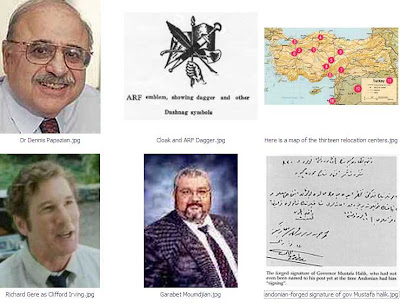
 Read Full Post !

 University of Minnesota Press 1971