Showing posts with label Norman STONE. Show all posts

21.6.19

3708) Norman Stone (1941–2019) A Fond Tribute To The Historian

Norman Stone (1941–2019)
A fond tribute to the historian and fearless advocate of Turkey, who died at his home in Budapest yesterday
BY DAVID BARCHARD | JUNE 20, 2019

If Norman Stone and Professor Ali Doğramacı, then rector of Bilkent University, had not shared a flash of inspiration during an international conference in Ankara in 1995, the love affair between the country and its most famous international academic friend might never have begun. Norman was in Ankara, at a conference on Bosnia, not too happy with his life as a professor at Oxford, and what he saw of Bilkent appealed to him. Why not work there?

It was a sort of intellectual quantum leap. The disillusioned Oxford professor vanished, to be replaced for two decades until 2017 by a far happier professor of international relations at Bilkent.

In the mid-1990s Norman was already a national celebrity in the UK. Born in Scotland, trained at Cambridge, his first book, The Eastern Front 1914-1917, propelled him instantly to the front rank of the historical profession. In the UK this meant becoming a star public intellectual. But when Norman swapped a fellowship at Cambridge (which he always loved) for a full professorship at Oxford, things started to go wrong – despite a very happy family life in a huge Victorian mansion in north Oxford.

The professorship was marginal to the life of the history faculty. At Cambridge Norman had taught a succession of brilliant students destined to become famous figures in academia and politics. Somehow that did not happen at Oxford, though there were exceptions, such as Victor Orban, the present prime minister of Hungary. . . .

Read The Full Post by Clicking Here Read Full Post !

25.10.11

3326) Meet Norman Stone: Turkey’s Staunchest Defender: 'I'm Not Always Consistent, But I'm Always Right'


Pictures from the Armenian conflict, which Stone terms a civil war, not a genocide., Kathryn Cook / Agence VU


Oct 23, 2011

“Turkey is the only country in the region whose past seems to flow toward a positive outcome, a history with a future. As with any narrative, to make things interesting, you want a sense of progress—otherwise you get that famous definition of history as ‘one damn thing after another.’ The Turks have always played a role in making things happen in the world. For a while they seemed pretty dormant, but I knew it would change.”

As the sun goes down, Prof. Norman Stone is standing on the
. .

Read The Full Post by Clicking Here Read Full Post !

19.7.11

3292) Response to Lord Avebury & Baroness Flather, House Of Lords, England

© This content Mirrored From  http://armenians-1915.blogspot.com
Updated 22 July 2011

Response letter to Baroness S. Flather’s reply by Prof Norman Stone

Dear Lady Flather,

The London Turks showed me your letter on the Armenian issue. I’m a historian of the First World War, familiar with the background, and please will you reconsider.

Your first port of call should just be the Foreign Office, and please remember that the British, in occupation of Constantinople, found no proofs of genocide and had to release the Turks whom they were holding (on Malta). There were massacres, yes, but you might also bear in mind that the Ottoman government itself put fifty-odd of its people on trial and executed a governor.

If a member of say the French Senate accused the Sikhs or the Hindus of genocide in the Punjab in 1947 I imagineyou might hit the roof, and rightly. There are some very serious books about all of this, and I cannot think why politicians think they need to opine one way or the other.

Yours sincerely,
Norman Stone
Professor Emeritus of Modern History,
University of Oxford
(and sometime Fellow of Trinity College, Cambridge)


. . .


British FCO Letter 2. 19 October 2007


British FCO Letter 1. 27 February 2006


Response letter to Baroness S. Flather’s reply by Lale Olcay 21jul11

Dear Baroness Shreela Flather,

I learned that at House of Lords you have recently proposed recognition of so-called Armenian genocide which depends on forgeries, falsified documents and lies which were confirmed by the English authorities, your ancestors themselves, depending on archival documents including those from the American archives.

After the Ottoman State was defeated in the 1st World War in 1918, the English, your ancestors and their allies arrested 144 high level Ottoman veteran or civil officials including the ex-prime ministers, ex-deputies, governors and many newspapermen, and banished them to Malta Island, claiming that they were responsibles for the death of Armenians.

However, the English authorities, your ancestors, had to make them all free in 1921, since they could not find any proof to be able to verdict them.

The following documents belong to your own archives:

Last word of Attorney General of Malta Tribunals

The letters written by H.M. Procurator-General’s Department to Mr Lancelot Oliphant (directed by Earl Curzon of Kedleston) dated July 29th, 1921 read:

‘It seems improbable that the charges made against some of the accused will be capable of legal proof in a Court of Law.’

(F.O. 371/6502/E.5845: L.Olipant (F.O.) to Mr Woods (Procurator-General’s Department)

5845/132/44 of May 31st,1921)

‘Until more precise information is available as to the nature of the evidence which will be forthcoming at the trials, the Attorney General does not feel that he is in a position to express any opinion as to the prospect of success in any of the cases sumitted for his consideration’

(F.O. 371/6504/E.8745: Woods (Procurator-General’s Department) to the Under Secretary of Stat efor FO., of July 29th, 1921)

Upon the receipt of Attorney General’s opinion Mr WS Edmonds minuted:

‘From this letter, it appears that the chances of obtaining convictions are almost nil…

‘The American Government, we have ascertained, cannot help with any evidence…

‘In addition to the ABSENCE OF LEGAL EVIDENCE there is the extreme unlikelihood that the French and Italians would agree to participate in constituting the court provided for in art.230 of the Treaty (of Sevres)….

‘ON THE OTHER HAND WE CERTAINLY CAN NOT RELEASE ANY TURKS UNTIL OUR OWN PRISONRES ARE RETURNED…. THE PROPER TIME FOR THE RELEASE OF THE TURKS SEEMS TO BE WHEN IT CAN BE DONE AS PART OF A GENERAL SETTLEMENT WITH TURKEY.’

‘IT IS REGRETTABLE THAT THE TURKS HAVE BEEN CONFINED AS LONG WITHOUT CHARGES BEING FORMULATED AGAINST THEM….’

(PRO-F.O. 371/6504/E.8745: Minutes by Edmonds of August 3rd,1921)

From: Simsir, Bilal. Malta Sürgünleri. Bilgi Yayinevi, Ankara, 1985.

Please note that the Ottoman government had been taken prisoners by your ancestors and all the Ottoman archives had been under control of your ancestors and cynically an Armenian official was assigned to the Ottoman Archives.

Also note that YOUR FAMOUS BLUE BOOK, the telegrams of Aram Andonian and the diary of Ambassador Morgenthau which are proposed as supporters of the present Armenian thesis even now, had already been published at that time.

Please also note that during the trial in Berlin of the Armenian assassin Soghomon Tehlirian, who had murdered Talat Pasha in Berlin on March 15th, 1921, none of the Andonian documents were accepted by the court as evidence (Dashnakists’ book Justicier du Genocide, 1981, p.213)

Therefore, you personally should have found a new and reliable proof of a genocide which could not be found by no means by your ancestors and their allies themselves just at the time of these events.

I invite you to display these new evidences. I cordially believe that these evidences will make a real contribution to the scholarship of history.

Yours sincerely

Lale Olcay


Response letter to Baroness Flather’s reply by Sevgin Oktay 21jul11
19 July 2011

Dear Baroness Flather,

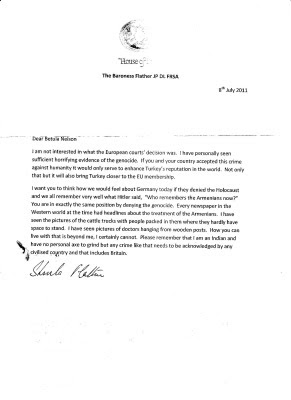
Your letter attached above to Betula Nelson prompted me to write this letter to you on a matter with which you are quite familiar, I assume; namely, the Armenian issue. The purpose of my letter is not to argue per se, but to have a conversation with you from a humanitarian point of view (since I believe you are one of the Vice Chairs of the All-Party Parliamentary Humanist Group) as to how it is that looking at the same events, two reasonable people can come to such different conclusions about the tragic human events that took place in the Ottoman Empire during the latter part of the nineteenth century leading up to and beyond First World War, WW I. I would like to learn from you as to what I am missing in looking at the whys and wherefores of these events. I should hasten to add that if it gets a bit too complicated to communicate through pecking on a keyboard rather than talking to each other face to face, I am willing to travel from New York to London to visit with you at your convenience. You might consider this as a naïve request on my part, but I am sincere. For, I respect you for what you have done in your life’s work and look up to you as an influential person whose guidance I need to come to terms with whatever real facts and logic may lead us to.

As for myself, I am an American citizen of Turkish origin who has been living in the United States for more than half-a-century. I have been following the Armenian issues for all those years and I could say that I am quite familiar with the issues involved.

If I may, let me start with the big picture rather than getting tangled up in the details. Can we perhaps first agree with the following historical markers, namely, that:

the Ottoman Empire was one of the largest and longest lasting Empires in history;

the recipe for its success was many fold, primarily among them:

a meritorious power system irrespective of ethnicity (race, color or creed);

an administrative policy of “live and let live.” For more, please see:

http://www.bbc.co.uk/religion/religions/islam/history/ottomanempire_1.shtml

Armenians (and many other ethnic groups) lived as loyal subjects of the Ottoman Empire for more than 600 years;

the early American Calvinists in mid-nineteenth century believed that “the Ottoman Empire soon would be cast down, the Jews would return to Palestine to become Christians, and the Reign of Christ was at hand based on faith in their interpretation of the Book of Revelation,” and that accordingly “their mission became to convert Muslims, Jews directly at first, [but having failed on that] the conversion of Christian Greeks, Armenians and other Middle Eastern Christians through the Reformation” (from Justin McCarthy, The Turk in America- The Creation of an Enduring Prejudice, the University of Utah Press, Salt Lake City, 2010, pp. 2-5);
encouraged by the West, the Dashnak Armenians tried to carve out an Armenia in an area of the Eastern Anatolia with a minority Armenian population of about 10%;

and in the process, Dashnaks terrorized not only the Turks and Kurds, but even killed their own kin surreptitiously to make them rise up against the Ottoman government ;

while the Young Turk administration of the Ottoman government offered the Armenians autonomy and they accepted it on the face of it, but behind the scenes;

Armenians conspired with the invading Russians to turn against their own Ottoman comrades in arms in the trenches instead of fighting the invaders;

and, as a last resort, the Young Turks ordered the relocation of the trouble maker Armenians away from the battle fields to distant parts of the Ottoman Empire, namely, Syria, while at the same time providing rail transportation to those who could afford it, and giving strict orders to the gendarmes to protect all who unfortunately had to walk hundreds of miles to their destination;

and also unfortunately, in the ensuing mayhem, thousands of innocent victims died of famine, disease and atrocities along the way;

at the same time, as many, if not more, Turks and Kurds were killed by the Armenians through their terrorism and rebellious acts dating back to late 19th century, as well as due to famine, disease and marauding that was rampant at the time of WWI.
I tried to make this listing as short as possible to start a discourse. I would be very glad to expand upon any one of the items if so desired. I would much appreciate if you could kindly let me know if there are any disagreements in the outline above and if so, which ones.

Finally, just a very quick and humble response to your letter to Betula Nelson:

1. There are just as many horrifying pictures depicting the deadly suffering on both sides. However, it has been shown many times over that what the Armenians have been unashamedly advertising for so many years have been proven to be fabrications galore. Please see attachment “Skulls,” for example.

2. As to what Hitler is reported to have said, that also has been shown to be another fabrication. Please see attachment on “Hitler.” Also, you may wish to see other brochures at www.cptstrs.org .

3. My heart goes out to those people and their families hanging from wooden posts that you mention. My heart also goes out to people who were locked in their mosques from the outside on prayer day, Fridays, and set on fire, and many more.

As a human being, I too do not want those terrible events (like many others around the world even now, for that matter,) to be allowed to happen again. I do much appreciate your stance as well, given your involvement with Humanist groups. However, we must be cognizant of how the historical “facts” are sometimes distorted, forged and fabricated. As a great historian of the Middle East , Bernard Lewis once said referring to the then atrocities:

“. . . to make this a parallel with the holocaust in Germany you would have to assume that the Jews in Germany had been engaged in armed rebellion against the German state, collaborating with the Allies against Germany, that in the deportation order the cities of Hamburg and Berlin were exempted, the persons in the employment of the state were exempted, and their deportation only applied to the Jews of Germany proper and when they got to the pogroms they were welcomed into shelters by the Polish Jews. That seems to be an absurd parallel.”

Let us also remember what president Shimon Peres of Israel has said:

“We reject attempts to create a similarity between the Holocaust and the Armenian allegations. Nothing similar to the Holocaust occurred. It is a tragedy what the Armenians went through but not a genocide.”

Of course Turks also went through a similar tragedy. But Turks must also be blamed for the distortion of history in front of their eyes as they did not respond to all these allegations for so many years. As C. F. Dixon-Johnson, British author of the 1916 book, The Armenians, appalled over the deceitful practice of his book’s subject, said then:

“Give a lie twenty-four hours start, and it will take a hundred years to overtake it.”

However, rest assured that there is a lively discussion going on in Turkey now, and that the 73 million Turks (minus a few including the likes of Taner Akçam, Fatma Gökçe, etc.) must be shown the undeniable documentation before they will accept the allegation of genocide against a people with whom they lived many years more in peace and harmony than fighting. You see, the diaspora Armenians- unlike the Armenians of Armenia, whom I call the “Yerevan Armenians”- lack an understanding or do not want to acknowledge what really happened during those terrible times of WW I. The “ Yerevan ” Armenians, on the other hand, understand too well, and they visit, vacation and work in Turkey now quite happily, and along with the Turks, wish a rapprochement to live as good neighbors once again. We must help them realize that sooner than later, rather than fanning the flames of hatred of the Diaspora Armenians. Wouldn’t be a wonderful thing if they can be freed from that “Life-Lie” that they seem to have embraced, but unfortunately will not be able to fly like the “Wild Duck” of Henrik Ibsen.

One final word: I seem to have been carried away, for which I ask your forgiveness. But I am really looking forward to hearing a positive response (not necessarily on the issue itself) to carry on with this conversation to a mutually agreed conclusion. We can of course, agree to disagree.

With Kindest regards,
Sevgin Oktay
Oktay Enterprises Int’l., LLC


Esteemed Lord Avebury,

I am sorry to note your consistent prejudice against the Turkish nation, to the extent of reversing written documentation. Should you have the frankness of speaking face to face, I am sure that your doubts (if not staunch bias) can be immediately rectified. I will make my statement very short hoping that you will have the courage to look into the given links and references.

a. I had given my autographed book to Mr. Ara Sarafian in 2008 in Istanbul and I have not heard any counter remarks from him.

b. My book has been on the Internet now for over 3 years and if you want to learn some of the facts "all from neutral and anti- Turkish sources" you can download it from: http://armenians-1915.blogspot.com/2008/04/2429-new-e-book-genocide-of-truth-based.html Should you want to have my autographed copy, I will be pleased to mail to you, plus my very recent book http://armenians-1915.blogspot.com/2010/12/3189-genocide-of-truth-continues-but.html

c.Mr. Ara Sarafian's last book distorting the contents of the last book of Talat pasha has been posted and replied by me, and my reply was sent to him by the "Armenians-1915.blogspot.com" offering to post his reply, if any. As always, he did not reply my counter comments on his distortions.

d. I had the honor of meeting Lord Maginnis. Should your authorized-concerned persons be interested in the TRUE SIDE of the events, I am prepared to FACE EVERYONE in the World. Gentlemen, my age is 81, I have read more than 50.000 pages of material and an official document, says: (U.S. National Archives Ref. 184.021/175)

[..., but the unanimity of the testimony of all witnesses, the apparent eagerness with which they told of wrongs done them, their evident hatred of Armenians, and, strongest of all, the material evidence on the ground itself, have convinced us as of the general truth of the facts, first, that Armenians massacred Musulmans on a large scale with many refinements of cruelty, and second that Armenians are responsible for most of the destruction done to towns and villages. The Russians and Armenians occupied the country for a considerable time together in 1915 ...]

Don't you think that you can be wrong and are doing a huge injustice refuting the British judges? When 144 Ottoman dignitaries were interned in Malta "pending charges for organized murders", the British could find NOTHING in the Ottoman Archives or US records for any legal indictment and they quietly released all Ottoman dignitaries, even without an indictment! What makes you think your Lordship, "that you know better" than those who lived the incidents ?

Yours Cordially,
Sukru Server Aya, (Researcher - author) Istanbul, July 19, 2011


From: Eric Avebury
To: Betula Nelson
Even Turks no longer deny the facts of the Armenian Genocide, of which there is fresh evidence in the surviving papers of Talaat Pasha, left in the possession of his widow and now published by Ara Sarafian of the Gomidas Press.

When Ara and I went to Ankara to launch his Turkish translation of the Blue Book we were unable to deliver copies to the members of the TGNA, but the Turks no longer have any excuse for their false claim that the Blue Book was nothing but a piece of wartime propaganda. We tried strenuously to engage the members of the TGNA in a dialogue on the subject, but not one of them ever replied to our letters!

Regards,

Eric Avebury
House of Lords, Tel 020-7219 xxxx
London SW1A 0AA
18 July, 2011


To: Baroness Shreela Flather
House of Lords
London SW1 OPW
England
16 July 2011

Subject: Wartime tragedy that engulfed Muslims and Christian alike; not genocide that only victimized Armenians

Dear Baroness Shreela Flather,

I was shocked and saddened to learn about your question and proposal at the House of Lords on the 16th of June 2011 regarding recognition by the British Government of the so called Armenian Genocide, a racist and dishonest version of history promoted by the Armenian lobby. Your biased approach to the Turkish-Armenian conflict showed a lack of appreciation of the facts surrounding this matter.

Please allow me to explain:

Bias & Bigotry In The Term Armenian Genocide

If one cherishes values like fairness, objectivity, truth, and honesty, then one should really use the term Turkish-Armenian conflict. Asking on Do you accept or deny Armenian Genocide shows anti-Turkish bias. The question should be re-phrased What is your stand on the Turkish-Armenian conflict?

Turks believe it was an inter communal warfare mostly fought by Turkish and Armenian irregulars, a civil war which is engineered, provoked, and waged by the Armenian revolutionaries, with active support from Russia, England, France, and others, all eyeing the vast territories of the collapsing Ottoman Empire, against a backdrop of a raging world war.

Armenians, on the other hand, totally ignoring Armenian agitation, raids, rebellions, treason, territorial demands, and Turkish victims killed by Armenians, unfairly claim that it was a one way genocide.

Genocide Allegations Ignore The Six T's Of The Turkish-Armenian Conflict

While some in unsuspecting public may be forgiven for taking the blatant and ceaseless Armenian propaganda at face value and believing Armenian falsifications merely because they are repeated so often, it is difficult and painful for someone like me, the son of Turkish survivors on both maternal and paternal sides.

Those seemingly endless War years of 1912-1922 brought wide-spread death and destruction on to all Ottoman citizens. No Turkish family was left untouched, mine included. Those nameless, faceless Turkish victims are killed for a second time today with politically motivated and baseless charges of Armenian genocide.

Allegations Of Armenian Genocide Are Racist And Dishonest History

They are racist because they ignore the Turkish dead: more than 3 million during WWI; about half a million of them at the hands of Armenian nationalists.

And the allegations of Armenian genocide are dishonest because they dismiss the six T's of the Turkish-Armenian conflict:

1) TUMULT (as in numerous Armenian armed uprisings between 1882 and 1920)

2) TERRORISM (by well-armed Armenian nationalists and militias victimizing Ottoman-Muslims between 1882-1920)

3) TREASON (Armenians joining the invading enemy armies as early as 1914 and lasting until 1921)

4) TERRITORIAL DEMANDS (where Armenians were a minority, not a majority, attempting to establish Greater Armenia, the would-be first apartheid of the 20th Century with a Christian minority ruling over a Muslim majority )

5) TURKISH SUFFERING AND LOSSES (i.e. those caused by the Armenian nationalists: 524,000 Muslims, mostly Turks, met their tragic end at the hands of Armenian revolutionaries during WWI, per Turkish Historical Society. This figure is not to be confused with about 2.5 million Muslim dead who lost their lives due to non-Armenian causes during WWI. Grand total: more than 3 million, according to Prof. Justin McCarthy.)

6) TERESET (temporary resettlement) triggered by the first five T's above and amply documented as such; not to be equated to the Armenian misrepresentations as genocide.)

Verdict Without Due Process Amounts To Lynching

Those who take the Armenian allegations of genocide at face value ignore the following:

1- Genocide is a legal, technical term precisely defined by the U.N. 1948 convention (Like all proper laws, it is not retroactive to 1915.)

2- Genocide verdict can only be given by a "competent court" after "due process" where both sides are properly represented and evidence mutually cross examined.

3- For a genocide verdict, the accusers must prove intent at a competent court and after due process. This could never be done by the Armenians whose evidence mostly fall into five major categories: hearsay, mis-representations, exaggerations, forgeries, and other.

4- Such a "competent court" was never convened in the case of Turkish-Armenian conflict and a genocide verdict does not exist (save a Kangaroo court in occupied Istanbul in 1920 where partisanship, vendettas, and revenge motives left no room for due process.)

5- Genocide claim--first appeared in 1965, that is, 50 years after the events--is purely political, not historical or factual. It reflects bias against Turks. Therefore, the term genocide must be used with the qualifier "alleged", for scholarly objectivity and truth.

History Is A Matter Of Scholarship, Not Consensus

History is not a matter of "conviction, consensus, political resolutions, political correctness, or propaganda."

History is a matter of research, peer review, thoughtful debate, and honest scholarship.

Even historians, by definition, cannot decide on a genocide verdict, which is reserved for a "competent court" with its legal expertise and due process.

What we witness today amounts to lynching of the Turks by Armenians (and their supporters) to satisfy the age old Armenian hate, bias, and bigotry. Values like fairness, presumption of innocence until proven guilty, objectivity, balance, honesty, and freedom of speech are stumped under the fanatic Armenian feet. Unprovoked , unjustified, and unfair defamation of Turkey, one of NATO's strongest members and a reliable ally of the West since the end of WWII in the troubled Middle East, in order to appease some nagging Armenian activists runs counter to Western interests.

Those who claim genocide verdict today, based on the much discredited Armenian evidence, are actually engaging in "conviction and execution without due process". Last time I looked in the dictionary, that was the definition of lynching.

Isn't it time to stop fighting the First World War dishonestly and give peace a real chance?

Yours sincerely,

Ergun KIRLIKOVALI
Son of Turkish Survivors of the Balkan Wars
President,The Assembly of Turkish-American Associations,
Washingon DC, USA
www.ataa.org
Cell: USA (949) 878-xxxx


Dear Baroness Shreela Flather,

The Ataturk Society of the UK has been astonished and dismayed to learn about your question and proposal regarding a possible timetable for the British Government to recognize the so called Armenian Genocide at the House of Lords on the 16th of June 2011. Whilst we appreciate your right to ask questions as a member of the House of Lords (not as an elected representative), we would like to bring the following facts to your attention regarding this matter.

First of all can we remind you that there is no legal justification for such a recognition unlike the Holocaust or Bosnian massacres.

As a historical event, it is a fact that Suzanne and Gregoire Krikorian took their case to the European Court of Justice in 2003 in reference to the so called Armenian genocide, and demanded moral and material compensation. However, they lost this court case on the 17th December 2003 and were ordered to pay the court expenses of 30,000 Euro for unfounded charges.

This issue began with the passing of an ill conceived resolution C-190 of the European Parliament on 20th July 1987 that Turkey cannot become a member of EEC unless she recognizes the so called Armenian Genocide!

Twelve years later, in 1999, Turkish Prime Minister Bulent Ecevit was negotiating with the EEC regarding Turkish candidacy and when the discussions were strained, the Turkish P.M. was invited to Helsinki talks. The Helsinki European Council decision was to officially invite Turkey into the E.U. Since than Turkey has been a candidate member and has many agreements with the EU, going back to 1963 Ankara Association Agreement).

This invitation obviously did not go the way the Armenian Diaspora wanted and they opened a court case against:

The European Parliament
The European Union Association Council
The European Commission

at the European Court of Justice, with reference to the European Parliament's resolution no. C-190, demanding that Turkey acknowledges so called Armenian Genocide before being offered membership status, otherwise EU's contractual status would be impaired and therefore insisting on “Responsibility from the European Union outside of its commitments and without any judicial justification.

We would like to remind you that this court case was rejected by the First Division of the European Court of Justice on December 17, 2003 under decision number T-346/03, confirming that there is no legally accepted justification for so called Armenian genocide.

Still unsatisfied the Armenian Diaspora applied to the Court of Appeals for the repeal of the referred decision. This application was heard by the Fourth Division of the European Court of Justice at the session dated 17.04.2004. It was rejected again under the clause No. C-18/04 and the Armenians were charged to pay the court expenses of 30,000 Euros.

Dear Baroness Flather, we would like to ask you to reconsider your question to the House of Lords in the light of the evidence presented above and before taking a stance against the decisions of the European Court of Justice which is an authorised Court set up to deal with these kind of cases and is officially recognized by the UK Parliament.

Turkish people have a right to request that you re-address the House of Lords regarding your question and put right the inaccuracies or injustices done to the Turkish Nation. We consider your action as biased and prejudiced, and also lacking in informed knowledge and the right facts of the matter.

Yours sincerely,

Betula Nelson
Foreign Media Coordinator
Ataturk Society UK
London


Extracts from the European Court of Justice decision number T-346/03;
Clause 25.

Secondly, as regards the requirement that the applicants must have suffered actual and certain damage, the applicants clearly confined themselves in their application to relying in general terms on non-material damage caused to the Armenian community, without giving the least indication as to the nature or extent of the damage which they consider they had suffered individually. Therefore the applicants have supplied no information that would enable the Court to find that the applicants in fact suffered actual and certain damage themselves (see, to that effect, Case T-99/98 Hameico Stuttgart and Others v Council and Commission [2003] ECR II-2195, paragraphs 68 and 69).

Clause 21.
As regards the alleged breach of fundamental rights (see paragraph 10 above), it is sufficient to note that the applicants merely claim that such a breach took place, without explaining how that follows from the conduct of the defendant institutions complained of in this case.

For further information please see:
  1. Armenians-1915.blogspot.com/2008/10/2610-genocide-lies-need-no-archives.html
  2. http://armenians-1915.blogspot.com/2007/04/1594-grgoire-krikorian-and-others-v.html
.

Read The Full Post by Clicking Here Read Full Post !

13.5.10

3073) ' Armenian Diaspora Regard Me As A Terrible Monster Because I Don't Go Along With Their Propaganda' Norman Stone


By Neil Tweedie / Daily Telegraph/UK / 12 May 2010

With a new book out about the Cold War, the famously contrary historian Norman Stone reveals an endearing side.

Norman Stone Photo: Andrew Crowley "Shall we do it in the pub?" suggests Norman Stone, half guiltily, half conspiratorially. .

We are standing in the study of his large Victorian semi in fashionable north Oxford, and he hasn't got long for an interview (to plug his new book) before catching a flight to Ankara, where he has lived in self-imposed exile for most of the past 15 years. The sun is barely over the yardarm, but so what? On the way, he talks amusingly about Tory prime ministers.

Four of the best sculpture gardens"Eden," he says. "Malcolm Muggeridge, a great man, had him right. Sir Anthony, he said, was like a former Guards officer who, through force of circumstance, must earn a living selling vacuum cleaners. Heath was the same, although an NCO."

Stone is good at history and good at making enemies. During his tenure as Professor of Modern History at Oxford, Heath referred to him thus: "Many parents of Oxford students must be both horrified and disgusted that the higher education of our children should rest in the hands of such a man."

What self-publicist could ask for more? Particularly such an ardent admirer of Ted's nemesis, Margaret Thatcher, or "Mrs T", as he always calls her. Stone, serious historian, popular historian, contrarian and columnist, was one of her speechwriters in the late 1980s. Time has not dimmed his passion.

"Nobody is interested in John Major or David Cameron, or any of these transitional nobodies. Mrs T stood up and turned this country around.

The fact that England, which was in a very bad way in the Seventies, stood up and said, 'Here we are again' - it mattered a lot to the Russians. It gave them a shock - a clear contradiction of their idea that capitalism wasn't working."

Thatcher is one of the heroes of his new work, The Atlantic and its Enemies: A Personal History of the Cold War, which chronicles, in a sometimes eccentric way, events between 1945 and the fall of the Berlin Wall. It is a refreshing book, quirky, partial, sweeping in its judgments and littered with good one-liners.

For a supposed book-plugger, though, he is curiously unhurried in approaching the subject of his new publication. Grabbing a double gin and tonic at the bar, he departs immediately to the smoking area under a corrugated roof at the back of the pub. For him, the smoking ban is the most irritating manifestation of the British nanny state. No matter that, at the age of 69, he wheezes alarmingly as fag follows fag.

"On the one side, people can't smoke in a bar; on the other side, the entire young generation is drunk. It's absurd."

He did once give up smoking but it turned him, he says, into an "ugly drunk". "I didn't like that because I am not at heart a nasty person."

Not nasty, clearly, but he likes to needle - inhabitants of small countries in particular, including his own. A Scotsman to his core, he nevertheless takes a perverse pleasure in his nation's subjugation. In The Atlantic and its Enemies, the United Kingdom is referred to time and again as "England". But his goading of the Scots is as nothing to the ire he inspires in the Armenian diaspora. Stone's "crime" is to refuse to describe the expulsions and massacres of a million or more Armenians by the Turks during the First World War as genocide.

"I get irritated by people getting stuff wrong," he says. "I'm constantly locking horns with the Armenians, which I don't like doing.

"It was a disaster, but I don't believe the Turkish leadership sat down and said, 'Let's wipe them all out'. Calling it genocide is a step too far and muddles the argument. The Armenian diaspora regard me as a terrible monster because I don't go along with their propaganda."

The Armenian lobby in turn accuses Stone of propagandising on behalf of his Turkish paymasters. It is a sensitive issue but, ever the iconoclast, he cannot resist a darkly humorous analysis of Armenia's brief flirtation with independence at the end of the Great War, before its reabsorption into Russia and Turkey.

"Once the Armenians set up their independent state they declared war on everybody. There is a wonderful moment when places become independent - the tears running down the cheeks of the archimandrites into the rumbles of their double chins, and then the double-headed lobster goes up on the flag, which is printed on Marks & Spencer Y-fronts. The national anthem starts, which has been written by a Budapest Jew. They have a cabinet meeting and say, 'What shall we do, Excellency?' 'Let's invade Georgia on Christmas Day'. So they end up being attacked by everybody - it's like Paraguay. One should be respectful, but one can't."

Would he ever visit Armenia? "I would come back with my head in a basket." But he has, he says, absolutely nothing against the Armenian people. "I have never met an Armenian I haven't admired and liked."

Stone was born in 1941. He never knew his father, an instructor in the RAF, who was killed in a training accident over Wales.

"February 25, 1942. I wasn't even one.

"Family closes round, so I wasn't conscious of anything. But the point came in my late thirties when I began to realise what damage it had done. Not having your daddy is a very bad thing. If I read about women bringing up children on their own, deliberately making babies, I get very angry indeed. I think, 'Why don't they just buy a dolly?'"

Members of his father's squadron clubbed together to pay for his education at Glasgow Academy. A modern languages scholarship to Cambridge followed - Stone speaks lots of languages.

"If you quote me I will kill you, but I can do five live on the telly.

I do Turkish on telly and make thousands of mistakes, but they do like it."

History was his passion, though, and he soon converted. Did he ever consider a life outside academia, like the Foreign Office? "I would have destroyed everything I touched."

Andrew Roberts, Niall Ferguson and Orlando Figes all passed under his wing, and there was acclamation for his books, including a history of the Eastern Front during the Great War. But in later years he was regarded by less media-friendly (Stone prefers the word boring) historians as a sell-out, a hack pumping out books for money.

Boredom and money drove him from Oxford to Turkey's Bilkent University. He has no intention of leaving Turkey ("Good place.

Splendid people.").

As for Britain: "There are so many good things in this country. The music in Oxford and London is very good. There are plenty of intelligent people around the place. It's just the endless irritations."

His marriage to Christine is his second. His first wife, Nicole, was Haitian. "It was a wonderful disaster." Her father was? Struggling to keep a straight face: "Papa Doc's finance minister. Charming, charming."

How long did he spend in Haiti? "Two years." What did he make of it?

"Long live England."

His taxi is coming. Ankara beckons. The book? "I got offered a huge sum of money to write a history of the 20th century, and thought" -draws on cigarette - "it's been done.

"Paul Johnson had already brought it off wonderfully, and Eric Hobsbawm as well. I just couldn't do it."

The Cold War, he thought, was short of a well-written account. What makes good history? "You have to have a sense of humour. A J P (Taylor) was just sensational. And someone I've been reading a lot is Trevelyan. I had always been put off Trevelyan because he was a bit sort of English triumphalist. But then 18th-century England is such an extraordinarily interesting country. It abolished Scotland, which is a good thing."
© This content Mirrored From  http://armenians-1915.blogspot.com
Naughty. And Communism - was it always doomed?

"Yes. I'm a purist on this. Marx himself made two vast mistakes: one was to not understand religion and the other was to hate peasants. I don't like the Common Agricultural Policy either, but peasants do exist and you don't shove them into camps."

Stone is a believer in the Great Man theory of history - that individuals can make a difference. Maybe that is why he cannot tolerate life in England - no big beasts any more.

"Look at Mrs T. A unique character. What would the Conservatives have been in the Eighties without her? Heath - Heath! Flabby-faced cowards.

They didn't have the balls. I wouldn't either. I don't like being disliked. I would have made concessions to people. Mrs T didn't."

Good bar room stuff. But the rain falling on the corrugated roof is drowning him out, and his taxi is waiting.

Reading Norman Stone, you imagine that he is as tough as, well, Norman stone. But in person there is an endearing vulnerability. "You are not going to send me up are you?" he says, getting his coat. Of course not. Why try when he does it so well himself?

* 'The Atlantic and its Enemies: A Personal History of the Cold War' by Norman Stone (Allen Lane).

Read The Full Post by Clicking Here Read Full Post !

9.4.08

2419) What’s This ‘Genocide’ To Do With Congress? What Has This ‘Genocide’ To Do With Congress?

 Norman Stone © This content Mirrored From  http://armenians-1915.blogspot.com * Norman STONE, April, 2008

Two elderly shoe-shiners were shouting with rage outside my local in Istanbul. The subject was America, and they ranted on and on first about the disaster in Iraq, then about the stirring up of the Kurds, and then about the latest effort in Congress to ‘recognise the Armenian genocide'. What is so very strange about all of this is that American relations with Turkey have generally been very good. In a sense, modern Turkey belongs with Germany and Japan as the most successful creation of the United States after the second world war. In any year, there are 25,000 Turks at American universities, some of them sprigs of the Istanbul rich, many on scholarships, with which the Americans have been generous. Co-operation has gone far in other ways: for instance, the great air base at Incirlik has been vital all along for America's defence interests, and now, given the Iraq problem, the port of Iskenderun, the old Alexandretta, is also important. Turkey has a good defence industry, especially good when it comes to making aircraft (the F-16s win prizes). . .

She might have developed into an Egypt, but instead she is closer to Spain industrial, in many places quite prosperous, literate. By most measurements she is now better off than Russia, let alone most countries of the Middle East. But something has gone badly wrong, and opinion polls now show that the Turks are even more anti-American than the Palestinians. The latest row concerns the adoption of a resolution by the House of Representatives branding the Armenian massacres of 1915 as genocide. What on earth causes Congress to bring up this subject now, almost a century down the line, and relating to an Ottoman empire that has long ceased to exist? And why on earth should these public bodies lecture historians as to what they should be saying? One basic cause seems to be simple enough: money. We all know about the eccentricities of the American legal system, the business of class actions. If Congress recognises the massacres as ‘genocide', then who knows what claims would be presented to Turkey proper? There was a great deal of Armenian property in eastern Turkey back then. Nearly all Turks would anyway dispute the notion of ‘genocide'. Ever since 1878 the Armenians had become more and more restive and the nationalists started to make the running even murdering prominent Armenians who dissented and who said (as did the Patriarch in 1890) that it would all end in disaster. In the spring of 1915, just as the Russian army (with an Armenian division in tow) came over the border, there was a revolt, encouraged by the Russians and the Armenians who lived under the Tsar. Many prominent Armenians in Turkey also encouraged or organised rebellions because, with the British about to land at Gallipoli and the French training an Armenian legion on Cyprus, they expected the Turks to collapse. In the eastern city of Van the Muslim quarter was smashed, and many inhabitants were killed. The Ottoman government then decreed that Armenians with many exceptions should be deported out of areas where they could damage the defences, or sabotage the telegraph lines and railways. The deportees were sent to northern Syria, but on the way they were sometimes attacked by wild tribes, in some cases with the connivance of officials.

In 1916 and this surely tells against ‘genocide' the Ottomans tried 1,300 of these men and even executed a governor. About half a million Armenians arrived in the southeast and a very great number then died of the disease and starvation that were so prev alent at the time. Muslims also died in droves. In addition, the figure given for overall losses by the Armenian representative at the Paris peace treaties was 700,000 not 1.5 million as has been widely claimed. Genocide? First of all, much depends on your definition. If we take the classic version, then there are serious difficulties. The British occupied Istanbul for four years and had a run of the archives. The law officers could not find evidence to convict the hundred or so Turks whom they had arrested. In the summer of 1920 some documents did turn up, allegedly drawn from a guilt-ridden Turkish official, but they were fairly clumsy forgeries (this has not stopped Robert Fisk from quoting one or two): the dating system was wrong, the governor's signature was not accurate, the paper came from a French school, etc. The documents have since disappeared - not what you would expect if they had been so very damning. Evidence for genocide can be called into question otherwise: for instance, a professor at Princeton examined the text of the American ambassador's memoirs and showed that it had been retouched by an Armenian secretary.

How will the elections that determined the new President of Armenia and the ensuing demonstrations by the opposition reflect on Turkish-Armenian relations? This question is one of the points that the Turkish decision makers on foreign policy are paying careful attention to. It is clear that the "new" President will not take up Ankara's offer of a "joint historical commission". The US and the European Union wants Turkey to go one step further and re-open the border with Armenia. Only the signs coming from Ankara show that this is unlikely to happen in the near future.

Public bodies have no role in historical disputes

On the whole historians who know the subject and the sources (they are very difficult) do not take the ‘genocide' line: the best recent account of it all is Guenther Lewy's A Disputed Genocide (Utah University Press, 2005). But whether they are right or wrong, it is surely nonsense for Congress to be involved at all, or any other body. The French National Assembly provoked some trouble in Turkey when, by a very narrow vote, it proposed to make genocide-denial a crime: Sarkozy is now a hate-figure. Various other bodies have been pushed into this bizarrely, Edinburgh City Council last year, along with Lithuania and Chile and who knows where else. None of this is any help to Armenia; she is a poor and landlocked place, dependent for energy on of all places Iran, and without diaspora money she would be in an even worse state. She regularly loses people to emigration 60,000 of them incidentally to Istanbul and she badly needs good relations with Turkey. Perhaps such countries, once they are independent, should make a second declaration of independence from their diasporas. But the business in Congress is also associated with other much greater problems. There is first of all Iraq. Almost all Turks thought that the Americans were very wrong in going in: yes, Saddam was a monster, but his removal would only make matters worse. Maybe the sensible thing would have been for the Turks themselves to provide an occupation force, especially in the Kurdish areas of northern Iraq; they know the area, and might even have proclaimed some kind of confederal link with the Kurds. But the Allies failed to occupy Iraq in 1991 and the Turks themselves did not co-operate on the ground 12 years later, when Saddam was overthrown. The result is the emergence of a Kurdish proto-state, and given the tremendous mountain terrain it is easily possible for anti-Turkish guerrillas of the PKK to hide and cross over. In the past few weeks strangely timed in parallel with the Armenian resolution there have been many vicious attacks on the Turkish military in the south-east.

As far as Turkey herself is concerned, that makes for very great problems. For generations, Turks and Kurds got along; but there is now tension. Kurdish society remained rather different from Turkish. A tradition of polygamy went on, and one outcome is a great problem of demography. Diyarbakir, the chief town of the Kurdish region of Turkey, is an astonishing place. Its great grim basalt walls go back to Roman times and maybe earlier; its warren of very narrow streets is studded with old monuments, including varieties of Christian churches; it sits grandly on a bend in the river Tigris. The town centre is quite lively, but if you go to the old citadel area, it becomes depressing: that quarter is swamped in ragged children, hanging like bunches of grapes. They are quite cheerful, but the demographic problem is only too obvious, and so it is in other parts of the area. You wonder how on earth the country can stand the pressure on its infrastructure, and the problem causes much resentment in Turkey proper, where families are now limited in size. In fact vast numbers of Kurds migrate to the cities of the centre and west, especially Istanbul, and there a process of assimilation goes ahead: if you hear young Kurds talking among themselves, they use a mixture of Kurdish and Turkish, the more so as, quite often, they cannot quite understand each other's dialects. The Kurdish problem boils down to a race between demography in the east and assimilation in the west. It can only be vastly complicated by the existence of a Kurdish national entity over the border, and besides there are dimensions of drugs-smuggling to make matters worse.

Huge fortunes are made out of this and it is very difficult to detect. Tens of thousands of lorries pass the border every month; Turkey has also a considerable headache from refugees (of whom there are 2,000,000, often from Iran). Now there is a suspicion, almost universal in Turkey, that the Americans will set up a ramshackle Kurdish state, and then prepare to leave the whole Iraqi mess behind. Turkey would then have to pick up the pieces and, though economic prosperity grows, this is not a happy time for the country. She had, after independence in 1923, a relatively good 20th century. But given her geographical placing, the 21st is shaping up with versions of the old historical problems. It would be bad if her people have to relapse into that old line of Turkish nationalism,Türkün dostu sadece Türktür. meaning, ‘the only friend of the Turk is the Turk'.

*Bilkent University, Dep. of International Relations, Former Advisor to Margaret Thatcher


http://www.eurasiacritic.com/articles/what%E2%80%99s-%E2%80%98genocide%E2%80%99-do-congress-what-has-%E2%80%98genocide%E2%80%99-do-congress
.

Read The Full Post by Clicking Here Read Full Post !

2.11.07

2151) Norman Stone: There Is No Armenian Genocide

Norman Stone: 'There is No Armenian Genocide'

21 October 2006

“The Armenian ‘genocide’ is an imperialist plot.” So said Dogu Perincek, in Marxist mode, and
he chose to say it in Switzerland. Switzerland passed a law threatening prison for anyone
‘denying’ that there had been a genocide of the Ottoman Armenians in 1915, and Mr. Perincek
was interrogated by the police. . .

© This content Mirrored From  http://armenians-1915.blogspot.com . . .

Read The Full Post by Clicking Here Read Full Post !

2146) Prof. Norman Stone Addresses the ADL's Abe Foxman

© This content Mirrored From  http://armenians-1915.blogspot.com The following is a letter written by Professor Norman Stone to Abraham Foxman of the Anti-Defamation League, when the latter caved in to Armenian pressure without regard to the facts, and accepted the "genocide" definition. The idea was, of course, to get the politically-motivated Mr. Foxman to see the light, presuming Mr. Foxman would set a higher priority to the truth. Let's hope he will, but let's not hold our breath.

The ADL has a program called "No Place for Hate," but evidently they only care about select peoples. By acknowledging a false genocide that perpetrates hatred, the ADL has become accomplices for hatred.

(Of course, the Armenians were extremely "foxy" in pressuring Mr. Foxman of the ADL, and other Jewish groups, in an atmosphere both Armenians and Jews have had much to do in creating, making designated genocides sacrosanct. Jewish groups such as the ADL could not afford to be branded as "genocide deniers," and thus the weaker-willed among them had no choice but to buckle.)

An article by Norman Stone follows.

Dear Mr. Foxman,

I am writing to you about the resolution, recently-published, of the ADL, concerning the Armenian events of 1915 in Turkey.

Dr. Norman Stone. Ironically, he was part of PBS's "The Great War," which crazily affirmed the Armenian tale. (Stone lent his expertise on Russia here.)

My qualifications for doing so are I think such that any historian of the period would vouch for me: I taught at Cambridge and Oxford for thirty years before taking early retirement from the Chair of Modern History, and going to Turkey. I have just had published a book about the First World War (Penguin) which is currently being translated into a number of languages and will no doubt shortly appear in the USA. Beyond that, I have started a book about Russia and Turkey in the 1878-1930 period. A friend in Istanbul has asked me to write to you about the recent statement concerning the Armenian massacres in 1915. I am afraid to say that there will be some dismay if the Anti-Defamation League makes even such carefully-expressed assertions as to whether the massacres amounted to a genocide.

The chief authority is surely Bernard Lewis at Princeton. He told a French newspaper some years ago that there is no document proving the (genocidal) intentions of the Ottoman government, and, on the matter of definition, 'it depends what you mean by genocide'. His reward for this was to be sued in the French courts, and he even lost one of the cases with a symbolic franc's damages. Be it said that the Armenians used as lawyer one Maitre Verges, who defended Carlos the Jackal, a notorious holocaust-denier, and other such unsavoury characters; he volunteered to defend Saddam Hussein as well. But there are other frankly well-qualified authorities in the USA, better-qualified in terms of academic record than anything to be found on the Armenian side. Guenther Lewy (who has just retired from a Chair at Amherst) has a recent book that is clearly fair-minded ('A disputed genocide') and it does material damage to the scholarly performance of the chief diaspora historian, Dadrian. Justin McCarthy, an Ottoman demographer, can also usefully be consulted. In Paris, at the College de France, there is Gilles Veinstein, who wrote a telling summary of the whole question in L'Histoire of 1993. These are frankly in the top flight of scholars, and this subject is an extremely difficult one, requiring knowledge not just of modern Turkish but Ottoman, which is obsolete. There are other scholars who also question the 'genocide' account, for instance a young man at Harvard, Michael Reynolds, who can handle both the Ottoman archives and the records of the Russian military administration, which took over eastern Anatolia in 1915. The Russian documents, I gather, support what the Turks have claimed about 1915 - that there was a tremendous Armenian-nationalist provocation, followed by a cruel deportation of the population.

I might add that each of these men has faced vicious attacks, and attempts to stop publication - for instance, the manipulation of peer-review tactics, vastly exaggerating the number and significance of slips. In the case of one celebrated American historian, Stanford Shaw at UCLA, his car was booby-trapped and his house fire-bombed.


The more vociferous Armenian diaspora historians like to claim that 'historians' support them but this is just not true. Quite the contrary: on the whole, the people who know the subject at first-hand do not accept the thesis of 'genocide'. The whole business of 1915 remains murky, but perhaps I can bullet-point some of it.

I can easily supply references for these, but I think that anyone familiar with the subject — including diaspora historians — will know my sources. In general, Professor Lewy's book (University of Utah Press) will serve in this respect.

1) The documents allegedly proving the genocide are forgeries, and the British law officers who were trying to find evidence over a four-year period of occupation in Constantinople refused to use them. With much regret, they said that they could not establish a case against some hundred men whom they were holding. The State Department were unable to help. This has not stopped the diaspora Armenians in France from using the most notorious of these forgeries (the 'Naim-Andonian documents') in their museum in the south of France.

2) The Ottomans themselves in 1916 put on trial some 1300 men for crimes committed during the deportation of the Armenians in 1915, and executed a governor.

3) The Armenians' leader, Boghos Nubar, was offered a post in the Ottoman cabinet in 1914, but turned it down on the grounds that his Turkish was not up to it.

4) The figure given by Boghos Nubar to the French for Armenian losses for use in the post-war treaties was 700,000. Most died of disease or starvation, but in eastern Turkey at the time at least one quarter of the entire population, Moslem and Christian, died of such causes. It was a terrible time.

5) The internal Ottoman documents talk of 'deportation', in the context of widespread Armenian nationalist risings in the early spring of 1915. The Russians and the French (on Cyprus) used Armenian regiments and legionaries.

6) The Armenian populations of Istanbul, Izmir and Aleppo were not affected by the deportation order. As Lewy says, it is as if the Jews of Berlin, Frankfurt and Vienna had been exempted from the Hitler genocide.

7) In the run-up to this tragic period, the Armenian nationalists murdered prominent Armenians who warned against risings - the Patriarch in Istanbul, for instance, and the mayor of Van (and many others).

8) The diaspora Armenians have never allowed this to come before a properly-constituted and competent court. Instead, they prompt parliamentary and other bodies to 'recognize the genocide' — Canada, France, Lithuania, Chile, Wisonsin, Edinburgh City Council etc. That will be where the ADL comes in.

9) The diaspora historians also refuse to meet Turkish historians even under neutral and well-intentioned auspices (for instance, in Vienna two years ago).


It is true that diaspora historians will find answers, of greater or lesser plausibility, to these points, but they have to try very, very hard, and their attempt to muzzle transparently competent and honest historians surely speaks for itself.

I might add incidentally that I consider myself neutral and I have never written anything to deny the possibility that a genocide (in the classic sense) was considered. However I do not think that the evidence that we have really adds up, and I quite agree with Professors Lewis, Lewy and Veinstein. I also know, from my ten years in Turkey, how strong the feeling is, there, among quite ordinary people, that the diaspora Armenians are being quite vindictive and perverse about an affair in which the Armenian nationalists have far more responsibility than the diaspora would ever admit. This does Turkish-Armenian relations no good, as I am sure the 100,000 or so Armenians in Turkey, their Patriarch at the head, agree.

The important thing is to bury the hatchet, and Armenia herself, a poor, land-locked place that has lost about a quarter of its population through emigration (a good part to Istanbul) also needs this before she withers on the vine.

Yours sincerely,

Norman Stone


Article by Norman Stone
Commentary, Chicago Tribune
Armenian story has another side
By Norman Stone, a historian and the author of "World War I: A Short History"
October 16, 2007

All the world knows what the end of an empire looks like: hundreds of thousands of people fleeing down dusty paths, taking what was left of their possessions; crammed refugee trains puffing their way across arid plains; and many, many people dying. For the Ottoman Empire that process began in the Balkans, the Crimea and the Caucasus as Russia and her satellites expanded. Seven million people — we would now call them Turks — had to settle in Anatolia, the territory of modern Turkey.

In 1914, when World War I began in earnest, Armenians living in what is now Turkey attempted to set up a national state. Armenians revolted against the Ottoman government, began what we would now call "ethnic cleansing" of the local Turks. Their effort failed and caused the government to deport most Armenians from the area of the revolt for security reasons. Their sufferings en route are well-known.

Today, Armenian interests in America and abroad are well-organized. What keeps them united is the collective memory of their historic grievance. What happened was not in any way their fault, they believe. If the drive to carve out an ethnically pure Armenian state was a failure, they reason, it was only because the Turks exterminated them.

For years, Armenians have urged the U.S. Congress to recognize their fate as genocide. Many U.S. leaders — including former secretaries of state and defense and current high-ranking Bush administration officials — have urged Congress either not to consider or to vote down the current genocide resolution primarily for strategic purposes: Turkey is a critical ally to the U.S. in both Iraq and Afghanistan and adoption of such a resolution would anger and offend the Turkish population and jeopardize U.S.-Turkish relations.

Given this strong opposition, why would Congress, upon the advice of the House Foreign Affairs Committee, make itself arbiter of this controversy? What makes the Armenians' dreadful fate so much worse than the dreadful fates that come with every end of empire? It is here that historians must come in.

First, allegedly critical evidence of the crime consists of forgeries. The British were in occupation of Istanbul for four years after the war and examined all of the files of the Ottoman government. They found nothing, and therefore could not try the 100-odd supposed Turkish war criminals that they were holding. Then, documents turned up, allegedly telegrams from the interior ministry to the effect that all Armenians should be wiped out. The signatures turned out to be wrong, there were no back-up copies in the archives and the dating system was misunderstood.

There are many other arguments against a supposed genocide of the Armenians. Their leader was offered a post in the Turkish Cabinet in 1914, and turned it down. When the deportations were under way, the populations of the big cities were exempted — Istanbul, Izmir, Aleppo, where there were huge concentrations of Armenians. There were indeed well-documented and horrible massacres of the deportee columns, and the Turks themselves tried more than 1,300 men for these crimes in 1916, convicted many and executed several. None of this squares with genocide, as we classically understand it. Finally, it is just not true that historians as a whole support the genocide thesis. The people who know the background and the language (Ottoman Turkish is terribly difficult) are divided, and those who do not accept the genocide thesis are weightier. The Armenian lobby contends that these independent and highly esteemed historians are simply "Ottomanists" — a ridiculously arrogant dismissal.

Unfortunately, the issue has never reached a properly constituted court. If the Armenians were convinced of their own case, they would have taken it to one. Instead, they lobby bewildered or bored parliamentary assemblies to "recognize the genocide."

Congress should not take a position, one way or the other, on this affair. Let historians decide. The Turkish government has been saying this for years. It is the Armenians who refuse to take part in a joint historical review, even when organized by impeccably neutral academics. This review is the logical and most sensible path forward. Passage of the resolution by the full House of Representatives would constitute an act of legislative vengeance and would shame well-meaning scholars who want to explore this history from any vantage point other than the one foisted upon the world by ultranationalist Armenians.

----------------------------------------------------
© Holdwater
The source site of this article gets revised often, as better information comes along. For the most up-to-date version, links and the related photos, the reader may consider reviewing the direct link as follows:
www.tallarmeniantale.com/stone-letter-foxman.htm
-----------------------------------------------------

Read The Full Post by Clicking Here Read Full Post !

17.10.07

2082) Armenian Story Has Another Side

© This content Mirrored From  http://armenians-1915.blogspot.com
By Norman Stone, a historian and the author of "World War I: A Short History"
October 16, 2007

All the world knows what the end of an empire looks like: hundreds of thousands of people fleeing down dusty paths, taking what was left of their possessions; crammed refugee trains puffing their way across arid plains; and many, many people dying. For the Ottoman Empire that process began in the Balkans, the Crimea and the Caucasus as Russia and her satellites expanded. Seven million people -- we would now call them Turks -- had to settle in Anatolia, the territory of modern Turkey.

In 1914, when World War I began in earnest, Armenians living in what is now Turkey attempted to set up a national state. Armenians revolted against the Ottoman government, began what we would now call "ethnic cleansing" of the local Turks. Their effort failed and caused the government to deport most Armenians from the area of the revolt for security reasons. Their sufferings en route are well-known.

Today, Armenian interests in America and abroad are well-organized. What keeps them united is the collective memory of their historic grievance. What happened was not in any way their fault, they believe. If the drive to carve out an ethnically pure Armenian state was a failure, they reason, it was only because the Turks exterminated them.

For years, Armenians have urged the U.S. Congress to recognize their fate as genocide. Many U.S. leaders -- including former secretaries of state and defense and current high-ranking Bush administration officials -- have urged Congress either not to consider or to vote down the current genocide resolution primarily for strategic purposes: Turkey is a critical ally to the U.S. in both Iraq and Afghanistan and adoption of such a resolution would anger and offend the Turkish population and jeopardize U.S.-Turkish relations.

Given this strong opposition, why would Congress, upon the advice of the House Foreign Affairs Committee, make itself arbiter of this controversy? What makes the Armenians' dreadful fate so much worse than the dreadful fates that come with every end of empire? It is here that historians must come in.

First, allegedly critical evidence of the crime consists of forgeries. The British were in occupation of Istanbul for four years after the war and examined all of the files of the Ottoman government. They found nothing, and therefore could not try the 100-odd supposed Turkish war criminals that they were holding. Then, documents turned up, allegedly telegrams from the interior ministry to the effect that all Armenians should be wiped out. The signatures turned out to be wrong, there were no back-up copies in the archives and the dating system was misunderstood.

There are many other arguments against a supposed genocide of the Armenians. Their leader was offered a post in the Turkish Cabinet in 1914, and turned it down. When the deportations were under way, the populations of the big cities were exempted -- Istanbul, Izmir, Aleppo, where there were huge concentrations of Armenians. There were indeed well-documented and horrible massacres of the deportee columns, and the Turks themselves tried more than 1,300 men for these crimes in 1916, convicted many and executed several. None of this squares with genocide, as we classically understand it. Finally, it is just not true that historians as a whole support the genocide thesis. The people who know the background and the language (Ottoman Turkish is terribly difficult) are divided, and those who do not accept the genocide thesis are weightier. The Armenian lobby contends that these independent and highly esteemed historians are simply "Ottomanists" -- a ridiculously arrogant dismissal.

Unfortunately, the issue has never reached a properly constituted court. If the Armenians were convinced of their own case, they would have taken it to one. Instead, they lobby bewildered or bored parliamentary assemblies to "recognize the genocide."

Congress should not take a position, one way or the other, on this affair. Let historians decide. The Turkish government has been saying this for years. It is the Armenians who refuse to take part in a joint historical review, even when organized by impeccably neutral academics. This review is the logical and most sensible path forward. Passage of the resolution by the full House of Representatives would constitute an act of legislative vengeance and would shame well-meaning scholars who want to explore this history from any vantage point other than the one foisted upon the world by ultranationalist Armenians.

Copyright © 2007, Chicago Tribune


Read The Full Post by Clicking Here Read Full Post !

6.8.07

1844) "Britain's A Terrible Bore, That's Why I Left" Norman Stone

© This content Mirrored From  http://armenians-1915.blogspot.com Norman Stone is Britain's most idiosyncratic historian, famed for his bibulous tutorials at Oxford, many delivered across a pool table. A natural rebel, he was one of the few academics to speak up for Margaret Thatcher and was the only man on earth to find lunch with Princess Diana a bore . .

The Sunday Times August 5, 2007
Rosie Millard meets Norman Stone

Although he does not seem like a misanthropist, there are plenty of things about British society that Professor Norman Stone does not like. Let us begin with the big one.

Stone has insisted we forgo our planned rendezvous at his club (the Garrick), because he needs to smoke. We are therefore sitting at a table outside a Covent Garden pub.

`The nanny state,' he says with venom. `The nanny state here is a terrible bore.' Not that Stone spends much time in Britain anyway, since for the past 10 years he has been based at Bilkent University in the Turkish capital of Ankara. And Turkey, by contrast, is positively antinannyish.

`Wonderful place,' he enthuses, lighting up. `As soon as I stepped off the plane, I became a Turkish nation-alist! There was a man in a black uniform, smoking heavily underneath a `No smoking' sign. I thought, `That's my kind of place'.'

This is exactly the sort of gently rebellious gesture that would appeal to Stone, 66, who has spent a lifetime agitating against the Establishment, while at the same time enjoying a career firmly within it. He is back here to promote his latest book.

For 13 years the Glaswegian-born academic was professor of modern history at Oxford University, where he immediately cemented his reputation as a maverick, media-friendly don. Columns (notably for this newspaper), myriad appearances on News-night, even a stint on Radio 4's The Moral Maze marked him out as anything but a lofty academic.

Some called his reign at Oxford `brilliant but turbulent', while Edward Heath said that `many parents of Oxford students must be both horrified and disgusted that the higher education of our children should rest in the hands of such a man', which was pretty stern stuff considering that Stone was (and still is) one of the cleverest, most articulate people to advocate the Tory cause.

However, he is a natural iconoclast, who simply cannot help putting the boot into Britain's treasures. Cackling with laughter as he sups with gusto on the first of several pints of bitter, he takes me through a detailed account of a lunch with Princess Diana.

`When I met her, it was quite disastrous. She talked the entire time about colonic irrigation and matters of that sort. Rabbiting on about rock stars and colonic irrigation. And hairdressers. It was chalk and cheese straight away,' says Stone, whose chaotic coiffure indicates he is not all that hot on hairdressers, and whose enjoyment of British pubs indicates he is probably not big on alternative therapies either.

`I always suspected it would go wrong, you know. With Diana and Charles. . . there was something about it . . . which smelt. I remember sitting there watching her TV interview with that chap, Martin Bashir, and getting terribly angry about it, because she was letting the side down.'

But Charles did the same thing, didn't he? `Did he? Is that right? Oh, I didn't remember that.'

After Diana, we proceed to British movies. `I once reviewed British films of the 1980s. Unbelievable tripe! Derek Jarman, do you remember him? Horrendous stuff. Hanif Kurei-shi has also done some dreadful rubbish . . . Everyone agrees I was right, in the end. All those films, nobody remembers them now. That dead world of subsidised art films,' he snorts, with pleasure.

Stone, who founded his reputation as a historian in 1975 with a prize-winning account of the eastern front in the first world war is, of course, ferociously bright. Fluent in eight languages (he learnt Russian in two years in Haiti; his first marriage was to the niece of Papa Doc Duvalier's finance minister) and conversant in Turkish, his latest book is a 40,000-word account of the great war he knocked out while simultaneously working on a giant project for Chatto & Windus. `The history of everything. From 1944 to today. It was in terrible doldrums for a long while.' He sighs. `Trying to write about modern history,' he says, as if that explains it all.

`I don't know if you have tackled any of those 800-page histories on the Cuban crisis, or biographies of Kennedy. Nightmare books. No shape or insight. They are usually American,' he adds, crisply.

`Well, I got bogged down reading this sort of thing. Dealing endlessly with beta (query) plus.' He shakes his head. I gather we are back in the world of the undergraduate.

`Beta (query) plus. Or beta double plus. It's the killer mark. It means the student who gets nothing wrong, and nothing right. You know?' I do. It's the place where most of us tend to congregate. Those of us who are only fluent in one language.

`Well, I was swimming in the glue of beta double pluses,' he continues. `And then, I got this e-mail from Random House asking me if I could write 40,000 words on the first world war. I said yes! I thought I'd take a bit of time out for crop rotation. You know, my carrots were wilting, let's try turnips.'

But however welcome the turnips were, they were not so good by the end. Delivering the finished manuscript, Stone stumbled into an entire entourage of beta double plus people. `First, I had the most utterly incompetent editor. Then I ran into the Armenian lobby.' It seems the Armenians were disgusted by his description of their treatment at the hands of the Turks as a `massacre'.

`The diaspora of Armenians in America were in hysterics. They won't settle for a massacre.' fumes Stone. `They have to have their own nice, homely genocide, all neatly baked by Momma in the kitchen. So they knifed the book. Then the editor sent it to someone who said the book was slapdash and full of inaccuracies.'

Fair comment? `Well, there are a few inaccuracies. I get Einstein's Christian name wrong. That is bad. And I also get the title of Hemingway's A Farewell to Arms wrong. Not good. But I'm not an inaccurate historian, slips apart.'

The upshot was that Stone's relationship with Random House was, effectively, severed. Did he retreat to his ivory tower in Ankara and fume? Hardly. This man is an operator.

`I took it to my son's agent [Nick Stone, the eldest of his three sons, is a successful thriller writer]. And she sold the book to Penguin in under 48 hours!' He must feel pretty triumphant. `Well, you know. If you are trying to write about the first world war in 40,000 words, you have to cut corners. But it's not a dishonest book.'

Indeed, it is rather engaging; from a brilliant account of how German U-boats brought America into the conflict, to details of how the beleaguered tsar licked his own stamps to save money, it is an energetic read of under 200 pages that never forgets to position the great war as the seminal event for the entire 20th century. It also balances what most people know about the war ` trench warfare on the western front ` with a clear record of the Italian front and the eastern front.

The book has been reviewed sparingly: most say, a bit like him, it has flashes of brilliance and good one-lin-ers but some bad inaccuracies. His peers were reluctant to tackle it, most not wanting to be the one who pointed out that a once great historian was dashing something off. Most wondered why he had done it at all.

Stone, who wrote the book in Istan-bul, in a study overlooking the Bosphorus, is a natural pan-European, although he describes himself as `a Scotsman, in my innermost fibre of my being'. He was brought up in Glasgow and went to the private Glasgow Academy on a scholarship for the children of dead servicemen (his father, a lawyer, was killed in the war).

Stone is depressed that the educationally aspirant country he grew up in has gone. These days, he is really a broad Continental, fascinated by multiple cultures, a man who arrives in a secondhand corduroy suit from Jer-myn Street clutching a Turkish novel that he has brought along to read `on the bus from Oxford' (where he still has a house).

Does he miss British university life? `The long and short of it is that British universities pay so badly. In the old days you were paid about half of what you needed to survive. Nowadays, it's about a tenth. It's a national scandal.

`And I wasn't terribly happy with Oxford. If you are a professor in these ancient institutions, the reality is that you come down very low in the list of college priorities. You were supposed to give lectures, but undergraduates don't go to them. I was having a wonderful time writing journalism.'

This apparently went down pretty badly with the university. `If I had written some leaden stuff of a left-liberal nature, no doubt they would have been quite pleased,' he says, anxious to press upon me that his cuttings file does not include one single piece of worthy writing.

`I was a Thatcherite! And they hated her. I was one of very few at the time who said, `This lady is on to something'.' He pauses. `She was a very remarkable woman, and I think probably nowadays people would agree I was right about the 1980s.'

Does his admiration for Baroness Thatcher extend to her current heir? `Cameron? He just seems terribly bland. I would like to see a Tory be a Tory. What I think will happen is that the Tories will repeat what happened with Heath, when 2m Tories just abstained. They will go on with this silly mistake of thinking they must win the middle ground, and alienate their own bedrock.'

So what is his take on our new prime minister? `Brown? I'm sorry to say, I have lost interest. Turkish politics is much more interesting.'

He has closely followed the recent Turkish elections, where fundamental Islamists were pitted against secularist Turks, and the issue of women wearing headscarves was a hot political potato. `The thing is that the secularist Turks are asking for our support, and we should understand them when they say they don't want women wearing bags on their heads!

`Most western journalists wrote them off as a bunch of snobs who didn't want the advancement of peasants. It's not that. In an Islamic country women aren't allowed to drive. And if you go out without your head covered, and have a beer in a pub, you are glowered at.

`Ataturk [the founder of modern, secular Turkey], was a great man. He knew no society can become civilised unless it stops women wearing bags over their heads.'

He shakes his head. `There are various proverbs I have great fun beating the Turks with.' He prepares for his favourite: `An educated man is a judge. An educated woman is a witch!'

Oh, professor. And I worried that you were a terrible chauvinist, what with your Garrick membership and all. Then he ruins it. `I mean, I agree! Privately, ha ha he he,' he cackles, downing another pint of 6X.

At the end of this month, Stone will leave Britain for his annual seven-month Turkish stint. He looks about the crowded pub forecourt, jammed with exiled smokers like himself.

`If you look at the English state, it does nothing. You are constantly reminded of the immortal words of Nietzsche. What the state has, is theft. What the state says, is lies.' He grins. `A big hand to the old boy, I say.'

Read The Full Post by Clicking Here Read Full Post !

17.4.07

1619) Bodrum Symposium 2007 :Turks, Armenians & Truth in History

About “BODRUM” PANEL, Apr.14, 2007 “Tarihte Turkler Ermeniler ve Gercekler – 2”

This panel, was a continuation of the larger symposium of Dec.5, 2005, and was again very well organized by cooperation of Marmara Egitim Vakfi – Bodrum Municipality – Bodrum Chamber of Commerce, under the leadership of kaymakam Abdullah Kalkan, ex beuty queen Gunseli Basar, starting at 10 a.m. and closing at 3.30 p.m. with a half hours coffee break, in the conference room of Marmara Koleji. . .

First speaker Prof. Yusuf Halacoglu, made a presentation showing some documents signed by Bogos Nubar, confirming that the (Dashnak) Armenians were “belligerents de facto” and that in 1918, 390.000 were alive whilst the number of relocated persons was 600 to 700.000. Hence, there is no confirmation in any Armenian document that 1.5 million died, who did not even exist. Halacoglu said that they have records of some 450.000 relocated by names, and that 518.000 were killed or died in the same area for same reasons. Halacoglu explained that Ara Sarafian changed his mind lately, to come and evidence the opening of a new mass grave and that he hoped that a Swedish professor would show up since he had accepted all their conditions. Halacoglu explained that he even offered to cover the cost for “classification of Boston Dashnak archives” (or Yerevan) which are both closed.

Second speaker Prof. Nursen Mazici, explained the close relationship between ASALA, PKK, Cypriot Greeks and explained the involvement of the missionaries in the old days as well as their present activities spread out over Turkey. She explained that Turkey cannot possibly accept the three main conditions put forward, viz. that (1) Turkey accepts the genocide accusation, (2) that we come to terms with PKK and (3) that we surrender Cyprus to Greeks. Mazici explained that another condition, Art. 301 of the penal law, was not related to any of these. She explained that other than the previous written agreements on Cyprus, the island is of “key strategic” importance for Turkey. Likewise on PKK, who caused some 30,000 deaths and are still active with modern weaponry and bombs obtained easily in Iraq, Turkey cannot let her unified country chopped up in districts by EU. Mazici also explained the “flip-flop” activities of the Jewish lobbies primarily for their own interests.

Third speaker Sukru S. Aya, explained that he took interest in the matter, because of contradicting and conflicting information given by so called scholars, and that he found many details to be totally wrong and still copied from one another. Aya explained that the relations between Dashnaks and CUP were extremely amicable, that they had offered Autonomy in August 1914 against their siding with Turks in the coming war, but that the Dashnaks in Tiblisi rejected the offer in their craze of war for looting, taking the advice of Britain and the higher bid of the Russian Tsar to give them two more Russian provinces, on top of the Six provinces offered by the Ottomans. A quick chronological count was made to prove that there was no reason, time, means, end benefits to plan any annihilation but that the war zones had to be evacuated immediately as a military necessity of both German and Turkish army commanders. In reply to a question, Aya explained the paradoxical dedication of the Dashnaks first to Tsarist Russia, France and Britain, later to Soviet Russia becoming their satellite state. But during WWII, some Armenians from Turkey and Lebanon joined Hitler’s army, and their Armenian 812 Battalion which started with 8,000 later increased to over 20,000 with addition of Russian Armenians who fell prisoner to Germans. Aya explained the role of the Nazi Armenian troops in rounding up Jews, when the Turkish ambassador and Consuls in France, saved close to 20,000 Jews related in one way or another with Turkey, giving them Turkish I.D. apers. These were finally transported in 1943 by trains in railway cars sent from Turkey. The incident was also confirmed in the Washington Post of June 17, 1943, but that these go unnoticed by the Jewish members of the US Congress and instead they speak of a sentence which Hitler never spoke, but which was used as another Andonian type fabrication, which converted Nazi Soldier Armenians, into “Russian Army Armenian prisoners” who found acceptance in large quotas into USA including General Dro-Antranik of the Nazi army.

Fourth speaker Prof. Norman Stone spoke in his broken Turkish and pointed out the frequent errors made by Turkish historians when speaking of Assyrians (Suryani) and Keldanis, both Christians in the South East of Anatolia, one of them faithful to the Ottomans, the other collaborating with British and Arabs against Ottomans.

Last speaker Asst. Prof. Orhan Cekic, made a presentation with photos, showing the devastation of the city Van as well as several massacres. Prof. Cekic showed samples of forged documents, similarities between the signature attributed to Talat Pasha and the Aleppo governor, who was not even there on indicated dates.

The panel audience was a few hundreds, with serious questions to the panelists, promptly replied. The panel will be continued next year.

Sukru Server Aya
Istanbul, 17.04.2007

Read The Full Post by Clicking Here Read Full Post !

20.10.06

1172) Armenian Question -COMMENTARY by Norman Stone

“The Armenian ‘genocide’ is an imperialist plot.” . . So said Dogu Perincek, in Marxist mode, and he chose to say it in Switzerland. Switzerland passed a law threatening prison for anyone ‘denying’ that there had been a genocide of the Ottoman Armenians in 1915, and Mr. Perincek was interrogated by the police.

There have been similar events in other countries and now we have the French parliament passing a law that is harsher than the Swiss one – a year’s prison and a heavy fine. This is a ridiculous and contemptible business – bad history and worse politics. It is also financially very grubby indeed. We all know how the American legal system can work: lawyers will agree to work for nothing, in return for a share of the profits at the end of a court case. Court cases are very expensive and it can simply be easier for banks or firms or hospitals to agree to make a payment without any confession of liability, just because fighting the case would be absurdly expensive, and the outcome – given how the American jury system works – unpredictable.

A burglar, crawling over a householder’s glass roof, fell through it, was badly wounded, and took the householder to court: result, a million dollars in damages. Class actions by Armenian Diaspora descendants in California shook down the Deutsche Bank over claims dating back to 1915 and collected 17,000,000 dollars; then they attempted the same with a French insurance company. We can be entirely certain that if Turkey ever ‘recognizes the genocide’ then the financial claims will follow.


But if Turkey refuses to admit it, she is in fact on perfectly good ground. The very first thing to be said is that the business of ‘genocide’ has never been proved. The evidence for it is at best indirect and when the British were in occupation of Istanbul they never found any direct evidence or proof at all. They kept some hundred or so prominent Turks in captivity on Malta, hoping to find some sort of evidence against them, and failed. They asked the Americans if they knew anything and were told, no. The result is that the alleged ‘genocide’ has never been subjected to a properly-constituted court of law. The British released their Turks (meanly refusing to pay for their journeys back home from Malta). There is a counter-claim to the effect that this happened because the Nationalist Turks were holding British officers hostage but the fact is that the Law Officers simply said that they did not have the evidence to try their captives.


Diaspora Armenians claim that ‘historians’ accept the genocide case. There is some preposterous organization called ‘association of genocide scholars’ which does indeed endorse the Diaspora line, but who are they and what qualifications do they have? Knowing about Rwanda or Bosnia or even Auschwitz does not qualify them to discuss Anatolia in 1915, and the Ottoman specialists are by no means convinced of the ‘genocide’. There is in fact an ‘A’ team of distinguished historians who do not accept the Diaspora line at all. In France, Gilles Veinstein, historian of Salonica and a formidable scholar, reviewed the evidence in a famous article of 1993 in L’Histoire.

Back then the Armenian Diaspora were also jumping up and down about something or other, and Veinstein summed up the arguments for and against, in an admirably fair-minded way. The fact is that there is no proof of ‘genocide’, in the sense that no document ever appeared, indicating that the Armenians were to be exterminated. There is forged evidence. In 1920 some documents were handed to the British by a journalist called Andonian. She claimed that he had been given them by an Ottoman official called Naim. The documents have been published as a book (in English and French) and if you take them at face value they are devastating: here is Talaat Pasha as minister of the Interior telling the governors to exterminate the Armenians, not to forget to exterminate the children in orphanages, but to keep it all secret. But the documents are very obviously a forgery – elementary mistakes as regards dates and signatures. At the time, in 1920, the new Armenian Republic was collapsing. Kazim Karabekir was advancing on Kars (which fell almost without resistance) and the Turkish Nationalists were co-operating with Moscow (in effect there was a bargain: Turkey would abandon Azerbaijan and Russia would abandon Anatolian Armenia).

The Armenians were desperate to get the British to intervene and save them, by landing troops at Trabzon. However, the British (and still more the French) had had enough of the problems of Asia Minor and were in the main content to settle with the new Turkey. Andonian’s documents belong in that context. The chief Armenian ‘genocidist,’ V.Dadrian, still passionately defends the authenticity of these documents but the attempt does not do much credit to his scholarship: for instance, to the claim that the paper on which these documents were written came from the French school in Aleppo, he answers that there was a paper shortage (leading the Ottoman governor to ask a French headmaster if he could use some of his school-paper? Not very likely). The Naim-Andonian documents have incidentally never been tested in a court. The British refused to use them and a German court subsequently waved them aside. They have since disappeared – not what you would have expected had they been at all that is the sum total of the evidence as to ‘genocide’.

Otherwise you are left with what English courts call ‘circumstantial evidence’ – i.e. a witness testifying that another witness said something to someone. Such evidence does not count. In the past three years Armenian historians have apparently been going round archives ın two dozen countries to find out what they contain – the Danish archives for instance. What they contain is what we knew already – that an awful lot of Armenians were killed or died in the course of a wartime deportation from many parts of Anatolia. Did the Ottoman government intend to exterminate the race, or was it just a deportation that went horribly wrong?


As to this, the experts are divided. A deportation gone wrong is the verdict of many of the best qualified historians – Bernard Lewis, Heath Lowry, Justin McCarthy, Yusuf Halacoglu. Other historians who know the old script and the background believe that it was a premeditated campaign of extermination, and some of these historians are Turkish (Mete Tuncay and Selim Deringil, unless I am taking their names in vain). There is a Turkish historian, Taner Akcam, whose book, based on the war-crimes trials set up in the early period of the British occupation, is obviously scholarly and who accepts the genocide thesis (though he does stress that the process cannot be compared with what happened in Nazi Germany to the Jews).

In view of these divisions among scholars it is simply scandalous that the French or any other parliament should decree what the answer is. But it is worse, because the Armenian Diaspora can be extremely vindictive. For instance, Gilles Veinstein, as a reward for his quite dispassionate article, faced a campaign of vilification. He had become a candidate for the College de France, which elects the very best scholars in the country to give seminars. The historians very much welcomed this: he is an extremely serious scholar. But the Armenian Diaspora organized a campaign against him, especially among the mathematicians for some reason. One of them, a Professor Thom, was told that, on the whole, the French historians supported Veinstein and did not like the genocide thesis. His answer: ‘they are all Ottomanists,’ as if that somehow disqualified them. The fact is that the Armenian Diaspora have never taken this affair to a proper court of law. Instead, they try to silence men such as Veinstein. There was an extraordinary episode in American publishing two years ago. A very well-known historian, Gunther Lewy, who was a professor at the University of Massachusetts and author of several books still in print on modern German history, wrote a book on the Armenian massacres on the basis of German documents.

The book is valuable because it shows how Dadrian twisted the German evidence. He offered it to his usual publisher, Oxford University Press (New York branch). A report was commissioned from one Papazian – not exactly a celebrity – who identified what he claimed were tremendous inaccuracies: they turn out either not to be inaccuracies, or just little slips of the kind anyone might make. On that basis Lewy’s manuscript was refused on the grounds that he had taken up ‘Turkish denialist discourse’. He found another publisher, the University of Utah Press. And lo and behold the senior Armenian historian in the USA, Richard Hovannisian (University of California) wrote in protest to the President of that University to complain about the publication. Be it said, incidentally, that the last two volumes of Hovannisian’s History of Independent Armenia are a well-written and fair-minded account – in some ways, even a classic of historical writing (the earlier two volumes are not of the same class).


Now, there is something very wrong here. If you believe that you are right, and then you will let evidence speak for itself, and if you face opposition you will simply expect to win the argument one way or the other. Attempts to silence opposition, to boycott lectures by, say, Justin McCarthy, to bully or manipulate foreign politicians – all of that surely argues that the Armenians themselves know their case is very far from being overwhelming. In any case it does nothing whatsoever for Armenia. If you go to eastern Turkey and Kars, look across the border at Armenia. It is very poor, and will continue so if there is no commerce with Turkey. The only obvious industry is the issue of visas for Moscow or the USSR (or for that matter Turkey, where up to 100,000 ex-Soviet Armenians live). The place obviously lives off Diaspora money (and the spread of American fast-food places now means curiously enough that the inhabitants are becoming obese in the manner of some Americans).

In Soviet times Armenia had a population approaching three million. Then came independence and the war over Karabagh. The population dwindles and declines every year and is now not much above 1,500,000 – of all absurdities, in other words, independence has caused the Armenians to lose twice as many as vanished in the supposed ‘genocide’ of 1915. There is in other words a sickness at the heart of this whole frankly preposterous affair.


What should Turkey do? If the French law does pass then Turks must be prepared to act, otherwise they risk being landed with enormous bills for compensation. It will take organization. I would volunteer, myself, to provoke some trouble in France: it would be very easy indeed for me to give a public lecture and just to point out what is wrong about the whole thesis of the ‘Armenian genocide’ – I might even just read out Veinstein’s article (or another important one by the then leading German general, Bronsart von Schellendorf).

The French government probably would be mad enough to put me in prison for a while (this was done to a well-respected French historian of slavery, whose crime had been to point out that many Africans were involved in the slave trade and that some slaves volunteered for transportation because it saved them from cannibalism). But someone has to make a stand against the ridiculous misuse of parliamentary power and the instructing of historians what they must say about an event nearly a century old in a country two thousand kilometers away with a language that very few people can now read.

Zaman
Copyright© 1995-2006 Feza Gazetecilik A.Ş.

Read The Full Post by Clicking Here Read Full Post !