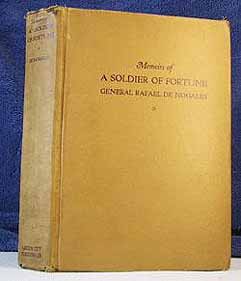
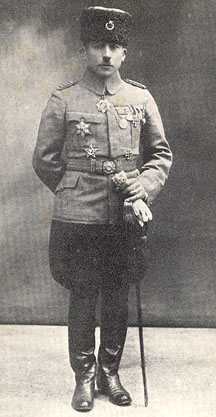
"Memoirs of a Soldier of Fortune"
The following two chapters of General Rafael de Nogales' book, "Memoirs of a Soldier of Fortune" (Garden City, NY, 1932) provide most revealing insights into the Turkish character, fighting man, and war conditions. De Nogales is more famous for having written "Four Years Beneath the Crescent," excerpts of which has been made good use of in the Armenian Genocide propaganda industry. The Venezuelan castle rustler and soldier-of-fortune evidently had feelings of ambivalence. While happy to get a shot at playing soldier on the side of the Ottomans, he no doubt disliked the idea of combating fellow Christians, the Armenians. He demonstrates his "complex" throughout, as well as his confused sentiments. (He refers to Van as the "capital of Armenia," for example.) . . .
In this book, he wrote that he was sentenced to death, because he knew too much. (P. 287.) He "had the misfortune of being the only Christian among the sixty thousand Turks who had put down the Armenian revolution," witnessing scenes "no Christian should have ever witnessed and lived to tell about later." He felt that Khalil and Djevded (governor of Van) had it in for him, because if de Nogales had reached "Constantinople alive and let out [his] information, they would have a devil of a time justifying themselves." Yet he speaks well of both men, saying they were "the best of friends," and their murderous intentions were only the result of "self-preservation," and that he would "probably have done the same," had he been in their place. Although he decided to "shut up like a clam on all matters concerning the Armenian massacres until the day arrived when [he] could write about them from a safe distance!" (p. 290), it seems odd he would have been allowed to slip through the Turks' fingers if murder was really the Turks' intent. If de Nogales was truly threatened by the two men he named, that only demonstrates — if these two were guilty of indiscriminate mass murder — that crimes were committed on the local level. If there were a centrally-directed plan for systematic extermination, and if the Ottoman leadership decided de Nogales would spill the beans afterwards, it would have been very easy to have done away with him.
(With thanks to Cihan.)
TURKISH SKETCHES
(pp. 312-333)
XXIV
PERHAPS battles are not always fought by efficient soldiers. Consider, for instance, our attack on the Suez Canal in January, 1915. That affair, according to the majority of the Turkish soldiers who took part in that expedition, turned out to be a failure because two of our Takaut reserve officers, of the old "Hamidian school," were carrying, concealed in their saddlebags, several chickens and a rooster so as to have fresh eggs for breakfast. The enemy, according to our askars, never suspected our presence on the eastern shore of the Suez Canal until dawn-when the blessed rooster suddenly stuck its head out of the saddlebag and let out a sonorous "cock-a-doodle-doo" which put the wary Britishers wise to our scheme.
But for that confounded rooster—our askars claim—we would probably have won the World War; because by interrupting the traffic on the Suez Canal we could have cut off England from India and Australia as well as France from her north and central African possessions, since our occupation of the western shore of the Canal would, undoubtedly, have caused a revolt in Egypt, and this, in its turn, a general revolt of Islam against Occidental world supremacy.
General Sir John Maxwell, the "savior of Egypt" during that occasion, ought to carry, therefore, the image of a crowing rooster on his coat-of-arms in memory of that droll yet, according to the Turks, absolutely historical incident. Speaking of efficient soldiers, the effectiveness of the Turkish army during the World War (in spite of the damaged reputation it gained during the Balkan Wars) should be attributed partly to the services of Field-Marshal Von der Goltz; for thirty years he had served as instructor of the Ottoman army in an advisory capacity; he had not been, therefore, in a position to build up the army in the way he would have desired. But he left the terrain prepared, so that when Marshal Liman von Sanders, the hero of the Dardanelles, was appointed director of the German military mission in Turkey, in 1912, with executive powers, all he had to do was to build the structure on the ground already prepared for him by Von der Goltz.
The Turks were excellent artillerymen and machine-gunners. During the Gallipoli campaign, for instance, during which some of the mightiest battleships the world has ever seen were sent to the bottom of the Mediterranean by the Turkish mines and submarines, those two splendid arms of the Ottoman army filled the forty or fifty thousand graves which our gallant foes left on the golden shores and historic battlefields of ancient Troy.
During that fearful struggle Allah stood by us. He even "threw sand," as the Arabs say, into our enemies' eyes on a certain occasion so as to prevent Constantinople from falling into their hands. This happened after a series of tremendous attacks which cost the British and French fleets several of their strongest units and caused them to withdraw, temporarily at least.
If, instead of withdrawing, the Allies' fleets had ventured another attack, they could have easily forced the entrance of the Dardanelles, because by that time we had hardly any heavy artillery ammunition left. It was then that Allah gave us a helping hand by "throwing sand" into our enemies' eyes, because, when the Allies had recovered from their shock, had rubbed "the sand" out of their eyes and renewed their attack, several trainloads of heavy artillery ammunition, which had arrived in the meantime from Constantinople, enabled us to shut the entrance of the Dardanelles tighter than a Scotsman's purse.
Our machine-gunners and artillerymen, however, were not the only bravos in the Ottoman army; even our auxiliary troops, for instance our sappers; were endowed with extraordinary sang-froid and determination. During our attack on the Suez Canal, in January, 1915, one of the outstanding events was the voluntary sacrifice, not to say suicide, of a company of Ottoman sappers who, after crossing the canal by means of a hastily constructed pontoon bridge, let themselves be killed to the last man rather than surrender.

Rafael de Nogales
Our cavalrymen were also excellent soldiers; but they did not seem to husband their mounts the way they should have done, probably on account of their Tartar descent. It should not be forgotten that centuries ago the Mongolians, like their pupils, the Cossacks, used their horses not only for warfare but as beasts of burden, to transport their troops across the steppes and deserts between Turkestan and India, China and Hungary.
Each warrior of those long KaImuck raids used to take along ten or more tough, frugal little ponies, which maintained themselves all the year round on moss and natural pasturage, requiring no care from their master. Only in this way could the Turkomen have made seventy or eighty kilometers a day, day after day, month after month, without losing their mounts. The Tartar's attitude toward his horse, as a creature requiring neither food nor care from him, persists with the Turk to-day. That is why the Ottoman cavalry, which approximated an army corps at the beginning of the World War, had become reduced at the end of it to almost nothing.
The only blot on the Turkish army was the Takaut officers. I still remember with consternation the various months when I had to deal with them while I held the position of mufetish, or inspector of our Mamoureh-Kadme service of supply center in northern Syria, in 1915.
The majority of those Takauts belonged to the retired officers' corps of ex-Sultan Abu-Ul-Hamid's regime; that is to say, they had been recruited from among the sergeants and corporals for fear that graduate officers, if given the command of troops, might organize a revolution. Those "regimentaries," or "old regime reserve officers," were, as a rule, abhorred throughout the country because of their rapacity and rascally instincts.
They were only employed in the commissary departments. They represented in my opinion the greatest plague that devastated Turkey during the World War, because locusts, al- though voracious, usually destroyed nothing except harvests and pastures; while those inveterate parasites sold the medicines and rations of man and beast and, had they found a buyer, would probably have sold the locomotives of our Baghdad railroad.
That is why the officers' corps of the Young Turks who dethroned Sultan Abu-UI-Hamid was composed almost entirely of regular army officers, that is to say, not of officers who had risen from the ranks, but of military academy graduates belonging in many cases to the most aristocratic families of the empire. The most efficient arm was represented in our Ottoman army by the infantry; by those fierce askars who once laid the banners of over a hundred conquered nations at the feet of their mighty sultans.
While fighting and running alternately on our various fronts I had opportunity to observe our Turkish soldiers rather closely. We hardly ever dared to order them to attack with the bayonet, for we had no way of recalling them after they had started to charge. We did not use bugles in action, only whistles.
As soon as the command to attack was given, off they went, shouting " Allah, Allah," to die to the last man beneath the concentrated enemy artillery and machine-gun fire. Those askars never looked back, only forward.
In the Bukowina, in northern Rumania, for instance, we had two or three Turkish divisions helping the Germans and Austrians stem the Russians' advance. Every time the mujiks attacked the Austrians our Turks had invariably to rescue Emperor Joseph's soldiers and drive back the enemy. So much so that finally orders were given that the Austrians' military activities should be limited to digging trenches and to preparing food for the Turks who, in exchange for the Austrians' menial work, would do all the fighting alone.
One day the Turks were not satisfied with the way the Austrians had dug out a new set of trenches and went on a strike ; they attacked the Russians without orders and refused to return unless the Austrians were ordered to rebuild their trenches in a proper way.
Whenever I entered one of our barracks and watched our soldiers fixing up their beds, mending their uniforms, or squat- ting cross-legged on the floor, reading their prayer books, I could not help feeling as if I had entered a cage full of tame lions and Bengal tigers.
I will cite my chief orderly, Tasim Chavush, as an example. He had served for twelve years in the cavalry and was generally known as a "son of Satan" until I got hold of him and tamed him properly. From then on he became my shadow. He used to spend the night wrapped in a blanket in front of my tent or sleeping-room, in full war regalia: carbine, saber, cartridge belt, etc. Several enemy spies and sundry other vermin who tried to "intrude" had been quietly buried in our courtyard without my ever knowing anything about it.
That spurred, rosy-cheeked Albanian giant, with his short sandy mustache and the boyish look in his light blue eyes, was usually silent as the grave; but he was awake to everything that was going on-ever ready to attend to everybody in the proper way when necessity forced him to do so.
My few earthly possessions were in his hands. He bossed my household like a born mayordomo. Whenever he referred to anything—my clothes, my horses or the beautiful grayhounds which a Kurdish sheik had given me—he would invariably refer to them as "ours." For instance-" Beym, I wonder what- ever became of that little pair of scissors of ours which we bought in Erzeroum two years ago?" He had the keys to my luggage; he carried my purse, and tasted every drop of coffee, liquor or food before it was served to me because—L'Orient c'est l'Otient! In spite of the cavalry escort which accompanied me every- where, Tasim never lost sight of me. He always kept close to my heels. Whenever the enemy opened fire on us unexpectedly he would ride up immediately, apparently for the purpose of asking for orders but, in reality, to protect me with his body from the enemy bullets. As soon as we had passed the danger line he would fall back at once and follow me as before, at regulation distance.
The Turk reveals plainly his Tartar descent during theatrical performances when, as among the Chinese, male actors substitute for female actresses. He is also like a Tartar in his way of dressing. Most of our soldiers, like the average Kalmuck of central Asia, were of the opinion that heavy clothing protects one not only from cold but also from heat. I have frequently seen some of our Takaut reserve officers take off their military tunics and then peel from their bodies, as from an onion, one layer after another; first, two or three fancy waists with gaudy designs—birds, flowers, etc.; next, three or four striped or polka- dotted shirts and, finally, maybe half a dozen woolen under- shirts, before they struck bedrock.
Some of the oldtimers among the civilian population of Asia Minor used to wear even in midsummer, on top of all that paraphernalia, also a silken kaftan, or a sort of nightgown entwined around their waists by a ten-yard-long silken or woolen scarf, and a heavy fur-lined overcoat; not to mention their big white turbans.
Those old fellows seemed to enjoy their wardrobes immensely. Many of our soldiers wore, seemingly without discomfort, even in the heart of the desert, the same heavy woolen uniforms which they used among the eternal snows of the Caucasus.
Another of the peculiarities of the Turks was their preference for bread. They ate, as a rule, very little meat or vegetables; but bread, no matter whether fresh, stale, black or white, they .would eat by the bushel, probably on account of their Koran, which, like the Bible, speaks feelingly about "our daily bread."
Our soldiers were always buried lying sidewise, with their faces turned south, in the direction of Mecca and Medina, the Holy Cities of Islam. The feathers of their religious sentiment were frequently ruffled by the thoughtlessness of some of their German instructors, as happened once in our military camp of Baalbeck, in central Syria, where Major X had two parallel rows of new baths constructed for the convenience of his men. The latter, however, to his great disappointment, bluntly re- fused to make use of those comfortable newly dug baths. Luckily, after a while, some friendly soul whispered into the major s ear :
"Don't you see that those baths have been dug with their entrances toward the north instead of the south, in the direction of Mecca and Medina ? "
Only then did the major understand. Naturally, no True Believer would ever turn his back on the Holy Cities while taking a bath. That would be rank sacrilege. So he had the baths reconstructed, facing south, whereupon his askars blessed Allah for having enlightened him. They reverently bowed toward Mecca and Medina every time they took a bath.
I could not help admiring the religious sentiment of our Turkish soldiers, a sentiment which was usually kept alive by the presence of numerous priests in their ranks.
"Come over here," I barked once at a black-bearded, white-turbaned soldier who was busily engaged sweeping the floor of one of our barracks at Jerusalem; whereupon the bowlegged askar in his baggy olive-green uniform shouldered his broom, waddled clumsily, like a fat pelican, in my direction, came to a halt with much shuffling of his trailing, yellow morocco slippers, and finally managed to stand at attention in front of me.
I had to smile inwardly as I riveted a stern look on the stolid- faced, comical creature who kept eying me wistfully—with almost a scared look in his eyes. His left instead of his right hand was respectfully raised to his bat-like ear which the heavy turban was causing to stand out at a forty-five-degree angle. He was a typical hodcha-effendi, or clergyman; for in Turkey even the clergymen had to don the Sultan's uniform during the World War and fight for the glory of the Caliphate. One of our crack regiments on the Sinai front was, for instance, that of the "Howling Dervishes," which suffered heavy casualties and finally had to be withdrawn because those holy men stubbornly refused to take off, while in action, their two-foot tubular fezes which used to betray them to the enemy sharpshooters every time they rose over the trenches.
The only distinction between our priest-warriors was that the "seculars," or ordained priests, as well as the students of the Mohammedan seminaries, were classed as "officiers aspirants," or acting lieutenants, whereas the laymen, or brothers of the monasteries—that is to say, the hodcha-effendis—had to serve in the ranks as privates or non-commissioned officers. The one I had summoned was a layman and, therefore, a plain soldier. I always felt sorry for those poor fellows, and generally maneuvered around until I managed to get them a decent job, usually as clerks in our commissary department.
Mter sizing up our priest for a while I asked him gruffly: "What was your occupation before the war ?"
" A clerical layman, Beym," he answered meekly, and shifted uneasily from one foot to the other.
"Can you write and read?' Do you know anything about arithmetic?" I continued questioning him while I pulled nervously at my short-clipped mustache,
"Yes, Bt'ym," he answered, "I used to help keep the books in our monastery at Konia. "
"In that case,” I said, “ you report at once to the capudan- effendi of our service of supplies and tell him to put you to work in his office right away. You get me? And now, beat it-haidi git!"
Though the face of our hodcha-effendi remained inscrutable I could not help noticing in his deep-set eyes a look of sincere gratitude as he turned around slowly and waddled awkwardly off in the direction of our Intendence, whose low, dark-gray buildings must have looked at that moment to the poor humiliated sky-pilot like heaven itself:,
In such a manner I became, little by little, the protecting angel of every hodcha-effendi who had the misfortune to fall into my clutches, and I must confess that giaur—Christian dog—though I was, those poor grateful wretches always stood by me faithfully, and obeyed my orders implicitly even under the most trying circumstances, Through them I acquired much valuable information about the inner political conditions in Turkey during the World War, and about the soul of the Orient,. which will always remain a mystery to most Gentiles, no matter how long they may have lived in Asia.
On the first of January, 1917, occurred an incident which might have precipitated our loss of Palestine but for the valor and cold-bloodedness of a hodcha-efft'ndi whom I had befriended and appointed chief accountant of our Twelfth Infantry Regiment. His name was Suleiman Effendi. At daybreak of that date a veritable cyclone broke loose over Es-Salt, capital of Transjordania, accompanied by torrential rains, which totally destroyed our military automobile road to Jerusalem, bridges and all. Almost simultaneously with this disaster came the news that the English had passed beyond El-Arrish and were at the gates of Gaza; also that our troops stationed there were barely sufficient to check the enemy's advance.
One hour later a message arrived from Colonel von Kress Bey, commander-in-chief of our expeditionary army in Egypt, ordering our garrison to march forth at once to reinforce the battleline on the Gaza front.
Half an hour later our four thousand askarsset out for Jerusalem with no other equipment than their arms, while I remained behind, in Es-Salt, with barely a hundred or so picked men to guard our stores of guns and ammunition which would have been sufficient to make the Arabs masters of Palestine could they have got hold of them. And, to make matters worse, it seems that the English advance had electrified and galvanized into revolt the twenty thousand inhabitants of Es-Salt, Who immediately armed themselves to the teeth and prepared to besiege us in the massive old Catholic church, in which we had hurriedly entrenched ourselves and in whose interior were piled up, sky-high, thousands of boxes with rifles and countless kegs of powder and dynamite.
The church was situated in the center of the town, at the bottom of a steep canon through which ran the main thorough. fare of the city. If our powder magazine had blown up, the whole town, which rose in terraces on both sides of the canon, would have collapsed as if struck by an earthquake and tumbled like a landslide into the bottom of the valley.
Five minutes after our troops had left, the flat roofs of the surrounding buildings were covered with thousands of howling, shrieking and gesticulating armed Arab tribesmen, who demanded that we surrender or face extermination. Foreseeing all that, I had ordered Suleiman Effendi, the hodcha-effendi of the Twelfth Regiment, to invite the three sheiks or clan chiefs of the town to have tea with me, while we discussed the matter of surrender.
As soon as we had finished our unsuccessful pour-parler and the sheiks had stepped out, haughtily, through the main entrance of the church into the street, Suleiman Effendi arrested them in the midst of the excited townspeople, then hog-tied and threw them into our powder magazine with the warning that "no quarter would be given," and that the minute any tribesman or citizen should fire a shot at us, I would order Suleiman to "press the button" and blow the sheiks, ourselves and the city of Es-Salt with every living soul in it, into the blue sky.
Three days and three nights Suleiman Effendi sat on top of that mountain of explosives ready to "press the button," while the twenty thousand inhabitants of Es-Salt howled bloody murder without daring, however, to fire a shot at us. Finally, during the afternoon of the third day, a message from Colonel von Kress announced the definite withdrawal of the enemy from Gaza, whereupon the Arabs quickly hid their guns, cheered and blessed our crimson crescent and welcomed with tears in their eyes their three lost sheep, who probably had never gone through such a harrowing experience before in their lives.
After our evacuation of Bir-Es-Sabah and the retreat of its garrison to Jerusalem, the three regiments of the Third Imperial Lancers kept defending the rear of Our troops against the enemy cavalry, which did not give them a minute's rest. At Daharie, where the Bir-Es-Sabah-Hebron military road entered the foot- hills of southern Palestine, our Third Imperial Lancers stopped suddenly, faced about, deployed in battle formation and, protected on both Ranks by their divisional field artillery and machine-gun sections, made ready to fight back the numerous British and Australian cavalry regiments which were pursuing them.
The Britishers prudently stopped at a safe distance, suspiciously eying the wily Turks. How was it possible—they probably asked themselves—that three tattered, starving Turkish cavalry regiments should dare to defy in the open eight, ten or maybe more, well-fed and splendidly equipped British and Australian regiments? Of all the impudence! Such a thing had never happened before! Still, it had happened before, less than a year previously, during the second battle of Gaza, when that same tattered and starving Third Cavalry Division of ours had cut off the enemy's right wing, composed of the bulk of the British and Australian cavalry in Egypt, and forced it to with. draw after inflicting heavy losses on it.
While the Britishers sat tight, trying to find out what it was all about, one of our regiments, the Sixth, finally got tired of waiting, rode forth with raised lances and challenged an enemy regiment to single combat. Seeing that its challenge was not accepted, the Third Squadron of our Sixth then sallied forth alone and defied single-handed a whole British or Australian regiment.
That was a little too much even for the phlegmatic Britishers. A squadron of Australians picked up the glove. The Cross and the Crescent clashed amid a cloud of dust. After the fight was called off only about three dozen Australians and Turks remained standing in their stirrups. Not a rifle, machine-gun or fieldpiece cracked or thundered on either side until that handful of Knights of St. George and Paladins of Allah had safely re- treated to their respective lines. El-Hand-Ul-Illah! While speaking about the Turkish soldier I cannot help remembering Enver Pasha, the greatest man that Turkey produced for many a generation. He was a soldier, a statesman and a patriot. It was on a sunny morning of January, 1915, that we met; a day which I will never forget because that morning I felt as if I had discovered America. It all seemed so strange to me, especially after I had donned my first Turkish uniform and walked up the broad marble staircase of the war department to report to his Excellency, Colonel Enver Bey (later Enver Pasha), secretary of war and vice-generalissimo of the Ottoman Empire.
When I stepped out of the auto at the main entrance of the enormous rectangular four-story-high Ministère de la Guerre, which stood solitary in the center of an empty maidan surrounded by kiosks and a tall, iron railing, a military band, dressed in historical uniforms, was playing a weird, wild march such as the janissaries used to play long ago, while besieging Budapest or charging Napoleon's Old Guard at the foot of the Pyramids.
I felt a real thrill as I crossed and recrossed the beautifully decorated reception halls before I was finally ushered into Enver's office. The minute I entered he rose, smiled affably, shook hands with me cordially, invited me to sit down and, after we had smoked a cigaret and enjoyed a thimbleful of black coffee à la turca, we parted the best of friends. He was about forty or forty-two at that time*, medium-sized, slender, extremely good-looking, wore a mustache à la Kaiser and had a charming personality.
He never used his official titles.
"I am Enver; glad to meet you," was the way he introduced himself.
Being the first A. D. C. to the Sultan he naturally wore an A. D. C.'s uniform, but only a plain one, like that of any of his own A. D. C.'s.
Once, in the spring of 1918, one of our former Austrian officers on the Sinai front, a captain of artillery, wanted to meet Enver very badly before he returned to Austria. He had been proposed for a war medal which only Enver could confer. So he begged me to secure him an audience with II Seiner Exzellenz! " I got it for him, naturally. He was to be received on Tuesday at 2 p.m. sharp. His audience was to last five minutes, which means two minutes more than was usually granted to subaltern officers.
*Enver, born 1881, was 33 or 34 years old
A few days later I met our captain again. He had got his medal all right, but there was a story attached to it. After being ushered through four different reception rooms, and after having been asked by four different A. D. C.'s whom he wanted to see, he entered a fifth salon where another A. D. C., dressed exactly like the others, addressed him with a courteous:
" Anything I can do for you, sir ? "
"Do what?" the captain snarled angrily. "of course you can; I have got to med: Enver Pasha at 2 p. m. sharp. Through all of these blooming delays I have lost already three of the precious five minutes which my audience is supposed to last!"
Instead of getting angry, the A. D. C. smiled affably and replied:
"Please, don't worry, Captain. I am Enver." He immediately granted the captain's request.
Unlike other Young Turk leaders, Enver was a man who ro~ by his own force of character. He was the hero of the Tripoli campaign, during the Italo-Turkish conflict in 1910-11, and it was he who turned the tide in favor of the Turkish army during the Second Balkan War.
After the fall of Adrianople the Turkish Cabinet which was then in power had assembled in the palace of the Sublime Porte for the purpose of signing an armistice by means of which Turkey ceded not only Adrianople, but practically the whole of Thrace to the Bulgars. A few minutes before the proposed treaty was to be signed and sealed, Enver and two other Young Turk army officers presented themselves, unexpectedly, and demanded that the cabinet immediately sign its resignation. The secretary of war was the only member of the council of state who refused to sign, whereupon Enver shot him down and, assuming the supreme command of the Turkish army, reconquered Adrianople from the Bulgars and built up, with the help of Marshal Liman von Sanders' German military mission, a modern Turkish army.
This not only withstood the Allies during the World War, but finally freed the Ottoman Empire from the humiliating "extraterritorial rights," or capitulations, by means of which the imperialistic European nations had kept Turkey in bondage for over half a century.
Enver died during the Greek conflict in 1923, while he rushed at the head of several thousand Turkomen to the aid of Mustapha-Kemel, who had begged him to come to his rescue. He shot his way through the Bolshevik troops which tried to block his advance, but ran out of ammunition and, when he charged again at the head of his tribesmen, a Red soldier pumped a machine-gun load into him, at five yards distance, which tore him to pieces.
Thus died Enver Pasha, the biggest Young Turk and the real protagonist of modern Turkey.
The indomitable courage—or fanaticism; call it what you will—and the traditional boldness of the Osmanlis, frequently during the World War offered examples of that ferocious endurance which, from time immemorial, has made them famed as one of the most valiant and warlike nations of the Old World.
During our Caucasus campaign I repeatedly ran across trenches filled with corpses-the frozen bodies of our askars, both officers and men—who had frozen to death rather than budge from the positions they had been ordered to hold at any price. During those dreadful months among the eternal snows of the Caucasus the Muscovite high command had ordered its Russian divisions to be replaced by the Siberian Iron Legions, because even the Russian mujiks could not withstand any longer the terrible cold.
We were fighting most of the time up to our necks in the snow, at an altitude anywhere from ten to twelve thousand feet above sea level Nevertheless the Turks, who had been rushed to the front with hardly any preparations at all, or even an adequate service of supplies, owing to the rapidity with which things had happened, stood their ground wonderfully well; sometimes even without overcoats or proper footwear; in many cases without the necessary medical attention and, most of the time, with hardly anything to eat except a crust of bread. Those were men who knew how to fight and die without a murmur, without ever showing the slightest sign of insubordination.
During our miscarried offensive of Sari-Kamish; near Erzeroum, in 1915, for instance, we lost thirty thousand men in less than two days, mostly frozen to death. Nevertheless, in spite of that drawback, our Third Caucasus army kept fighting the Russians and driving them back at the point of its bayonets with more vigor than ever.
A far greater toll than by bullets and cold was exacted from us by the terrible typhus epidemic which broke out in Turkey almost immediately after the beginning of the World War. On our Caucasus front, where we were separated from the rest of the world by a roadless barrier of two hundred miles of mountainous frozen wilderness, hundreds and even thousands of our wounded and typhus-stricken askars , for whom there was no room left in our Erzeroum lazarets, were handed some money and a knapsack full of food and allowed to trek back across the howling wilderness in search of Erzindjan, Trebizond or Sivas, which were the only three towns provided with hospitals within a radius of two hundred miles.
I met hundreds of those poor dying wretches along the goat- trails which crossed those snowy wastes. Most of them were al- ready on their way to the great beyond: Living skeletons who were dragging themselves by the dozen on hands and knees over the frozen snow-fields, closely followed by ravenous bands of wolves which were waiting only for the night to set in. I remembered a wounded soldier who had bandaged a fresh saber-cut on his arm with some filthy rags which he had torn from the festering wounds of a dead comrade.
I mention the foregoing examples only to support my contention that the Turk is one of the most enduring, best-disciplined of soldiers. I would pity the European officers who should try to submit their troops to the hardship and misery which the Turkish soldier suffered during the war. Yet our askars never uttered a word of complaint, but stumbled along starving and fighting for the glory of the crimson crescent and the cause of the Mohammedan world until merciful death finally put an end to their sufferings.
I remember well how one afternoon, while. we were fighting the Siberian Iron Legions in the heart of wild Kurdist.an, my horse was shot and I landed knee-deep in the snow. As I protected my face with one hand from the raging blizzard and fought off with the other a Cossack, I felt someone pulling at the hem of my long military coat. It was Ismail Effendi, one of our squadron commanders, who by half buried beneath the snow. One of his ryes had been put out by a deep sword-thrust. His violet, trembling lips were muttering feebly, as if in a dream :
"Nogales Beym, bir limonade, reyaederim, " which means "please get me a lemonade, Nogales Bey." At that moment I managed to get clear of my Cossack assailant with a well-aimed saber-cut and, bending down, I lifted Ismail's head carefully and whispered into his ear:
"Right away, brother, right away."
He stretched out his weary limbs, trembled slightly and smiled happily as he passed the threshold of Paradise. To show the devotion of the Turkish askar to his officers I will cite the following example:
At dawn of April 25, 1915, during the siege of Van, capital of Armenia, which I was conducting, our artillery opened fire by sections, and the thunder of musketry, which had been diminishing during the night, recommenced emphatically. Wherever our shells fell walls and roofs crumbled to the ground, raising columns of smoke and dust intermingled with showers of sparks which, scattering, poured down like lava torrents upon the combatants.
While inspecting our eastern sector I noticed a commotion. Bayonets flashed. Wild Kurdish tribesmen with drawn yataghans
poured by the dozen from a neighboring building like rats fleeing from a sinking ship. A concussion shook the building in which some of our artillerymen had placed a fieldpiece for the purpose of breaking through the walls which separated them from the enemy. As a result of the repeated discharges of the gun the roof had caved in with a crash, burying beneath its debris and cutting off a part of the gun-crew who ran the risk of falling into the hands of the Armenian comitadchis. These had not been loath to take advantage of the general confusion in order to invade the burning building. Having made up my mind to save our gun and its crew at all costs, I rushed into the midst of the ruin, followed by a sergeant and a corporal who had joined me voluntarily.
I soon got sight of the crimson fezes of the Armenians. They were yelling and rushing hither and thither, like giant bats, across the thick smoke-screen and the clouds of dust which the crumbling walls kept kicking up as they toppled over and hit the ground with a crash that could be heard for blocks around. They fired their Mauser pistols pointblank at us and occasion- ally slashed at our faces with their long, curved, razor-like yataghans. Though half blinded by the flash of the shots and volleys which illuminated fantastically the surrounding twilight, the sergeant and I continued to repulse the Armenians. They kept pressing us from the front and both sides. Finally, the corporal succeeded in fastening a rope to the gun-carriage of the field- piece and the rest of the crew began to pull it hurriedly from the smoldering ruin. The salvage of that gun cost us five lives and a number of wounded, the corporal among the latter, as a bullet had ploughed through his cheek at the last minute.
After the siege of Van we decided to retreat with our expeditionary army across Kurdistan for the purpose of entrenching ourselves around Bitlis, in western Armenia. Our Van Gendarmery Division, composed of twelve veteran battalions, was to form the vanguard; and, after picking up some reinforcements at the kasaba of Shaghmanis, it was to continue in the direction of Vastan, followed closely by the rest of our expeditionary forces.
Our unexpected retreat did not fail to alarm the Russians, who immediately turned all their artillery loose on us and launched a vigorous bayonet charge against our rearguard. Nevertheless, their efforts to keep us penned up along the Persian- Turkish frontier proved in vain, for we broke through their lines and made for the mountain regions of Bervar and Nordoz, with Vastan as our destination.
Our situation was extremely difficult and the worst might have befallen us but for the prompt arrival of a Kurdish bandit, by the name of Noro, who, in exchange for the commutation of the death sentence hanging over him, engaged himself to lead our thirty thousand men across the snows and ice-covered wastes of the upper Bohtan-Su and Mount Djahydi. Governor Djevded Bey, the Vali of Van, assured me that I was the first foreigner to visit those regions. It was the second time in my life that I found myself traveling across geographically unexplored lands. At first the Russian cavalry followed us, though at a safe distance; but noticing that we paid no attention to them, they finally turned back, perhaps fearing an ambuscade.
On the following day we ascended a snow-covered range, craggy and threatening, whose 'silvery summits arched from peak to peak and from crest to crest until they melted into the Hartosh, neighbors of the clouds. We were in the midst of an absolutely unknown land, in the heart of wild Kurdistan.
After crossing a divide which was covered with a fifteen-foot layer of hard-packed snow we descended the almost perpendicular face of that harsh and beetling range by following the wild mountain streams whose reddish boiling waters thundered over rocks and cliffs, dragging along huge blocks of ice and forming cataracts which dashed against the depths of the precipices with a deafening roar.
We were so short of food that during the following three days we had to subsist almost entirely on wild onion-like herbs which the Kurds used in the preparation of cheese. However, vegetation increased as we descended, so that about sunset of the fourth day our thirty thousand soldiers were comfortably camping around mighty fires from which sparks showered amid the scarlet flames. As I lay somewhere in the shadows, wrapped in my heavy overcoat, listening to the whisperings of the night and watching the neighboring cliffs, tinged with purple by the glare of our fires, the uncanny silence of the night was rent now and then by a strident howl or weird, long-drawn moan which seemed to descend from the shadowy summits of the silver hillocks which surrounded us.
As soon as our Kurds, who were crouching in circles around their camp-fires, heard that dreadful moan, they immediately murmured verses from the Koran so as to be delivered from the devil of those mountain wastes.
That infernal moan and the distant howling of the hunting- pack reminded me occasionally that we were in the heart of the Keliehan, which was not man's dominion but the exclusive kingdom of djinns, or spirits of the wilderness.
After picking up our reinforcements at Shanghmanis, near where I spent the night among the ruins of an ancient castle which was said to have been inhabited once by Tamerlane, we continued our advance on Vastan. This fair-sized kasaba was situated south of Lake Van. We had it occupied the previous night by a detachment of two or three hundred askars for the purpose of protecting our right flank. I was leading the vanguard. As we approached the hamlet of Kasrik we heard the incessant rat-tat-tat of machine-guns and after a while the ever- increasing rumble of artillery fire.
That kalabalik, or messed-up affair, was due to the fact that our two or three hundred askars who had been ordered to hold the Vastan divide at all costs had just been attacked by the Russians and the Armenian volunteers from Van, whose combined force was not less than three or four thousand foot soldiers and about eight hundred Siberian Cossacks, with two or three batteries of mountain artillery.
Our situation was serious; in fact, extremely serious, for if the enemy managed to sweep our handful of bravos off the Vastan divide it could crush our right flank and cut us off from our main force which was following us at a distance of several miles. Therefore, the defile had to be held!
With that in mind I galloped away toward Kasrik, at the head of our vanguard cavalry, while my A. D. C. hastened back to summon our Erzeroum and Mussul battalions.
As we raced over the dusty, rock-strewn Valley of Kasrik, which rose gradually until it reached the Vastan divide, the enemy shells started ploughing up the ground all around us. My orderly's mount went down with a crash, but he jumped deftly on the rump of the nearest soldier's horse and, when my horse stumbled over a boulder and fell, I did likewise because we did not have a minute to lose.
I could see our askars lying in rows and firing at top speed from behind some hastily thrown-up stone breastworks. Some of them were moving about like ants, carrying off the wounded or filling in the gaps which were widening rapidly; while silhouetted on the deep blue sky, amid a cloud of powder smoke, our crimson crescent fluttered proudly, as if beckoning to us and urging us to take a hand in the fray.
Finally, after minutes which seemed an eternity, we jumped off our horses and raced to the top of the divide at the very moment when the Russians and the Armenian comitadchis were reaching also the top from the opposite direction.
Then we clashed. It was a fight to the death: no quarter was given, no quarter asked— l'Orient c'est l'Orient! A tall, gray- haired, bare-headed comitadchi in a flowing kaftan made a lunge at me with his long, curved yataghan, only to crumple up in a heap as one of our soldiers placed a bullet right between his eyes.
Though the clash of steel, the roar of volleys at short range and the yelping and howling of the storming enemy kept me busy trying to keep my soul and body together—for one's skin does not grow but once—I could not help admiring the utter disregard for life of our grim-faced askars, who kept shooting and hacking away all around me, with only a subdued "Allah" passing now and then through tightly pressed lips, or a low moan when an enemy bullet, bayonet or yataghan, found its mark.
They, or we, rather, were doomed and they knew it. Nevertheless they continued fighting savagely, in an almost suicidal manner, against that avalanche of fur-capped mujiks whom the Russian officers kept driving against us before their whips like sheep—much the same as had happened during the famous battle of Thermopylae almost twenty-five hundred years before.
In the meantime things had happened in our rear. Our Erzerown Battalion had advanced on the double-quick and hurled itself suddenly against the enemy's right flank, while our Mussul Battalion had taken possession of a series of heights from which it could sweep the enemy artillery with its rifle and machine-gun fire; so that in less than an hour we found our' selves once more the sole possessors of the Vastan divide and, a title before nightfall, also the absolute masters of the situation. Allah akbar! Allah kerim!
TURKISH SKETCHES II
(pp. 334-346)
For only a few weeks did I enjoy a real rest in Turkey during the World War. This was after I had passed my superior staff officer's examination in the Kiaght-Hane military academy in Constantinople and had become comandane-vekile of the First Imperial Lancers, whose Fourth Squadron was doing duty in the Sultan's palace of Dolma-Bagtche.
Our First Lancers were at that time, in July, 1918, the only complete cavalry regiment which was left in Turkey; for the regimental units of the Third Cavalry Division and other cavalry detachments on our various fronts had shrunk to one- third or less, perhaps, of their original fighting strength.
Our regiment was lodged in the dependencies of former Sultan Abd-Ul-Hamid's palatial residence of Yildiz-Kiosk, of Pierre Loti fame. I used to lead it almost every day to our Shishly training camp, where it usually remained until nightfall. I felt proud of those boys in their carefully polished and spurred riding-boots, their olive-green homespun uniforms, and their woolen military caps drawn deep over their young, sun- burned, manly faces. With their broad, sheathed swords dangling from the right side of their German saddles, their shining Mauser carbines hanging across their backs and the long steel lances resting lightly on their stirrups, they sat on their horses like so many born cavalrymen.
They seemed to be conscious of the secret pride which I felt every time I looked them over carefully from head to foot. And 1¥hy shouldn't they? Weren't they the descendants of those fiery Janissaries, Comitadchis and Goenelies who paraded for centuries the emerald-hued banners of Mohammed and the crimson crescent of their mighty Caliphas from one end of the Old World to the other, cowing nations and forcing them to adopt their creed in the one and only God ?
As soon as my bugler had blared out my command to assemble for the evening salute and the buglers of the different squadrons had followed suit, the grayish plain of Shishly was suddenly enveloped in a dense cloud of dust as our eight hundred chargers, each mounted by a grim-faced daredevil, thundered up from different directions at breakneck speed to form in battle- line. Their officers, a dashing, smartly uniformed, yet thoroughly soldierly looking set of young military academy effendis, were racing ahead of their men at regulation distances. Though trained in the Prussian school, none of them wore a monocle except myself, and I only because I needed it: my right eye had been roughly treated at the Sinai front.
All of our effendis were excellent horsemen; some of them had distinguished themselves during the military tournaments, especially in the tests of endurance and jumping. But their endurance was not limited only to their riding ability, for they could outdrink even our Bavarian guests without batting an eye. The most remarkable thing about the proceeding was the air of modesty and resignation which they used to affect as they drained at a single gulp an enormous glass of native anisette which would have put most Christians completely hors de combat.
"By Jove, those Turks are certainly the first gentlemen of the Orient!"
By the time our squadron had halted, reassembled and lined up in battle formation, I rode forth and took my place in front of them. There I remained for a while waiting for the muezzins to call from the top of the neighboring minarets the Faithful to the vesper prayer. Their sonorous, long-drawn “La-Ilah-Il-Lalah ...!” was timed to the setting of the brick-red sun. When it came my bugler sounded attention while I, with my feet firmly set in the stirrups and my right arm raised high over my head, called three times in succession, at the top of my voice :
"Padishamis Tchok fashaaaa!"
Our men, with their swords and lances flashing in the air , shouted back my salute, "Hail thee, our Lord, our Mighty Sultan!" with a thundering, frantic, savage Shout, which almost caused the earth to tremble beneath our horses' feet, and finally died out gradually, almost reluctantly, like the distant roar of a wounded lion.
I will never forget as long as I live that terribly sublime, awe- inspiring scene; that mighty, savage sound as I heard it so often in the deserts of Arabia, Mesopotamia and among the eternal snows of the Caucasus, when scores of neighing horses raced up with empty saddles and stood proudly in line, by sheer force of habit, as soon as our buglers sounded "assembly;" when many a wounded soldier in blood-drenched uniform kept swaying back and forth in his saddle while vainly endeavoring to stem with his poor, knotty hands a steady stream of blood and shouted, or tried at least to Shout, with a last hoarse effort, "Hail thee, our Lord, our Mighty Sultan!"
Whenever I remember those scenes of almost incredible valor, I cannot help feeling proud of having led those brave and modest "unknown soldiers" of the Ottoman Empire during the four years of the World War, for those tattered fellows with rusty swords and lances certainly knew how to fight and die like men when grim death knocked at their doors and grinned. No wonder that when Marshal Izzed Pasha, during the Armistice parleys, indignantly refused to surrender the German troops which remained still in Turkey the British commander of the Allied forces exclaimed aghast at such gallantry:
"By Jove, those Turks are certainly the first gentlemen of the Orient!"
If one adds to that Britisher's opinion that of the majority of the British and colonial officers who fought against the Turks in Egypt, Mesopotamia and the Dardanelles and who unanimously declared the Turk to be a "clean fighter," one may be able to draw an approximate picture of the Turkish soldier as I knew him and studied him during the four years of the World War.
According to the Turks it is not a disgrace to "run" as long as one stops once in a while and looks back. That is the way they did it during the Second Balkan War .After their defeat at Adrianople the Turks retreated toward Istambul, hotly pursued by the Bulgarian army, which did not give them a minute's rest. finally, tired of tramping along on an empty stomach, one of the Turkish soldiers borrowed from his comrade a cigaret, lighted it and crouched behind a boulder to have a rest. His example was promptly followed by other retreating soldiers, who also lighted cigarets and crouched comfortably behind the rocks to have an occasional pot-shot at the advancing Bulgarians.
Thus, after a quarter of an hour, the retreating Turks had formed their famous Tchajaltla line, at first by taking a rest and smoking cigarets, and afterward by digging themselves in behind the rocky ledges and boulders of the surrounding plain in order to enjoy a good night's rest.
In that way an Osmanli askar, by stopping and looking back for a moment, had halted the retreating Turks and forced the victorious Bulgarian army to beat a hasty retreat and to abandon Adrianople once more to the Osmanlis.
Many a Turkish proverb explains why the apparently clumsy and slow-witted Turk usually has his way when he settles down to business. One of them states that the easiest way of catching a rabbit is to hunt it down in a carriage. After scaring it up one most follow at a slow trot and, after catching up with it and scaring it again and again—about a couple dozen times—one steps out of one's carriage and picks the tired rabbit up by the ears.
There is a lot of philosophy in that simple system of yawash, yawash, equivalent to "take it easy; don't get rattled!" which, when applied to politics or warfare, represents the real reason why the European nations, in spite of their many efforts, have never been able to put anything over on the wily Turk. Once the Turk has made a resolution it is almost impossible to beat him at his game.
I used to enjoy watching our soldiers in their routine life in the barracks, especially during their meal hours. The minute the mess call sounded they filed in solemn groups of eight to their company or squadron kitchens where the cook and his white-aproned assistants dished out to them in their collective big, shallow, tin platters their eight rations of soup, bread, meat and vegetables, as well as a big pitcher full of steaming sugared tea.
After thanking him with a dignified phrase—for the cook is a very important personage in a Turkish military unit—the various groups sat down cross-legged on the floor, preferably beneath a shady cypress or a blossoming orange tree. After pulling up their sleeves, they produced their precious tin spoons, which they treasured higher than anything else in the world. They usually carried those spoons jammed deep into the top of their woolen leggings or the shafts of their riding-boots. Only after the corporal or the oldest member of the group had taken the first mouthful of food did the rest dig in also. The Turks are very respectful of their elders.
No "real" Turk will ever sit down or address his superior or elder—be he a prince or only a ragged white-bearded beggar— until the latter has sat down or addressed him first.
One of the reasons why my men used to feel kindly toward me must have been that I never allowed anyone to cheat them out of their rations, and I also saw to it that the sick and wounded were always cared for. I used to go frequently from one company or squadron kitchen to another examining their food. On several occasions I even exiled to the desert delinquent officers and medical men. Those radical measures were usually crowned with success, because they helped to strengthen the faith of our soldiers in their superiors, causing them to plug along steadily under circumstances which might have deterred any other but a Turkish soldier.
If it had not been for the Greek and Armenian profiteers who accumulated fortunes at the expense of our poor half-starved Turkish soldiers we would have had provisions to spare.
I have never yet heard a Turkish soldier complain of hunger or thirst. Those askars of ours would file along, grim and silent, sometimes with no more nourishment than a crust of stale bread or a handful of olives, without letting a complaint or even a whisper of dismay cross their fevered lips.
Though the Mohammedan religion may appear admirable and inspiring to the occasional unbiased observer, it nevertheless has certain faults which are a regular nuisance and caused us many unnecessary losses during the war. For instance, its precept: "Thou shalt not kill inoffensive animals." How often did I look on in dismay, and absolutely powerless to prevent it, while our kind-hearted askars, on a sunny day in the snow- covered mountains of the Caucasus, squatted around their camp-fires examining their underwear and instead of squeezing the cooties to death dropped them on the floor still alive; where- upon those cooties wagged their tails with appreciation and clambered immediately up the nearest soldier's leg to thrive and multiply.
Another of the precepts which used to drive me wild because it deprived me sometimes of a much-needed drink of water was the one which demands that every True Believer shall wash his face, arms, feet and so forth every time—which means five times a day—before he recites his prayers. Owing to that most holy rite, I had to pick out our vanguard very carefully, because the minute our True Believers spied a waterhole they rushed it immediately and plunged into it to perform their ablutions with the result that by the time we got there even our horses would not go near it.
Our askars reminded me always of overgrown boys. They were voracious whenever they had a chance to make up for lost time. Though tortured by gnawing hunger, sometimes for weeks, there were fortunately also days when we lived on the fat of the country, for the Turkish government provided for us generously whenever it could.
If it had not been for the Greek and Armenian profiteers who accumulated fortunes at the expense of our poor half-starved Turkish soldiers we would have had provisions to spare. During my few months' stay in Constantinople the food which I was entitled to buy every day from our military commissariats at ridiculously low prices included five kilos of meat, five kilos of white bread and ten kilos of wholewheat bread.
In Beersheba, on the Sinai front, I was granted, also at a ridiculously low price, a monthly allowance of tobacco, consisting of ten kilos or more of all sorts, from cigarets of the Turkish Regie down to German Knaster cigars. That I could not consume all those foodstuffs and delicacies alone is natural, but we usually gave a speedy account of them between all of us, for I had a big household to provide for.
My happy family consisted of Tasim and Mustapha, my two orderlies, and their two horses; furthermore of our pack-mule, our cook, Mr. Silberstein, and his saddle-donkey, and my five saddle-horses, all of whom had to be properly cared for.
It was a lucky thing that the war ended as soon as it did. In spite of the fact that the Turkish government provided for me very generously, by the time of the Armistice I had only twenty- five dollars left of a cheque of two thousand dollars which I had taken with me to Turkey for a rainy day.
One of the most charming traits of the Turkish military life consisted of the loyal camaraderie which existed as a rule between the officer and his orderly. The latter's faithfulness was usually amply rewarded.
No officer will ever rise from the table without leaving an it at least half of his meal for his orderly. Inborn kindness and generosity are the noblest qualities of every true Turk, whereas distrust and extreme cruelty, when his wrath has been aroused, represent his biggest drawbacks.
Probably because I always respected their religious opinions and their domestic rules, my Turkish fellow-officers treated me always with the greatest regard, even when they were carrying my death-warrant in their pockets. I remember, for instance, how one afternoon, while several of us were sitting together in the Istambul military casino, discussing the siege of Adrianople, a major, who was especially interested in our discussion, suddenly exclaimed:
"Yes, it was precisely on that day that the Bulgarians attacked our positions and we launched a counter-offensive; and when the Bulgarians attacked us again we sallied forth and not a single Christian was left alive!"
When I meekly protested against his remark about the Christians on the grounds that I also was a Christian, he and the other officers laughed good-naturedly and patted me on the back with a hearty:
"That's true, but you have proven to be also a good Moslem!"
"Thank you," I retorted quickly and buried myself in a club chair to do some tall thinking. The remark of that major, who was supposed to be an ultra-modern and unbiased young Turk, reminded me of the fact that a Turk, no matter how cultured and liberal-minded, will always remain a Turk and a raving fanatic when you happen to strike him on his crazy-bone, which is religion.
The fact that the young Turks used to eat pig's meat and drink schnaps by the gallon does not imply by any means that they had decided to stop their religious controversies. The leopard cannot change its spots. It is for that reason that I feel a little sceptical about Mustapha Kemal's reforms, for we old- timers have witnessed such miracles more than once-on paper. It should not be forgotten that the Mohammedan world could have elected a new caliph long ago if it had wanted to; but it does not want a new caliph, it wants its former caliph back again on his throne.
The Turkish soldier is a rather ticklish citizen when one tries to step on his toes. There is the case of Field Marshal von der Goltz's son-in-law, or nephew, I don't remember which, who was holding the job of instructor in a Turkish regiment at Adrianople just after the Second Balkan War. While the young lieutenant was trying to explain in true Prussian style to one of our Albanian askars the way he ought to wear his military fur cap, and shoved it unceremoniously back to where it belonged, the askar, without saying a word, raised his gun and shot the lieutenant down.
Lord Kitchener who served several years as a captain or major in the Turkish army, and Field Marshal von Moltke, the hero of the Franco-Prussian War, who also served in the Ottoman army, are supposed to have witnessed and reported cases of a similar character which go to uphold the statement that one must never try to step on a Turkish soldier's toes or mistake him for a fool or an easy mark, especially when he smiles. Beware of the Turk when he smiles!
The first time I observed his smiling countenance was when I arrived at Mush, in ancient Armenia, in March, 1915. I was having supper as the guest of the sub-governor of the province, when another honored guest, also of Christian extraction, Senator X, who was on his way to Istambul, started upbraiding me in a most impudent way because I, as a Christian, had joined the Turks. Whereupon I gave him in good old cowboy style a piece of my mind which caused him to go away back and sit down. What surprised me in the performance was that neither the sub-governor nor his Turkish guests seemed to resent the vulgar and insolent remarks of that Armenian but, on the contrary, smiled at him and flattered him in a way that made his Excellency swell up like a peacock.
Next morning the sub-governor and several other high dignitaries accompanied the senator to his carriage and waved him good-bye. Half an hour later his Excellency's escort of mounted gendarmes returned with his Excellency's—empty—carriage. His Excellency's name was not mentioned again while I remained in Mush.
During a memorable trek from Istambul to the Caucasus I enjoyed at the hamlet of Gumereck one of those peculiar Turkish breakfasts which only an Oriental chef is capable of designing and preparing. It consisted of an omelet swimming in fat and stuffed with almonds, raisins and pistachio nuts; followed, pell-mell, by sweet gelatine, sausages fried with garlic ; tea; a salad of raw onions; fresh strawberries with cream; hunks of cheese saturated with olive oil; ice cream smelling of rose and violet, and, finally, fried barley, or "bulgur,"—the obligatory final dish of every Near Eastern menu.
After partaking liberally of that excellent breakfast, I was afraid at first that I would die—and then again that I wouldn't. I remained prey to the most conflicting feelings until my faithful Tasim rushed up with a stiff drink of raki which finally put me on my feet again.
One of the various reasons why I have always felt kindly toward the British and Colonial officers is because they usually gave a man credit for what he has done, even if he were an enemy. How often have I listened with intense satisfaction to the matter-of-fact way in which those officers used to praise our askars. As, for instance, while referring to the capture of the city of Es-Salt, in Transjordania, where the British expeditionary forces suffered heavy losses through the Turkish machine- gun fire from a neighboring height.
After the Britishers had stormed the ridge they found it occupied only by two Turkish machine gunners Who had stopped the enemy's advance for over an hour with their steady and murderous fire. The same thing happened, according to those officers, near Tine, after the fall of Beersheba, where a Turkish machine gunner fought single-handed the whole British army until his ammunition gave out. The Australians found him afterward sitting on the ground with an air of quiet contentment on his face, with both hands Comfortably resting on his stomach, and a lighted cigaret in his mouth.
I will never forget a certain chilly morning in the Sinai Front, just before dawn, when from an enemy trench the sound of a song started floating slowly in our direction. As soon as we heard its first melodious strains—"Oh, Paddy dear, and did you hear.. ."—firing ceased all along our line. And when the last strains of "The Wearing of the Green" had died out like a sigh in the morning breeze, though nobody but myself had understood a word, a murmur of appreciation rose from our trenches.
Shortly after that incident I had to go to Jerusalem on some business or other. While visiting the ruins of an old monastery in the hamlet of Bethany one of our men pointed out to me a low, narrow, doorless, pitch-dark opening in a wall which he claimed was the entrance to the sepulcher of Lazarus. I passed it as if it did not interest me, because among Orientals one must never show surprise or curiosity at anything if one wants to keep their respect.
When I returned to Bethany the following day I dismounted a few hundred paces away from the ruin and ordered my orderly to wait there for me with our horses. The minute I was out of sight I retraced my steps and, trailing along some crumbling walls, I reached the entrance of Lazarus' sepulchral cave.
I entered resolutely, feeling my way ahead through the darkness. I had advanced only a few yards when I suddenly slipped or stepped into a void and, after turning a couple of somersaults in the air, landed with a thud on a pile of rocks, spraining my left foot and cutting a deep gash in my right knee-which put me temporarily out of commission.
It seemed that the upper part of the stone staircase had collapsed. At any rate, there I was, dragging around my legs like a wounded cockroach in the gloomy sepulcher of Lazarus, with hundreds of bats flapping around my head and with no earthly hope of ever getting out of that gruesome place alive on account of my injuries.
Remembering the old Turkish saying "don't get rattled," I sat down in the darkness, lighted a cigaret and waited for Allah to come to my rescue. Fortunately, Allah finally took pity on his heathen sore-kneed warrior, for, while I lighted my third cigaret —the first and second had been knocked out of my mouth by the bats—I suddenly heard a faint voice drift down from the top of the ruined staircase.
It was Tasim, my faithful orderly. After waiting in vain for me to return, he had tied our horses to an olive tree and followed my tracks. If it had not been for Tasim's common sense I would probably still be in that cave in company with the spirit of Lazarus and his infernal bats.
When I returned to Jerusalem that afternoon I found an invitation waiting for me. One of our Arab army chaplains, Who had wandered to his native village without permission and had remained there for two years without the slightest intention of returning to the ranks, was going to be shot publicly, as an example. It was a rather spectacular affair.
To make a long story short: A few minutes before the execution took place the doomed chaplain sat down on a rug, with a lighted cigaret in his mouth, surrounded by a "square" of some four thousand Arab soldiers belonging to our pick and shovel battalions. The show had been staged for their benefit—to deter them from deserting by the dozen. The crime of desertion is a thing which no Arab peasant recruit will ever be able to understand. The reason why they seldom went over to the "Inglis" was because they knew that the "lnglis" would put them to work right away. Therefore they deserted to their villages instead, where their womenfolk would do all the work for them and support them as usual.
As soon as the chaplain had sat down on the rug and started puffing unconcernedly at his cigaret, as if nothing were the matter with him, another chaplain, who was supposed to con. sole him during his last moments, sat down in front of him. But, instead of conversing about spiritual things, they started a philosophical discussion which would probably have wound up with a fist fight if several members of the military band, which was playing the "Funeral March" of Chopin for the entertainment of the public, had not dropped their instruments, rushed to the fray and separated those two fighting-cocks who were already preening their feathers and preparing to jump at each other's throats.
After the firing squad had done its duty our poor, dying chaplain doubled up slowly and lay quiet, with the ignited cigaret still in his mouth.
----------------------------------------------------
© Holdwater
The source site of this article gets revised often, as better
information comes along. For the most up-to-date version, and
the related photos, the reader may consider reviewing
the direct link as follows:
www.tallarmeniantale.com/nogales-turk-sketches.htm
-----------------------------------------------------
 Read Full Post !