Shuttle traders between Turkey, Armenia decry cargo price hike
February 1, 2011, VERCİHAN ZİFLİOĞLU, ISTANBUL – Hürriyet Daily News
Armenian traders, Turkish bus companies and stores in the heart of the shuttle-trade business in Istanbul are suffering from a price hike by a leading road freight company operating on the Yerevan-Istanbul route over Georgia. The dispute also reflects in prices in Armenia. Traders and bus companies are worried the continued prices could affect business
A 100 percent increase in cargo prices by the main Armenian transportation firm operating between the capital city of Yerevan and Istanbul has caused a halt in the shuttle trading between the two countries, sources said.
Armenians held demonstrations last month to protest Karlen Cargo-Transportation, a local monopoly, for raising per-kilogram cargo prices from $4 to $8 at the beginning of the year, said Maya Y., the executive of an Armenian company who declined to give his full name due to security concerns
Armenian shuttle traders transport goods to Istanbul on buses owned by nearly 20 Turkish bus companies on a 36-hour route over Georgia due to border disputes between Turkey and Armenia. They purchase goods in Istanbul to bring back to Armenia, for which they then arrange cargo truck transport in Istanbul before they return home via the passenger buses.
Traders with budgets varying from $500 to $2,000 were able to send goods to Turkey twice a week before the price hike by the company, the Hürriyet Daily News & Economic Review has learnt . . .
“Armenians are worried and waiting for a resolution,” Maya Y. told the Daily News in an online interview.
“The mafia in Armenia has turned into a monopoly that restricts our lives,” he said. “Armenians cannot afford these high customs costs. They can hardly make a living. Life has almost stopped in the second big city of Gyumri [as the goods from the shuttle trading are not arriving].”
Textile prices have particularly skyrocketed, Maya Y. said.
Along with Karlen, three more Armenian transporters – Azad, Kaya and Çınar – also have offices at the Aksaray international bus and cargo terminal but the Daily News observed that their operations had halted.
Ruzanna Harutyunyan, an Armenian trader, said: "We cannot afford the price-per-kilogram they demand. The market suffers from the monopoly of the mafia.”
The passenger fare for buses from Istanbul to Armenia, which cooperate with the cargo carriers, is between $50 and $70.
Not only Armenian traders are affected by the price hike. Turkish bus firms and traders in Istanbul’s Beyazıt and Laleli neighborhoods, the heart of shuttle trading in Istanbul, said they have experienced great losses.
Executives of the Turkish bus firms declined to name their companies or their own identities.
Noting that he has been driving passengers to Armenia for 18 years, Ali, a driver, told the Daily News that the cargo terminal in Aksaray has turned into a “ghost town” since the price hike.
“Like the Armenians, we also suffer from the problem,” he said. “We are worried.”
According to data from the terminal officials, there were 1 million Armenian shuttle trade visits arrived in Turkey last year. Driver Ali said Armenians whose visas have expired were being sent back to their countries via Tbilisi with Georgian buses under very difficult conditions.
More than 50 trucks carry 17 tons of cargo to Armenia from Istanbul via Georgia each week, the officials told the Daily News.
Some 20 Turkish bus firms may go bankrupt if the transport dispute continues much longer. “We will be forced to close our stores if the Armenians do not keep on trading,” said Mustafa Kamiloğlu, a shop owner.
“The merchants in Laleli make their living from trading with Armenians. If this situation continues, it is inevitable that we will go into a crisis.”
Calling on the two governments to open their mutual border gates, Kamiloğlu said, “The mafia is making the use of an authority gap, and we suffer from this.”
Karlen Mıgırdiçyan, manager of Karlen, declined to respond to the Daily News on the issue
Armenian schools open doors to a different audience
January 30, 2011, VERCİHAN ZİFLİOĞLU, ISTANBUL - Hürriyet Daily News
Armenian schools in Turkey are set to begin admitting students according to a new policy in light of the increasing number of children born to couples of mixed Turkish-Armenian and non-Armenian descent.
A number of children born to intercultural couples are already attending a variety of the 18 Armenian schools in Istanbul.
Previously, for a child to be allowed to register at an Armenian school both parents had to be members of the Armenian Apostolic Church, however the Education Ministry recently issued a notice stating that only one of the parents had to be a church member.
Principal Karekin Barsamyan of the Private Pangaltı (Mıhitaryan) Armenian High School told the Hürriyet Daily News & Economic Review recently that a number of the school’s students were registered as Muslim on their identity cards, while some were registered as Syriac and others were registered as having Turkish-Greek parents. “Regardless of what their identity cards say, these kids are receiving an Armenian-Christian education and they will decide upon their identities themselves in the future,” Barsamyan said.
Mıhitaryan High School has been the “coordinating school” of all Armenian Minority Schools since the first years of the Turkish Republic, according to an official notice issued at the time.
Parents are content
While intercultural parents who send their kids to Armenian schools in Istanbul were mostly reluctant to speak on the record about the issue, Hacer – unwilling to reveal her surname – told the Daily News that she had a very happy marriage with two kids, aged 12 and 6, who both attended Armenian schools. “I am learning Armenian together with them,” she said.
Aylin, also unwilling to reveal her surname, said her heritage was in the eastern province of Muş, adding that her parents chose to convert to Islam in 1915. Her family members were all very devout Muslims, she said. "My family is extremely conservative, but they did not say anything against me marrying an Armenian man,” she said. However, her 9-year-old son is having trouble with his identity.
“He is asking me how I became a Christian and married his father, while my parents were Muslim,” Aylin said. “I wear a headscarf and go to a mosque when required, but I also attend mass at church. This is very confusing for him. I am trying to explain the situation to him as best I can.”
Answering a question about why she decided to send her son to an Armenian school, she said: “I could not learn about my language and my culture. I want him to at least have a notion about it.”
Elif Baharol, who told the Daily News she was about to divorce her husband for economic reasons, said her child would continue to receive an Armenian-Christian education “as it is supposed to be.”
The new Education Ministry regulation opens the way for children of the Armenian immigrants who have come to Turkey since 1988 to also be educated at these schools.
In the 2011-2012 academic year, Armenians who have already obtained work and/or residence permits can have their children registered in these schools, according to Barsamyan.
Mıhitaryan High School officially applied to the Education Ministry to be allowed to admit children born to intercultural couples in the past because of the great number of Armenian kids being deprived of their right to an education, Barsamyan said, adding that the request was granted without fuss. “Most probably, we will be admitting these kids next year,” he said.
Barsamyan believes the new situation might help the currently strained relations between Turkey and Armenia. “I am keeping an eye on how well the kids from intercultural marriages and Armenian parents relate to each other,” he said.
“It is really promising. This will absolutely contribute greatly to establishing sound relations between the nations in the future.”
.
5.2.11
3214) Armenian Mafia Restricts Shuttle Traders Between Turkey & Armenia / Education: Children Of Turkish-Armenian Couples in Turkey
Labels: S, Vercihan Zifliyan
11.12.10
3188) Istanbul Gomidas Concert 2010 / Armenian Architects of Istanbul in the Era of Westernization
Kütahya-born Armenian musician Gomidas Vartabed commemorated on his 140th birthday throughout Armenia, the diaspora and Turkey. Thursday’s free concert presented the Kusan 2010 Choir’s rendition of the great composer’s ‘Badarak’ (Divine Liturgy)
The Kusen 2010 Choir performed a concert to commemorate a milestone in Armenian music, the birth of Gomidas Vartabed.
Groups in both Turkey and Armenia hold a series of free concerts to mark the 140th birthday of Kütahya-born Gomidas Vartabed, who is widely recognized as the father of modern Armenian classical music.
. .
“We want to commemorate Gomidas in the land where he was born,” said Istanbul University Radio and Television Department student Sayat Dagliyan, 23, who helped form the Gomidas Platform.
The commemoratory “Gomidas Liturgical Music” concerts, which were made possible by a grant from the Istanbul 2010 European Capital of Culture Agency, will be held Thursday at 9 p.m. at the Surp Yerortutyum Armenian Church (Üç Horan Armenian Church) in Beyoglu’s Balikpazari and on Nov. 26 at Istanbul Kültür University’s Akingüç Oditorium free of charge.
The music performed by the Kusan 2010 Choir, the descendent of the original Kusan Choir that Vartabed formed himself over a century ago, and will be conducted by two Armenian maestros, including the conductor of Istanbul’s Lusavoriç Armenian Choir, Hagop Mamgonyan, and the conductor of the Karasunmangazs Armenian Choir, Edvin Galipoglu.
Mamigonyan said the Kusan 2010 Choir would perform a capella and be composed only of men, as it was in the past.
Galipoglu, meanwhile, said the choir members were made up of 30 amateurs from different age groups that were all educated in Istanbul’s Armenian choirs.
The choir performed Vartabed’s polyphonic “Badarak” (Divine Liturgy), which the maestro composed for the Armenian Apostolic Church but was not completed until its notation by his student in 1933 in Paris.
Turkish and Armenian youth together
One of the founding members of the Gomidas Platform, Sona Mentese, said realizing the project was akin to making a dream come true.
“We learned that the 2010 Istanbul Agency invited an orchestra from Armenia for Gomidas’ birthday but the orchestra was unable to come. Later, we presented the project and it was accepted. We thank the agency on behalf of Istanbul’s Armenians,” Mentese said.
At the end of last year Dagliyan made a short film on Vartabed, titled “Incu/Neden.” With the other members of the platform, he has been organizing the “Blind Photographers Project” since the beginning of the year for the performance of Vartabed’s works.
There are also young Turkish people among the team members. “We experience the pleasure of doing something together,” Dagliyan said. “In this way, we share the universal language of music and love like Gomidas showed us.”
Mamigonyan and Galipoglu said they had accelerated their rehearsals since August.
Noting that there had been disagreements among Armenian choirs, Mamigonyan said: “Some did not believe us that we would be able to make it properly. But we, a handful people, wanted to give life to Vartabed again.”
Galipoglu agreed with Mamigonyan and said the Armenian Patriarchate had provided great support to them.
Istanbul’s Armenians, who have closed themselves in the past because of their small numbers and a variety of other problems, have increasingly started to engage with the wider society. “It is true that we have opened to society in the cultural field. Some of our members are interested in politics, too,” said platform member Misak Hergel. “But the assassination of [Armenian-Turkish journalist] Hrant Dink discouraged us.”
Ethnomusicologist, composer and maestro Gomidas Vartabed was born in the Aegean province of Kütahya, which is famous for its tiles, in the middle of the 1800s. Born Sogomon Sogomonyan, Vartabed (which means priest) was an orphan and was sent to the Armenian Apostolic Central Church in Armenia to receive a religious education.
Later, he studied music at Berlin University and organized important conferences there. He is especially known for researching Armenian, Anatolian and Transcaucasian music, as well as Turkish, Kurdish, Azeri and Iranian musical forms.
When he recorded Armenian religious music at the beginning of 1900s, he had problems with Etchmiadzin and the Turkish Armenian Patriarchate.
He was also one of 230 Armenian intellectuals who were arrested in Istanbul and deported on April 24, 1915. After witnessing the murder of a number of friends during the deportation, Vartabed lost his mental health. He died in 1935 in Paris.
Text used from Hürriyet Daily News November 2010, VERCIHAN ZIFLIOGLU, ISTANBUL
Armenian Architects of Istanbul in the Era of Westernization
Last night, Istanbul Modern Museum was host to the Armenian-Turkish community and an exhibition on Armenian Architects of Istanbul. This event must have been an afterthought as it was not in the published list of exhibitions for December 2010, the final month of the 2010 Istanbul European Capıital of Culture Program and was held in the entrance hall and cocktails were served in the area beneath the hanging books at the Istanbul Modern Museum, where an exhibition by Kutlug Ataman is also taking place. I attended the opening ceremonies and viewed 100 large photographs of works by 40 Armenian architects with an architect friend, Beyhan Turer, who used to work in the States and was one of the founding members of the Society of Turkish-American Architects, Engineers and Scientists, in April 1970, which is celebrating its 40th anniversary this year.
The exhibition was evidently organized by the Hrant Dink Foundation and the Istanbul 2010 European Capital of Culture Agency. I believe it is a useful exhibition although crammed in a small area, which made it difficult to view the excellent photographs. Many buildings that we see around Istanbul were designed by Armenian Turkish architects, from palaces to mosques to villas, all wonderful buildings, even a dam and many towers and the entrance to Dolmabahce Palace and the Palace itself...
There were also two short video on the subject matter. A book featuring articles on the architects and architecture of the period and the photographs of buildings included in the exhibition is also available (60 TL.) In addition, within the scope of the exhibition, a panel on ''The Armenian Architects of Istanbul'' will be presented on December 14.
Several people spoke including Rachel Dink, wife of the late Hrant Dink who was murdered 3 years ago, first in Turkish than in Armenian. However, an earlier speaker mentioned the tragedy and stated that they will never forget, which I thought was inappropriate. Everyone was there, Cengiz Aktar, Cengiz Candar, many Armenian authors and writers, President of Istanbul Modern Mrs. Eczacıbası and many others.
An Armenian who was wearing a hat complained about several things, stating that may be 10 of the attendees numbering 300 were true.. In fact I never saw an opening with so many people before..
Yuksel Oktay
Istanbul’s Armenian Architects Remembered In Exhibition
December 9, 2010, ISTANBUL - AA
Armenian architects, who have built many well-known structures in Istanbul, are remembered in an exhibition that opened Wednesday at the Istanbul Modern. The exhibition displays photos of 100 buildings constructed by 40 Armenian architects who lived in Istanbul in the end of the 19th century and the beginning of the 20th century
The exhibition at the Istanbul Modern, displaying photos of Istanbul's well-known structures constructed by Armenian architects, also sheds light on the city's recent history.
An exhibition titled “Armenian Architects of Istanbul in the Era of Westernization,” featuring photos of 100 buildings constructed by 40 Armenian architects who lived in Istanbul at the end of the 19th century and the beginning of the 20th century, opened Wednesday at the Istanbul Modern.
The exhibition is organized in collaboration with the Istanbul 2010 European Capital of Culture Agency, Istanbul Modern, International Hrant Dink Foundation and Architects and Engineers Solidarity Association, or HAYCAR.
At a press conference for the opening of the exhibition, chief curator Levent Çalikoglu said the exhibition featured more than 100 works by 40 Armenian architects whose names had been forgotten, adding that the educational event would also shed light on Istanbul’s recent history. Çalikoglu said architect Hasan Kuruyazici visually documented the buildings on every street in Kurtulus, Pangalti, Taksim, Cihangir, Tarlabasi, Tünel, Galata, Eminönü and Mahmutpasa.
“There will also be two short films screened during the exhibition and visitors will learn about the buildings thanks to the sound system in the exhibition area. In parallel with the exhibition, designed by Erkal Levi, a panel discussion on Istanbul’s Armenian architects will be organized and visitors will see the buildings accompanied by guides.”
Istanbul Capital of Culture Agency Deputy Secretary-General Mehmet Gürkan said the modernization period that started during the Tanzimat reform era brought innovations in cultural fields and resulted in changes to physical structures. He said settlement areas were also developed during that period and the city needed architects.
Gürkan said Armenian architects made many works during that period. “Among the ones working for the palace, the Balyan brothers left their mark on many structures including the Çiragan, Beylerbeyi and Dolmabahçe palaces.”
Raising awareness
Speaking on behalf of the Hrant Dink Foundation, Sibel Asna said the exhibition reminded Istanbul residents of forgotten Armenian architects and their structures, and had a mission to raise awareness about the protection of those structures that are creating the silhouette of the city.
Asna said a book prepared within the scope of the exhibition, city tours and conferences would also contribute to the issue. She said many renowned structures like Kuleli Military School, Harbiye Military Museum, the Ortaköy Mosque, Büyükada Port, Beyazit Tower and Kadiköy Süreyya Theater were built by Armenian architects.
The curator of the exhibition, Hasan Kuruyazici, said they attached importance to visual features of the exhibition during the preparation process. He said he carried out a 15-year study about the works of Armenian architects in Istanbul and the photography took one year.
The exhibition will run until Jan. 2. Hurriyet
Armenian Architects To Be Immortalized In New Book, Exhibition
07 July 2010, / TODAY’S ZAMAN
Curiosity, as the proverb goes, might kill the cat, but more often than not, it yields pleasant results. The curiosity in architect Hasan Kuruyazici has done just that -- in the form of a book project.
Curious about the architects of awe-inspiring old buildings in Istanbul’s historic quarters such as Galata, Cihangir and Tarlabasi, Kuruyazici set out to document the contributions Armenian architects of Istanbul made to the city’s urban landscape. The outcome is a book and exhibition project, titled “Armenian Architects of Istanbul and Their Contributions in Istanbul’s Architecture.”
The project, which is co-financed by the Istanbul-based Hrant Dink Foundation and HAYCAR, a solidarity group of Turkish architects and civil engineers, seeks to highlight the role of forgotten Armenian architects in shaping Istanbul’s urban architecture during the 19th and 20th centuries.
The project will conclude in November with the publication of the book and a parallel exhibition, both coming as part of the Istanbul 2010 European Capital of Culture program.
Having conducted a similar project earlier with Greek architects in Istanbul, Kuruyazici describes the motive behind his study. “Today there is a huge stock of buildings dating from the 19th century [in Istanbul]. Although many of them had been ravaged, these are ones that managed to survive. The question of ‘Who built all these buildings?’ has brought me to conduct such research,” he said.
The list of architects Kuruyazici came up with after long trips around the streets of Kurtulus-Tatavla, Pangalti, Taksim, Cihangir, Tarlabasi, Tünel, Galata, Eminönü and Mahmutpasa will be mentioned in the upcoming exhibition and book.
The Hrant Dink Foundation says work is still under way to uncover information about Armenian architects in Istanbul and their works, particularly the life stories of those who lived and built in Istanbul in the late 19th and early 20th centuries.
.
Labels: S, Vercihan Zifliyan
13.5.10
3072) "I Am Neither Accepted By Turks Nor Armenians" Vercihan Ziflioglu & Reply Comment By Sukru Aya

Arman Gharibyan, 2010/05/10
Vercihan Ziflioglu, a 35 year-old reporter, has been working at "Hurriyet Daily News" for the past twelve years. Her Armenian family name is Zilfian. She was recently in Armenia to cover the events surrounding the 95th Anniversary of the 1915 Genocide. While here, she was kind enough to grant an interview with Hetq.
My mother didn't know Armenian well, just the level that was . . spoken in Anatolia. My father was a fluent speaker, but we didn't live at home with him for too long. I went to school, but conditions for learning Armenian weren't the best. We had nothing, but I had the awareness at an early age to learn. By fifteen, I was reading the Armenian papers "Marmara", "Jamanak" and "Bagin".
I and some friends put out a serious Armenian periodical on Istanbul Armenian writers. It was called "Nor San" and lasted some ten years.
Then it closed down; everyone moved to different countries.
We were in the first group at "Agos". I wrote a column there and then moved to the Turkish press. Conditions are better for reporters in the Turkish press. If I stayed with the Armenian papers I wouldn't have reached anywhere. I had goals and was able to find my spot in the larger press field.
You have to think more and do more. If I had stayed in that little group of ours, I would have had the same thoughts for years. I was really interested to know what the Turkish press was thinking.
There is no such thing as the Armenian press in Istanbul anymore.
"Agos" doesn't only cover news about Armenians. What it does isn't reportage. As a reporter you must be impartial.
"Hurriyet" was important for me because it was the leader when it came to covering issues of the national minorities. I faced many difficulties over the years, but gradually, I get my point across even to the most nationalist of individuals because I disseminate news.
For example, 3-4 years ago I started a series regarding the road travelled by Armenians in the Ottoman era. They found it strange that I should write such a thing. They had no idea what Armenians had accomplished during that period.
Then, one day, a fervent nationalist began writing about me, saying how lucky they were to have Verjihan, so that now we can understand what happened during the Ottoman era.
Sometimes, the Turks alter the news. Here, in Armenia, they think that it's done on purpose with enmity. Yes, sometimes they have nefarious aims but other times they just don't understand. But I can use both sides in my news items. I see it all and can comment in an appropriated manner. There's an advantage to being in the middle of both sides. But it's also problematic. Neither the Turks nor Armenian accept me. I have no identity, no religion, as a reporter. The news is what's important to me because that's how I'll get by. The Turk wants a Turkish reporter to write and the Armenian wants me to be silent and not to write. You will see the mistakes of the Istanbul Armenian community over time, but the community doesn't accept its mistakes.
They see you as a lamb that has gone astray and they start to label you; a "spy" and who knows what. And the Turkish side gradually starts to open up and thinks more deeply.
Do you feel that you are being used by the Turkish press?
Some Dashnak guys ask me the same question. If you have this mentality, as an Armenian why can't you comprehend the fact that your forbearers founded papers in Anatolia and helped develop the Turkish press? Why is it that we always see ourselves as being used? Isn't it better to swim in a big sea and tell others who you are and what you have done? I voluntarily switched over to the Turkish press. If you have a brain and use it, then no one can use you.
In your opinion, are the Armenian and Turkish societies ready to freely relate?
Armenians and Turks will intermingle. There will be literary and artistic events, concerts. There is an Armenian community in Istanbul of 50,000. Armenia now says there are 15,000 of its own citizens in Turkey, but I believe the figure is more. Turks are more intimate with Armenians from the RA and not just due to "football diplomacy" but much earlier. Serzh Sargsyan came after Levon Ter-Petrosyan and Kocharyan. We only see what is presented to us but there is much more.
The Armenian and Turkish communities will be able to unite in the near future but what is more important is a final verdict on the events of 1915.
We must start talking, sharing our pain, as to what happened. The issue must be given closure in order to create friendship. It will be very difficult. Armenia must craft a culture and the youth must change many things. They must look to the future more boldly and not be used by others, but rather use others themselves.
Both in Armenia and in the Istanbul Armenian community, we live with pain. My forbears lived such pain. I wasn't dropped from the heavens.
It's sad but how many days can I relive the Genocide. They have turned me into a lamb. One mustn't constantly grieve. They have turned it into something psychological. We must be saved from that. For example, I was visiting the Genocide Museum here. A family had brought along a five or six year-old boy and telling him - See...a genocide happened.
Fine, tell about it, but it's not asthma. You will be creating a sick new generation that won't be able to look to the future. They will always be in the midst of grief. The West has come a long way and is no longer operates on emotions. Things have changed in the 21st century. We must change much in our lives.
Perhaps the pain will soften when Turkey recognizes the Genocide and apologizes.
Why is everything we do linked to Turkey? For example, if Turkey were to one day recognize the Genocide, what will we do? We will create something new. Now, we are all focused on the Genocide.
Armenians and Turks are quite similar; the same glances, the same craziness. Even the mentalities are the same. Only in the political and "elite" strata are there differences. The two sides will enter a stage of even greater nationalism. I came to Armenia in 2008; during an interview with the Dashnaks I asked one how he perceived me. He simply laughed and replied that in his eyes, I was a Turk.
Yes, I am a citizen of Turkey on paper, my official nationality is Turkish. But I am Armenian. If I go to Turkey and ask "who am I", they will answer, "you are a national minority". If I come to Armenia, I also become a minority. Wherever you go, you will become a minority,
Do you ever harbor fears that Turkish nationalists might one day cause you harm? Have there been such threats?
What can they do? Threats are made but it is normal. In the end, every field of work has its consequences. Reporters must use their pencils very adroitly. You can use a sharp word or a rather delicate one in order to get a story told.
Hetq.am
Reply Comment by Sukru Server Aya
1- I do not read local papers, since their coverage and depth do not appeal to my knowledge and understanding.
2- I understand and sympathize Ziflian's interview, and wish to make some suggestion.
3- She says "she is not accepted by Turks", but which Turks, the ones that have a narrow knowledge and take refuge under nationalism and religion, or the average
neighbor who feels, thinks, loves, eats and shares everything decently, other than another broken language at home ?
I as a Turk do not feel any necessity to be understood or accepted by most other persons, regardless of their nationality and faith. Are we going to think and deal on the "basis of knowledge, humane ethics and reciprocality", or are we going to swallow the "crude speeches, d,ctum and brain storming of people trying to USE us by appealing to our nationality of faith based on unproven and logically nonsense theological stories"?
4- I am afraid that the writer knows not even 1% of the facts behind the "Genocide fanfare", who need a continuation of this "huge palaver", simply to continue their present life of income, or personal satisfaction and expectations for some reparations or empty words of bravery, nationalism etc. I would strongly recommend that she starts reading the books and "documents" on the E-library to make up her own decision. Once she starts reading, she will be amazed with the discoveries, and see that behind all "boastings" there is a lot of dirt and savagery for both sides, and "boasting, screaming, reacting" is nothing but a "cover up of the shortage of evidence."
5- She has already experienced the reaction of the Dashnaks! Their approach to all matters stand very strong, for more than a century. Now, behind the complaint of "being a minority" (which is unavoidable like the religion), there may be a desire of "discrimination by superiority - using victimization as a tool". Lately, there are too many "Turkish human right activists" and "outside brain washing" on the genocide tale and "to serve unknowingly the objectives of the "masters behind the curtain" who need continuation of this huge distortion, to keep the "show going on, so that everyone pays, when a few plays".
The writer, despite her young age, is on the right track of sentiments and logic. To stand up for the truth, compassion and amicable unity, is much more difficult and unrewarding, compared to those who swing to the rhythm of the one who blows the pipe.
Once you have taken that stance of treasuring ethics and truth, regardless of ethnicity, nationality and faith... you hardly need applause or acceptance of others who can hardly enter in your logical sequence. So, if you want to be "your own" do not expect or need the acceptance or applause of others. Just "learn more to avoid mistakes by prejudice"...and remember the advice of Mevlana: "Either be as you
appear to others, or appear as you really are"!. Wish success on the same track...without need of applause from either side!
S S Aya
.
Labels: Hetq.am, S, Sukru AYA, Vercihan Zifliyan
20.12.08
2678) "Study Armenian Genocide With Confidence " by Sarafian / "Darling Of Denialist Turkish Media: Sarafian" By Jabarian
Study The Armenian Genocide With Confidence by Ara Sarafian, December 18, 2008
Sir:
On November 26, 2008, Hurriyet Daily News published an article based on an interview titled, "Sarafian: Focus on the Diaspora." This interview followed a conference I participated in organized by the International Hrant Dink Foundation at Bosphorus University, Istanbul, on Adana in the late Ottoman period.
The Hurriyet Daily News article caused anxiety in some Armenian circles because of the apparent harshness of my statements as they had been rendered in the Turkish press. The most forceful response came from my detractors in Internet chat . . groups.
Given the interest created by the Hurriyet Daily News article in some Armenian circles, I would like to disclose the substance of my interview for your information. Below are the key points:
1. Context: Turkey today
Turkey is going through a period of change. It is true that many of the old anti-Armenian voices are still around, and one can still see restrictions on free speech in Turkey. However, there are also significant alternative voices being heard from academics, journalists, lawyers, diplomats, and ordinary people. This multiplicity of voices seems to be part of the democratization process of Turkey.
Twenty years ago Turkish state intellectuals were denying the Armenian Genocide by saying that nothing happened in 1915; if there were killings, they were Turks killed by Armenians; that Armenian Genocide allegations were the product of Armenian terrorism or a Soviet conspiracy to destabilize Turkey. The official Turkish thesis on the Armenian Genocide was prescribed by the state with no alternative voices or dissent allowed.
Today, the Armenian Genocide debate has already shifted inside Turkey. It is now quite normal to hear that "terrible things happened to Armenians in 1915", that Armenians were poorly treated, that there were massacres, etc. Turkish citizens are also more and more aware of the contribution of Armenians to Ottoman-Turkish identity and culture. Most of the protagonists making a case for the gradual rehabilitation of Armenians are Turkish liberal intellectuals. This change has been part of a process that is still in progress.
Armenian intellectuals can play a positive role in engaging Turkish-Armenian debates as they open up by setting the tone for better understanding of a shared past, including practical ways to address the legacy of 1915. A sensitive Armenian approach can foster a positive outcome in Turkey, while a coarse response will close minds and play into the hands of Turkish chauvinists.
2. Diaspora-Armenia scholarship
Over the past 25 years, practically all cutting-edge scholarship on the Armenian Genocide has taken place outside of Armenia. A good part of this work was done by diaspora Armenians, and many non-Armenians were nurtured or benefited by the efforts of diaspora Armenians. The diaspora is at the core of the Armenian Genocide debate. If Prime Minister Erdogan's government is looking for an engaging strategy to resolve the Armenian Genocide issue, it has to address the diaspora as much as the Armenian government.
3. Partisan scholarship, prosecutorial approach
Our understanding of the Armenian Genocide has been influenced by partisan scholarship because a number of academic institutions and political parties in Armenian communities, such as in the United States or Great Britain, have nurtured a prosecutorial approach to the subject. Consequently, some important elements of the events of 1915 have been distorted. The main thrust of the prosecutorial approach has been the assertion that the genocide of Armenians was executed with the thoroughness of the Nazi Holocaust, and that all Turks and Kurds were involved in the genocidal process. This approach is best exemplified by Vahakn Dadrian's The History of the Armenian Genocide: Ethnic Conflict from the Balkans to Anatolia to the Caucasus.
4. The Armenian Genocide and the Holocaust
The Armenian Genocide is not the same as the Holocaust. The Young Turks did not have the apparatus to carry out a genocide on par with the Holocaust. It is also a fact that many Ottoman officials, including governors, sub-governors, military personnel, police chiefs, and gendarmes saved thousands of Armenians during the Genocide. Most Armenians from the province of Adana, for example, were not killed. This very basic fact is elided in the works of prominent Armenian historians. There are other examples too. The "Holocaust model" of the Armenian Genocide is fundamentally flawed.
5. Archives
Key "Armenian archives" on the Armenian Genocide remain closed to critical scholars. This matter concerns all scholars and should be subject to scrutiny. The most important examples are the archives of the Jerusalem Patriarchate, which include materials from Ottoman Turkey related to the Genocide. Partisan scholars have used these archives in their work, though their assertions can not be checked. In the 1980s the Zoryan Institute collected the private papers of individuals in the diaspora, yet the materials have remained under lock and key. Such standards should not be acceptable within our communities. We should object to them as we object to any manipulation of Ottoman archives in Turkey today.
6. Diaspora and Turkey
As Turkey continues to examine various taboos, more and more Turks are discovering their human, material, and historical ties to Armenians. If Turkey continues to develop in this direction, with freedom of thought and expression, there is no reason why diaspora Armenians cannot be brought into public and academic debates in Turkey. The Armenian diaspora is historically rooted in Turkey.
7. Playing the victims of the Armenian Genocide
The present generation of Armenians cannot assume the victim role when discussing Turkish-Armenian relations. Given the seriousness of the subject, academics and community activists should be expected to be well informed about their subject matter and give fair consideration to all parties. The Genocide issue is not a simple question of justice for Armenians, but a case of justice for everyone. This attitude is essential for the peaceful resolution of past differences. There is no room for ignorance and bigotry.
8. Freedom of thought, freedom of expression in Armenia
Recent events have shown once more that freedom of expression is not something that is universally respected in Armenia. In the past weeks we have heard of the brutal beating of Edik Baghdasaryan, chief editor of Hetq and the president of the Investigative Journalists' Association of Armenia. His beating was preceded by attempts to harass and intimidate him with impunity. This is not the first time that people have been intimidated and beaten for their critical views in Armenia. In my opinion this lack of freedom has restricted critical research in Armenia on the Armenian Genocide.
9. Joint commission
Prime Minister Erdogan has suggested that a commission of historians should be formed by the Turkish and Armenian governments to examine the events of 1915. I would propose an alternative as follows: (1) Relevant archives in Turkey should be open to researchers, with special procedures to allow them ready access to records; (2) Independent groups of specialists from different disciplines should be funded to collaborate on specific projects related to 1915; (3) The work of such groups should be open to the scrutiny of third parties; (4) Academic excellence should be the governing criteria in putting research teams together, not ethnicity, citizenship, or horse-trading among Turkish and Armenian bureaucrats; (5) The examination of archival records should not be limited to Ottoman records but include other archives outside of Turkey.
Very truly yours,
Ara Sarafian
London
(c) 2008 Armenian Reporter
Sarafian: Focus On The Diaspora By Vercihan Ziflioğlu
ISTANBUL - Multilateral efforts to improve relations between Armenia and Turkey is the wrong way to resolve the Armenian issue, says respected historian Ara Sarafian, arguing that the solution lies in the huge and influential diaspora.
Sarafian: Focus on the diaspora Sarafian, the head of the London-based Gomidas Institute, said Prime Minister Recep Tayyip Erdoğan’s offer to Armenia to establish a commission of historians to resolve the Armenian issue was positive, but Armenia was the wrong address.
Armenians argue that the death of hundreds of thousands of Armenians in 1915 constituted genocide while Turkey says many Turks also died in the wartime circumstances and denies there was a state-enforced policy to kill Armenians.
Sarafian was invited to Turkey by the Boğaziçi, Bilkent and Sabancı Universities and the Hrant Dink Foundation to attend a history conference in the Mediterranean province of Adana.
Sarafian said there were two problems that would arise out of any effort to improve relations with Armenians through closer ties with Armenia. "Freedom of expression for historians in Armenia is limited and the genocide issue has become a political tool," he said.
He said Turkey should continue with its plan to form a commission of historians who would discuss the matter, but suggested Turkish historians to meet with moderate Armenian historians in the diaspora rather than Armenia. "The solution should start from the diaspora," he said.
"The members of the diaspora who still have Anatolia in their hearts should not be ignored," he said, adding that the diaspora was not part of Armenia but part of Anatolia. He also said Turkey needed to fund the commission of independent historians. "I believe Turkey is not how it used to be. It has a modern perception and wants solutions to the problems," said Sarafian.
Armenian archives
Prime Minister Erdoğan’s suggestion to form a commission also involves the opening of the state archives of both Armenia and Turkey. Sarafian said the archives in Armenia were inadequate. "The real documents on the genocide are in the Zoryan archives in Boston and the Armenian Patriarchy archives in Jerusalem," he said.
He said the most important question was whether Armenians wanted to overcome this chronic problem. He asked, "Will we be able to free ourselves from this instinct of revenge and share our grief?" Armenians should stop seeing themselves as the victims, said the historian.
"We cannot compare the Armenian genocide with the Holocaust. Those who were banished from their land suffered a lot but survived," he said.
He also said Turkish society could not be blamed for what happened in the past. "No one can deny the genocide but the entire Turkish nation cannot be held responsible. Moreover, many Turks rescued Armenians from death," he said.
The lobbies had turned the issue into a political tool, said Sarafian. "They want to control everything and fear historians opening a brand new page," he said. He said a language of peace should be created between Turks and Armenians.
He still had to be careful when he undertook research in Turkey and added, "I, as a historian, try not to display a wrong stance and create tension. I know I need to be objective. Additionally, Turkey is being constructive and it would be wrong to miss this chance."
He said the restoration of the Armenian Akdamar Church in the recent past could have created an environment of dialogue but had become a missed chance. "Armenians did not want to take that chance because it did not suit their interests," he said.
The Armenian response, both from the diaspora and Armenia, to Turkish calls to work together was complete silence, he said. "The diaspora boycotted any cooperation with Turkey because it only wants to blame and lay accusations against Turkey. Unfortunately, radical groups within the diaspora have turned a sensitive issue, like genocide, into a political tool.
He said it was important for future generations to free themselves from the victim psychology, concluding his remarks by saying, "We need to ensure our children live in peace. The revenge instinct will do no one any good."
© Copyright 2008 Hürriyet
Ara Sarafian: The Darling Of Denialist Turkish Media By Appo Jabarian
Noyan Tapan, Dec 15, 2008
Ara Sarafian, the head of the London-based Gomidas Institute, has become the darling of the denialist Turkish media. The November 24 issue of Hurriyet ("Liberty"), a Turkish secular, conservative-nationalist broadsheet daily newspaper, and notorious for its Armenian genocide denialism, has made a headline of Mr. Sarafian's anti-Armenian comment: "We cannot compare the Armenian genocide with the Holocaust. Those who were banished from their land suffered a lot but survived."
Mr. Sarafian sounds more like a denialist than an Armenian that is devoted to the pursuit of justice for his people. In reality, the Armenian Genocide does differ from the Jewish Holocaust. While Jews were killed en masse in foreign lands -- Germany and Vichy France --Armenians were systematically annihilated in their ancestral lands in Western Armenia and Cilicia. But sadly, that's not what Mr. Sarafian is pointing out. He is effectively saying that no Genocide occured in Turkish-occupied Western Armenia and Cilicia.
If this is the result of his numerous Ankara-funded trips to the Turkish archives, one can tell what's in store for Armenians through the Turkish-promoted joint commission of Armenian and Turkish historians that Sarafian, a self-proclaimed reconciliator, so enthusiastically proposes in the Hurriyet article.
Mr. Sarrafian and his likes need to be reminded that Ankara has long been willing to recognize the Armenian Genocide provided that the Armenians in Armenia and the Diaspora do not demand the return of the Turkish-occupied Armenian territories.
By "offering" to form a "joint commission" of historians, Turkey is effectively plotting to undermine the political gains achieved in the Diaspora and to reduce the international recognition of the genocide to "he said, she said" type of political dead-end which can reverse all the achievements by the Diaspora to the benefit of denialist Ankara. And I am sorry to remark that Sarafian seems to be all too willing to become a tool in the hands of these denialists.
Sarafian also said Prime Minister Recep Tayyip Erdogan's offer to Armenia to establish a commission of historians to resolve the Armenian issue was positive, but Armenia was the wrong address. The solution should start from the diaspora.
Denialist Turkish Officialdom knew that, but what they didn't know and were pleasantly surprised to know that there is a member of that "huge and influential diaspora" who would be willing to sell out his people's Cause.
For some time, Ankara has been working diligently to recruit certain elements of the diaspora that are willing to trade their own lands for a 'horse.'
A few days ago, just before I left for France, I visited with an Armenian beef jerky ("abukhd" or "basturma") manufacturer in Hollywood, California.
The " abukhd" ("basturma") maker joyfully said how proud he was because the Consul General of Turkey in Los Angeles had visited his store and bought some beef jerkys and "kissed" his hand. I told him: "If things continue the way they've been evolving in the diaspora, and the Armenians continue to consolidate their political and economic power, he would one day kiss other parts of your body as well. "
It seems like Ara Sarafian has already become one of the few Diaspora recipients of these "kisses."
In contrast to Sarafian's and his denialist handlers' actions, just recently, notable Turkish conservative historians and other professors have publicly apologized for the Armenian genocide of 1915 but have fallen short of calling on the state to do the same.
Even then, righteous historian Ayse Hur said apologizing is the duty of those who were responsible for the act or for those who share their arguments. "It seems that a very elite group discussed that petition, because I learnt about this petition from the media and I was surprised, ...
I approach these types of events as a scientist, as a historian, not as a member of the Turkish nation. For me, all these events were the fault of Turkish nationalism flourishing at that time, and personally, I don't identify with it, so I do not feel the need to apologize personally." (Daily Zaman, Dec 9).
She also pointed out that the petitioners are concentrating only on 1915; however, she says there were events after and before. "There is a state tradition which legitimizes all these events and prevents any discussion about them. Firstly, the state has to ensure a suitable atmosphere to discuss all these things; then it has to apologize on behalf of the perpetrators and for itself, because it has legitimized their actions through the years."
That is why, first and foremost, Turkey needs to form a joint Turkish-Turkish commission formed by Turkish academicians who already recognize the genocide and by those that deny it. It is after the Turks come to a consensus on the genocide that an Armenian-Turkish joint commission becomes warranted in order to formulate various settlement options regarding the reparation for the immense real and personal losses inflicted on the victims and the return of the lands of Western Armenia by Turkey in compliance with the Treaty of Sevres.
Labels: Ara SARAFIAN, Hetq.am, S, Vercihan Zifliyan
10.9.08
2589) Liberal Vs Radical Armenian Perspectives
Young Armenians, both radicals and liberals, discussed Turkey-Armenia relations on the axis of ‘genocide’. Liberals think Tashnaks’ actions and attitudes damage Armenia. Tashnaks, known for their radical stance, set ‘genocide’ as precondition for developments of bilateral relations. .
To what degree Armenians' claims of genocide should be a determining factor in Turkish – Armenian relations remains an open debate in Yerevan.
Isxhan Saxatelyan, a radical member of the Armenian Revolutionary Dashnaksutyun Bureau, and Aren Manukyan, a liberal Armenian, discussed the issue with a Turkish Daily News reporter recently.
Unless the mass killings of Armenians at the hands of Ottoman Turks are recognized as genocide the Armenian nation would not favor a dialogue with Turkey, according to Saxatelyan.
Manukyan disagreed. “I am an Armenian too. And ‘genocide' definitely gives me as much pain than it gives them. Tashnaks should give up using the issue of ‘genocide' for their own benefit. They have no right to exploit such a sensitive issue.”
Manukyan was critical of the strongly nationalist party the Tashnaks' current stance.
“Tashnaks do not want the borders between Armenia and Turkey to be opened because if they are opened they would let loose the chance to exploit this country – both mentally and materially. They are simply afraid of losing their comfort.”
‘Turkey constantly sets conditions'
According to Saxatelyan, Turkey has turned toward Armenia because it is seeking regional dialogue after witnessing the most recent developments in the Caucasus. “But there is one thing that Turkey forgets as it is searching for a dialogue: Borders between Armenia and Turkey were closed unilaterally by Turkey,” he said.
Turkey constantly sets various conditions related to the issues of “genocide,” Nagorno-Karabagh and the diaspora and asks Armenia to comply with them, said Saxatelyan, adding that Armenia would not back off on any of these issues. The Armenian occupation of Nagorno-Karabagh, an enclave that belongs to Azerbaijan under international law, remains an obstacle to the normalization of relations.
Saxatelyan said they were already sufficiently aware of the significance of Turkish President Abdullah Gül's visit to Yerevan.
“We hope Armenia will not be asked to fulfill some prerequisites again,” he said.
Regarding the demonstration Tashnaks held during Gül's arrival to Yerevan, Saxatelyan said: “If Gül had not come, no such demonstration would have taken place. As the world's attention focused on us, we wanted to take the ball and remind the world once again about the issue of genocide.”
Tashnaks' attitude not reflective of Armenians'
Manukyan disagreed with Saxatelyan, adding that the Tashnaks' demonstrations did not reflect Armenian citizens' general attitude. Even many of those who voted for the Tashnak party have decided to end their support, he said.
“They organized a demonstration simply for the sake of organizing a demonstration. Their purpose is just to cause tension. Indeed, holding demonstrations have become the life and soul of the Tashnak party,” he said.
For Manukyan, Armenia should never set recognition of “genocide” as a condition for Turkish-Armenian relations to develop. He said historical documents on the “genocide” do exist in libraries in various parts of the world, but disagreed with the idea that a commission of Turkish and Armenian historians should conduct collaborative studies on the issue.
“All archives in different parts of the world can be opened to Turkish researchers. If they want, they can peruse all of them. And we can help them in any way possible. If that happens, they will see the facts. In fact, they are already aware of that,” said Manukyan. He said though genocide is a serious issue they still want to look to the future and live in peace and harmony.
Manukyan also commented on the diaspora. “If Armenia sets correct policies, it can play a substantial role in the region. And from now on, Armenia will have the right to direct the diaspora unlike what has been the case so far,” he said.
Vercihan Ziflioglu, Yerevan - Turkish Daily News, September 10, 2008
Labels: S, Vercihan Zifliyan
1.8.08
2547) Prejudice Lost On Two-City Line By Vercihan Ziflioglu

BATMAN TO YEREVAN:In 1915 members of Droyan's family left Turkey's Batman where they had lived for over a millennium and fled to Russia. Two years later they moved to a village located a few kilometers away from Yerevan, . . the capital of modern day Armenia.
Siranuys Dvoyan, a young Armenian academic who teaches literature at Yerevan State University, visited Istanbul for the first time to get to know Turkey and the Turks, about which she has been told since her childhood. But first she needed to get rid of all her prejudices about Turkey and its people.
A literature professor at Yerevan State University in Armenia has overcome her prejudices about Turkey and Turkish people by paying a visit to the country for the first time in her life. Siranuys Dvoyan's family lineage traces back to Anatolia. But in 1915 members of her family left Batman, a province in modern day Turkey's Southeast, where they had lived for over a millennium and fled to Russia. Two years later they moved to a village located a few kilometers away from Yerevan, the capital of modern day Armenia.
“In many Western countries, children grow up by listening to tales of their parents. But I spent all my childhood listening to stories that were full of pain,” said Dvoyan. Setting aside her prejudices, however, she decided to set out on a visit to Turkey in September 2007. Her reason for making the trip was to get acquainted with the Turkish people and with the land where her ancestors once lived. In addition to financial problems, a major obstacle for her was her mother's constant inculcations that she should not make the trip. Nevertheless, after saving for a year, she bought a ticket and flew to Istanbul.
She told the Turkish Daily News all about her experiences in Turkey. “At the very moment I took my first step out of the plane, I smelled that ‘indescribable' smell as if it had been familiar to me for ages. This brought peace to my soul.”
History tells the story of ‘pain'
“Istanbul is the capital city of the Armenian literature,” said Dvoyan, adding that she spent her undergraduate years dreaming about the Istanbul described in the novels she read. Literary works tell of a fantastic Istanbul, but history tells a more realistic story, a story of pain, she said. Suffering can, however, be alleviated through dialogue and mutual understanding, she added, pointing to the bitter events that mark a common history between Turks and Armenians. Dvoyan's students also grew up listening to painful episodes told to them by their parents. “My students have suffered traumas. But I keep advising them to look at life through an objective lens, even to painful events,” she added. “Rather than brainwashing young generations with poisonous ideas, we should raise them up by planting the seeds of peaceful ideas.”
Welcome to Turkey
Dvoyan tells of becoming more nervous as her trip to Turkey drew near. “I was fighting with the Armenian inside me. My soul was deep in conflict.” When the time came, however, she was able despite all her reservations and uncertainty to put aside any prejudices she still had about Turkey and the Turks and finally made the trip. After what was her first international flight, the first foreigner she met was a Turkish customs official at Atatürk Airport. When she approached him, she was for some reason afraid and was careful to observe how he acted, worried her eyes would betray her fear. “When I gave my passport to the policeman, my heart was about to stop beating. I was so worried. But he behaved in a very respectful manner and said to me, ‘Welcome to Turkey!' This was incredible.”
‘Would they kill me in Armenia?'
Strolling through Istanbul's endless streets, “I was wondering what Turks, going about their daily life, would think of me,” Dvoyan said. She paid a visit to the Kapaliçarsi Grand Bazaar) in Sultanahmet and a historic center of Istanbul. She likened the atmosphere she encountered to a typical bazaar atmosphere in the famous stories of “One Thousand and One Nights.” As she was shopping, one of the sellers asked her if she was Italian and she said she was hesitant to tell him she was Armenian. “The seller was surprised, and putting aside a packet of Turkish delight in his hand he asked, ‘If I come to Armenia, would they kill me there?'” To which Dvoyan replied, “I am here in Istanbul, would you kill me?”
Dvoyan has been in contact with authorities in Armenia about plans to organize a conference for next July that would deal with the issue of “pain.” At the conference, participants would discuss the effects painful events in history have had on human psychology and the way in which they shape the way societies relate to one another. Despite limited financial resources, Dvoyan wants to invite Turkish intellectuals to the conference. According to her, only Turkish and Armenian intellectuals, who are objective and can free themselves of any prejudices, can overcome the problems facing the Turkish and Armenian societies.
YEREVAN-Turkish Daily News
July 30, 2008
Labels: S, Vercihan Zifliyan
23.4.08
2435) 24Apr2008 Ist Bilgi Uni Panel : A Sarafian, R Zarakolu. . What Happened On 24th April 1915 In Istanbul?

“A Democratic Pluralist Life Is Difficult Without Coming To Terms With 1915”
Bia News Service, 27-04-2008
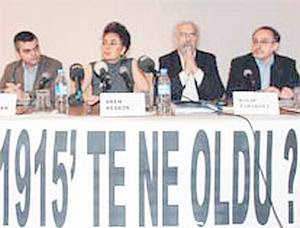
Speaking at the panel “What happened on April 24, 1915?”, Sarafian, Keskin, Aydın and Zarakolu say that still not talking about what happened and not coming to terms with the past, the problem persist in different forms.
Speaking at the panel “What happened on April 24, 1915?”, organized by the Human Rights Association (İHD), Ara Sarafian, a historian at the Gomidas Institute, who specializes in the late Ottoman period, told that “April 24 was the political act of the Committee of the Union and Progress. April 24 opened the way for the liquidation of the Armenians in Anatolia.” . .
Also: See Here for the Follow Up On This Panel
The publisher Ragıp Zarakolu, the lawyer Eren Keskin and the writer Erdoğan Aydın participated in the panel held at İstanbul Bilgi University yesterday. While more than three hundred people watched the panel, there were many police officers around the university.
April 24 stands for the few days in 1915, during which 220 Armenian intellectuals in Istanbul were arrested and today this day is acknowledged as the “genocide commemoration day” by all the Armenians around the world.
“The same mentality persists”
Giving the opening speech, the IHD branch president Gülseren Yoleri stated that the genocide claims were still neither discussed nor accepted and the same was the case regarding the Kurdish problem.
“They could not live in their own land, nor die in it. They made enemies out of Kurds, Turks, Armenians, Greeks, the neighbors.”
Stating “the mentality of the Committee of the Union and Progress continues”, Keskin added that “If we do not discuss the Committee of the Union and Progress, the Special Organization (Teşkilat-i Mahsusa), Şemdinli incident, 6-7 September pogrom of 1955 against Greeks in Turkey and the latest Ergenekon incident, we will not get very far.”
“We have failed to come to terms”
Saying “I think that there is a generation that represents an enlightened conscience, like the hundreds of thousands who walked behind Hrant”, Aydın likewise added that “Since we did not come to the terms with what Armenians, Assyrians, Syrians went through, the Kurdish problem, the May First celebrations, the Alevi problems persist as individual paranoids.”
Zarakolu also stated “April 24 also forms a model for the arrests of the intellectuals.”
“There is a visible and an invisible state: there is the Special Organization and the Ottoman civil servant who could not adjust to this new method.”
Reading an article Hrant Dink wrote about April 24, Zarakolu added that “This society can emphatize, provided that nobody overshadows it.”
Sarafian: There were 2 million Armenians in 1913
Sarafian talked about the historical documents regarding the genocide claims.
“According to the 1913 census of the Istanbul patriarchate, there were 2 million Armenians within the borders of the Ottoman Empire. The great majority of Armenians lived in the country with Turks and Kurds, intermingling with Muslims. Most Armenians lived in Istanbul and in the East. Those Armenians not in the war zone were exiled as well.”
“40 thousand Armenians lived in Harput, divided into 50 settlement regions. Not a single village was left after 1915. Harput plain was not a war zone. The local Armenians were very passive and they could do nothing against genocide.”
“On April 24, 1915, Armenians from various professions in Istanbul such as intellectuals, politicians, artists, and teachers were sent to Ayaş and Çankırı. In Ayaş, 55 out of 70 people were slained. About the fate of the 150 Armenians who were sent to Çankırı, no definite information has been discovered.
* This news was compiled from Atılım, Milliyet and Radikal.
A common enemy that is called hate by Vercihan Ziflioglu
Istanbul – Turkish Daily News, Saturday, April 26, 2008
VICIOUS CIRCLE: Turkey's stance toward Armenians has only helped the efforts of Armenian lobbies and committees, says Sarafian. Armenians, meanwhile, make comical claims for land that only serve to reinforce Turkish reluctance to engage in dialogue.
Neither Turks nor Armenians are interested in free-thinking researchers, says historian Ara Sarafian, arguing that both Armenian and Turkish nationalists seek to prolong the animosity between the two peoples
Turkey and Armenia must together create the opportunity to secure a peaceful future and the current tactics of the Armenian diaspora are not helpful in the view of the director one of that same diaspora's leading think tanks. That iconoclastic view was shared by Ara Sarafian, who heads the London-based Gomidas Institute on the sidelines of a conference this week held by Bilgi University on the day often associated with allegations of an Armenian genocide at the hands of Ottoman Turks that is said to have begun on April 24, 1915. Indeed the date is important Sarafian told the Turkish Daily News, as on that day, “ 220 Armenian intellectuals in Istanbul were arrested and were never heard of again.” But, he said, the ongoing campaign by the Armenian lobby to generate declarations by parliaments around the world, a campaign bitterly opposed by Turkey, has hardly produced the desired results. It is time for a new approach, he said. This was the message Sarafian shared at the conference, organized by the Human Rights Association (I.HD) Istanbul branch and held at Bilgi. And it was a theme Sarafian returned to in a conversation with the TDN. He said nationalists among both Armenians and Turks are fed by hatred and animosity. The researcher agreed that Armenian lobbies and committees are certainly organizing anti-Turkish activities, but argued it is wrong to categorize the entire Armenian diaspora as a single camp. Turkey's stance toward Armenians has only helped the efforts of these Armenian lobbies and committees, he said. Armenians, meanwhile, make comical claims for land that only serve to reinforce Turkish reluctance to engage in dialogue. “Problems will not be solved by people talking from their comfortable chairs in Los Angeles,” he said.
‘Those who accused Dink of being a Turkish agent made him a hero' On Armenian-Turkish journalist Hrant Dink, who was murdered by a teenage Turkish nationalist on Jan. 19, 2007, Sarafian noted a particular irony. For years, many in the Armenian diaspora accused Dink of being a Turkish agent for his views that development of empathy between the two communities was not served by genocide polemics. Now that he is dead, those same critics of Dink when he was alive have turned him into a hero. “Dink created an opportunity for Turkish-Armenian rapprochement but that is now lost,” he said. If the genocide issue was solved all these lobbies and groups would face serious hardship because they would have nothing to do, he said. “We have lived like enemies until now. From now on, we must work for peace,” said Sarafian, adding that the only thing separating Turks from Armenians was religion.
Neither side is interested in free-thinking researchers: Sarafian said neither Turkish nor Armenian nationalists wanted free-thinking researchers, accusing some professors of Armenian origins in the United States of creating obstacles for German researcher Hilmar Kaiser and noted that some invitations for meetings were canceled at the last minute. “Even this interview will make me a target of some groups,” he said. Being a historian is mutually exclusive from being Armenian, he said, adding that most of his own family was lost during the incidents in 1915. “As a historian, my duty is to objectively seek the truth. In the 1990s, I conducted research in Turkey,” he said. However, he and Kaiser had encountered serious obstacles during his studies in the Prime Ministry archives, claiming that they were eventually barred from entering it. The Turkish press was manipulating the exchanges with Turkish History Foundation Chairman Yusuf Halaçog(lu, he said. “Upon Halaçog(lu's invitation to work together, I proposed to center our studies in Elaz?g(. I asked for a list of Armenians deported from the province. If these people were exiled to somewhere and then continued their lives, there must be records. After this request, Halaçog(lu invited me to Ankara and also told a reporter on CNN-Türk, ‘Sarafian knows well that such incidents never took place under the Ottomans.' After this statement, I decided to put a stop to the decision to work together. Halaçog(lu, with that statement, showed his stance. As a historian, it is impossible to conduct an objective study.”
Armenians accuse Ottomans of committing organized massacres of Armenians in 1915 that was tantamount to genocide. This week Armenia's new president announced the campaign to secure international recognition of such claims will continue. Turkey dismisses the allegations and argues that there were huge numbers of casualties on both sides and most were caused by inter-communal fighting and wartime conditions. To date, parliaments in some 20 countries have passed resolutions supporting the Armenian position. The United States and the United Kingdom have remained notable exceptions and refrain from use of the word “genocide”
Killings Of Armenians In Ottoman Empire 'Genocide,' Says Sarafian in Istanbul
April 25, 2008, TDN
Thousands of social facilities, churches and schools that once belonged to Armenians cannot be seen in Anatolia today, providing more convincing evidence than written documents that the World War I-era killings of Armenians in the Ottoman Empire constitute "genocide," an American historian said yesterday.
“Although there were around two million Armenian people living in Anatolia during the Ottoman Empire before 1915, today it is not possible to find any historical or social mark reminding them,” said Ara Sarafian, head of Gomidas Institute in London, an organization that carries out research on Armenian history.
Sarafian was speaking at a conference titled “What happened on April 24, 1915?” held in Istanbul by the Istanbul branch of the Human Rights Association (İHD).
Several intellectuals discussed the "genocide" claims of Armenians and argued that Turkey has to face its history without ignoring or denying the truth.
“All of us, who kept quiet and did not resist to the killings of Armenians are guilty, no matter what you call what was done toward the Armenian people living in the Ottoman Empire; genocide or injustice,” said Eren Keskin, a lawyer.
“April 24 is a symbol for the Armenian community all around the world since many Armenian intellectuals were exiled to the central Anatolian provinces of Çorum and Çankırı where only some of them could survive. They were murdered by the gangs supported by the Ottoman Teşkilat-ı Mahsusa [Special Organization, created in 1913 under the imperial War Department],” said Ragıp Zarakolu, a prominent intellectual and writer. Zarakolu said this date is the first time in Turkish history where intellectuals were arrested collectively.
“I was arrested in the middle of the night. I was lucky that I survived, unlike many of my Armenian colleagues who were arrested in 1915,” he said, noting that discussions on the issue should not be based on number of Armenians killed since they were all individuals and intellectuals who had unique lives. “It is not the numbers but what Turkey lost intellectually and socially after having exiled and murdered Armenians that is significant to remember,” he said.
The mainstream ideology as well as its alternatives should be questioned in Turkey in order to prevent such discrimination, said Keskin, noting that both all ideologies are based on militarist and male-dominated organizations. Keskin said the Turkish Republic was built on an ideology that excludes all identities except Turkish and Sunni.
What Happened On 24th April 1915 In Istanbul?
Panelists: Eren Keskin : 24th April 1915 from Human Rights Perspective
Ragip Zarakolu: 24th April – A milestone setting an example for the annihilation of intellectuals
Ara Sarafian: Why Armenians Commemorate 24 April 1915 to Signify the Beginning of the Armenian Genocide: a Critical Examination.”
Erdogan Aydin :Historical Consciousness and Confronting the History
Presented by Human Rights Association Istanbul
Thursday, 24th April 2008 02:00 p.m. Bilgi University, Dolapdere Campus . .
Human Rights Association Istanbul Branch
Press Release, 24th April 2006
Today, 24th of April, is worldwide recognized as the date signifying the Armenian Genocide. Only in Turkey it indicates a taboo. The Turkish state mobilizes all its resources to deny the meaning of this date.
At diplomatic platforms Turkish officials and their advocates claim that they recognise the “big tragedy” and they only object to its being named as a “Genocide”. That’s not true. At every occasion in Turkey not only the Armenian Genocide, but also the great agony of the Armenian people is denied and attempts are made to justify the genocide.
It was only last month that during a Symposium on the Armenian-Turkish relations the denialist official theses were voiced one after another, offending the Armenians in Turkey and elsewhere and insulting the memory of their grandparents. Lies were told in the name of “science”., like “Armenians have always sold their masters”, “deportation was a means of crisis management”, “death toll of deportation is comparable to the death toll of flu epidemic in England that time”, “there is no other people as noble as the Turkish nation in the world, it is impossible for them to commit a genocide”, and many more, humiliating a people who was one of the most advanced in science, art, literature, and in all other aspects.
Denial is an constituent part of the genocide itself and results in the continuation of the genocide. Denial of genocide is a human rights violation in itself. It deprives individuals the right to mourn for their ancestors, for the ethnic cleansing of a nation, the annihilation of people of all ages, all professions, all social sections, women, men, children, babies, grandparents alike just because they were Armenians regardless of their political background or conviction. Perhaps the most important of all, it is the refusal of making a solemn, formal commitment and say “NEVER AGAIN”.
Turkey has made hardly any progress in the field of co-existence, democracy, human rights and putting an end to militarism since the time of the Union and Progress Committee. Annihilation and denial had been and continues today to be the only means to solve the problem. Villages evacuated and put on fire and forced displacements are still the manifestation of the same habit of “social engineering”. There has always been bloodshed in the homeland of Armenians after 1915. Unsolved murders, disappearances under custody, rapes and arrests en masse during the 1990’s were no surprise, given the ongoing state tradition lacking any culture of repentance for past crimes against humanity.
Similarly the removal of a public prosecutor and banning him from profession just for taking the courage to mention an accusation against the military, a very recent incident, is the manifestation of an old habit of punishing anybody who dares to voice any objection to the army. And today’s ongoing military build up of some 250,000 troops in the southeast of Turkey is the proof of a mindset who is unable to develop any solution to the Kurdish question other than armed suppression.
Turkey will not be able to take even one step forward without putting an end to the continuity of the Progress and Union manner of ruling. No human rights violation can be stopped in Turkey and there will be no hope of breaking the vicious circle of Kurdish uprisings and their bloody suppression unless the Turkish state agree to create an environment where public homage is paid to genocide victims, where the sufferings of their grandchildren is shared and the genocide is recognized.
Today we, as the human rights defenders, would like to address all Armenians in Turkey and elsewhere in the world and tell them “we want to share the pain in your hearts and bow down before the memory of your lost ones. They are also our losses. Our struggle for human rights in Turkey, is at the same time our mourning for our common losses and a homage paid to the genocide victims”.
Labels: Ara SARAFIAN, Hilmar Kaiser, S, Vercihan Zifliyan
9.4.08
2420) Media Scanner 12 Apr 2008 (37 Items)
4.3.08
2374) Turkish Studies At Yerevan State University Makes Way For Warmer Ties
Founded by Istanbul-born philologist Professor Hrachya Acharyan in 1943, the Department of Turkish Studies at Yerevan State University (YSU) is home to outstanding studies in Turkish language and literature. Presently, a total of 100 undergraduate students, 25 master’s students and four Ph.D. students are enrolled in Turkish Studies at YSU . .
Turkey and Armenia have no diplomatic relations and the border between them remains closed, but their cultural and academic relations have no such borders. Despite the sour relations between the two countries, the undergraduate and graduate programs in Yerevan State University's Department of Turkish Studies attract tremendous interest from Armenian youth. The number of undergraduate students is 100, 25 students are enrolled to the Master's program while the number of PhD students is four.
Istanbul-born philologist Professor Hrachya Acharyan founded the Department of Turkish Studies in 1943. In 1968, the Faculty of Oriental Studies was founded as a separate body where currently not only modern Turkish but also Ottoman, Azerbaijani, Persian and Arabic studies are taught.
Department of Turkish Studies Chair Professor Alexander Safaryan, who has been teaching at the Department of Turkish Studies at YSU since 1986, told the Turkish Daily News that he believed both Turkish and Armenian linguists should undertake joint studies at the university level. Citing past collaborations of Armenian academics with the Middle East Technical University and the Ankara University in 2002, Safaryan said though exchange of both Armenian and Turkish academics between Ankara and Yerevan took place at that time, such cooperation has been impeded for some time due to political conditions and the closed borders between the two countries. But in the event that Turkish universities show any interest in renewing ties, Armenian academics are ready to conduct joint studies with them, said Safaryan.
Safaryan, who studied linguistics at the University of Moscow and the University of Damascus. He was awarded a gold medal by YSU in 2000 for his successful studies in linguistics.
Borders not obstacles to academic relations
Safaryan's studies are not only limited to classes he gives at the Department of Turkish Studies at YSU. He is the author of comprehensive books on Turkish language and literature. His latest work is a textbook written both in Armenian and Turkish for beginners to Armenian language. Safaryan worked with faculty colleagues Aşod Soğomonyan and Istanbul-born artist Diran Lokmagözyan during preparation of his 316-page book first published in 2007. “There are Armenian textbooks written in Russian but the textbook we prepared is a pioneering work. It includes explanatory grammar and teaches Armenian directly in Armenian not through another language. In this way, it is easier to learn Armenian,” said Safaryan. He noted that it was journalist Hrant Dink, the slain founder editor-in-chief of the Turkish-Armenian bilingual weekly Agos based in Istanbul, who first suggested in 2005 the idea of preparing such a textbook.
‘Literary works should be translated mutually'
Safaryan said translated works both from Armenian and Turkish literature play a major role in development of friendly relations between Armenians and Turks. He said he had exchanged ideas three years ago with well-known Turkish intellectual and academic Murat Belge and Osman Kavala, a co-founder of Turkey's prominent publication company İletişim Publications, about forming a joint commission and translating works both from Armenian and Turkish literatures. But the project failed due to financial problems, he added.
Nobel laureate Turkish novelist Orhan Pamuk's works have generated great interest in Armenia, said Safaryan. When the necessary budget is formed, the first Turkish works to be translated into Armenian would be those of Pamuk's, he said.
The last translations from Turkish literature were made under the former Soviet Union. Most of those Turkish works translated into Armenian during that period were those belonging to Yaşar Kemal, Sabahattin Ali, Aziz Nesin, and Nazım Hikmet, who are all leftists.
But because no further editions were published it is currently not possible to find those works in Armenia. “There is a big lack of works of Turkish literature in bookstore shelves in Armenia,” said Safaryan.
Safaryan said that Turkish state television introduced him as a supporter of the genocide claims on the killings of Armenians at the hands of the Ottoman Empire in 1915-16 in the documentary film “Fair Bride” produced in 2003. That made him quite sad, he added.
“I am a linguist, not a historian. My area of specialization is Turkish language and culture. I have never ever conducted any studies on the 1915 killings and therefore it is not my area of specialization,” he said.
‘Contemporary Turkish literature has quests for some time'
Dr. Rupen Hovhannesi Melkonyan, a Yerevan State University (YSU) graduate and a student of Safaryan, has been teaching at the Department of Turkish Studies at YSU since 2005. His area of specialization is Modern Turkish Language and Literature and specifically the Village Literature in the realm of modern literary realism that dominated Turkish literature between 1930 and 1950. Melkonyan, noting masters of Turkish literature Yaşar Kemal, Fakir Baykurt and Orhan Kemal who produced outstanding works during that period, said that all the works produced at that time indeed reflect the political and social atmosphere dominant in Turkey in those years.
For Melkonyan, contemporary Turkish literature has for some time been in search of many things. Nobel laureate Pamuk's novels contain deep touches of postmodernism, he said. Another Turkish novelist that attracts Melkonyan's attention most is Elif Şafak, author of “The Bastard of Istanbul”.
Şuşanik Zakaryan (21) – Master's student at the Department of Turkish Studies at Yerevan State University (YSU):
Last year, I visited Istanbul and stayed there for 14 days. It was the first time I met with Turkish university students. Turkish youth do not have information about Armenians and are ultra-nationalists. Learning Turkish is highly important for me. In this way, I would like to get to know Turks, with whom we experienced so many big events in history, more closely.
Diana Hayrabedyan (22)- Master's student at the Department of Turkish Studies at Yerevan State University (YSU): We have to leave aside all hostilities and try to find rational solutions to problems between the two countries. Communication with Turkish university students is what we have to do. That's why I want to learn Turkish and specialize in that. As we all see, fights never work out.
Nareg Zulalyan (19), Master's student at the Department of Turkish Studies at Yerevan State University (YSU):
Tense relations between Turkey and Armenia are the main reason why I chose to study Turkology. Past incidents represent the biggest problems between the two countries. No diplomatic relations have existed yet, but once they are established, speaking Turkish will play a key role.
Lia Evoyan (19), Master's student at the Department of Turkish Studies at Yerevan State University (YSU): International relations is my area of expertise. I have chosen to attend the Department of Turkish Studies because of political problems Armenia has with Turkey and Azerbaijan. I have been learning Azerbaijani and Turkish for some time. We, as young people of Armenia, can look at the problems from a different perspective.
Anna Boğosyan (19), Master's student at the Department of Turkish Studies at Yerevan State University (YSU): Learning Turkey's history, social life and literature in all aspects is highly important for me since Turkey and Armenia have quite serious political and diplomatic problems with each other. Turkey perpetually claims that problems are caused by Armenia but this is unfair. We have to try to solve our problems through modeling Germany and Israel. Dialogue between the two nations is quite important.
March 4, 2008
Vercihan Ziflioğlu
YEREVAN - Turkish Daily News
Labels: S, Vercihan Zifliyan
2.2.08
2318) "Feel Like Man In Love With 2 Women & Cannot Give Up Either Turkey or Armenia"
February 2, 2008
Though the Turkey-Armenia border is closed, flights from Istanbul to Yerevan and vice versa are available each week. Charter flights are operated with planes from the Armenian state-led airline company Armavia Airlines and private Turkish airline Atlas Jet . .
Despite the land border between Turkey and Armenia being closed, regular weekly flights take place between Istanbul and Yerevan, Armenia's capital.
Flights between the two cities started immediately after the Republic of Armenia won its independence in 1995. After the closure of Armenia's former state airlines Armenian Airlines in 2000, Armavia Airlines, again led by state, started to function in the same year. In 2003, Armenian origins Turkish national Dikran Altun, owner of Tower Aviation and Travel Company, officially applied to the Turkish Directorate General of Civil Aviation in order to operate scheduled flights between Istanbul and Yerevan and obtained the necessary permission. Initial flights that were organized by Altun's company took place thanks to planes chartered from private Turkish airline Fly Air. Altun said Armenian people welcomed the very first flight to Yerevan with excitement. “We landed in Armenia in a plane that carried the Turkish flag. The plane was full of Turkish journalists and businessmen,” said Altun, noting representatives from Directorate General of Civil Aviation of Armenia welcomed them at the airport. There are three weekly flights between Istanbul and Yerevan. Altun said all flights to Yerevan are full. As to the passenger profile, Altun said that Turkish businessmen made up the majority of travelers. Also flights between the resort town of Antalya and Yerevan take place between June and September every year. A total of 3,500 Armenian businessmen traveled to Antalya on holiday last year, Altun said, adding they plan to increase the number of flights next season.
Armenia and Turkey, two sides of the bridge
Altun said his first visit to Armenia was after he received an invitation from Telman Der Bedrosyan, brother of Armenia's first president, Levon Der Bedrosyan. In his first visit to Armenia, Der Bedrosyan took Altun to the Markara Village of Yerevan. “In the past, the Turkey-Armenia border was in Markara. There used to be a bridge over the Aras River at that time. Once, while walking on that bridge, I stopped at the mid point and looked at both sides. One side of the bridge was Armenia and the other side was Turkey,” Altun said. “I cried unreasonably but unconditionally that day, I do not know why,” he said, describing his love for both countries with the following words: “I feel like a man who is in love with two women. I just cannot give up either of them.” The idea of starting flights between Istanbul and Yerevan came to Altun's mind after that first visit to Armenia.
Turkish Businessmen In Yerevan
After flights with planes chartered from Fly Air were met with great interest, they undertook the task of flying Armavia Airlines' passengers to Istanbul, Altun said. Finally, they started operating charter flights with planes from Atlas Jet. Altun, noting that about 20,000 Armenians from Armenia live within Turkey's borders and have commercial activities there, said that many Turkish businessmen also make significant investments in Yerevan. “There are no diplomatic relations between Turkey and Armenia and there is the reality of an embargo imposed on Armenia. Lower level Turkish bureaucracy supports the embargo while upper level Turkish bureaucracy wants the embargo to remain at minimum levels, said Altun, adding that flights between Istanbul and Yerevan started thanks to the warm attitude displayed by upper level Turkish bureaucracy. Altun said President Der Berdosyan used to have a warm attitude toward Turkey during the 1990s and if Turkey had responded to that, many problems between the two countries would have already been overcome.
Peace And Friendship Concert In Yerevan
Altun, believing that cultural relations are highly important, said he, with his own financial resources, invited a 100-member A Capella choir and a dance ensemble from Armenia to Turkey during the days when the French parliament was discussing the “genocide” bill. Altun said, though some problems occurred, he managed to obtain the necessary permission from the Turkish Foreign Ministry for the concert that was held in Istanbul. He said the message of peace that was sent to the world with that concert was highly important. Altun, arguing Western countries politically manipulate the Armenian question, said problems between the two peoples can only be overcome through dialogue. Altun will organize a second peace concert by Turkish artists in Armenia soon.
Vercihan Ziflioglu, TDN
Yerevan is a leading industrial, cultural, and scientific centre in the Caucasus region. It is also at the heart of an extensive rail network and is a major trading centre for agricultural products. In addition, industries in the city produce metals, machine tools, electrical equipment, chemicals, textiles, and food products.
| Educational and cultural facilities in Yerevan include universities, the Armenian Academy of Sciences, a state museum, and several libraries. The largest repository of Armenian manuscripts, and indeed one of the biggest repositories of manuscripts in the world, is the Matenadaran. Zvartnots International Airport serves Yerevan. The layout of Yerevan was designed by Alexander Tamanyan in the 1920's, and has grown way beyond his projections of a couple of hundred thousand residents. The center however remains pretty close to what he envisioned, with a grid pattern of streets intersected by some sircular roads and a lot of parks. Virtually all hotels, museums, government offices, clubs and the like are in the very center (see map below), which can be walked across in 20 minutes - making Yerevan an extremely walkable city, except for the drivers. |
Along with the Northern Avenue which is under construction, some of the hipper streets are Abovian St., Tumanian St., Sayat Nova, Terian St. Mashtots Ave., and Amiryan St. For those that live outside of the small center, public transport is cheap and easy, with Marshutnis (fixed route vans) bringing people to the center from all over, and the not-so-extensive metro also serving parts of Yerevan. Most of the cities popular shukas (bazaars) are outside of the center - such as the Hrazdan, Bangladesh and GUM shukas. |
| For locals in Yerevan - who like the rest of the republic have seen a sharp drop in living standards since the collapse of the USSR, the problem is not so much unemployment (as is the case in other parts of Armenia) as it is simply underpay and underemployment. People are working, but in jobs well below their capacity and/or for what most would not consider a living wage. Like much of the rest of Armenia, people depend to a great extent on remittances - money sent back home by relatives - and on foreign aid from governments and the Armenian Diaspora. |
| History. | ||
| Archeological evidence indicates that a military fortress called Erebuni stood on Yerevan's site as far back as the 8th century BC. Since then the site has been strategically important as a crossroads for the caravan routes passing between Europe and India. It has been called Yerevan since at least the 7th century A.D., when it was the capital of Armenia under Persian rule. Due to its strategic significance, Yerevan was constantly fought over and it passed back and forth between the dominion of Persia and the Ottomans for centuries. In 1827 it was taken by Russia and formally ceded by the Persians in 1828. After the 1917 Russian revolution it enjoyed three years as the capital of independent Armenia, and in 1920 became the capital of the newly formed Armenian Soviet Socialist Republic, a territory of the Soviet Union. With the collapse of the Soviet Union, Yerevan became the capital of the independent Republic of Armenia in 1991. Armenia was for most of its history a rural society, with few cities of its own. The modern city of Yerevan was built on tragedy and dreams. Little more than a garrison town of mud-brick and gardens before its first brief experience as capital of an independent Armenia in 1918, the city burgeoned under Soviet rule. The flood of refugees from the 1915 holocaust and its aftermath fueled an uneasy but productive alliance between Armenian nationalism and Soviet hopes of spreading the Communist gospel through the Armenian Diaspora. Modern Yerevan was built, deliberately, to be the universal center and pole of attraction for the diaspora, with an educational and cultural infrastructure far out of proportion to the size or intrinsic wealth of Soviet Armenia. In 1988, when the collapse of the Soviet Union became visible, Yerevan was a full-fledged, booming Soviet city of over 1 million people. A gracious street plan of parks, ring-roads, and tree-lined avenues had been laid out by the architect Alexander Tamanyan and his successors in the 1920s and 1930s for a population they dreamed might reach 200,000. That goal long surpassed, the process of expansion to reach the magic million-person threshold that qualified Yerevan for a metro and the other perquisites of a city of all-Union importance involved Armenia's successive First Secretaries in sordid expedients and half-finished, earthquake-vulnerable construction projects in sprawled, depressing suburbs. The city of Yerevan preserves little of its early history in a form of interest to casual visitors. Behind the anonymous Soviet facades, however, a rich and complex life took place and still does, in the "bak" or courtyard or in private apartments far better furnished -- with books, musical instruments, art, and hospitality -- than 70 years of official culture or a decade of grim poverty would suggest. |
|
| Hotels: - Hotel Armenia - Hotel Yerevan | Climate: Yerevan has a decidedly continental climate. Though it is at the same latitude as warm Mediterranean countries like Portugal, the 1km elevation and the distance from the sea means that the summers are very hot, the winters very cold, and the humidity very low year round. | Tourist attractions: - Monuments and buildings. - Museums - Night life - Restaurants and Cafes - Boutiques - Victory Bridge - Abovyan Street - Northern Blvd - Gold Market - Amusement parks - Hrazdan Gorge |
http://realty.armenie.eu
Labels: S, Vercihan Zifliyan
Labels | Categories | Authors | Subjects
A Rawlinson Admiral Bristol Adolf HITLER Agos Alfred De Zayas Ambassador Morgenthau American Missionaries AmericanCommittee-ArmenianSyrian-ReliefBulletins ANCA Andranik Pasha Andrew Mango Ara BALIOZIAN Ara GULER Ara Papian Ara SARAFIAN Aram Andonian ARF Armen GARO Armenian TERROR Arnold Toynbee Arthur Sutherland ASALA Ata ATUN AUSTRALIA Avim AYF Baskin ORAN Berch Keresteciyan Bernard LEWIS Bilal SIMSIR Boghos Nubar Pasha Book REVIEW C F Dixon-Johnson CANADA Captain Emory Niles Christopher Gunn Court Cases David Holthouse David Saltzman Dennis R PAPAZIAN Diaspora Dogu Ergil Dogu PERINCEK Drastamat "Dro" Kanayan Edward ERICKSON Edward TASHJI Erciyes University Ergun KIRLIKOVALI Erich FEIGL Erman SAHIN Esat URAS FactCheckArmenia France Free E-Books Fridthjof Nansen Fuat Dundar Gaston Gaillard General Harbord Geoffrey ROBERTSON Guenter LEWY Gunay Evinch Gunduz AKTAN Gwynne DYER Hakan YAVUZ Haluk SAHIN Hampig Sassounian Hans Lukas Kieser Harut SASSOUNIAN Hazel Cagan Heath LOWRY Henry Morgenthau Henry Theriault Hetq.am Hilmar Kaiser Holdwater Hovannes Kachaznouni Hrant DINK Hrant Sarian Ilki Ak Infographic Innocent(?) Armenians Israel Charny James Bryce JCAG Jeremy Salt Justin McCarthy K.S. Papazian Kamer KASIM Karabakh Karl SHOEMAKER Kemal Ataturk Kemal Cicek Kemal Karpat Kemal Simsek Khatchig Mouradian Khojaly League of Nations Levon Marashlian Limited Book Preview Lobbying Louise NALBANDIAN Lt Dunn Macreau AKA "Sinan" Maxime GAUIN Media SCANNER Mehmet PERINCEK Melih BERK Michael GUNTER Mumtaz SOYSAL Murad Topalian Naira Gasparyan Nicholas Warndorf Noam Chomsky Norman STONE O E LUTEM Orhan PAMUK Pasdermadjian Pat WALSH Peter Balakian Pierre Loti Prof Hakan OZOGLU Rafael De Nogales Research PAPERS ReviewOfArmenianStudies Richard Hovannisian Robert Fisk Ronald Grigor Suny Ruben Safrastyan Russian-Armenian Relations Sadi DINLENC Salahi SONYEL SAM Samuel WEEMS Saro Dadyan Sedat LACINER SlideShows Soghomon Tehlirian Southern Poverty Law Center Stanford Shaw Stephan Steiner Sukru AYA Switzerland Tal BUENOS Talin Suciyan Taner AKCAM Theodore Roosevelt TruckTurkey Turkkkaya ATAOV U.N. UK Vahagn Avedian Vahakn DADRIAN Vahe AVETIAN Vercihan Zifliyan Vicken Cheterian Videos William Saroyan Woodrow Wilson Yucel GUCLU Yuksel OKTAY Yusuf Halacoglu Zoryan Institute
Your Opinion Matter To Us
Please Update/Correct Any Of The 3700+ Posts Here
By Leaving Your Comments
Please Help Us
To Remove Any Dead Links
by Reporting via The Comment Box