
- Armenian Churches of Lake Van
- Russia Touts Regional Ties At Summit Snubbed By Neighbors
- ‘Sonbahar' Clinches Two Prizes At Armenian Film Fest
- Turkey's Last Qualifier To Take Place In Bursa
- Turks Won The Genocide Case Against Armenians In The US,
- 126 Congressmen Signed Resolution On Armenian Genocide, AZG Armenian Daily
- Russian Expert: Opening Of Armenia-Turkey Border To Make Armenian Exports Cheaper
- Establishment Of Diplomatic Relations Does Not Mean Recognition Of Turkey's Borders
- Reference Book For Socially Unprotected Armenian Citizens Created
- Armenia's Ministry Of Diaspora Able To Carry Out Serious Work
- Armenian Organizations Appeal to Obama, Other Minsk Co-Chair Presidents
- Wikipedia Has New False Facts About Nagorno-Karabakh
- Armenian-American Defence Cooperation www.mil.am/
- A Cemetery To Die For Lake Van’s Ahlat
- Armenian Genocide: The Turkish Use Of The Important Decision Of The Court Of Massachusetts
- Congressional Concern Mounts Over Turkey's Reversal On Proposed "Roadmap"
- Turkish, Armenian, American Youth In "Tolerance Camp"
- Diaspora-Armenian Charged with Plotting to Assassinate President Sargsyan; Couple from Aleppo Cries
- ‘Yes, We Have’ Celebrates Armenian Contributions To American Civilization
- AYF Targets Corporate Complicity In Genocide Denial With Launch Of Chevron Protest Campaign
- Charitable Corruption: Dutch Ngo Claims Armenian Branch Stole Funds [ 2009/07/20 Sona Avagyan
- Armenian Students From Russia To Undergo Practical Training At Ra Ministry Of Diaspora
- 70 Teachers From Diaspora Take Courses In Yerevan 21.07.2009
- Armenian Expert: Turkey Has Not Yet Decided What It Wants And What It Should Do
- The Caucasus Research Resource Centers Present The 2008 Armenia Corruption Survey Of Households
- 86% Of Survey Respondents Say Corruption A “Serious Problem” In Armenia
- Armenian Version Of Corruption And Human Rights: Making The Connection Report Represented In Yerevan
- Armenia Should End Occupation Of Azeri Territories - Mammadyarov
- More Armenian Cemetery In Van
- Exhibition In Yerevan On "The World Of Women"
- Beauty Contest "Miss September 2009-Continents" In Yerevan
- Performance Test: Armenia Needs A Team Effort Off The Pitch
- “Turkey’s Canny Foreign Minister Seeks to Pursue Delicate Diplomacy All Around”
- Chevron Responds To National Campaign Exposing ‘Profit From Genocide Denial’ Scheme
- A Summer For Movie Buffs
- Istanbul Squad Aims For More Than Medals In Panarmenian Games
- Caucasus Still Needs More Attention, Say Experts
- Armenia To Send Forces To Afghanistan This Year
- Armenia Doesn't Seek Friendship, But Only Normal Neighborly Relations With Turkey
- Armenians Cynical Over Delays In Border Opening
- Artists Know No Borders
- Turkish-Armenian Rapprochement And Obama's Policy In Caucasus, Národná¡ Obroda
- America's Tense Multicultural Bouquet: Armens, Native Americans, Asians, Blacks, Latinos Exploding Time-Bomb?
- Historic Euphrates River Is Drying Up Strangled By Clashing Policies & Rampant Misuse, Campbell Robertson
- Iceland Throws Down Political Challenge To Turkey
- NC Hollywood Summer Forum : 2010 Census for Little Armenia
- Launch Of Negotiations On Armenian - Turkish Rapprochement Was Mistake
- Turkish Denial Campaign Continues In California AZG
- Guests From Armenia To Be Given Flowers & Served During Armenia-Turkey Football Match In Kesaria
- Armenian National Congress: Karabakh Talks Close To Producing ‘Unfavorable’ Solution For Armenians
- Statement On Nagorno-Karabakh By U.S.
- Karabakh Calls For ‘Resetting Distorted Process’
- French Ambassador To Armenia: “Nothing Unfamiliar” In Nkr Negotiations
- "Come To Home" Project Of Diaspora
- Turkish Association Appeals Landmark Massachusetts Court Ruling
- Anger China Or Defend Uighurs? Turkey Walks Fine Line, Yigal Schleifer
- Our Own Nurhan Arman: Spanish Festival Concert
- Ambassador Denies Abbas Sided With Greek Cyprus
- Dangerous Tendencies For Armenia Concealed In Madrid Principles ArmInfo
- China Dismisses Erdogan’s Remarks On Genocide
- Caucasus Talks Won't Resolve Issues , Vercihan Zifliog(lu
- Pwc: Turkish, Global Media Market To Prosper Despite Crisis
- "Nagorno Karabagh Needs You!", ANCA Update
- Will Karabakh Peace Talks Lead To Breakthrough?
- Prof Mustafa Ayd?n: Eminent Authority On Foreign Policy, Security
- Armenian Soldier Crossed Border To Azerbaijan: I Reject Armenian Citizenship
- Armenians Are Aboriginals In Turkey, Georgia, Azerbaijan
- Armenia Diaspora Comes Home
- Film Festival Helps To Bridge Centuries-Old Barriers Between Turks And Armenians, Voice of America
- Armenia Calls Back Its Sons Home
- Armenia Paradox: Cant We All Just Get Along? Okay. We Cant. But, Still
- Turkish PM Compares Violence In China To Genocide
- US, France, Russia Urge Solution to Karabakh Conflict
- Aliyev: Talks Aim At Phased Armenian Withdrawal
- Platform To Bring Armenian, Turkish Filmmakers Together
- Petition Against Six Denialist Corporations
- History Of The Establishment Of Armenian And Turkish Theater In The Ottoman Empire
- Muslim Art In Hand Of An Armenian
- Armenia Has Failed In Its Relations With Turkey, Opposition Mps Say
- Al Pacino Will Play The Role Of Jack Kevorkian
- Fighting Of Raphael Lemkin
- President Gül And Obama Discuss Armenia Talks
- Majority Of Turks Critical Of US Foreign Policy
- ARF’s Way Forward After Leaving Coalition
- Turkish PM: No Document Proves 1915 Events To Be Genocide
- Armenian Genocide: The Turkish Army Bans Axa Offers Department Of Defense
- Striking Words By Turkish Citizens Of Armenian Origin
- “I Cannot Hide What I Saw in Van”
- Deportations That Were Not Noticed By The World-1
- Diaspora Not To Agree To Establishment Of Armenia-Turkey Relations Without Recognition Of Armenian People's Rights
- Sarkisian Signals Frustration With Turkey
- Hrant Dink Murder Case – July 6 2009, 10th Hearing
- An Effective Investigation And Hrant Dink’s Trial
- Armenian Assembly Of America Training New Diaspora Leaders
- From ANCA To Armenian Americans (Not To Americans Of Armenia Ethnicity): "Secure On Line Donations" Today (!)
- Armenian, Hellenic Australians Focus On Genocide Recognition
- MP Calls For Armenian Genocide Condemnation
- New Book: "Armenian Organization And Ideology Under The Ottoman Rule, 1908-1914"
- Armenia-Turkey Thaw Tinged With Pain By Tom Esslemont , BBC News
- Will French Authorities Respond To Anti-Armenian Manifestations?
- Position Of Shimon Peres With Respect To Armenia Is Not Nonsense, ARF Dashnaktsutyun
- "Turkey Firm On Armenia Talks" FM Davutog(lu
- Canadian Minister Appoints Babikian New Citizenship Judge
- Editor Of Book Slams Criticism Of Honesty
- State Of Hawaii - Good Friend Of Armenians
- Turkey Becomes Key Partner For Europe In Caucasus
- Usa Ambassador To Armenia Defends Obama
- "Turkey Season" Begins In France
- In Defense Of A Hero Of Armenia
- 70,000 Carnations to Mask Hoax Behind Turkey-Armenia Soccer Match
- G8 FMs Call for Karabakh Peace, Armenia-Turkey Ties
- Turkey Urges Canada To Act Constructively On Armenian Issue
- Year Of Turkey In France
- Armenian Community In US Makes Another Provocation Against Turkey
- Archives: Armenians Killed 73.727 Azerbaijanis In Nakhchivan In 1919-1921
- Prosecutor General: “Issue Be Raised Before UN For Recognition Of Actions Committed By Armenians Against Azerbaijanis In 1918 As Genocide”
- March 31- Day Of Genocide Against Azerbaijanis Commemorated In Israel
- Member Of Armenian Parliament Claiming Support Of Baku And Ankara
- Recognition Of Genocide By UK
- Give Up G-Word Economist
- Israeli Scholar Is Ashamed Of Israel's Position On Genocide
- Turkey Or Adjara? -Domestic Tourism Facing New Challenge Sikhuashvili
- Disputed Territories Not Occupied Territories By Efraim Karsh
The Armenian Churches of Lake Van
The church of Holy Cross
Travelers who make the pilgrimage out to distant Lake Van, a daunting 1,644 kilometers southeast of İstanbul and just an hour's drive short of the Iranian frontier, are seldom disappointed with what they see.
The deep blue waters of this remote, high-altitude soda lake, ringed by snow-capped mountains up to 4,000 meters high, have a truly haunting beauty. Rocky mountain spurs run right down into the limpid waters; reed-fringed bays backed by lush, snow-melt fed fields are bordered by rows of stately poplars, whilst avocets and herons wade through breathlessly still marshland in search of prey. In early spring, blossoms coat the trees in the apricot and cherry orchards; later rare orchids bloom in the meadows.
At the tail end of the 19th century, skirting the lake en route to Bitlis, the formidable British traveler Isabella Bird wrote, “All along I am quite impressed with the resemblance which the southern shores of Lake Van bear to some of the most beautiful parts of the Italian Riviera.” Even today, Armenians, who established themselves in the area as early as the ninth century B.C., have a saying, “Van in this world, paradise in the next.”
Lake Van's premier attraction is not, however, its spectacular natural beauty. It is Surb Khach, the Church of the Holy Cross, picturesquely sited on the small island of Akdamar, a 20-minute boat ride from the mainland. Built between A.D. 915 and 921, it is arguably the most beautiful Armenian church in Turkey. The subject of a massive restoration project carried out under the auspices of the Ministry of Tourism and Culture completed in April 2007, it heralded the beginnings of a tentative rapprochement between feuding neighbors Turkey and Armenia. The church is superbly proportioned, with its compact 12- by 15-meter cruciform plan surmounted by an elegant, polygonal drum capped with a pyramidal roof. Inside, the frescoes, formerly in a shocking state, have been sensitively restored, and it is easy to make out New Testament scenes such as the baptism of Christ, the raising of Lazarus and the Crucifixion.
But what makes this church so special are the relief carvings, which run in a series of five bands around the entire exterior of this red-sandstone wonder. Under the eaves is a frieze featuring the faces of humans and animals; beneath it runs a vine-scroll inhabited with men and various creatures. Lower down is a band of relief-carved animals, but the widest, most prominent band is given over to scenes of a truly religious nature, including Jonah appearing to dive from a boat into the jaws of a most unlikely looking whale. David takes on Goliath, sling in hand, and Abraham grasps his son Isaac by the hair, dagger at the ready. King Gagik, a member of the Artsruni family who ruled the Armenian kingdom of Vaspurakan at the time the church was built, is carved in bold relief, presenting a model of Surb Khach to Jesus. Fine art historians may sniff at the naivety of the carvings, which were heavily influenced by styles prevalent in nearby and politically dominant Iran and the Abbasid caliphate based in Baghdad, but their vibrancy is undeniable.
Most visitors, of course, make the obligatory trip out to Akdamar without realizing that there are literally dozens of other Armenian churches in the region -- several of them well-worth a visit if your appetite has been whetted by the Church of the Holy Cross. The most obvious one is the Church of St. John (Surb Hovhannes in Armenian) on the island of Çarpanak, a one-and-a-half-hour boat journey north of the harbor in Van town. Few people make it out here as the church is, as yet, little promoted and the cost of hiring the boat makes it prohibitive unless you have a group. It's worth the effort though. Whilst the substantial fore-church (zhamatun) of this 15th century monastery church may be constructed out of the familiar red sandstone, the main body of the structure, including its drum and pyramidal dome, is made from an attractive pale limestone, enlivened by bands of darker stone. There are several khachkars (carved crosses) built into the fabric of the structure and the setting; a tiny pear-shaped islet a stones throw from the tip of the peninsula opposite, is stunning. Visit in late spring, and you'll be bombarded by aptly named Armenian gulls defending the nests littering the island.
Easier to get to are the remains of the once-substantial monastery complex of Varagavank, know today in Turkish as Yedi Kilise (Seven Churches). Originally constructed in the eighth century, the shattered shells of the churches are now part and parcel of Yukarı Bakraçlı, a village 20 kilometers southeast of Van. Nestling in poplar stands, it is set high on the rocky west slopes of the distinctive volcanic peak of the 2,750-meter-high Mount Erek. The best-preserved church, now kept locked and looked after by a caretaker (he'll open up for you), is that of St. George. It must have been much rebuilt, as the British archaeologist cum diplomat Henry Layard, taking time out from his excavations at Nineveh and Babylon in the mid-19th century, describes the church as “a modern edifice.” He was more impressed with the monastery's location, saying: “It is beautifully situated near the mouth of a wooded ravine, half way up a bold mountain, which ends in snowy peaks. Spread beneath it is a blue lake and smiling plain.” Fronted by a zhamatun boasting some elaborate relief carvings, the main body of the church, extremely high in proportion to its ground area, is built to a cruciform plan. Traces of fresco survive, though the dome has partially collapsed, and villagers use the fore-church to sell handmade socks, scarves and other village crafts. There are also a few early-20th century black-and-white photographs showing the monastery in its former glory, complete with now-vanished multiple domes.
Further to the south, 25 kilometers northeast of Başkale (itself 75 kilometers south of Van), is the important sixth century church of Surb Bartolomeos. This substantial monastery church once sported three cupolas, but these have now collapsed. The western entrance has some beautiful relief carvings, but unfortunately the hill-top building is surrounded by razor-wire (it is part of an army camp) and is off-limits unless you gain permission from the military -- best done in Van. It's probably only worth coming here (you can at least look at the exterior of the church from the road in Albayrak village) if you head a further 20 kilometers on to the village of Yanal. Here is the fine sixth to seventh century Surb Echmiadzin in Soradir, a small church which, aesthetically, strove for height over bulk and which some architectural historians believe was the inspiration for the later Surb Khach on Akdamar. The spectacular rock formations nearby (optimistically named Vanadokya after their more famous counterparts in Cappadocia) near the village of Yavuzlar are also well worth a look. A trip out here can also be combined with the famous castle at Hoşap, which you pass en route to Başkale.
Back by the lake, but perched on a spectacular headland on the southern shores of the lake rather than on an island, is Surb Tovmas (Church of St. Thomas), around 30 kilometers east of the small quay opposite Akdamar Island. It is possible to hire a boat from here or drive from Van via the villages of Göründü and Altınsaç, from where it is an hour's walk. Dating back to the 14th century, though much rebuilt in 1581 and again in 1801, the compound wall has survived well, as has the main body of the church, though a big chunk of the pyramidal dome has collapsed.
If you are still not satisfied, try heading south to the village of Çatak, 40 kilometers from Van. The village, split by the gushing waters of the Botan Çayı, has the remains of the Church of St. John the Baptist, where the now roofless nave serves as a market garden. En route is the village of Elmacı, where the typically cruciform Surb Tikin presents a curious, irregular profile, as all its facing stones have been stripped. The villagers here -- as everywhere else where Armenians once dwelt -- will assume you are here looking for the treasure buried here by the Christians before they fled. The more adventurous can head over the near 3,000-meter-high Karabel pass to Bahçesaray, a gorgeous mountain village drowned in a sea of walnut trees. Above the river here is the small church with several beautifully carved khachkars set in its walls. According to Layard, when he visited this extremely remote area some 160 years ago, 40 of the 60 villages comprising the district were Armenian Christian. He was most rude about the Christians, possibly as they had no information for him about the ancient sites in the area, saying, “I found them even more ignorant than their fellow-countrymen in the districts around Van, whose stupidity has passed into Turkish proverb.”
With time, money and your own vehicle, you could spend weeks in the mountains and valleys around the shores of Lake Van, searching for ever more remote examples of Armenian Christian architecture and enjoy some fabulous scenery in the bargain.
Travel tips
Getting to Van: Turkish Airlines -- daily flights from İstanbul and Ankara. Pegasus -- daily from Ankara and İstanbul. SunExpress -- Mondays and Wednesdays from Antalya, daily from İzmir. Regular coaches from all parts of Turkey
Getting to Akdamar: A ferry leaves from the quay on the mainland opposite the island at frequent intervals in the summer. TL 5
Getting to Çarpanak: Hire a boat from Van harbor, which costs around TL 250. The boat holds up to 20 people and will wait for you to explore/picnic on the island.
Admission, permissions and opening hours: Akdamar, dawn-dusk, TL 3. Neither Çarpanak Island and church, nor any of the other churches mentioned here have admission fees or opening hours. To visit Surb Bartolomeos, try the Ayanis Travel Agency in Van (www.ayanis.com.tr) or Remzi at the Büyük Asur Hotel. Tel 0432 216 8792
Where to stay: Tamara Hotel, Kazım Karabekir Caddesi. It's the best of the city hotels. www.tamaraotel.com Tel 0432 214 3296
Şahin Hotel, central Van. Much cheaper than the above and perfectly adequate. www.otelsahin.com Tel 0432 216 3062
Where to eat: İmsak, Mareşel Fevzi Çakmak Caddesi. Van breakfasts are famous with honey, clotted cream, herbed cheese and much more. This small place is excellent.
Guides and maps: “The Book of Ahtamar Reliefs” (published by Turizm Yayınları), edited by Takeko Harada. “Armenian Van/Vaspurkan,” by Richard G. Hovannisian (Mazda Publishers Inc). “Blue Guide Turkey,” by Bernard McDonagh. “The Rough Guide to Turkey,” by Rosie Ayliffe, et al.. Map series No. 6 by cartographer Reinhard Ryborsch.
14 July 2009, TERRY RICHARDSON VAN
Russia Touts Regional Ties At Summit Snubbed By Neighbors, July 19, 2009 MOSCOW – Agence France-Presse
Russia touted economic integration with former Soviet nations even though several of them snubbed an informal regional summit on Saturday, as the Kremlin's ties with its neighbors grow more fraught.
Only five of the 11 countries comprising a post-Soviet grouping known as the Commonwealth of Independent States or, CIS, attended this year's event, a horse race the Kremlin held in lieu of a formal summit.
In a meeting with Kazakhstan's Nursultan Nazarbayev on the sidelines of the event, Russian President Dmitry Medvedev praised progress in creating a single customs bloc with Kazakhstan and Belarus, while his Kazakh counterpart said other ex-Soviet nations were keen to join the future bloc.
"We are currently in the stage of agreeing on all positions," Medvedev told Nazarbayev in televised remarks.
Last month, Russia said it would seek membership in the World Trade Organization as a single customs bloc with Minsk and Astana - an organization that largely exists on paper only - but then backtracked on its decision after the West said the move jeopardized Russia's 16-year-long WTO entry bid.
Nazarbayev said other ex-Soviet nations - which he didn't identify in his televised remarks - were willing to join the bloc.
"For the first time it will be a very important step on the path of integration. I am absolutely confident that other CIS members will be interested too," he said.
The horse race has become an annual tradition which in the past has been attended by the CIS leaders and this year took place at Moscow's Central Hippodrome.
Medvedev and his guests, who also included Armenian leader Serzh Sarkisian, Azerbaijani President Ilham Aliyev, Emomali Rakhmon of Tajikistan, and Moldovan President Vladimir Voronin, watched the race from a round table under a white tent decorated with white roses.
Sergei Bagapsh and Eduard Kokoity, leaders of the breakaway Georgian republics of Abkhazia and South Ossetia, respectively, were also in attendance.
Unlike in previous years, presidents and other spectators could not place bets on favorites as it is against the law in Russia, the Kremlin said.
The race attracted the top echelon of Russian society, including billionaire Viktor Vekselberg and Medvedev's chief foreign policy aide Sergei Prikhodko.
Bronze Cannon, a horse belonging to Ramzan Kadyrov, the 32-year-old strongman leader of Russia's volatile Chechnya region, which was considered to be the race's favorite and ridden by a British jockey, lost to a Russian horse, Monomakh.
Belarussian leader Alexander Lukashenko was a no-show at the event, as were Ukrainian President Viktor Yushchenko, Uzbekistan's Islam Karimov, Turkmenistan's Gurbanguly Berdymukhamedov and Kyrgyz President Kurmanbek Bakiyev.
Some observers have said the no-show by five CIS members was a sign that the post-Soviet grouping faced the worst time in its 18-year history.
Russia has pushed to regain lost influence in the region after it was irritated by US efforts to form political and military ties with ex-Soviet countries, and Medvedev declared boosting ties within the CIS a top priority of his foreign policies.
But relations with neighbours like Belarus and Turkmenistan took a beating in recent months as the countries - formerly solid allies of Russia - have sought closer ties with the West.
The CIS comprises all the former Soviet republics with the exception of Estonia, Latvia and Lithuania, as well as Georgia, which announced its withdrawal from the grouping after its war with Russia last August.
‘Sonbahar' Clinches Two Prizes At Armenian Film Fest
‘Sonbahar' clinches two prizes at Armenian film fest - “Sonbahar” (Autumn), Turkish filmmaker Özcan Alper's 2008 feature debut, has won two prizes at Armenia's Golden Apricot Yerevan International Film Festival, which ran July 12-19 in its sixth iteration this year.
“Sonbahar” (Autumn), Turkish filmmaker Özcan Alper's 2008 feature debut, has won two prizes at Armenia's Golden Apricot Yerevan International Film Festival, which ran July 12-19 in its sixth iteration this year.
The drama, which follows the last days of a convict released from jail for health reasons, won the International Federation of Film Critics (FIPRESCI) Prize and the Jury's Special Prize in the festival's feature competition.
23 July 2009
Turkey's Last Qualifier To Take Place In Bursa
The Turkish national soccer team will play against the Armenian national soccer team on Wednesday, Oct. 14, in the western province of Bursa for its last 2010 World Cup qualifying game.
A statement posted on the Turkish Soccer Federation (TFF) Web site notes that the Turkish team will play against Armenia at Bursa's Atatürk Stadium. The kickoff hour and ticket prices will be announced later, according to the statement.
22 July 2009,TODAY'S ZAMAN
Turks Won The Genocide Case Against Armenians In The US, 25 July 2009
Turkish associations to which, Turkish President Abdullah Gül gave responsibility in order to increase the trade volume, succeeded to protect Turkey's 2 Billion $ worth export to California. Paul Krekorian, Member of the California State Assembly, introduced a bill which based on the Armenian claims, to the State Assembly in order to block the trading between Turkish companies and California companies.
First Turkish associations succeed on Assignment Committee to hold the bill and they also prevented the discussion of bill in the General Assembly. Finally they applied to the court in order to abolish the bill on grounds of contradiction to constitution and they won the case.
Paul Krekorian tried to convince the Assembly that the bill was intended to prevent California from doing business with companies that "do business with genocidal regimes." But, Turkish American Legal Defense Fund (TALDF) which takes support from associations like Assembly of Turkish American Associations (ATAA), Turkish-American Business Association (TABA) won the case against the Armenian claims. As a result of that Assembly Bill (AB) 961 has been effectively held in the CA Assembly Appropriations Committee by Chairman Kevin De Leon.
UÄŸur Terzioglu, Board Chairman of TABA said "California constitutes nearly %30 percent of whole Turkish- American trade volume. Judge decided that no one can intervene trading issues like that. We want peace between Turkey and Armenia."
After the judgment Turkish companies which export goods to California are relieved.
This news is based on Sultan Uçar's news appeared in Haberturk Daily on 25.07.2009
By Burhan Dogus Ayparlar (JTW)
, 25 July 2009, Journal of Turkish Weekly
126 Congressmen Signed Resolution On Armenian Genocide, AZG Armenian Daily 25/07/2009
126 congressmen have already signed the resolution 252 of the U.S. Congress on Armenian Genocide, Arpi Vardanian, the director of Armenia and Nagorno-Karabakh offices of Armenian Assembly of America told the reporters at news conference. But still efforts are made to double the number of pro-s to the resolution, she said.
Note that the resolution calls on the U.S. President to guarantee USA foreign policy comprehension and understanding of human rights, ethnical filtration and Armenian Genocide justified by U.S. documents.
Russian Expert: Opening Of Armenia-Turkey Border To Make Armenian Exports Cheaper, Today.Az July 24 2009
Opening of the Armenia-Turkey border will reduce cost of Armenian exports specifically that of mining products, Transition Economies Institute expert Lev Freinkman said.
"Opening of Armenia-Turkey border will have more positive impact rather than negative," he said.
The expert said one of the possible advantages is that it will make exports specifically that of the mining goods cheaper and will open Turkey's market for Armenian electricity and building materials.
"Turkey has larger, competitive and attractive market," the expert said.
There are also two disadvantages for the Armenian market from the opening of the border. First, agriculture in Armenia's agriculture faces hard times because of the blockade which could end as soon as transport becomes cheaper.
Secondly, there is a risk that the government "will be so pleased at opening of the border that it will not think about other things", he said.
At the same time Freinkman is confident that opening the border is not the solution to all problems of the Armenian economy.
"Railways and open borders are not enough without de-monopolization of economy and addressing high cost of doing business in Armenia," he said.
Establishment Of Diplomatic Relations Does Not Mean Recognition Of Turkey's Borders, /PanARMENIAN.Net/24.07.2009
/PanARMENIAN.Net/ "We will go to Turkey to play football, if there advancement is achieved over opening the roads between Armenia and Turkey. It is necessary to stress that we wish to open a road between Armenia and Turkey, not the border, since who said that the existing line is the true boundary between the two countries?", Galust Saakyan, the head of the parliamentary fraction of the Republican Party of Armenia told a press conference today.
According Galust Sahakyan, the problem of opening the roads between Armenia and Turkey is on the agenda of world powers. A goodwill of Turkey's authorities is apparent today, but since there are different problems inside the country, so the Turkish authorities make different statements, he said.
"Establishment of diplomatic relations does not mean recognition of Turkey's borders," Galust Saakyan said, answering the question of a PanARMENIAN.Net adding: "Recognition of the Turkish state on the part of Armenia and establishment of diplomatic relations with Turkey does not entail recognition of its borders."
Reference Book For Socially Unprotected Armenian Citizens Created, 24.07.2009
/PanARMENIAN.Net/ Today Yerevan hosted round-table discussions entitled "Protection of socially insecure citizens' interests through legislative changes".
The discussion hosted representatives of state institutions and social organizations, engaged in social maintenance and protection of socially unprovided citizens' rights.
"Collaboration between state institutions and social organizations in social sphere is very important. Significant results could be reached if we followed these principles," Head of Social Maintenance Department at RA Ministry of Labor and Social Issues, Astghik Minasyan said.
"Reference book for socially unprotected Armenian citizens was created to provide complete information on the rights of citizens requiring social protection. The book contains contact details of state institutions and public organizations engaged in social security issues," Public dialogues and Initiatives center Executive Director Ruzanna Sedrakyan stated.
Armenia's Ministry Of Diaspora Able To Carry Out Serious Work,24.07.2009
/PanARMENIAN.Net/ Ministry of Diaspora of Armenia managed to do serious work for a short time, Arpi Vartanian, regional director of the Armenian Assembly of America (AAA) told journalists in Yerevan today.
"Overall activities of the Diaspora ministry can be assessed as positive. Recently the diaspora minister Hranush Hakobyan met a group of students arrived from abroad, such meetings are very important for the Armenia-Diaspora cooperation", Arpi Vartanian said.
AAA regional Director attached importance to "Ari Tun" (Come home) program, carried out by the ministry. "This program enables Armenians from the Diaspora come and stay at homeland. This is how ties between homeland and Diaspora can be strengthened," Arpi Vartanian said.
Armenian Organizations Appeal to Obama, Other Minsk Co-Chair Presidents, Jul 20th, 2009
WASHINGTON–A number of organizations representing the Armenian American community of the Western United States have appealed to the Presidents of France, Russia and the United States—which co-chair the OSCE Minsk Group mediating the Nagorno-Karabakh conflict–to respects Karabakh’s right to self-determination. In three separate letters to President Barack Obama, French Ambassador to the US Pierre Vimont and Russian Ambassador to the US Sergey Kislyak, the organizations called for an immediate correction to the flawed peace plan sought by the Minsk Group and warned that any agreement reached without Karabakh’s participation and which ignores its security, independence, is doomed to failure.
Below is the text of the letter.
“While we, as the Armenian organizations representing the Armenian community of the Western USA are encouraged by all international efforts made in good faith to bring about a peaceful resolution to the hostilities, unresolved status and territorial issues relating to Azerbaijan and the Republic of Nagorno Karabakh (NKR), we are deeply concerned about the recent initiative by the co-chairs of the OSCE Minsk Group that excludes the democratically elected leadership of NKR from the peace process and deliberately ignores the will of the people of Nagorno Karabakh that was lawfully expressed through the referenda of 1991 and 2006. Such flawed attempts – as manifested by the co-chairs of the OSCE Minsk Group – at resolving the Karabakh conflict will not achieve any positive results and are doomed to fail.
Considering the above, we the undersigned firmly believe that a durable and sustained peace in the region can only be achieved if:
a) The right of the people of Nagorno Karabakh to self determination is upheld and respected by Azerbaijan and the international community.
b) The Nagorno Karabakh Republic maintains a contiguous border with the Republic of Armenia as it currently enjoys.
c) The Armenian territories of Gedashen and Shahumian in the north of Karabakh are returned to the NKR by Azerbaijan.
d) A treaty is signed between Azerbaijan and Nagorno Karabakh affirming the end of all hostilities and the establishment of full diplomatic and good neighborly relations.
e) That only upon the conclusion of the above the security zone surrounding the NKR be considered for complete demilitarization:
We respectfully request that our foregoing concerns and stated positions be given due consideration and approval.
Sincerely,
Armenian Apostolic Church of America – Western Prelacy
Armenian Catholic Eparchy, United States
Armenian Democratic Liberal Party
Armenian Evangelical Union of North America
Armenian National Committee of America – western Region
Armenian Revolutionary Federation – Western Region
Armenian Social Democratic Hunchakian Party
Wikipedia Has New False Facts About Nagorno-Karabakh Today.AzJuly 20 2009
The articles posted to Wikipedia online encyclopedia indicates false information which says Nagorno-Karabakh allegedly belongs to Armenia.
The letter by Day.Az reader testifies to it:
"A Wikipedia article has false information which says that Nagorno-Karabakh belongs to Armenia. It says Nagorno-Karabakh is an "ancient territory" of Armenia and unrecognized independent country."
It is noticeable that Wikipedia posted misinformation to the page on Nagorno-Karabakh which says that large part of Nagorno-Karabakh is controlled by the unrecognized "Nagorno-Karabakh Republic" and that Azerbaijan is located within its territory.
We want to emphasize once again that this region is located in the territory of Azerbaijan as it is an integral part of Azerbaijan. This is evidenced by the facts provided not only by Azerbaijani scholars and historians, but also by their foreign counterparts.
For example, the American Christian scholar Samuel Weems in his book "Armenia: Secrets of Christian Terrorist State" says that Nagorno-Karabakh is a historical province of Azerbaijan.
American scholar argued that the tiny country of Armenia appeared in 1918 after which it began to make false claims on land belonging to its neighbors - Georgia, Azerbaijan and the Ottoman Empire.
"The so-called "Karabakh problem" is a result of false claims by Armenia. From the fourth century BC to the eighth century AD, the present territory of Nagorno-Karabakh region of Azerbaijan was a province of the Caucasian Albania, an ancient state of Northern Azerbaijan. Karabakh has never been a part of Armenia until the Armenians captured it in 1992 in the most brutal way," the American scholar said in his book.
Is this not enough for Wikipedia and Armenia to realize and understood the fact that Nagorno-Karabakh belongs to Azerbaijan? It is unclear why Wikipedia has borrowed this false information about the Nagorno-Karabakh from Armenian sources, thereby contributing to the spread of misinformation about the Nagorno-Karabakh. It is also noticeable that the resolution of the UN General Assembly indicates Nagorno-Karabakh is a territory of Azerbaijan. Is this not enough?
So, the online encyclopedia Wikipedia has posted false information about Azerbaijan and there is gross misrepresentation of the country's territorial integrity. We have repeatedly written about it. We encourage all readers Day.Az visit this Web site and to correct erroneous facts relating to the territorial integrity of Azerbaijan.
Armenian-American Defence Cooperation www.mil.am/
On the 16th and 17th of July, 2009 the Armenian-American Bilateral Cooperation Planning Conference (BCPC) took place in Yerevan. The delegation included representatives from the Office of Secretary of Defense (OSD), Defense Security Cooperation Agency (DSCA), US European Command (EUCOM), Marine Forces Europe (MARFOREUR), US Air Force Europe (USAFE), Kansas National Guard.
During the event, together with the American side, the work done in this year was summarized and the main directions of cooperation for the coming two years were projected. On the 16th of July the American delegation visited the Peacekeeping division of the RA Armed Forces and the humanitarian demining centre, and on the 17th of July they visited the Institute for National Strategic Studies (INSS) of the RA MoD.
In the frames of the visit the RA Minister of Defence received the delegation. Greeting and thanking the members of the delegation for the work done, Seyran Ohanyan wished them success in their further cooperation. Pointing out the importance of such conferences for broadening and developing the cooperation through discussions, the Minister of Defence paid attention to the sphere of Armenian-American defence cooperation, to the events that have been accomplished and to the work to be done to enrich them. During the meeting it was stated that the cooperation is to be enforced particularly in the spheres of military medicine, demining, and development of peacekeeping capabilities. At the same time the US advisory assistance is to be continued in the process of defence strategic review.
A Cemetery To Die For Lake Van’s Ahlat
Flanked by Mount Nemrut (3,050 meters) to the southwest and Mount Süphan (4,058 meters) to the northeast and with Lake Van shimmering away to the south, Ahlat has to be one of the world's most impressively situated graveyards.
There can be few more arresting sights in Turkey than the eerie cemeteries of lakeshore Ahlat, home to a forest of beautifully crafted, improbably angled tombstones interspersed with the striking, cylindrical mausoleums of medieval Islamic notables.
The setting is superlative. Flanked by the mighty volcanic cones of Mount Nemrut (3,050 meters) to the southwest and Mount Süphan (4,058 meters) to the northeast and with the vast, vivid blue expanse of Lake Van shimmering away to the south, this has to be one of the world's most impressively situated graveyards.
It certainly caught the imagination of British archeologist Austen Henry Layard, who visited Ahlat (or Akhlat as he spells it) in the mid-19th century. “At out feet, as we drew to the lake, were the gardens of the ancient city of Akhlat, leaning minarets and pointed mausoleums peeping above the trees. We rode through vast burying grounds, a perfect forest of upright stones seven or eight feet high of the richest red colour, most delicately and tastefully carved with arabesque ornaments and inscriptions in the massive character of the early Mussulman age. In the midst of them rose here and there a conical turbeh (tomb) of beautiful shape, covered with exquisite tracery. The monuments of the dead still stand, and have become the monuments of a city, itself long since crumbled into dust. Amidst orchards and gardens are scattered here and there low houses rudely built out of the remains of earlier habitations,” he wrote.
What you see today at Ahlat is pretty much as described by the intrepid Layard, who had made his way here on horseback from the distant Black Sea port of Trabzon, en route to begin his famous excavations at the Mesopotamian sites of Babylon and Nineveh. But how did this remarkable collection of funerary monuments get here? It's almost certain that the first people to leave their mark on Ahlat were the Urartians (circa 900–700 B.C.), a civilization whose empire stretched from modern Armenia in the north to the mountains of Hakkari in the south and from Iran's Lake Urmia in the east to Malatya in the west. They were superseded at Ahlat by another race very much associated with Lake Van, the Armenians.
All the monuments visible today, however, are Islamic. In 1071, following the crucial battle at nearby Malazgirt (Manzikert), the town fell to the Selçuk Turks, who were quickly displaced by the Kurdish Ayyubid dynasty. They could do nothing against the Mongol onslaught of 1244, though the more moderate Ilhanid dynasty from Persia soon took over. Next up, around 1400, came the Akkoyunlu (White Sheep) Turcomans, who made the town the “capital” of their loosely knit confederation. The Ottomans weren't able to cement their hold on Ahlat until 1548, but even then the Kurdish emirs of nearby Bitlis exercised the real control.
Layard had the advantage over the modern visitor of being able to wander at will around Ahlat's cemeteries on horseback -- indeed he even set up camp amongst the tombs. Today's visitors, on the other hand, have access to the site's small but informative museum -- the logical place to start your explorations. Although it might now appear that Ahlat was just one big graveyard, this was once a vibrant, industrious settlement churning out beautiful glazed pottery by the cartload. Some fragments of this pottery are on display in the museum, along with information about the kilns used to fire it and examples of coins made in the town's own mint. There is also some fine Urartian bronzework on show, including mirrors, belts, daggers and arrowheads. Before leaving the museum, make sure you examine the boards bearing detailed ground plans of the site, as the main points of interest are scattered over a wide area.
A couple of hundred meters south of the museum is Ahlat's largest tomb, aptly named the Ulu Kümbet (Great Tomb). Built between 1273 and 1275 for a Mongol chieftain, it is almost 20 meters high and surmounted by a conical stone roof. The 12-sided, reddish stone exterior is embellished with finely carved, flowing arabesques and pierced by ornate arched windows and a doorway. Like all the tombs at Ahlat, the Ulu Kümbet is two stories. The bottom floor, partly sunk beneath ground level, was for the mummified deceased (up to four family members could be interred here); the much higher upper floor was a prayer hall and contained an empty, symbolic sarcophagus. It is certain that the fashion for this kind of tower-tomb, spread into Anatolia by the Turks, came from further east and predates Islam. More contentious is the theory that the distinctive shape is based on the felt yurt (tent) of Central Asian nomadic tribes. In fact, it is highly likely that the kümbets of Ahlat derived from the gumbet, the polygonal, conical roof-capped drum of the region's Armenian churches, many built centuries before the arrival of the Turks.
Immediately north of the museum is a large expanse of flower-studded grassland liberally strewn with free-standing tombstones, some up to two meters tall. The headstones, often leaning at crazy angles, are covered in flowing calligraphic epitaphs (in Arabic and Persian) and floral and geometric motifs. At the north side of this vast (two kilometer square) cemetery, lies the most individual of Ahlat's tombs, the Bayındır Türbesi (1491). Built at the height of Akkoyunlu Turcoman power for the chieftain Bayındır, it boasts a colonnaded drum, allowing you to look out over the cemetery when inside the prayer hall. Apparently the only other tomb like it is to be found in Azerbaijan. Layard was duly awed by this fine structure, writing: “Around the turbeh [türbe or tomb] were scattered richly carved head and foot stones, marking the graves of less noble men; and the whole was enclosed by a grove of lofty trees, the dark-blue lake glittering beyond. Whilst the scene was worthy of the pencil of a Turner, each detail of the building was a study for an architect.”
Heading east from the Bayındır tomb brings you to the heart of the medieval city. It's set in a gorgeous valley, with a swift-flowing stream and apricot, cherry and walnut trees. Tortoises amble through the bleached yellow grass and iridescent bee-eaters nest in the mud banks. The soft rock of the valley side is riddled with rock-cut dwellings and tombs, though most of the free-standing houses have long since crumbled. Layard found many of the caves occupied by locals, whom he describes as “as noble a race as I have seen anywhere, tall, brawny men, handsome women and beautiful children. They were Kurds, dressed in the flowing and richly coloured robes of their tribe. I talked to them and found them courteous, intelligent and communicative.”
Spanning the stream below is the attractive old Bridge of Bayındır, built at the behest of the Akkoyunlu leader, set attractively beneath shady poplars and above the foaming white curtain of a natural weir. Above, poised dramatically on the lip of the valley, is the second biggest tomb in Ahlat, the Hasan Padishah Türbesi. Built in 1275, it is a virtual mirror image of the Ulu Kümbet, its 12-sided drum sporting blind arcades. Behind it is another cemetery full of 14th century tombstones, far less visited than that near the museum.
There is much, much more to see in Ahlat, including the striking Çifte Kümbetler (Twin Tombs) and the Ottoman-era fortress, and you'll need at least a day to take in all the main attractions. Layard, who spent a couple of nights camped here, was very reluctant to leave. “On my return [from exploring the site] to our encampment the tents were struck, and the caravan had already begun its march. Time would not permit me to delay, and with a deep longing to linger in this favoured spot I slowly followed the road leading along the margin of the lake to Bitilis. I have seldom seen a fairer scene, one richer in natural beauties.”
Travel tips
Getting to Ahlat: Flights to Van: Turkish Airlines from İstanbul and Ankara -- daily flights. Pegasus daily from Ankara and İstanbul. Sunexpress Mondays and Wednesdays from Antalya, daily from İzmir. Regular coaches from all parts of Turkey. Buses to Tatvan/Ahlat: At least five daily to Tatvan. Hourly minibuses from Tatvan to Ahlat, 45 minutes.
Where to stay: Selçuklu, Zübeyde Hanım Caddesi (0434/412 5697) on the shore at the extreme east end of town, built of local stone. Recently renovated and trying hard. Metropol (0434/412 4572). Further out of town but cheaper than the Selçuklu, with cheerful rooms and a good grill restaurant.
Where to eat: Vangölü, opposite the PTT in the lower town, is excellent, scrupulously clean and always full of local teachers, women and families. Döner kebab and sulu yemek take precedence in the day, grills and pide in the evenings. N.B. There is more choice of accommodation and restaurants in Tatvan.
Opening times and admissions: Cemeteries and old city (free, dawn to dusk); Museum (TL 3, Tues-Sun 8 a.m.–noon, 1p.m.–5 p.m.)
21 July 2009, TERRY RICHARDSON BİTLİS
Armenian Genocide: The Turkish Use Of The Important Decision Of The Court Of Massachusetts, 22 July 2009 by Stéphane / armenews
A month ago, the Armenian Assembly of California (Assembly) reported the major setback that the current global campaign to conceal the truth about the Armenian Genocide had been before a district court of the USA. First President Mark Wolf ruled in favor of the Department of Education of Massachusetts (Department). According to its decision, the Department is allowed to continue teaching the facts of the Armenian Genocide and other crimes against humanity, in the public schools of the State, in the form of oral presentations and with the constitutional guarantee of the Government .
Shortly after this landmark case, and as part of a campaign to prohibit the teaching of human rights, the Assembly of Turkish American Associations (ATAA) stated in a letter from his lawyer Harry Silvergate of 23 June to the editor of the Boston Globe, that it intended to appeal the decision of the First President in the Wolf case Griswold v. Driscoll. The appeal was officially registered on 13 July in the Court of the District of Massachusetts.
The Armenian Assembly appreciates the court's decision in this case and work to support his appeal.
This ruling makes clear to Turkey and its allies that it is revisionist allowed to write the history of campaigns at the option of denying state-financed Ankara, 'said the chairman of directors of House Hiraïr Hovnanian.
Carolyn Mugar, President of the Board, added: "Given the overwhelming historical evidence to support the reality of the Armenian Genocide, the decision was a victory for all those engaged in the development of teaching and the prevention of genocide. "
Upon introduction of this four years ago, the Assembly responded by s'adjoignant one of the experts of the First Amendment's most renowned of the country, Professor Irwin Chemerinsky of Duke University, assisted by Arnold Rosenfeld of the firm K & L Gates LLP. Throughout the procedure, the Assembly, along with others, challenged the ATAA, replying to each of the arguments in a case using the procedure of the Amicus Curiae (information deliberately to the court) . This testimony was intended to assist the court in its search for a solution to the rule.
The vice-chairman and adviser Robert A. Kaloosdian chaired the committee and represented the Assembly in the trial. "This decision of the Federal Court, trial Grisworld discards the request of the ATAA Board of Education in Massachusetts to include in the guide education citations against the reality of genocide. Judge Wolf wrote in his expected that 'the law does not allow applicants to take in a classroom of about contrary to a qualification of genocide. " He added that "the course guide called the defendants (the Department of Education of the State of Massachusetts) they include documents concerning the Armenian Genocide."
"I hope that the latest attempt to thwart the ATAA the story and stifle education will be rejected on appeal," said Rosenfeld. "Based on the First Amendment, the First President Mark Wolf of Federal District Court of Massachusetts has reaffirmed the right of the state of Massachusetts to provide freely the truth about the Genocide of Armenians in his students. I hope that this important decision will know the horrors of the crime of genocide internationally recognized to those who did not want to hear, and that the voice of the people will rise to say that these illegal acts aimed at the destruction of national, ethnic, racial or religious will no longer be tolerated. "
Van Krikorian, a member of the administrators and advise the Assembly, to which Rosenfeld, prepared and presented the Amicus Curiae before Judge Wolf stated that if Judge Wolf had accepted the requests of the ATAA, he opened the door to any extremist group such as the Holocaust deniers, to challenge the subjects before the court.
"This is a message not only for ATAA, but also for others who might want to misrepresent history," said Krikorian. "This is a direct hit brought the aims of the ATAA to get a favorable decision here and then repeat the tactic in each district education across the country. The decision of the court ended, destroyed this plan protected and the Department of Education of the State of Massachusetts against the manipulations of a denial of the genocide, which leads east to west dishonest campaign, "added Krikorian
The threat of attack ATAA program Education on Human Rights and the vote of the Prevention of Genocide California.
Causing the ATAA and its allies another defeat in its campaign of denial, July 8, the California Senate has voted unanimously the proposal of Senate 234, "Act of Prevention of Genocide" which calls on the Commission Courts in California to include an oral presentation on genocide, including the Armenian Genocide, in the course of history of its universities.
A public hearing on the Education Committee of the Senate of California, the ATAA and the denial of the Armenian Genocide Bruce Fein testified against the vote of the Prevention of Genocide. He questioned the fact that ill-treatment made to the Armenians, as well as similar cases in Cambodia and Darfur are genocide, despite the fact that legislators in California have repeatedly recognized and commemorated every year on Armenian Genocide since 1968.
The Assembly was one of the sponsors of SB 234, and contained in the records as an organization supports the vote.
Recently, the ATAA is intensifying its strategy tired of harassment by the Southern Poverty Law Center (SPLC, the Center on Poverty Law South) the target of a defamation action brought by Guenter Lewy, a former teacher of the University of Massachusetts, argued for such action by the so-called Legal Defense Fund Turks of America. The Communications Act Southern Poverty was established in 1971. It is a legal organization fighting racism and prejudice in the USA. In 1991, the SPLC created Teaching Tolerance (Learning Tolerance), an educational program designed to help teachers K-12 (all classes of primary and secondary) to promote respect and understanding in the classroom. Teaching Tolerance is now a leading provider of resources for anti-discrimination.
The assignment follows the publication of an article under the title "State of Denial" in which SPLC criticized several academics, including Lewy, saying: "The revisionist historians who question the Armenian Genocide, paid by the Turkish government, the politicians provide the security that they lacked intellectual to proclaim their refusal to tell the story, instead of denouncing the current interests of a foreign government. "
It is well known that Lewy, defended by lawyers Bruce Fein and David Saltzman, of Saltman & Evintch, PC Saltzman's partner, Gunay Evinch, is the president of the ATAA.
Established in 1972, the "Armenian Assembly of America is the largest national organization based in Washington promoting understanding and public awareness on issues concerning Armenia. The Assembly is an organization of 501 (c) (3) of the U.S. tax code applicable to NGOs, exempted from taxation.
Translation provided by the Gilbert Béguian
Congressional Concern Mounts Over Turkey's Reversal On Proposed "Roadmap"
Armenian National Committee Of America www.Anca.org Press Release July 21, 2009
-- Congressional Letter Urging "Administration to separate the issues of normalization and genocide recognition" has Growing Support
WASHINGTON, DC - House Members concerned about Turkey's backtracking on a so-called "roadmap" to advance Armenia-Turkey dialogue are set to urge President Obama to separate Armenian Genocide recognition from normalization of ties between the two countries, reported the Armenian National Committee of America (ANCA.)
In a letter to President Obama, initiated by Congressional Armenian Caucus Co-Chairs Frank Pallone (D-NJ) and Mark Kirk (R-IL) as well as Armenian Genocide resolution lead sponsors Adam Schiff (D-CA) and George Radanovich (R-CA), Members of Congress question Turkey's commitment to talks normalizing relations with Armenia, as stated in a "roadmap" agreement signed just two days prior to April 24th, the international day of commemoration of the Armenian Genocide. Turkey has since added preconditions to continued discussions, which have led most observers of the process to conclude the effort to be stalled indefinitely.
"It would appear that Turkey, in an effort to block U.S. recognition of the Armenian Genocide, agreed to a roadmap it did not intend to uphold," notes the letter to the President. "Therefore, we urge your Administration to separate the issues of normalization and genocide recognition. We hope that renewed efforts and focused resources from the Administration can be utilized to nurture the Armenia-Turkey normalization process without preconditions and within a reasonable timeframe, and continue to remain strongly supportive of your stated campaign policy to officially recognize the Armenian Genocide."
Armenian American have been contacting their legislators to cosign the Congressional letter, set to be sent to the President on July 24th
Turkish, Armenian, American Youth In "Tolerance Camp" 21 July 2009
Turkish, Armenian and American students came together by the occasion of a ’tolerance camp’ in Çanakkale that is arranged by Turkish embassy of United States.
19 Turkish, 15 Armenian and 10 American students and 25 English teacher from the same countries attended to the ’tolerance camp’ that will continue till July 31. Camp is being held in Çanakkale College and Istanbul Consul General of United States Sharon Wiener, Ali Temel from Çanakkale provincial directorate for National Education, Head of Board of Directors of Çanakkale College Kemal Karakas, teachers and students attended to the opening ceremony of camp.
Watching activities of students, Concul General Sharon Wiener expressed content over meeting of Turkish, Armenian and American students at a ’tolerance camp“and said, “The purpose of this camp is teaching students tolerance. They will have great time here during two weeks. They will understand and learn about each other.”
Evaluating meeting of Turkish and Armenian students at the same ’tolerance camp’ in a period when there are debates about allegations of Armenian genocide, U. S. Consul General to Istanbul Sharon Wiener said, “Lately there are positive steps between Turkey and Armenia. For example Turkish President Abdullah Gul visited Armenia for watching a football game. I hope this process will go on.”
Copyright © 2005 - 2009 Historyoftruth.com
Diaspora-Armenian Charged with Plotting to Assassinate President Sargsyan; Couple from Aleppo Cries, [ 2009/07/21 ,Ararat Davtyan
“Those ungodly ones have concocted this case and laid it on my husband,” says French-Armenian Flora Sargsyan. Her husband, Avetis (Bashar) Kalaydjian, is charged with conspiracy to murder Armenian government and political leaders, in particular President Serzh Sargsyan.
Flora Sargsyan and Avetis Kalaydjian met in Aleppo in 1999 and the couple repatriated to Armenia in 2002. In 2004, Avetis became a member of the Republican Party of Armenia (RPA). Later on Flora, at the urging of her husband, also joined the party.
However, in March of this year, Avetis quit the party. He handed in a statement entitled “I resign from the Republican riff-raff”. This letter showed up a few days ago as evidence in the criminal case initiated against him.
Kalaydjian resigns from Republican Party “riff-raff”
In his resignation Kalaydjian writes that “As the first diaspora-Armenian member of the RPA” he was quitting the party given that he considered even a partial return of Artsakh, an inseparable part of historic Armenia, to Azerbaijan as national treason.
“I resign from this denationalized and anti-Armenian party that continues to hold in its prison cells the glorious freedom-fighters of our people, political activists, diaspora-Armenians and local Armenians. As a result, Armenia remains on the list of the world’s most authoritative nations and bring shame to Armenia and the Armenian people.”
“Under the guise of mock national unity, the RPA continues to deceive simpleminded diaspora-Armenian by declaring that the Ministry of the Diaspora will be their home and ‘that a good portion of the ministry staff will be comprised of Armenians from the diaspora’, according to Minister Hranoush Hakobyan. When I directly asked Minister Hakobyan how many diaspora-Armenians were working at the ministry she replied ‘I lost the list’ in an attempt to evade the question. Turning to leave I told her that there was just the one staffer from the diaspora and that the person was preparing to return to the United States,” writes Kalaydjian.
He concludes his statement by saying, “Together, let us liberate Armenia from the dictators, dregs, deceivers, traitors, those who would sell out Armenia and those in the Ministry of the Diaspora who are selling deputy ministerial posts for money.” The statement ends, “freedom or death”.
Flora says, “Sure, a person can say a few things over the top when irritated, but this man is truly concerned about the plight of the country. He may be dissatisfied with the regime but he has never wished any harm to the authorities.” She claims that her husband’s irritation stems from serious financial problems and the fact that certain officials betrayed his trust.
Flora goes on to say that in May, 2008, Avetis placed their land, located nearby the former Ministry of Defense building, as collateral and took out a loan to publish a book entitled “Turkish-Turanist Expansionism and 70 Martyred Nations”. He gave 150 to the Defense Ministry; 50 as a donation. The rest were to be sold.
Defense Ministry owes Kalaydjian 600,000 drams
“Minister Seyran Ohanyan warmly received my husband. But it seemed that Manouk Manoukyan, the ministry’s head cashier, didn’t want to pay us. He even called to say that the books had been lost. In fact, they distributed the books to various military units. They still haven’t paid the 600,000 owed to us,” claims Flora Sargsyan
On March 20, 2009, after another unsuccessful attempt to get paid by the Ministry of Defense, Avetis paid a visit at the home of his friend Martik Baghdasaryan, who lives close to the ministry. His friend, Martik, wasn’t home at the time so he chit-chatted with Masis Baghdasaryan, Martik’s son, over coffee. During their conversation, Jirayr Mkrtoumyan, a friend of Masis who fought in the Artsakh War, dropped by.
Alleged plot to assassinate Sargsyan on Easter Sunday in Etchmiadzin
According to the criminal case file, “Being convinced that J. Mkrtoumyan was politically opposed to the RoA authorities, Kalaydjian presented his criminal plan to him – to carry out the murder of President Sargsyan and other top government and political figures during their visit to the Mother See at Etchmiadzin on Easter Sunday, April 12.”
According to the National Security Service, Avetis suggested to the Artsakh War vet that he would get his hands on two or three “sawed-off” Kalashnikov’s for the job and promised to chip in $500 apiece for the weapons.
“The entire criminal case is a fabrication. At the house of that guy (Martik), the guys were talking to Avetis about various things. They complained about the regime and how the country had to rid itself of the authorities. They even spoke about doing away with the authorities by the use of weapons. Avetis even put a stop to this sort of talk on three occasions, thinking they were taking him for a ride. He really didn’t take what they were saying seriously. But later on, those guys testified that it was Avetis who made those threats,” says Flora.
According to the case files, Artsakh veteran Jirayr passed on the plans of the “General” (Avetis Kalaydjian) to Hovhannes Kerteshyan, advising him not to attend church services that Easter at Etchmiadzin. Hovhannes passed on the information to the RoA National Security Service (NSS), which resulted in Avetis being arrested.
Kalaydjian to President Sargsyan – “I never conspired to murder you”
From his prison cell Avetis wrote to President Serzh Sargsyan saying, “I never conspired to commit a crime, especially not your murder. Let me also note that I never engaged in any preparatory activity for any type of assassination. This is borne out by the testimony of Masis Baghdasaryan and Jirayr Mkrtoumyan who state that they never went to report the matter to law enforcement because they didn’t take what I said seriously.”
In the description section of the criminal case initiated on April 6 it is pointed out that, “Arriving in the RoA from Syria in 2002, Kalaydjian, having ambitions in planning a role in the governmental and socio-political life of Armenia, presented himself to the RoA authorities stating that he could assume a high administrative post in the government dealing with diaspora issues. However, not realizing that goal and blaming President Sargsyan and other government and political leaders for his shortcomings and fueled with a desire for revenge, he planned to put an end to their activities via murder.”
“In 2003, my husband formulated a plan to create the Diaspora Ministry. Prime Minister Andranik Margaryan and the others welcomed the plan. When Kocharyan left office and it was the time for Serzh to take over, one of his aides called my husband to set up a meeting. They met 2 or 3 times and discussed plans to set up the Ministry for Diaspora Affairs. They even mentioned that they wanted to give him the post of minister,” says Flora, adding that she doesn’t know the name of the presidential assistant in question.
Flora goes on to say that Armen Ghazaryan, an employee at the NSS, told her that no one from President Sargsyan’s staff ever met with her husband. She says she doesn’t believe this to be the case.
They promised my husband the job of Minister of the Diaspora
“Later, they appointed Hranoush Hakobyan as Minister of the Diaspora. My husband respects her and would say that it’s all for the best that a local Armenian get the job, this way it would appear in the diaspora that locals are really concerned about their problems. They then promised to select Avetis as deputy minister or department head. In the end, Avetis was given nothing, Flora recounts, “It’s true my husband was quite upset. We were paying interest to a loan shark and paying apartment rent. I needed money for an operation. But this doesn’t mean that he could have ever done such a thing. To even ponder such a possibility is ridiculous.”
Flora confesses that when this all started she would break down and cry. Now, she says she laughs it off like some “bad movie plot” and doesn’t believe that “a man can be charged based on the false testimony of two individuals”.
The case rests upon the testimony of Masis and Jirayr. The actual trial has yet to begin. At one of the pre-trial sessions Gayaneh Sahakyan, a neighbor of Masis, showed up and, in her words, “demanded justice from the court”. She stated that Masis had a number of peculiarities, that he had been found guilty of a crime in the past and that he liked to drink. She said that the court shouldn’t base its case solely on the statements of such a person.
43 year-old Gayaneh says, “After the incident Masis’ family skipped town. No one in the building knows where he is. Staring back in January he would go around trying to con people for money to go to Russia. I ask myself how will the court ever track him down or proceed with the trial without him.”
Avetis Kalaydjian has been charged with violated Articles 30-305 of the RoA Criminal Code and faces 10-15 years and possible life imprisonment if found guilty.
The trial will continue on July 20 at the Avan and Nor-Nork District Court.
One Response to “Diaspora-Armenian Charged with Plotting to Assassinate President Sargsyan; Couple from Aleppo Cries”
Aram Says:
July 21st, 2009
Now I know why Armenia’s population is not growing, and indeed on the decline, not only due to emgiration but low birth rates.
To sustain a population, each woman needs to bear on average 2.1 children. Today, this rate is at 1.1 children per woman.
According to a recent estimate (2002), there are no more than 2,500,000 Armenians in Armenia. At present birth rates, there will be less than 1,200,000 within a generation (about 30 years). Factoring in emigration, Armenia’s population will be around 1,000,000 in 2040. Factoring in criminal killings, this number would be even less.
If we do not develop civil society SOON, then this will be the last chapter of our history…
http://hetq.am/
‘Yes, We Have’ Celebrates Armenian Contributions To American Civilization
LOS ANGELES—The Armenian Arts Fund has released Yes, We Have, a new compendium of American-Armenian contributions to American life. The illustrated volume contains contributions by American-Armenians in the fields of science, technology, visual arts including film, literature, music, sports, and public service.
Yes, We Have was compiled by Stepan Partamian, founder and president of the Armenian Arts Fund. “As I researched the material for the book and learned of all the wonderful milestones achieved by Armenians in this country, I was simply in awe of the range and significance of their contributions to American civilization,” Partamian said.
“Yes, We Have presents a mosaic of American-Armenian accomplishments and recognizes the extraordinary men and women behind them,” Partamian continued. “Today we take pride in them not only as exemplary sons and daughters of the United States, but as sources of inspiration and role models, particularly for the new generation of American-Armenians.”
Yes, We Have opens with the April 24, 2009 statement of President Barack Obama about the Genocide of the Armenians in 1915. With his commemorative words, Obama became the first-ever American president to acknowledge the wide-scale devastation of the Armenian people during the Genocide, and also the first to refer to the tragedy by its Armenian term, Medz Yeghern. The president’s statement reads, in part: “The United States of America is a far richer country because of the many Americans of Armenian descent who have contributed to our society.”
The rich history of the American-Armenians began as early as the 1600s, when Martin the Armenian, an expert silkworm grower, settled in Jamestown Colony, Virginia. The first entry in Yes, We Have belongs to him. The book goes on to document a panoply of achievements by American-Armenians in the centuries since, from the Armenian-born Thomas Corwin (governor of Ohio and U.S. secretary of the Treasury) to the rock band System of a Down, academician Vartan Gregorian, and California assemblyman Paul Krekorian.
Yes, We Have also includes information about numerous lesser-known American-Armenian luminaries such as organ-transplant pioneer John Najarian and Oscar Banker (Asadour Sarafian), one of America’s most prolific inventors and a pioneer of consumer advocacy.
Oscar Banker invented the first practical automatic transmission and successfully fought car companies to have them adopt his own safety standards. It’s why he came to be known as “the man who made [consumer advocate] Ralph Nader.” Banker next invented the primary controls of the first generation of helicopters. Thanks to his designs, U.S.-made helicopters saved the lives of an estimated 20,000 servicemen fighting in the Pacific during the Second World War. Banker practically donated his invention to the American government. His long list of groundbreaking inventions also includes the first versatile needleless inoculation gun and the first four-color flatbed printing press. “Banker is one of those tireless geniuses whose work has made American life as we know it all the better,” Partamian said.
Since the release of Yes, We Have earlier this month, many readers have bought extra copies of the book and sent them as presents to various U.S. elected officials, at Partamian’s prompting. “We’re doing this because we need to remind American leaders of their American-Armenian constituents’ outstanding contributions to our country. It’s also a great way to share our sense of pride with the American public at large,” Partamian explained.
The Armenian Arts Fund is encouraging readers throughout America to gift copies of Yes, We Have to elected officials and institutions including members of Congress (both local and U.S.), the U.S. administration, local governments, school boards, libraries, and schools. The Armenian Arts Fund has simplified the gifting process through a special shopping cart on its site, yeswehave.org. Readers who visit the site can order copies of the book and instruct the publisher to send them to officials of their choosing. The Armenian Arts Fund will then mail out the books with no shipping charges (within the 50 American states). According to Partamian, the Yes, We Have site will include a list of all U.S. elected officials who have received copies of the book as well as those who haven’t yet. “The goal is to share the wealth of American-Armenian achievements with every important government and community office in this country, by presenting them with copies of the book,” Partamian stressed.
All proceeds from the sale of Yes, We Have will benefit “The Armenian in America,” the latest initiative of the Armenian Arts Fund. Kicking off on August 1, 2009, “The Armenian in America” is a film and book project that will document off-the-beaten track Armenian life throughout the United States. Partamian, who will drive across the country to conduct interviews and film his subjects, is encouraging people to give him leads and suggestions as to which Armenian individuals, landmarks, and institutions to include in the documentary, by calling (818) 244-2468 or emailing at partam@partam.com.
Established in Los Angeles in 1999, the Armenian Arts Fund is a nonprofit, independent organization that promotes artistic excellence, open public discourse, and the dissemination of Armenian culture. Future plans of the organization include the publication in 2015 of a volume titled Gifts to the World: A compendium of Armenian contributions to humanity, which will introduce an overview of Armenian contributions to the world as a whole. The book will be released on the centenary of the 1915 Genocide.
/Asbarez/
AYF Targets Corporate Complicity In Genocide Denial With Launch Of Chevron Protest Campaign
July 22nd demonstrations at Chevron headquarters; local stations to spotlight energy company’s lobby efforts against Armenian Genocide Resolution (H.Res.252)
WASHINGTON–The Armenian Youth Federation (AYF) will join with Armenian Americans and human rights activists in kicking off a nationwide campaign to raise awareness about Turkish Government coercion of energy giant Chevron and some five multinational corporations currently lobbying against Armenian Genocide legislation.
The protest will begin on July 22, 2009 at the Chevron headquarters in San Ramon, California and local stations across the U.S., in conjunction with an online letter writing campaign to Chevron CEO Dave O’Reilly urging the company to publicly apologize for profiting from Genocide denial. Details are posted on the Armenian National Committee website – www.anca.org/chevron. Over 1000 activists are already part of a Facebook group taking action on the initiative.
“No company – however big or powerful – should be allowed to profit from genocide or its denial,” said AYF Eastern Region Chairwoman Lauren DaSilva. “Chevron and its partners must be exposed for their outrageous actions and breach of their own stated corporate code of conduct.”
According to their website, the corporation prides itself on running the company the “Chevron Way” — responsibly, ethically and with respect to human rights. However, on June 13th, the Associated Press revealed that Chevron and 5 other multinational energy and defense corporations, including BAE Systems, Raytheon, Northrop Grumman, United Technologies and Goodrich have filed disclosure forms with the Senate and House “quietly” lobbying against H.Res.252 the Armenian Genocide Resolution, among a wide array of legislation.
In first quarter of 2009 alone, the six firms have spent some $14 million in Congressional lobby efforts. This is in addition to the over $3 million spent annually by the Government of Turkey to block U.S. affirmation of the Armenian Genocide, a cornerstone of their foreign policy priorities. The firms would not respond to press inquiries regarding their opposition to the House resolution.
“Clearly, Turkey will spare to no expense to cover up its dark past, “said AYF Western Region Chairman Vache Thomassian. “Coercing corporations like Chevron to do its dirty deeds is just the latest tactic – exporting genocide denial to our neighborhoods, one gas station at a time.”
Spearheaded by Representatives Adam Schiff (D-CA), George Radanovich (R-CA), and Congressional Armenian Caucus Co-Chairs Frank Pallone and Mark Kirk, House Resolution 252 specifically “1) calls upon the President to ensure that the foreign policy of the United States reflects proper understanding and sensitivity concerning issues related to human rights, ethnic cleansing, and genocide documented in the United States record relating to the Armenian Genocide and the consequences of the failure to realize a just resolution; and 2) calls upon the President in the President’s annual message commemorating the Armenian Genocide issued on or about April 24, to accurately characterize the systematic and deliberate annihilation of 1,500,000 Armenians as genocide and to recall the proud history of United States intervention in opposition to the Armenian Genocide.”
The resolution has the support of over 125 cosponsors, including Majority Leader Steny Hoyer (D-MD), Foreign Affairs Committee Chairman Howard Berman (D- CA) and Republican Whip Eric Cantor (R-VA).
/Asbarez/
Charitable Corruption: Dutch Ngo Claims Armenian Branch Stole Funds [ 2009/07/20 Sona Avagyan
“Do you see possibilities in fighting for the rights of our NGO Famtofam in this case of real corruption”,- ,” reads the letter sent to “Hetq” by “Famtofam” Dutch NGO President Hoite Spijkstra. The organization carries out charitable projects in Shirak Marz and presently supports about 200 poor children with a monthly allowance of 10 Euros apiece.
According to Hoite Spijkstra, Avetik Melik-Sargsyan was the NGO’s representative until he was dismissed last year, because “as Dutch board of NGO Famtofam we had many problems with him in the last years.”
In past years the NGO sometimes faced problems regarding the distribution of charitable donations, i.e. second-hand computers or other projects the NGO carried out. “But we were still on speaking terms. That changed when we would implement a new system of international banking for the poor families,-” Hoite Spijkstra writes.
He explained that the Dutch sponsors are eligible to pay less income tax when they spend money for charitable goals. “Famtofam” is one of those charitable organisations recognised by the Dutch Ministry of Finance. The Ministry asks organisations like “Famtofam” to maintain a transparent and trustworthy administration. Therefore, “Famtofam” is required to implement an international banking system via the Ardshininvestbank so that families in Armenia could get their monthly money easily.
“Mr. Avetik Melik-Sargsyan was very upset about the new system and tried to stop its implementation. At the time, he wrote a letter to our Dutch supporters by e-mail (he had the database of our NGO with e-mail addresses) and declared that he would no longer work with me and our treasurer. Our board decided to stop working with Mr. Avetik Melik-Sargsyan and discharged him as of 1 March 2008,” Hoite Spijkstra writes.
The letter written to the Dutch sponsors was signed by Armenian “Famtofam”. According to the letter, the Dutch NGO’s treasurer Sytze P. Boersma had sent an e-mail to Ardshininvestbank, informing the bank that A.M.-Sargsyan is causing a lot of problems and has declared that he would not work any longer with Hoite Spijkstra and the treasurer Sytze P. Boersma.
Noted in the letter of the Armenian branch of “Famtofam” is the following: “First of all Armenian Famtofam declared: who gave right to Sytze P. Boersma to write this kind of words and sentences about the president of Armenian Famtofam and send it to the Direction of Ardshininvestbank: it’s a position of an audacious man. A. Melik-Sargsyan is a respectable person not only in Gyumri and your words offensive for his authority! … You deliberately at the end of year decide artificially to insert your Electronic Banking system. Of course you are sure that if you don’t send children money of December from that will be suffer only the children. But you and Hoite don’t want to change your stubborn position for the sake of poor children’s. … Armenian Famtofam declared: it’s a position of weak man; it’s a position of antichrist man. Who narrowed the children’s he will be punished from the GOD!”
Armenian “Famtofam” believes that there isn’t any need to change its bank account and system but the representatives of Dutch “Famtofam” don’t take this into consideration and deliberately aren’t sending the December funds to the Armenian “Famtofam” bank account so that they can fabricate a scandal surrounding the gifts envisaged for Christmas and New Year’s.
The Dutch NGO sent a registered letter to RoA Cadastre, the Regional Administrator of Shirak and Ardshininvestbank, informing them that Mr. Melik-Sargsyan had been dismissed and that he was no longer their representative.
“We ordered Mr. Avetik Melik-Sargsyan to hand over the car and office keys and the organization’s seal to Mrs. Lyda Nanyan, the Shirak Regional Administrator, because we didn’t have an official representative at the time,” writes Hoite Spijkstra.
Hoite Spijkstra said the car and office were bought by funds they had sent. The Gyumri staff had requested that an office be purchased to organize the work of “Famtofam” since they believed an office was necessary as a reception center for beneficiary families. Staffers also said they needed a car to visit needy families.
The Dutch NGO sent 4500 Euros for the office and 4300 Euros for the car. “Famtofam” has also sent additional funds to repair the office building.
Hoite Spijkstra noted that after they had collected the money in Holland and sent it they ordered A.M.-Sargsyan to officially register “Famtofam” in Armenia as an NGO.
“He didn’t do it the way we asked but rather founded his own NGO and registered that as “Famtofam”. Mr. Avetik Melik-Sargsyan purchased an office at Peace Square (Building #4, Apt. #10). The office was bought on 27 March 2003 for the “Famtofam” program (not a NGO). The official opening of the office was on September 27, 2003 with the participation of a high-ranking delegation of Dutch board members and supporters of NGO Famtofam. He didn’t immediately register the office in the name of our “Famtofam” NGO. (He registered it on January 19, 2005 with the Cadastre). He also did the same with the car,” Hoite Spijkstra wrote to “Hetq”.
The board of “Famtofam” decided that Hoite Spijkstra and Angela Melkumian, as board members, should retain the office and the car for their organisation.
On August 8, 2008 the “Famtofam” NGO sent detailed information to Director of the Investigation Department of Shirak Marz, Colonel K. T. Tovmasyan, concerning the property of the office and the car and requested that he follow up on the matter.
On August 19, 2008 the Dutch NGO sent a registered letter to Aghvan Hovsepian, Prosecutor General of Armenia. The letter contained detailed information about the above-mentioned office and car.
“We didn’t get a response to that letter. On 22 January 2009 we again sent an email request to the Prosecutor’s Office for information, but again we get no reaction,” Hoite Spijkstra says.
On May 11, 2009, the NGO received a decision reached by the Head of Investigations Department of Shirak Marz, K.T.Tovmasyan, and Inspector of the Investigations Department of Shirak, A.N.Yedigarian, concerning their investigation.
According to the finding of K.T.Tovmasian and A.N.Yedigarian, “…the president of Dutch “Famtofam” NGO has informed that on 25 February 2003 and 26 March 2003 they sent 4500 Euro and 4300 Euro to Avetiq Meliq-Sargsyan, the representative of their office (Hoite Spijkstra wrote to us that the word “office” shold be “NGO”, because “we had no office there at that moment: we had sometimes meetings at the office of TV Shirak, of which Avetik was at that moment the director”) in Armenia for acquiring a car and office. But later not being representative of “Famtofam” NGO, Avetiq Meliq-Sargsyan refused transferring the car to Shirak Regional governor Lida Nanyan.”
According to the finding of K.T.Tovmasyan and A.N.Yedigaryan, the president of Armenian “Family to Family” NGO Mr. Melik-Sargsyan explained that during the last 10 years the Dutch “Famtofam” Fund was carrying out different projects in Armenia, as well as with Armenian “Family to Family” NGO, but he had never been the representative of Dutch “Famtofam” Fund in Armenia. The Armenian “Family to Family” NGO is registered as a social union with a status of juridical person and functions as an independent organization according to the RoA Constitution. Mr. Melik-Sargsyan has also reports that although the Dutch “Famtofam” Fund has carried out different projects in Armenia, it had never had any property in Armenia.
Wrongdoing on the part of Mr. Melik-Sargsyan not substantiated.
“There’s no programme, budget or a financial contract proving the fact of transferring the property to Armenian “Famtofam” NGO.” Besides, the apartment in Gyumri /Khaghaghutyan Square 4, apt. 10/ and the white VAZ 21213 car with 45 os 990 license plates had never belonged to Dutch “Famtofam” Fund. The above-mentioned apartment is the property of Armenian “Family to Family” NGO and was purchased through his personal investment. And the car was bought his own means and belonged to him. At present the car has been sold to another individual and the apartment serves as the office of Armenian “Family to Family” NGO. This is the finding of Inspector A.N.Yedigaryan citing the explanation given by A.M.-Sargsyan.
The resolution also says that, according to President A.M.-Sargsyan of Armenian “Family to Family” NGO, in 2003 they indeed got some sum from the Dutch “Famtofam” Fund for implementing a series of various functions, included are also the receipts attached to the letter sent to the Public Prosecutor by the President of Dutch “Famtofam” NGO Hoite Spijkstra dated 2/25/2003 and 2/26/2003 regarding the sums of 4500 Euros and 4300 Euros respectively, but the mentioned sums were spent, upon the agreement of the Dutch party, on his apartment in Gyumri, Sayat-Nova 7, apt. 27, which was their office and on the repairs of their red Niva automobile. The same explanations were given by Kima Asatryan who voluntarily assisted in organizing the financial statement of Armenian “Family to Family” NGO.
Dutch NGO President – “It’s a pack of lies”
Hoite Spijkstra described this finding as “a declaration full of lies told by Mr. Avetik Melik Sargsyan and Mrs. Kima Asatryan”. In the Dutch NGO president’s words, the latter individual wasn’t even a member of their Armenian “Famtofam” organization when they bought the office and opened it.
“We have sent our response in which we declare that these claims are outright lies” and received no response from the Prosecutor General and no response by the Gyumri Department of Investigations to our last letter. “A brother of Mr. Avetiq Meliq-Sargsyan holds a high position somewhere in Yerevan in the judicial system. We don’t know where he is working, but maybe he is protecting his brother,-” Hoite Spijkstra wrote in the letter to “Hetq”.
On the other hand, the Inspector and the Head of Investigation Department of Marz Shirak Marz offer another point of view. “Thus, in the result of the material’s preparation there wasn’t acquired any fact proving that the money of Dutch “Famtofam” NGO was stolen by Avetig Meliq-Sargsyan. It’s substantiated that the present argument between them is of civil character and can be solved through the court system.”
On the basis of the above-mentioned and according to the juridical code of the Republic of Armenia (Article 35, Part 1, Point 1, Articles 181 and 185) it was decided to reject the proceedings of the criminal case, taking into consideration the absence of corpus delicti.
On August 8, 2008 Hoite Spijkstra sent a letter to K.T.Tovmasyan. In the letter the president of the NGO emphasized that A.M.-Sargsyan indirectly accepts the fact that the property of the office and the car belongs to the Dutch NGO “Famtofam”, which transferred the money to buy those two objects necessary for the work of “Famtofam” in Armenia given that Mr. Melik-Sargsyan, in an email dated February 3, 2005, expressed his views about the property.
In this e-mail Avetik Melik-Sargsyan wrote: “We have already mentioned at the beginning of the letter that the transfer of the office has finished by the name of FamtoFam office. Till the official resign of FamTofam president, I A. Melik-Sargsyan am ready to sell the office and the car and send the money back to Holland.”
Later, in a letter dated July 1, 2009, Head of the Shirak Investigation Department, K.T.Tovmasyan, informed Hoite Spijkstra that “on June 6, 2009, according to RA Criminal Code Article 179, Part 3, Point 1, Criminal Case 61203209 has been initiated by the Prosecutor General of Armenia A.G.Hovsepyan and sent to the Shirak Investigation Department for preliminary investigation.”
http://hetq.am/
Armenian Students From Russia To Undergo Practical Training At Ra Ministry Of Diaspora
YEREVAN, JULY 21, NOYAN TAPAN - ARMENIANS TODAY. A group of Armenian students from Russia's Saint Petersburg State University and the Faculty of International Relations of Nizhni Novgorod State University started their practical work at the RA Ministry of Diaspora on July 15.
By the timetable worked out jointly by the ministry's department of Armenian communities in CIS countries and the department of pan-Armenian programs, the trainees together with Chairman of the Armenian community in Nizhni Novgorod Tigran Shahnazarian and the group head Sona Davtian became acquainted with the structural subunits of the ministry. The heads of the departments and units presented briefly and comprehensively the functions of their subunits. The students from Nizhni Nogvorod University showed interest in the activities of the newly established ministry, its current and future programs. They expressed a desire to take part in the events of Ari Toun (Come Home) Program.
According to the Press and PR Deparment of the RA Ministry of Diaspora, a meeting of the trainees with RA Minister of Diaspora Hranush Hakobian is scheduled. During two weeks the students from Russia will study the ministry's regulations and work at its regional departments, as well as familiarize themselves with the sections and goals of Armenians Today electronic newspaper.
The students will also do practical work at some other ministries and scientific and educational institutions.
70 Teachers From Diaspora Take Courses In Yerevan 21.07.2009
/PanARMENIAN.Net/ The Government of Armenia with the assistance of the Ministry of Education and Science has organized courses for 70 teachers from the Armenian Diaspora of 14 countries.
The event is aimed at fostering national identity. Teachers from Egypt, Turkey, Kuwait, Iraq, Syria, Kazakhstan, Lebanon, Iran, Germany, Bulgaria, Argentina and UAE are taking courses in Yerevan. Training program will be carried out in 4 different groups for teachers of Sunday schools, middle and high secondary schools and institutions for pre-school education.
Lecturers of the State Pedagogical University of Armenia after Khachatur Abovian, as well as specialists from the National Institute of Education will be engaged in conducting trainings.
Armenian Expert: Turkey Has Not Yet Decided What It Wants And What It Should Do, ArmInfo 2009-07-21
ArmInfo. Turkey has not yet decided what it wants and what it should do. It is surprised because it has underestimated Azerbaijan's reaction and overestimated its own capacities, Director of the Armenian Center for National and International Studies Richard Kirakosian said during a press-conference today.
Armenia and Turkey have good prospects for rapprochement but even if the governments fail to normalize their relations the Armenian-Turkish border will be opened in the minds of people. People in both countries are actively discussing this subject and, particularly, the Armenian Genocide issue, an issue that is a matter of future for Turkey.
Today, much more is expected from Turkey than from Armenia. Turkey is suffering much bigger pressure than Armenia. The Turkish president and the prime minister are playing a good policeman, bad policeman game, a show aimed against Armenia. It is early yet to say if this show is good or bad.
This show will most probably end in Nov and if nothing serious happens by that time we will be able to say that it was a bad show. Neither the United States nor Russia will be happy if this show has no logical end.
If Turkey decides to open its border and to establish diplomatic relations with Armenia it will be a normal decision rather than a present.
The Caucasus Research Resource Centers Present The 2008 Armenia Corruption Survey Of Households, armradio.am 21.07.2009
On July 21st the Caucasus Research Resource Centers, a program of the Eurasia Partnership Foundation in Armenia, presented the key findings from the USAID Mobilizing Action Against Corruption (MAAC) Activity's 2008 Armenia Corruption Survey of Households. The survey sample included 1,549 adults from all over the country.
The current economic crisis has had drastic effects on Armenia, and the South Caucasus in general, but what persists throughout both the global crisis and periods of prosperity is the presence of corruption. The Corruption survey provides a unique and valuable opportunity to examine the general perceptions, personal experience, and perceptions of the government's anticorruption activity.
The basic findings of the survey reveal that 86% consider corruption a very serious problem. The level of corruption is perceived commonly in the electoral system (66%), police (66%), healthcare (61%) and education (58%).
Inside the public sector, 45% of respondents see corruption as more severe among high-ranking public officials, whereas only 9% believe it is most prevalent among low ranking public officials.
The overall perception of what constitutes corruption was assessed: 95% agreed that paying a judge to achieve favorable treatment was a form of corruption, while only 37% considered using=2 0an office car by a government employee for private purposes to be a corrupt act. But there is some hope, though 53% of individuals reported they would pay a bribe if asked, 72% stated they would not take a bribe if offered.
Surprisingly, punishment is not an effective way to prevent bribery since only 5% of those who would not pay a bribe, and 11% of those who would not take one, mentioned a high risk of being punished.
What is most concerning is that more than half of the respondents believe there is nothing they can do personally to reduce corruption. The data shows that from the respondents' perspective the government is doing very little, with 52% of Yerevan respondents and about 30% of respondents from other cities and rural areas disagreeing with the statement that the government has a sincere desire to combat corruption.
Despite the government and societal inadequacies, the perceived level of corruption in Armenia slightly diminished: 30% of respondents of the survey believe it has decreased relative to the year before, while 17% believe it has increased.
In the long run, this survey provides a unique tool for the Government and NGOs in Armenia to create solid strategies to fight corruption taking into account the public opinion and perceptions, as well as empower citizens of in defending their rights.
86% Of Survey Respondents Say Corruption A “Serious Problem” In Armenia 2009/07/22
On July 21st the Caucasus Research Resource Centers, a program of the Eurasia Partnership Foundation, presented the key findings from the USAID Mobilizing Action Against Corruption (MAAC) Activity’s 2008 Armenia Corruption Survey of Households. The survey sample included 1,549 adults from all over the country.
The basic findings of the survey reveal that 86% consider corruption a very serious problem. The level of corruption is perceived commonly in the electoral system (66%), police (66%), healthcare (61%) and education (58%). Inside the public sector, 45% of respondents see corruption as more severe among high-ranking public officials, whereas only 9% believe it is most prevalent among low ranking public officials.
The overall perception of what constitutes corruption was assessed: 95% agreed that paying a judge to achieve favorable treatment was a form of corruption, while only 37% considered using an office car by a government employee for private purposes to be a corrupt act. But there is some hope, though 53% of individuals reported they would pay a bribe if asked, 72% stated they would not take a bribe if offered. Surprisingly, punishment is not an effective way to prevent bribery since only 5% of those who would not pay a bribe, and 11% of those who would not take one, mentioned a high risk of being punished.
What is most concerning is that more than half of the respondents believe there is nothing they can do personally to reduce corruption. The data shows that from the respondents’ perspective the government is doing very little, with 52% of Yerevan respondents and about 30% of respondents from other cities and rural areas disagreeing with the statement that the government has a sincere desire to combat corruption.
Despite the government and societal inadequacies, the perceived level of corruption in Armenia slightly diminished: 30% of respondents of the survey believe it has decreased relative to the year before, while 17% believe it has increased.
Armenian Version Of Corruption And Human Rights: Making The Connection Report Represented In Yerevan
YEREVAN, JULY 22, NOYAN TAPAN. The USAID Mobilizing Action Against Corruption Activity (MAAC), RA Ombudsman's Office and International Council on Human Rights Policy (ICHRP) represented the Armenian version of the ICHRP Corruption and Human Rights: Making the Connection report on July 22.
In RA Ombudsman Armen Haroutiunian's words, corruption is today a serious problem for Armenia, and a considerable part of the complaints got by the Ombudsman's Office relates to the facts of corruption. "This is the phenomenon the struggle with which is rather difficult and which is deeply rooted in our society," A. Harutiunian said. In his words, one must not pay attention to punishments in the struggle against corruption but must be able to root out those phenomena with the help of a number of institutes and reduce them with the help of preventive mechanisms. In A. Harutiunian's words, while the corruption has such large scales in the country, it is difficult to speak about an ordinary citizen and harmonious mutual relations of state structures.
ICHRP Robert Archer mentioned that the corruption in Armenia has a wide spreading in different spheres, starting from the judicial system to small structures. In his words, though a number of anti-corruption events are implemented in Armenia during the recent years, but there are numerous problems.
MAAC President Francois Vezina stated that according to surveys of the Transparency International organization, Armenia has received 2.93 points over last 6 years measured by the 10-point scale. He also mentioned that Armenia shows good indexes among the South Caucasian and Central Asian states but it has still much to do at the world level.
To recap, the 4th Anti-Corruption Conference organized by the MAAC and ICHRP took place in Yerevan on the same day.
Armenia Should End Occupation Of Azeri Territories - Mammadyarov Interfax July 20 2009 Russia
Armenia should lift the occupation of Azerbaijan's territories, Azeri Foreign Minister Elmar Mammadyarov told a briefing in Baku on Monday.
"A schedule for the withdrawal [of Armenia's armed forces] is being discussed today," Mammadyarov said.
"It is already clear that the Armenian armed forces have to leave the Azeri territories, after which Azeri refugees will be able to return to their land," the minister said.
The areas that should be returned to Azeri refugees have been devastated, and "there is an initiative to hold a donor conference with the European Union" to help revive them, he said.
All motorways need to be opened to traffic, including roads linking Azerbaijan and Armenia, and across the whole region, Mammadyarov said.
"Besides, there are issues related to the co-existence of the ethnic Azeri and Armenian communities. None of us will leave the region.
That is why we need to look for ways to develop and deepen contacts, after which we will have to work on their status. Our opinion is that it can be the highest status, but within the territorial integrity of Azerbaijan," he said.
Armenia should end occupation of Azeri territories - Mammadyarov (PART 2)
Armenia should lift the occupation of Azerbaijan's territories, Azeri Foreign Minister Elmar Mammadyarov told a briefing in Baku on Monday.
"A schedule for the withdrawal [of Armenia's armed forces] is being discussed today," Mammadyarov said.
"It is already clear that the Armenian armed forces have to leave the Azeri territories, after which Azeri refugees will be able to return to their land," the minister said.
The areas that should be returned to Azeri refugees have been devastated, and "there is an initiative to hold a donor conference with the European Union" to help revive them, he said.
All motorways need to be opened to traffic, including roads linking Azerbaijan and Armenia, and across the whole region, Mammadyarov said.
"Besides, there are issues related to the co-existence of the ethnic Azeri and Armenian communities. None of us will leave the region.
That is why we need to look for ways to develop and deepen contacts, after which we will have to work on their status. Our opinion is that it can be the highest status, but within the territorial integrity of Azerbaijan," he said.
The minister also said he did not rule out a possible meeting between representatives of Nagorno-Karabakh's ethnic Azeri and Armenian communities. Such a meeting could take place in this region, as well as in other countries, he added.
Russia has begun playing a bigger role in the settlement of the conflict over Nagorno-Karabakh, which is a positive step, he said.
"We sensed new hopes after our meeting with [Russian President] Dmitry Medvedev," the minister said.
However, the Azeri authorities expected progress at the Moscow meeting, which, unfortunately, did not happen, Mammadyarov said.
The co-chairmen of the OSCE Minsk Group will pay separate visits to the region in early September, after which they will continue their work to update the basic settlement principles, the minister said. At the end of September, they will pay a joint visit to the region, and the next round of talks between the presidents of Armenia and Azerbaijan could take place in October, he said.
"We sense an intensification of this process. I positively assess the settlement-related statement that was adopted by the presidents of the [OSCE Minsk Group] co-chairing countries in L'Aquila. It demonstrates their interest in advancing this process," he said.
More Armenian Cemetery In Van 25 July 2009 by Stéphane / armenews
Two Turkish villagers they had invented a story claiming that the construction of a school took place on an ancient Armenian cemetery in a village near Van. They said according to the Turkish press that they invented the story because they did not want to be disturbed by the noise of children.
On 22 April to begin this history and an investigation was launched after the locals have complained that school was being built on land formerly used as an Armenian cemetery in the village of Aydinocak near Van.
The sector was officially assigned as grassland, but some villagers have alleged that contained an Armenian cemetery. The mayor of the city Altintas Bahri, told the Anatolia news agency that the village was shocked by stories that bones were found on the school's website under construction.
"Two people in the village have made statements to journalists who visited the village. We approached them and asked to repeat their statements. And they said they did not want the school to be built near their homes and that was why they made these statements, "said Bahri Altintas. In the past, Muslims and Armenians were accustomed to living side by side, "said Muhtar of the city civil officer, representing the Ministry of Interior. "We respect all religions. We do not build a school on top of a cemetery "he said.
He said that certian stones wore crosses were found and reported elsewhere in the village only to be shown as if they had been discovered during construction. A villager, Fehim Yurdagül, said that statements on the construction of the school had painted the village as anti-Armenian. "We respect all faiths and not just Armenians, but of all. The villagers would never have allowed to build on a cemetery, "he said.
Previously, the local administrator of the region Tahsin Aksu, dismissed the statements explaining that the villagers had told him that the bones were buried there were from animals that died 50 years ago.
Exhibition In Yerevan On "The World Of Women"
In film "Moscow" of Yerevan, a three-day exhibition opened on July 23 on "World of Women".

Women Have Always Come Before Men in Armenia
Various object close to the world of women linked to their everyday life, health and beauty leu recalls the female universe of women in general. This is the 8th exhibition on the same subject organized by Expomedia with the support and counsel to the wife of the Republican Party of Armenia.
The exhibition aims to bring women the latest Armenian.
Krikor Amirzayan
Beauty Contest "Miss September 2009-Continents" In Yerevan, 25 July 2009, Krikor Amirzayan / armenews
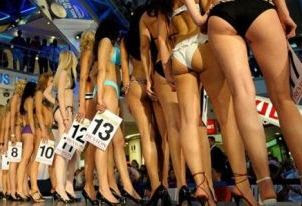
We thought the earth was composed of five continents. But we learned that Armenia has more ... As for the first time in Armenia, the Yerevan Opera Soundoukian to be held Wednesday July 29 the competition of beauty "Miss-seven continents in 2009.
Dozens of beauty came from Armenia, but also from England, Belarus, Bulgaria, Germany, Tunisia, Turkey, Italy, Latvia, Poland, Estonia, Kazakhstan, Russia, Slovakia, Georgia, the Czech Republic, Serbia, Ukraine and France will try to win the title. The event is sponsored by the International Foundation "Miss and Mister" and the "Media Focus".
Krikor Amirzayan
Performance Test: Armenia Needs A Team Effort Off The Pitch
A week before Armenia shuts down for summer holiday there is an air of anticipation here that is less about relaxing than about the crucial condition of regional relations.
When heads of government return to their posts in September, they will have about six weeks to convince constituents and outsiders that they have a workable plan for peace between Karabakh and Azerbaijan, and harmony between Armenia and Turkey.
Let us hope leadership gets lots of rest during the annual holiday. Their task is monumental.
When (if, as plans have not been formalized) President Serzh Sargsyan and his Turkish counterpart Abdullah Gul meet for `Football Diplomacy II' around October 14, their meeting could signal the most significant period of change in independent Armenia's history.
Or, failing to find common ground could pour fresh salt in old and deep wounds and lead to an unraveling of whatever peace is found in the tenuous Karabakh ceasefire and tightening (if that's possible) of locked borders with Azerbaijan and Turkey.
Recent days - indeed, recent years - have been full of hours-long negotiation from which invariably emerge the refrain of 15 years of hopeful doubt: `We believe progress has been made . . .'
The October soccer match outcome could be predicted now - not in favor of Armenia. But the World Cup qualifier is hardly the focus. Rather it is the life-and-death issues surrounding it that makes sport secondary to the chance the game offers off the pitch.
Sargysan and Gul's anticipated meeting in Turkey carries the weight of expectation that relations will be `normalized', or that further fractious disagreement will lead to an eruption of simmering discontent.
Both presidents stand to gain. Making amends with Armenia would look good on Turkey's application for European Union membership. Settling the Karabakh issue to the satisfaction of his citizenry would put Sargsyan on a pedestal neither of his predecessors achieved.
But only Sargsyan stands to lose, should any agreement with Gul compromise Karabakh.
Oddly, the Armenian president in 2009 faces a similar situation as his nemesis, Levon Ter-Petrosyan, faced and was undone by, in 1998 (when Ter-Petrosyan appeared ready to concede regions of Karabakh, in exchange for a settlement).
The stage for the autumn gamesmanship is being set in Yerevan's blistering summer when political debate has heated beyond expectation.
This week saw movement toward a potential new oppositional coalition that would unite ARF (Dashnaks), Heritage (Raffi Hovanissian) and ANC (Ter-Petrosyan). A unified platform by the three would surely achieve a more formidable power than the opposition has seen.
Is should also signal a shift (a diminishing in fact) of Ter-Petrosyan's leadership role. The former president is famous for demanding regime change. Meanwhile, the Dashnaks focus on policy change. Even in resigning from the Government last April, the Dashnaks did not call for Sargsyan to step down (as ANC has repeatedly done). Plus, the Dashnak call for the resignation of Minister of Foreign Affairs Edward Nalbandian last week can be read as a denouncement of policy rather than personnel.
The middle ground is represented in the Heritage Party (national-liberal) which, like the Dashnaks (socialists), advocates `national ideology' and has demonstrated time and again that it is surely a party of the people.
An alignment of the three parties would strengthen attempts to keep pressure on President Sargsyan to step carefully while under the strong influence of his Moscow advisors.
Also in this hot summer, every politico in Armenia and plenty outside has roared his/her/their voice over speculation of positions that should be more sharply defined when October gets here.
Meanwhile the impression from Baku is that Azerbaijan's President Ilham Aliyev would be disappointed with any outcome except renewing the war in Karabakh. Short of former US President George W. Bush's `smoke `em out' frothing at the mouth (referring to Osama Bin Laden) in 2001, hardly no president could appear more blood thirsty.
Last week in London the Azeri president said that his country `reserves the right' to consider military action against Karabakh, adding that, otherwise, there would be no incentive for Armenia to pursue peace. Dissected, Aliyev's comment says that Armenia is incapable of diplomacy unless it comes with a threat. Nice. Has anyone pointed out to Aliyev that this discussion would be irrelevant had his country won the war that led us to this point?
Now is the time to let the air out of patriotic chest puffing. On both sides. Aliyev's rhetoric lowers the bar on constructive dialogue. Let us hope that Armenia's leadership will show its ability to perform on a higher plain. Such hope cannot be realized unless there is unity of purpose - a condition sadly lacking in recent days as Armenia is polarized over `Madrid Principles' and `Road Map' diplomacy, and the usual vagaries that create division of political ideology.
Let us hope that the August reprieve will return leadership on all sides that is ready to present a team effort of solidarity when its soccer squad takes the field for a relatively meaningless match.
armenianow.com
“Turkey’s Canny Foreign Minister Seeks to Pursue Delicate Diplomacy All Around”, 2009/07/24 
What follows is an article from the July 23 edition of The Economist. regarding the new foreign policy approach of Turkey ever since Ahmet Davutoglu took over the reins of the foreign ministry in Ankara. The article points to the flexibility of Turkish foreign policy in dealing with regional neighbors; a policy that “blends real politik with fierce pride”.
At a time when much is being discussed as to Armenia’s problemmatic rapprochement with Turkey and Ankara’s renewed interest in the South Caucasus (e.g., Karabakh), we should be making a point to read all we can on Armenia’s neighbor to the West and her intentions.
WHEN the official result of Iran’s contested presidential election was announced last month, Turkey was one of the first countries to congratulate Mahmoud Ahmadinejad. Set against the repression (and deaths) of Iranian protesters in the streets, this raised eyebrows in Europe and America. It even provoked the tired old question of whether Turkey may be turning its back on the West.
“People see only one side of this story,” complains Ahmet Davutoglu, Turkey’s foreign minister, in an interview. He does not elaborate. But Turkey’s friendship with the Islamic republic has also proved useful to the West. Its behind-the-scenes mediation was instrumental in securing the recent release of British embassy staff in Tehran. And it can play both ways. Five Iranian diplomats detained by the Americans in Iraq in 2007 were freed earlier this month at Turkey’s urging.
The ease with which Turkey juggles different worlds, be they Arab or Jewish, Muslim or European, prompted Hillary Clinton to call it an “emerging global power”. Its strong relations with Israel matter to both countries, as became clear when they cooled during the invasion of Gaza in January. The Turks have just had a high-profile spat with China over its treatment of Xinjiang’s Uighurs, whom they regard as kinsmen. It was understandable that one of Barack Obama’s first presidential visits to a foreign country was to Turkey.
Some credit is due to Mr Davutoglu, who was a foreign-policy adviser to the prime minister, Recep Tayyip Erdogan, for seven years before becoming foreign minister in May. This spry former academic is seen as the architect of Turkey’s soft power, which blends realpolitik with a fierce pride. A pious Muslim with a moralistic bent, Mr Davutoglu has been among the most influential foreign ministers in the history of the Turkish republic.
His approach rests on two pillars. One is to have “zero problems” with the neighbours, many of them troubled or troublesome. The other is “strategic depth”. This calls for a Turkish zone of political, economic and cultural influence, primarily among neighbours (many of them former Ottoman dominions) in the Balkans, the south Caucasus and the Middle East.
None of this detracts from Turkey’s determination to join the European Union. Rather, it enhances its appeal as a member, says Mr Davutoglu. He seems unfazed by the hostile noises from France and Germany. Both Nicolas Sarkozy and Angela Merkel are lobbying for a “privileged partnership” instead of full membership for Turkey. Mr Davutoglu suggests that they are merely playing to their respective electorates. “Instead of complaining, of being angry, we should work together,” he says. For Turkey that means reviving the flagging reform process that won it the opening of EU membership talks in 2005. Mr Davutoglu is hopeful, for example, that the Greek Orthodox seminary on the island of Halki off Istanbul will soon be reopened.
But EU diplomats say none of this will let Turkey off the hook over Cyprus. Mr Davutoglu agrees that decades-old peace talks between Turkish- and Greek-Cypriot leaders should not be open-ended. A deal really needs to be struck by the end of this year. For that to happen the EU and America must tell the Greek-Cypriots to get serious (though, as EU members already, they have little incentive to help). A settlement would avert the possible train wreck in Turkey’s relations with the EU that might otherwise come in December. In theory Turkey has until then to open air- and seaports to the Greek-Cypriots, but it refuses to do this until EU trade restrictions on Turkish-controlled north Cyprus are lifted.
Might France and Turkey’s other enemies use this as an excuse to freeze the EU membership talks altogether (eight chapters have already been suspended)? Turkish leaders like to believe that Europe needs Turkey more than Turkey needs Europe. It has become even more crucial as a potential transit route for Europe-bound natural gas from energy-rich Azerbaijan and Central Asia, as well as from Iraq (and eventually Iran). Mr Davutoglu points proudly to the recent signing of an agreement between Turkey, Bulgaria, Romania, Hungary and Austria on the Nabucco pipeline that is meant to carry gas through these countries, reducing Europe’s dependence on Russia.
Yet some say that Turkey is overplaying its hand. Its energy dreams are tightly linked to its ethnic cousins in Azerbaijan. Relations between these Turkic allies took a dive in April when Turkey unveiled a draft agreement to establish diplomatic ties and reopen its border with Armenia. In a dramatic shift, Turkey even dropped its long-running precondition that Armenia must withdraw from the territories that it occupied in the 1990s after its war with Azerbaijan over the mainly Armenian enclave of Nagorno-Karabakh.
An infuriated Azerbaijan promptly threatened to turn to Russia. In June it signed a deal to sell gas to the Russians from 2010 onwards. So Turkey did another volte-face. Mr Erdogan declared that friendship with Armenia was no longer possible unless it withdrew from Nagorno-Karabakh. Mr Davutoglu insists that Turkey wants peace with Armenia. But one Western diplomat says that “rapprochement with Armenia is on its last legs.”
This has raised the spectre of a row with Turkey’s most powerful ally, America. Armenian-Americans want Mr Obama to honour his election pledge to insist that the massacre by Ottoman forces of more than a million of their ancestors in 1915 was genocide. In a fudge in April Mr Obama said that he had not changed his views on the matter; yet he spoke only of the Medz Yeghern (”great calamity” in Armenian). He did not want to torpedo Turkish-Armenian rapprochement by using the G-word.
Turkey’s strategic location had once again proven decisive. As American forces withdraw from Iraq, Turkey is seeking to avert a looming conflict between the Arabs and the Kurds, especially over the disputed city of Kirkuk. Turkey urged Iraq’s Sunnis not to boycott elections in 2005. Mr Davutoglu is again lobbying to ensure that all Iraqi groups take part in the parliamentary election in January 2010. “We have excellent relations with the United States at every level,” he says. And, notes a Western official, “when it comes to Turkey and Armenia, Turkey wins every time.”
Chevron Responds To National Campaign Exposing ‘Profit From Genocide Denial’ Scheme
SAN RAMON, CA–Chevron Corporation tried to explain away its opposition to Congressional legislation affirming the Armenian Genocide, using the standard Turkish and Azerbaijani government talking points to justify their complicity in denying this crime against humanity, reported the Armenian Youth Federation (AYF).
“As a major energy producer in the region, we support the integrity of multiple energy transportation routes and a diplomatic relationship between Turkey and Armenia,” Chevron spokesman Justin Higgs announced, adding that the genocide resolution, “would have hurt, not helped, relations between Turkey and Armenia.”
“An enduring diplomatic relationship between Turkey and Armenia can only be based on truth,” said AYF San Francisco chapter chairman Matt Senekeremian, leading the Bay Area protest. “Lobbying against the Armenian Genocide resolution is a pure and simple case of profiting from the denial of the murder of 1.5 million men, women and children – a short-sighted policy which only serves to fuel greater instability in the region.”
Chevron’s comments came as the Armenian Youth Federation (AYF) joined with Armenian Americans and human rights activists in kicking off a nationwide campaign to raise awareness about Turkish Government coercion of the energy giant and some five multinational corporations currently lobbying against Armenian Genocide legislation (H.Res.252). The resolution, spearheaded by Representatives Adam Schiff (D-CA), George Radanovich (R-CA), and Congressional Armenian Caucus Co-Chairs Frank Pallone and Mark Kirk, has over 125 cosponsors.

Rep. Schiff chastised Chevron and the other corporations for opposing the Genocide resolution, noting “I don’t think any major American corporation should be lobbying against the genocide recognition and become complicit in another country’s genocide denial,” Schiff told the Glendale News-Press. “I don’t think that’s being a good corporate citizen. It’s certainly putting profits in front of the public interest.”
The protests began on July 22, 2009 at the Chevron headquarters in San Ramon, California and local stations across the U.S., including sites in Burbank, La Crescenta, Pasadena, San Fernando Valley, Orange County, Glendale, Fresno, as well as Bethesda, MD, Orlando, FL and Philadelphia, PA. An online letter writing campaign to Chevron CEO Dave O’Reilly was launched in conjunction with the protests, urging the company to publicly apologize for profiting from Genocide denial. A copy of the letter was hand delivered to the Chevron corporate headquarters by protesters in San Ramon.
Concerned about public response to their action, Chevron’s corporate headquarters had alerted their franchisees about the AYF led protest prior to the campaign launch. Washington, DC area protesters also reported that Chevron had sent their own photographers to the protest.
Protests were covered in local newspapers, including the Orlando Sentinel, where AYF Keri chapter member Raffi Mekhdjavakian explained “It’s contradictory of Chevron to have their motto ‘The Chevron way’ and say that they are responsible and ethical when they are lobbying against a human rights situation,” said Raffi Mekhdjavakian, an Oviedo resident with the Armenian youth group. “If [the genocide] is denied it’s as if it never happened.”
Mekhdjavakian referrred to statements on Chevron’s website where the corporation prides itself on running the company the “Chevron Way” – responsibly, ethically and with respect to human rights. However, on June 13th, the Associated Press revealed that Chevron and 5 other multinational energy and defense corporations, including BAE Systems, Raytheon, Northrop Grumman, United Technologies and Goodrich have filed disclosure forms with the Senate and House “quietly” lobbying against
Demonstrators in Orange County delivering a letter to be sent to Chevron's corporate headquarters.
H.Res.252 the Armenian Genocide Resolution, among a wide array of legislation. In first quarter of 2009 alone, the six firms have spent some $14 million in Congressional lobby efforts. This is in addition to the over $3 million spent annually by the Government of Turkey to block U.S. affirmation of the Armenian Genocide, a cornerstone of their foreign policy priorities.
“Clearly, Turkey will spare to no expense to cover up its dark past,”said AYF Western Region Chairman Vache Thomassian. “Coercing corporations like Chevron to do its dirty deeds is just the latest tactic – exporting genocide denial to our neighborhoods, one gas station at a time.”
Complete information about Chevron’s lobbying efforts – including lobby disclosures forms filed with the Senate and House – are posted at http://www.anca.org/chevron. A Facebook group calling attention to the effort has over 1300 activists.
Asbarez/
Despite Obama, Turks Still Highly Dislike US, July 24, 2009 Ümit Enginsoy Washington – Hürriyet Daily News
Despite U.S. President Barack Obama's efforts to restore relations with Turkey and the Muslim world and his recent high-profile visit to Ankara and Istanbul, Turks still hold an unfavorable view of the United States, according to a poll released here Thursday.
Only 14 percent of Turks have a favorable view of the United States, while 69 percent have an unfavorable opinion, according to the 2009 Global Attitudes report by the Pew Research Center, a well-known U.S.-based polling institution.
The poll results are the product of interviews with more than 25,000 people in 25 countries during late spring. The favorability rating of the United States in Turkey was only 9 percent in 2007 and 12 percent last year, so this year's increase of 2 points is seen as statistically unimportant.
This outcome also means that the Obama administration’s high priority of improving ties with Turkey has not been reflected in Turkish public opinion.
The U.S. favorability rating in Turkey was 52 percent in 2000. The ensuing huge drops came as a result of the Iraq war and related developments, analysts say.
Other worrying news for bilateral ties is that about 40 percent of Turks view the United States as an "enemy," while only 18 percent consider it a “partner,” the results said.
Additionally, 54 percent of Turks still see the United States as a potential military threat for their country. That number is down from the 76 percent of Turks who viewed the United States that way two years ago.
Turks like no one:
Also, President Obama fares much better in Turks' eyes than former President George W. Bush, who last year had a favorability rating of only 2 percent. According to this year's poll, 33 percent of Turks said they trust Obama.
But, a better Turkish opinion of Obama has not helped the way Turks see the United States or Americans.
Only 14 percent of Turks said they have a favorable view of the American people, the report said.
In another worrying poll result, only 22 percent of Turks have a favorable view of the European Union, which Ankara wants to eventually join, while 59 percent hold the opposite view.
Large majorities of Turks also dislike Russia and China, the report said.
This year's findings on Turkey were similar to the 2008 results, which showed that Turks basically trust no foreign entity or leader.
A Summer For Movie Buffs, July 24, 2009 Emrah Güler Istanbul - Hürriyet Daily News
Though there are just a handful of new films in theaters, summer is not a completely dry season for movie-lovers. Upcoming film festivals in tourist towns, approaching competition deadlines and movie-making courses have much to offer enthusiasts
The International Silk Road Film Festival in the historic city of Bursa is getting bigger, better and bolder with each passing year.
Last year, the festival screened nearly 100 films from places as far away as China, Estonia and Mexico for Turkish and international guests, including Mexican heartthrob Gael Garcia Bernal. Though there are still months ahead before the festival, which will take place in November, filmmakers planning to enter the Golden Karagöz Short Film Competition this year have just a month and a half to finish their projects and apply for the grand prize of 9,000 Turkish Liras.
The deadline for the competition is Sept. 11. Entries must have been filmed in 2009; similar to last year, submitted films must also contain no dialogue, monologue or other narrative voice. The competing 15 films will be announced Oct. 3 on the festival’s Web site, ipekyolufilmfest.com.
From the Black Sea to the Mediterranean
The Black Sea region might be the best place to travel to in Turkey’s scorching summers, and movie buffs now have another good reason to head north. A brand-new film festival will begin Aug. 9 in the northeastern town of Hopa, near the border with Georgia. The festival, aptly titled Caucasus Film Days, will screen movies from five neighboring countries – Armenia, Azerbaijan, Georgia, Russia and Turkey – as well as a selection of documentaries.
Films to be screened include Armenian director Harutyun Khachatryan’s “Border,” Azerbaijani director Hüseyn Mehdiyev’s “Ösga Vaxt” (Another Time), Georgian director Jülie Bertuccelli’s debut feature and Cannes favorite in 2003, “Since Otar Left,” Russian director Aleksandr Sokurov’s “Alexandra” and new Turkish director Özcan Alper’s award-winning and groundbreaking “Sonbahar” (Autumn). Organized by the Biryaşam Culture and Ecology Association, the festival will delight viewers by screening the films on the beach under the moonlight.
Mixed news about two other festivals comes from the southern coast of Turkey. The good news is that the beautiful coastal town of Köyceğiz will host its Golden Film Festival, screening popular Turkish movies from last year and hosting acclaimed names from Turkish cinema such as actress Nebahat Çehre and director Erden Kıral. Check back for the Daily News’ festival coverage in the coming weeks.
Unfortunately, the popular tourism town of Bodrum has announced that the sixth Bodrum Film Festival, scheduled for September, has been canceled for undisclosed reasons. The residents strongly suspect it may have something to do with their newly elected mayor. They hope this will just be a short gap in the festival’s history and that Bodrum will be remembered for more than sun, sea and drunken tourists.
Movie courses for movie buffs
Staying on the southern coast, we move to Alanya, a magnet for German tourists. The town’s impressively active cinema group, the Alanya Sinematek Filmmakers Association, will offer a documentary-making workshop for the second time in September. Participants will include no more than 25 budding filmmakers, who are required to have basic knowledge of the craft. The workshop will feature an introduction to documentary making and courses on production, writing, cinematography, cameras and editing. Students will complete a joint documentary by the end of the program. Visit sinematekalanya.org.tr for more information.
Another workshop will bring aspiring screenwriters together in Istanbul next month. Organized by the Istanbul Photography and Cinema Amateurs Association, or İFSAK, the courses will be led by director, writer and costume designer Cem Başeskioğlu and will run on Wednesday evenings between Aug. 5 and Sept. 23. Başeskioğlu is known for his debut feature, “Sen Ne Dilersen” (Whatever You Wish), which won the Best Newcomer Writer award at the 17th Ankara International Film Festival. He is currently working on his new movie, “Merhamet” (Compassion). Check ifsak.org for information on the workshop.
Istanbul’s Digital Film Academy continues to bring film enthusiasts together for courses given by experts that offer full access to expensive equipment. Istanbul is the third center of the Digital Film Academy, which was founded by American actor and director Patrick DiRenna in New York. A new course on digital filmmaking will begin Aug. 24 and include instruction on project design, writing, production design, directing, working with actors, cinematography, lighting, camera techniques, sound editing and editing. Each student will complete one short film or a documentary by the end of the course, with each working on the others’ projects to master each element of the process. Check digitalfilmacademy.com.tr for information on this course and others to be offered in the coming months.
Istanbul Squad Aims For More Than Medals In Panarmenian Games, July 24, 2009 Vercİhan Zİflİoğlu Istanbul - Hürriyet Daily News
A squad of 31 athletes is set to represent Turkey at the PanArmenian Games, hoping to contribute to the dialogue between the two countries.
The games, which will bring together Armenian-origin athletes from more than 80 countries from all over the world, will be organized from Aug. 9 to 16 in Yerevan. Despite financial woes, Turkish Armenians decided to participate, thanks to financial support from the Istanbul Metropolitan Municipality and Şişli Municipality, going to the games to defend its title of the “team that represents its city the best,” which it won in 2007.
But it must be noted that not everything went well for the Istanbul athletes in previous games. A brawl broke out in a basketball game between American-Armenian team Glendale and the Turkish-Armenian team in 2007, after a Glendale team member verbally insulted his opponents. The police had to intervene in the brawl, but Turkish captain Akın Tekbıçak later added that two teams’ members made peace after a dinner together.
Garo Hamamcıyan, co-captain of the Turkish-Armenian squad, said the reception they got was much worse in early PanArmenian Games, but that things have changed.
“When we first went to Armenia [in 1999], there was prejudice and a certain distance toward us. They would not accept us as Armenians,” Hamamcıyan, a trainer and a former football player, told the Hürriyet Daily News & Economic Review.
Hamamcıyan notes that the number of Armenian people coming to Turkey for work has directly helped break the ice.
“About 40,000 Armenian people are working in Turkey,” said Hamamcıyan. “That contact has helped break the wall between Armenian people and Istanbul-based Armenians.”
Hamamcıyan, who was a prolific striker at Istanbul club Sarıyer in the early 1970s, said sports have always been a major factor in bringing countries together.
“In the past, many troubled countries took their first step toward amity with the help of sports,” said Hamamcıyan. “I hope that a new process that started with ‘football diplomacy’ will echo in relations between Turkish and Armenian people.”
“Football diplomacy” refers to the Armenia-Turkey World Cup qualifying round game in Yerevan on Sept. 6 at which Turkish President Abdullah Gül met with Armenian President Serge Sarkisian.
Hamamcıyan believes the Turkish team, which still has a dim chance of making it to the World Cup, is the favorite for winning the second game in Bursa in October, but regardless of the result, the game may be another opportunity to build on the positive steps of better relations between the two countries.
Caucasus Still Needs More Attention, Say Experts, July 23, 2009, Lacey Gonzales Istanbul
A workshop on Turkey-Georgia relations took place in Istanbul on the eve of the anniversary of Russia’s August war with Georgia – a conflict that sent shockwaves through the South Caucasus and sparked outcry among the international community.
Although Georgia and Turkey have historically close ties, the Caucasus region still needs more attention and focus, conference organizers and participants said Thursday.
The workshop was organized by the Foundation for Political, Economic and Social Research, or SETA, a Turkish nongovernmental organization that researches regional, national and international issues and proposes policy recommendations. Delegates from NGOs, universities, government and the media attended the conference aimed at looking more closely into the Turkish-Georgian relationship.
Building bridges
The Caucasus is a meeting point of opportunities, Savaş Barkçin, chief adviser to the prime minister, said, adding, “If we look at the horizon that unites both countries, this meeting will be fruitful and we will be able to build bridges.”
During the opening speech, he emphasized Turkey’s close proximity to the Caucasus region, a region that is, he said, at a crossroads. “When we look at today, [the Caucasus region] is an area of global competition in energy and security. The Caucasus region was at the periphery of world politics, but it is now coming to the center of world politics,” Barkçin said.
Taha Özhan, SETA director-general, said the main focus of the workshop was to question the status quo in the Caucasus and to try to bring solutions to the region.
In addition to diplomacy and stability, the Nabucco project, a natural gas pipeline project from Central Asia to Austria, was mentioned several times during the introductory speeches. “The Nabucco energy pipeline system brought forward all the relations between the Caucasus countries,” Özhan said. “It means that we need to focus our attention more on that region.”
SETA had organized two similar conferences prior to this workshop in Istanbul. Within the past three months, it also held a Turkey-Armenia workshop and a Turkey-Azerbaijan workshop. Hatem Ete, one of the workshop organizers, said SETA hopes to organize a Turkey-Russia workshop, with a culminating international workshop following that would bring together the ideas discussed in all four workshops between Turkey and members of the Caucasus region and Russia.
Armenia To Send Forces To Afghanistan This Year, July 23, 2009, YEREVAN – Daily News
Armenia is set to send forces to Afghanistan by the end of this year, the defense minister of the ex-Soviet nation said Tuesday. According to Defense Minister Seyran Oganian, Armenia is discussing details of the deployment with Germany, CTV News reported on its Web site. The minister did not elaborate on the number of servicemen Armenia is planning to send to contribute to NATO and U.S. operations in the war-torn country, but officials have said it would likely send munitions experts and communications officers. Armenia had approximately 50 military personnel in Iraq before withdrawing its contingent earlier this year. Oganian said some Armenians who fought in the Soviet Union’s unsuccessful war in Afghanistan in the 1980s would like to return to the turbulent country as part of the new force.

Armenia Doesn't Seek Friendship, But Only Normal Neighborly Relations With Turkey /Panarmenian.Net/14.07.2009
Armenia seeks rapprochement with Turkey without preconditions or opening of Armenian-Turkish border, National Security Council Secretary Arthur Baghdasaryan said in an interview with Spiegel Online German newspaper. According to him, opening of borders with Turkey spells new economic projects, new possibilities for energy supply diversification. "Our neighbors are no enemy to us," he noted.
When questioned if friendship between Armenia and Turkey is possible in case Ankara refuses to recognize the Armenian Genocide, Arthur Baghdasaryan stated, "Armenian Genocide has already been recognized by many states, and we have to take our best efforts to prevent such tragedies from happening again. We don't seek friendship, but only normal neighborly relations with Turkey. There are dark periods in the history of our nations. But we have to look into the future, instead of living in the past."
Istanbul Armenian Historian Gives Lecture In Usa On Subject "Human Rights And World Peace", Noyan Tapan July 13, 2009
WASHINGTON, ARMENIANS TODAY. Between June 28 to July 7 famous Istanbul Armenian linguist and historian Barsegh Tooghladjian took part in the scientific and art conference in Washington held by American Biographical Academy and Biographical Center, Cambridge, England and gave a lecture on the theme "Human Rights and World Peace".
According to the Marmara daily, Tooghladjian is often invited to these conferences and often gives lectures. In 2000 he gave a lecture on the theme "The Turkish-American Relations in the History" and presented George Washington's oil painted portrait painted by talented painter Erol Sarafian.
Tooghladjian took that portrait to the White House himself and gave it to USA President Bill Clinton.
This time he took USA Secretary of State Hillary Clinton's oil painted portrait, which is also painted by Erol Sarafian, and gave it personally to the Secretary of State.
In Washington Tooghladjian visited Armenian Ambassador to the US Tatul Margarian and Turkish Ambassador to the US Nabi Shensoy.
Armenians Cynical Over Delays In Border Opening
Turkish-Armenian rapprochement reached a peak when President Abdullah Gül (R) met with his Armenian counterpart, Serzh Sarksyan, during a Sept. 6 visit to Yerevan.
Turkish-Armenian rapprochement reached a peak when President Abdullah Gül (R) met with his Armenian counterpart, Serzh Sarksyan, during a Sept. 6 visit to Yerevan.
On Yerevan's central Baghramian Avenue, a billboard used to advertise vacations in Turkey, but Armenian Prime Minister Tigran Sarkisian has told top-level officials here to take only short vacations and to take them in Armenia.
Sarkisian cited the need for more intensive government efforts to tackle the economic recession. “The individuals occupying the most important positions have no right to be absent from Armenia,” he said, as quoted by Armenia's azatutyun.am news site, adding that hard work awaits the government in their efforts to overcome the economic crisis.
In an openly antagonistic move against Turkey, the young members of the Armenian Revolutionary Federation Party (ARF or Dashnaksutyun) also appealed to the mayor of Yerevan to remove the advertisement for vacations in Turkey.
According to Richard Giragosian, director of the Armenian Center for National and International Studies (ACNIS), these are signs of a brewing distrust of Turkey in Armenia because of a sense that Turkey has been using the prospects of reopening its border with Armenia to gain an upper hand against the Armenian diaspora's pressure on world governments for genocide recognition.
Giragosian said further postponement of reopening the border with Armenia's estranged neighbor Turkey would make the normalization of relations harder, as their ties were severed in 1993 after Armenia occupied part of Azerbaijan's territory in a war over Nagorno-Karabakh.
Artists Know No Borders
The sixth Yerevan International Film Festival Golden Apricot was launched on July 12, with the traditional blessing of apricots and with dozens of movies from 65 countries, including Turkey.
Directed by Özcan Alper, “Sonbahar” (Autumn) will be screened in the festival's International Competition program. In addition, Senem Tüzen, with her feature film project “Komitas,” and Sibil Çekmen, with “Verchin Zang,” will participate in the Directors Across Borders Third Regional Co-Production Forum, according to İstanbul-based Anadolu Kültür.
The Armenia-Turkey Cinema Platform, initiated by Anadolu Kültür and the Golden Apricot International Film Festival, will also organize a documentary film workshop within the festival. The selected projects from Turkey are “Bavfille” by Müjde Arslan, “Once Upon a Time” by Zeynep Güzel and Nagehan Uskan and “Hasine” by Haydar Demirtaş.
“The longer Turkey waits, the more they lose trust. This is the perception in Armenia,” he said.
Observers say this perception has been increasing especially after Turkey and Armenia announced on April 22 -- just ahead of US President Barack Obama's April 24 address commemorating the World War I-era killings of Anatolian Armenians in the Ottoman Empire -- that they had achieved solid progress in talks on normalizing their relations and had agreed on a roadmap for restoring ties.
Yerevan Press Club head Boris Navasardian said it was obvious that Obama would not use the word “genocide” in his statement after the announcement by Turkey and Armenia. Obama indeed did not use the word. Instead he called the tragedy “Meds Yeghern,” (Armenian for “Great Catastrophe”) disappointing many Armenians. This was interpreted as Obama's desire to avoid harming efforts by Turkey and Armenia to establish ties and as recognition of Turkey's importance as a partner of the US in achieving several foreign policy goals in the region.
Following the April 22 agreement, the ARF decided to walk out of Armenia's coalition government, protesting the accord.
Months have passed, and there have been no steps forward by Turkey regarding reopening the border with Armenia. Instead, Turkish officials have stressed that “the restoration of Azerbaijan's territorial integrity is a condition for normalizing relations between Ankara and Yerevan.”
Gevorg Ter-Gabrielyan, country director of the US, Norway, and UK-supported Eurasia Partnership Foundation in Armenia, said expectations for Turkey are high and are held not only by the Armenian side.
“There are a lot of expectations, but they are not just Armenian. They are also US and Russian. Everybody wants this border to be opened; it is in everybody's interest,” he said.
He also said that Turkey and Armenia should establish diplomatic relations before the two countries' soccer match in October in Turkey.
“The border should be opened to receive Mr. [Serzh] Sarksyan. And then they should forget to close the border,” he said. “Opening the border for Sarksyan will have a symbolic significance, but if it closes again, it will make people very disappointed.”
Indeed, Armenian President Sarksyan accused Ankara of failing to honor agreements and “misleading the international community” last week, although he had seemed quite optimistic about the early steps toward normalization of Turkish-Armenian relations.
Political observers even say that Sarksyan might refuse to go to Turkey for the upcoming soccer match if a commitment such as signing an agreement to open the border is not made between Yerevan and Ankara.
16 July 2009, Yonca Poyraz Doğan
Turkish-Armenian Rapprochement And Obama's Policy In The Caucasus, Národná¡ Obroda, July 15 2009, Slovakia
I have asked Vahan Dilanyan, President of Political Developments Research Center, Yerevan, to write an article for Slovak magazine Euro-Atlantic Quarterly. He was very kind and he agreed. His piece was published in Slovak in 2/2009 edition and you can find it here in English.
The developments from the Russian-Georgian war of last August, to the global financial crisis brought about essential changes in the political situation in the Caucasus. All the energy programs that have until now been implemented in the region, having Armenia debarred from, have always made the Caucasus “incomplete” in terms of regional security. The Baku-Tbilisi-Ceyhan and Baku-Supsa pipelines blocked during August war asserted the time for “political railroads, roads and pipelines” is over and that the Caucasus would be more secure if it were full of “economic cross-roads”. In these circumstances, Turkish and Armenian leaders took historic and courageous steps on reconciliation of their over 15 years “closed” relationships. The rapprochement of Turkey and Armenia considers being “a new Door” for resolution the vacuum in the region and creation of good atmosphere for future regional intimacy.
In 1993 Turkey closed the borders with Armenia regarding Nagorno-Karabakh war between Azerbaijan and Armenians. Ankara has always set preconditions on Armenia to opening the borders; withdrawal of Armenian troops from Nagorno-Karabakh and refusal of Armenian Genocide done by Ottoman Turks in 1915. Instead, Yerevan has been demanding the opening of the border and the establishment of diplomatic relations “without any precondition.”
Turkey and Armenia intensified their negotiations in August 2007 with diplomats regularly meeting in Geneva to discuss the issues related to reconciliation. With President Abdullah Gul’s visit to Yerevan in September last year to attend a Turkish-Armenian soccer match, and the meeting between Armenian President Serzh Sarkisian and Turkish Prime Minister Tayip Erdogan in January 2009 during World Economic Forum in Davos, indicated the political will of both sides about proceeding with rapprochement. The next meeting of Armenian and Turkish Presidents in Prague on the 8th May 2009 was the “verification of common wishes”; “We agreed to respect the agreement reached,” the Armenian President told reporters.
Since mid 1990s US has worked intensively on establishing a dialogue between Turks and Armenians through meetings among Civil society actors. Both of these two nations entertained big hopes with President-elect Obama. The recent visit to Ankara of US President made obvious that US fully supports the started dialogue between Ankara and Yerevan. “An open border would return the Turkish and Armenian people to a peaceful and prosperous coexistence that would serve both of your nations. That is why the United States strongly supports the full normalization of relations between Turkey and Armenia.”- President Obama stated in the Turkish Parliament. Back then both Turks and Armenians were impatient to observe president Obama’s annual April 24 statement, the day when the world’s Armenians commemorate the historical tragedy. Barrack Obama’s campaign promise was to call the mass slaughter of Ottoman Armenians in 1915 a “Genocide”.
Turkey is sensitive about Genocide issue. It had several times been stated by Turkish side that the incremental diplomatic progress could well be lost if Obama recognizes Armenian Genocide. The “solution” was found in April 22, when Turkey and Armenia, together with the Swiss mediators, signed a joint statement saying: “The two parties have achieved tangible progress and mutual understanding in this process and have agreed on a comprehensive framework for the normalization of bilateral relations in a mutually satisfactory manner.” In this context, a road-map has been identified. Later on April 24 American President tried to please all sides, by uttering the Armenian term “Medz Yeghern”, meaning “great calamity” and praising Turkey’s and Armenia’s peacemaking efforts. The Turkish newspaper Hurriyet writes, Turkey signed the agreement under US pressure to escape from the Obama’s possible pronunciation of the term “Genocide”.
The US State Department welcomed the agreement. “It has long been and remains the position of the United States that normalization should take place without preconditions and within a reasonable timeframe,” said spokesman Robert Wood. It was obvious that the “road-map” was one of the achievements of Obama’s policy in the Caucasus. It essentially refreshed the US traditional position in Turkish-Armenian dialogue process and balanced the recently activated Russian influence over it.
Baku is distressed about Turkish-Armenian rapprochement as it has always had Turkey’s sympathy over Azerbaijan regarding the Nagorno-Karabakh issue. The road-map alarmed the possible end of “one nation-two states” Azeri-Turkish concept as no mention of the Karabakh precondition was there in the agreement. Yet the philosophy of Obama’s security policy considers the opening of Armenian-Turkish borders as a “clue” of re-establishing “Trust” in the region and a stimulus to settle the Karabakh conflict. The “positive mood” created by the Turkish-Armenian roadmap, “gives a new energy to accelerate our work to help resolve the Nagorno-Karabakh conflict” said Matthew Bryza, US Co-Chair of the OSCE Minsk Group.
Turkish-Armenian intimacy will also destroy the “century wall” between US and Russia. Armenia is the only country bordering Turkey, a NATO member, where Russia has troops, the only Russian military presence in the Caucasus. After the borders open and diplomatic relations establish, there will be no need of Russian troops presence. It will assist NATO’s enlargement towards the East, and US could see Turkey as a “controller” in the Caucasus. Turkish-Armenian intimacy could positively influence the possible formation of a dialogue between Iran and West taking Armenia’s friendly relations with Iran.
Therefore, this will have a regional re-balancing role on the Russia dimension. The latter though, meets several challenges. Turkey imports 65% of its natural gas and 25% of its oil from Russia, Armenia’s railroads belong to Russian Railways and 70 % of the energy sector of the country also is owned by Russians. These facts create obstacles on Armenia’s entire integration to the West through Turkey. However, the re-opening of Kars-Gyumri rail-road, which could be one of the 1st steps of the road-map, is welcomed by Russia as well. Moscow now supports the Turkish-Armenian rapprochement while it has always been worried about loosing control in the Caucasus if Armenia integrates with Turkey. The August war has “cut” Russia’s “connections” with the South. Now it needs to functionalize “alternative connections”, through Armenia and Turkey, while trying to isolate Georgia. Moscow’s will to buy Azerbaijan’s gas which is considered to become one of the main suppliers for Nabucco, and the intention to realize the Russia-Azerbaijan-Iran railroad project, pursues the same purpose.
It should be noted that the Turkey’s recently activated “eastern initiative” has formed a new environment for Turkish-Russian rapprochement. US should take into consideration the recent actions by Turkey; the fact that Turkey, being a NATO member, kept a neutral position in Russian-Georgian war and the “Security Platform in Caucasus” offered by Turkey without the consent of the United States. However, Obama’s opposition on the war in Iraq, which caused Turkey to turn away from the US, has created a good atmosphere to re-evaluate the American-Turkish partnership. The recent visit of president Obama to Turkey was a big boost towards this end. The US full support on Turkish-Armenian dialogue adds on to the reconsideration of the Turkish role in key energy pipelines. In this case, if Turkey, under US pressure, manages to reach to stabilized relations with Armenia, new routes for natural gas to Europe could open up in the future, decreasing Russian leverage against Europe. The law of Geopolitics highlights that the closeness of two Eurasian Powers’ interests is timely, and that they naturally confront. Thus, Turkey should realize the rapprochement with Russian isn’t long-lasting. Besides, Obama’s new administration should coordinate efforts on keeping up with its traditional image on Turkish-Armenian dialogue formation, which will affect the resolution of other conflicts in the region, create a “window of opportunity” for alternative energy projects and move the Caucasus states towards a common secure future. / Euro-Atlantic Quarterly 2/2009
America's Tense Multicultural Bouquet: Armens, Native Americans, Asians, Blacks, Latinos July 17 2009 Exploding Time-Bomb? www.examiner.com/ By Frosty Wooldridge
An odd thing happened to the United States in the 21st century as it tripped into quicksand over its guilt-ridden past of discrimination toward minorities such as Native Americans, Asians, Blacks and Latinos. What happened?
After all, the fact remains that white settlers trespassed, ravaged, and slaughtered 522 Indian tribestheir languages, cultures and ways of life. Anyone reading Bury My Heart at Wounded Knee or The Sand Creek Massacre cannot help but cry at the brutality committed against the aborigines of North America in the 1800s.
To see the Indian reservations today, one weeps at rampant alcoholism, domestic abuse and utter hopelessness of cultures unable to operate in the white mans worldbut totally cut away from their own traditions. Its sad beyond belief.
Their situation may be much like present day Palestine and Israel. The Jews of Israel commandeered the Muslims lands around Gaza, but unlike the docile American Indians, the Muslims responded with rockets, bombs and modern weaponry. An uneasy tension and outright hatred percolates throughout the region.
Back in the USA, without a doubt, African-Americans still suffer from being ripped out of their countries in Africa while forced into slavery. They lost their languages, cultures and ways of life. Traders shredded family members at will and with malice. The white man tore them from their agrarian lives into the mechanized age.
In the case of impoverished Mexico, Latinos crossed into the USA willingly to work the fields while enduring racism on every level. Of course, they hated the gringo equally, feeling that he stole their lands.
But in 1965, thanks to U.S. Senator Teddy Kennedy, the United States commenced changing its ethnic makeup by importing millions upon millions of immigrants from all over the third world. Under the guise of multiculturalism and diversity, the citizens of the United States watch(ed) indolently as their own culture, language and way of life vanished(s) into the hands of a peaceful, methodical and invading armada of humanity. Within the past 20 years, over nine million Middle Eastern Muslims now make the United States their home. They expect to grow to 20 million in a few decades.
Unlike the American Indians that maintained small populations, Latinos, by 2042 will become the new majority within the United Statestotally displacing the white mans culture and language within a 60 year period. As an ethnic group, they do not tolerate blacks or whites, and it will be interesting to see how they abide with Muslims.
America immigrated itself out of its identity and into a multicultural and diversity predicament. As President Teddy Roosevelt said, The one absolutely certain way of bringing this nation to ruin, or preventing it from continuing as a nation at all, would be to permit it to become a tangle of squabbling nationalities.
All the while, everything in America changes beyond its own understandingmuch like what happened to the American Indians. Upon his final capture, Warrior Chief Geronimo said, I think we have lost our way of life forever.
America spirals into the same dilemma on a gargantuan scale. In the past 40 years, the United States revoked its laws, its culture, its language and its Constitution in order to accommodate outcries from minorities, dispossessed and foreign religions.
In the 60s, Lyndon Baines Johnson offered billions to bring the poor into the Great Society. Tax dollars paid for college tuition for minorities. Every child passed to the next grade whether they accomplished the work or not. As a teacher, I saw affirmative action grading allow children who wouldnt do their workpassed to the next grade. Later, affirmative action jobs and quotas based on color rather than standards became the norm for workers and students.
But today, Black Americans suffer terrific unemployment, illiteracy and broken families. Millions of kids grow up with a single parent. Violence, ghettos, obesity and hopelessness prevail. In California, Latino gangs dominate Los Angeles neighborhoods as schools house students before graduating them to the streets, unable to read or write. Millions of unwed teens bring babies into the world with no hope of supporting them other than taxpayer welfare. In Detroit, Michigan, according to NBC anchor Brian Williams, high school dropout rates last year hit 76 percent.
Result: a horrific 32.2 million Americans subsist on food stamps! You must work to get your hands around that number! In America? How? Why?
Today, the same U.S. Congress that perpetrated our massive transmutation into a multicultural society, ponders the appointment of Latino Judge Sonia Sotomayor. By her own admission, she represents affirmative action quotas into law school and appointments. She most likely will become an affirmative action Supreme Court judge. Yet, when minorities scream at anyone making even the slightest racist statement, she said, I would hope that a wise Latina woman with the richness of her experiences would more often than not reach a better conclusion than a white male that hasnt lived that life.
Americans will find themselves in new conditions as this new legal, multicultural experiment manifests in the coming years. However, it does not portend well for anyone no matter what their race. In a speech in Washington DC, former Colorado Governor Lamm said, If you believe that America is too smug, too self-satisfied, too rich, then lets destroy America. It is not that hard to do. No nation in history has survived the ravages of time. Arnold Toynbee observed that all great civilizations rise and fall, and that, An autopsy of history would show that all great nations commit suicide.
Here is how they destroyed their countries, Lamm said. First, turn America into a bilingual or multi-lingual and bi-cultural country. History shows that no nation can survive the tension, conflict and antagonism of two or more competing languages and cultures. It is a blessing for an individual to be bilingual; however, it is a curse for a society to be bilingual. The historical scholar Seymour Lipset put it this way, The histories of bilingual and bicultural societies that do not assimilate are histories of turmoil, tension and tragedy. Canada, Belgium, Malaysia, Lebanon, Holland, Great Britainall face crises of national existence in which minorities press for autonomy, if not independence. Pakistan and Cyprus have divided. Nigeria suppressed an ethnic rebellion. France faces difficulties with Basques, Bretons and Corsicans.
Finally, with America adding 70 million more immigrants within the next 26 years, I see ramifications that explode beyond our current predicament best summed up by Dr. Otis Graham, Most Western elites continue urging the wealthy West not to stem the migrant tide, but to absorb our global brothers and sisters until their horrid ordeal has been endured and shared by all--ten billion humans packed onto an ecologically devastated planet.
Like a chemistry experiment where unknowing students pour a bouquet of chemicals into a beaker, no one knows what kind of an explosion will occur, but they feel something regrettable happening.
At this moment, the British, Dutch and French that will become minorities in their own countries by mid century, may be asking themselves why they did the same things as America.
And the American people, unlike the American Indians, did it to themselves. America will never be the same; never get better. Payback, as they say, is a *itch!
We need a "US Sustainable Immigration Policy" of 100,000 annually. Why that number? That's how many egress the country annually. It would allow a zero net gain and stable and sustainable population.
##
To take action: First and foremost, join www.numbersusa.com and become one of nearly a million Americans making impact with pre-written faxes and phone calls to change immigration policies toward a stable future. Bi-partisan and highly effective!
Second, join www.thesocialcontract.com for up to date information via the Social Contract Quarterly. Exceptional publication to keep you informed.
www.fairus.org ; www.vdare.com ; www.alipac.us ; www.firecoalition.com ; www.cairco.org ; www.limitstogrowth.com ; www.capsweb.org ; www.populationmedia.org ; www.worldpopulationbalance.org ; LimitsToGrowth.org
America on the Brink: The Next Added 100 Million Americans by Frosty Wooldridge. Describes the ramifications of sheer overpopulation loading of the USA within 30 years. For a copy: 1 888 280 7715.
Visit this site for a rendition of Colorado Governor Lamms speech: How to Destroy America
http://usawakeup.org/HowToDestroyAmerica.htm
Must see DVD: Blind Spot
This movie illustrates Americas future without oil, water and other resources to keep this civilization functioning. Its a brilliant educational movie!
In Canada: Tim Murray,
Director Immigration Watch Canada www.immigrationwatch.org
Vice President Biodiversity Firsthttp://biodiversityfirst.googlepages.com/index.htm
Bloghttp://sinkinglifeboat.blogspot.com
Watch the DVD movie: Blind SpotExceptional movie with top scientists candidly discussion what we face as a civilization if we continue on our hyper-population growth path. www.blindspotdoc.com
Please visit Annie Leonard at www.storyofstuff.com for a compelling and highly interesting 20 minute video concerning our high consumption, highly wasteful and unsustainable society. She educates and provides avenues for you to make a difference.
Visit this web site by Chris Martenson:http://www.chrismartenson.com/environmental_data
In Colorado: visit www.soprisfoundation.org for information how you can network with like-minded folks to create a more sustainable future for Colorado and other states.
View CNNs Planet in Peril with Anderson Cooper and Lisa Ling:
http://www.cnn.com/SPECIALS/2008/planet.in.peril/
Ghost of Thomas Painecompelling video of common sense
http://www.lawatchdog.com/index.html#anchor_2296
BARACK HUSSEIN OBAMA: D.C.: (202)224-2854 comment@whitehouse.gov
Books to read: The Long Emergency by James Howard Kunstler
Peak Everything by Richard Heinberg
Too Many People by Lindsey Grant
Become a member of Frostys Press Agent Corps whereby you volunteer a few hours to send out emails to top TV and radio hosts to offer top speakers on Americas overpopulation crisis driven by unending immigration. Email frostyw@juno.com and receive two informational letters showing you exactly what to do.
Roy Beck's "IMMIGRATION BY THE NUMBERS" is the single best educational appreciation of America's future if we allow ourselves to add another 100 million people. Just click on this site for the most sobering experience of your children's future.
http://video.google.com/videoplay?docid=4094926727128068265&q=roy+beck&hl=en
Roy Beck gives a graphic presentation of our fate if we continue to allow legal and illegal immigration to swamp this country. If you have children, you will be particular unnerved at their fate. I know Roy Beck personally and his integrity and knowledge stand at the top. Pass this web site 14 minute video far and wide across America to educate everyone you know. We either stop this human tsunami or the future of this country will be much like Rome's. We must, as a nation and a civilization, move to secure our country from this massive, unrelenting population overload from a line that never ends. This will be the most compelling 14 minute video of your life.
Once you see it, go to my web site for action items www.frostywooldridge.com and join www.numbersusa.com to become a weekly faxer of pre written letters and join the phone calling teams.
Bob Woodruff of ABC asked input from all citizens concerning the future of our planet. Go to www.earth2100.tv for a sobering reality check as to what we face and to what I have been writing about for the past 20 years. Our window to change to a balanced population and non-polluting energy diminishes every day we listen to irresponsible media and thus ignore the blatant symptoms manifesting all over America and the planet.
From: Frosty Wooldridge
This three minute interview with Adam Schrager on Your Show May 4, 2008, NBC Channel 9 News, addresses the ramifications of adding 120 million people to USA in 35 years and six million people to Colorado as to water shortages, air pollution, loss of farmland, energy costs and degradation of quality of life. In the interview, Frosty Wooldridge explains the ramifications of adding 120 million people to the USA in 35 years. He advances new concepts such as a Colorado Carrying Capacity Policy; Colorado Environmental Impact Policy; Colorado Water Usage Policy; Colorado Sustainable Population Policy. Nationally, the USA needs a "National Sustainable Population Policy" to determine the carrying capacity of this nation for the short and long term.
Historic Euphrates River Is Drying Up Strangled By Clashing Policies And Rampant Misuse July 15, 2009, Campbell Robertson, New York Times
JUBAISH, Iraq – Throughout the marshes, the reed gatherers, standing on land they once floated over, cry out to visitors in a passing boat.
"Maaku mai!" they shout, holding up their rusty sickles. "There is no water!"
Photo: Adilla Finchaan, 50, checks her land in Al Latifiyah, Iraq, July 9, 2009. A two-year drought and dams in Syria and Turkey have helped shrink the Euphrates River. (Hadi Mizban / AP)
The Euphrates is drying up. Strangled by the water policies of neighbouring Turkey and Syria; a two-year drought; and years of misuse by Iraq and its farmers, the river is significantly smaller than it was just a few years ago.
Some officials worry that it could soon be half of what it is now.
The shrinking of the Euphrates, a river so crucial to the birth of civilization that the Book of Revelation prophesied its drying up as a sign of the end, has decimated farms along its banks, left fishermen impoverished and depleted riverside towns as farmers flee to the cities looking for work.
The drought is widespread in Iraq. Along the river, rice and wheat fields have turned to baked dirt. Canals have dwindled to shallow streams, and fishing boats sit on dry land.
The area sown with wheat and barley in the rain-fed north is down by roughly 95 per cent, and the date, palm and citrus orchards of the east are parched.
For two years rainfall has been far below normal, leaving the reservoirs dry, and U.S. officials predict that wheat and barley output will be a little over half of what it was two years ago.
It is a crisis that threatens the roots of Iraq's identity, not only as the land between two rivers, but as a nation that was once the largest exporter of dates in the world, that once supplied German beer with barley and took patriotic pride in its expensive Anbar rice.
The Bible says the Euphrates river will be the initial division between the North and the South when the nations of the world begin to align in preparation for the battle of Armageddon. It is in this last battle that the nations of the earth will fight Jesus Christ and His angels coming down from Heaven. Jesus will conquer all the armies against Him and will begin to directly rule the world from His throne in Jerusalem. Map of Euphrates River Valley and Middle East: Battleground for World War III.
Now Iraq is importing more and more grain. Farmers along the Euphrates say with anger and despair that they may have to abandon Anbar rice for cheaper varieties.
Droughts are not rare in Iraq. But drought is only part of what is choking the Euphrates and its larger, healthier twin, the Tigris.
The most frequently cited culprits are the Turkish and Syrian governments. Iraq has plenty of water, but it is a downstream country. There are at least seven dams on the Euphrates in Turkey and Syria, according to Iraqi water officials.
With no treaties or agreements, the Iraqi government is reduced to begging its neighbours for water.
But many U.S., Turkish and even Iraqi officials say the real problem lies in Iraq's own deplorable water management policies.
Leaky canals and wasteful irrigation practices squander the water, and poor drainage leaves fields so salty from evaporated water that women and children dredge huge white mounds from pools of runoff.
There is no shortage of resentment at the Turks and Syrians. But there is also resentment against Americans, Kurds, Iranians and the Iraqi government. Scarcity makes foes of everyone.
In the southeast, where the Euphrates nears the end of its 2,780-kilometre journey and mingles with the less salty waters of the Tigris before emptying into the Persian Gulf, the situation is grave.
The marshes there that were intentionally reflooded in 2003, rescuing the ancient culture of the marsh Arabs, are drying up again. Sheep graze on land in the middle of the river.
The farmers, reed gatherers and buffalo herders keep working, but they say they cannot continue if the water stays like this.
"Next winter will be the final chance," said Hashem Hilead Shehi, a 73-year-old farmer who lives in a bone-dry village west of the marshes. "If we are not able to plant, then all of the families will leave."
www.thestar.com/news/world/article/666343
http://standeyo.com/NEWS/09_Earth_Changes/09_Earth_Changes_pics/090715.Finchaan.jpg
http://standeyo.com/NEWS/09_Earth_Changes/09_Earth_Changes_pics/090715.Euphrates.map.jpg
Iceland Throws Down A Political Challenge To Turkey
Baku, Fineko/abc.az. Iceland which bankrupted during first volleys of the global economic crisis has stooped to the proposal to become part of the European Union.
Alting, general assembly of the Island voted for country’s joining the EU.
33 mercantile citizens voted “for” and 28 liberty-loving vikings voted “against”. This numeral superiority can hardly be called large. Besides, the Island will not become a EU member right now. But the event for Europe as a whole and the EU in particular is decisive.
Icelandic Prime Minister Johanna Sigurdardottir has already called the voting a “historical moment to have very favorable consequences for the future of the nation”. But she apparently did not think of what a challenge the 33 mercantilists have thrown down to the European Commission.
The point is that registration of EU membership of Iceland, an island lying between Europe and America, while simultaneously the EU in fact refuses Turkey located on the European territory will mean moral and political insult to the Turkish elite that sets a goal of country’s acceding to the EU and agrees constantly on concessions for the sake of getting devout membership.
Acceptance of Iceland that in fact gives nothing to Europe with simultaneous refusal to Turkey will mean violation of norms established by the EU itself, in particular norms of equality, tolerance, democracy.
In practice it will mean that the 70-million European, although Moslem, country, has less rights to become part of the EU than the Christian island lost in the Atlantic. If such a choice is made, then Georgia with Armenia will be able to enter the EU earlier than Turkey which realized scheme of “Islamic democracy” (on analogy with European Christian democrats) or even earlier than secular Azerbaijan.
Iceland defied a challenge to the EU, Turkey and all the states that have done much to enter in “single Europe”. Choice in favor of Iceland will lead inevitably to appearance of alternate blocs.
At the same time no one should be deceived that Iceland was declining from membership in the EU for the reason of discontent with quota for fishing and that this island is a member of NATO, Northern Council, IMF, WB, UN and its organizations, CE and European Free Trade Association. But the same Turkey has no less regalia and deserts in “cold war”.
NC Hollywood Hosts Summer Forum on 2010 Census for Little Armenia
HOLLYWOOD, CA– Kicking off a round of upcoming summer activities, the Armenian National Committee of Hollywood (ANC Hollywood) hosted a summer Community Issues Briefing to raise awareness about the 2010 US Census within the Little Armenia community and provide an update on Armenian American issues at the federal, state, and local levels. The event was held at Karapetian Hall at Saint Garabed Armenian Church on Thursday, July 16th. Joined by representatives from the US Census Bureau including featured speaker and Partnership Specialist, Anahit Tovmasyan, the event drew over fifty local area residents many of them being high school and college students.
“It was great having an Armenian specialist from the Census Bureau explain the importance of next year’s census to Armenian-Americans and how it can affect our lives” remarked Paul Seradarian, ANC Hollywood Executive Committee member and one of the organizers of the evening’s event.
Tovmasyan explained how government funds are allocated every year on the basis of demographic data. This includes public school, public service, public safety, and other public budgets. She noted that while Armenian is not noted on an ethnicity on the current US Census form, Armenian-Americans can still stand up and be counted. While most Armenian Americans identify as Caucasian or “White”, there is a secondary question within the section asking for “Some other race – print race” in which individuals can mark “Armenian” in addition to the initial identification of “White” or other race/ethnicity that they may choose. While Armenian is an ethnicity and not a race, this is the option currently available for the Armenian American community to identify themselves as such on the upcoming US Census.
“If Armenian Americans make their voices heard through this simple step, we help ensure that our communities receive the respect and services they are due as contributing members of the communities in which they live,” noted Tovmasyan.
Tovmasyan explained that the US Census Bureau is partnering with community organizations to help raise awareness about the Census before 2010 to help make sure that everyone fills out the form and reduces the need for costly follow up efforts which would come at the taxpayers’ expense. She also discussed job opportunities with the US Census Bureau as the government is building its staff to help drive the educational and data collection effort. Tovmasyan was accompanied by colleagues from the US Census Bureau who helped her address audience questions.
The event was opened by Christine Semerdjian, a member of the ANC Hollywood Executive Committee who welcomed the community and discussed the ANC Hollywood’s recent activities including participation in this past May’s Armenian Independence Day festival on Hollywood Boulevard, and last week’s official unveiling of the Little Armenia freeway sign hosted by California State Assembly Member and Hollywood area representative, Kevin de Leon.
She was followed by Haig Hovsepian, Community Relations Director with the ANC Western Region, who updated the community about the recent developments with the Artsakh peace process, US recognition of the Armenian Genocide and its decoupling from Armenia-Turkey relations, and the foreign aid budget for Armenia and Azerbaijan for the upcoming 2010 fiscal year.
“I am really glad that I attended this very informational event. After learning about how the Census could affect Armenian Americans, I realized I have to be an active member of my community and inform others of the importance of it. I definitely look forward to attending other meetings like today’s because they open my eyes to what goes on in my community and Armenia itself,” said Tsovinar Karapetian, a senior at Francisco Bravo Medical Magnet High School who attended the briefing.
Seradarian delivered the closing remarks of the evening and encouraged those in attendance to stay involved with the ANC Hollywood. He noted that the ANC Hollywood would be joining the Thai Community Development Center next week on July 25th for its annual community fair. The day-long event is held each year and features community and social service organizations who work with the Hollywood community. ANC Hollywood supporters will be attending to help with the day’s event and translation needs. The event will be held at the corner of Western and Hollywood on the Metro plaza.
“The reinvigorated ANC Hollywood team is happy to have veteran community activists mentoring our newer members as we work together to do our best to secure the rights of Armenian Americans and promote their civic engagement in this community,” remarked Elli Menounou, a member of the ANC Hollywood Executive Committee Member in charge of community relations.
The ANC of Hollywood promotes greater understanding of issues of concern to the area’s Armenian American community and strives to increase Armenian American civic participation at the grassroots and public policy levels.
Asbarez/
Launch Of Negotiations On Armenian - Turkish Rapprochement Was A Mistake /PanARMENIAN.Net/ 16.07.2009
"I don't recall the last time when Presidents of major states like USA, France and Russia would make a joint statement," ARFD Supreme Body (SB) representative Armen Rustamyan told a news conference in Yerevan.
If earlier there were only conjectures in connection with Madrid principles, they're currently officially publicized by MG OCSE Co-Chairs, causing ARFD SB's agitated reaction.
Rustamyan also noted that RA President is currently under the pressure of USA, France and Russia.
According to him, opening the second diplomatic front was mistake as Armenia does not possess enough resources for simultaneous settlement of two issues.
Turkish Denial Campaign Continues In California AZG Armenian Daily , 16/07/2009
Last month, the Armenian Assembly of America (Assembly) reported that Turkey's ongoing global campaign to suppress the truth about the Armenian Genocide was dealt a major blow in a U.S. District Court. Chief Judge Mark Wolf issued a ruling in favor of the Massachusetts Department of Education (Department), which allows the Department to continue teaching the facts of the Armenian Genocide, and other crimes against humanity, in public schools across the Commonwealth, as constitutionally protected government speech.
Shortly after this landmark decision, as part of an ongoing campaign to derail human rights education, the Assembly of Turkish American Associations (ATAA) indicated, through a June 23 letter to the editor of the Boston Globe from its attorney Harry Silverglate, that it intended to appeal Chief Judge Wolf's decision in the case of Griswold v Driscoll. The appeal was officially filed on July 13, in U.S. District Court in Massachusetts.
"The Armenian Assembly appreciates the court's ruling in the matter and will work to ensure that it is sustained on appeal. This decision clearly demonstrates to Turkey and its revisionist allies that history cannot be rewritten to further Ankara's state-sponsored denial campaign," said Assembly Board of Trustees Chairman Hirair Hovnanian. Carolyn Mugar, the Board's President, added, "Given the overwhelming historical and legal evidence documenting the incontestable fact of the Armenian Genocide, this ruling is a victory for all those concerned about genocide education and prevention."
When this suit was initiated four years ago, the Assembly immediately responded by hiring one of the nation's preeminent First Amendment expert, Duke University Professor Irwin Chemerinsky, and co-counsel Arnold Rosenfeld of the firm K&L Gates LLP. Throughout this process, the Assembly, along with others, challenged the ATAA at every turn by filing a series of pleadings including an amicus curiae (friend of the court) brief. The brief was intended to assist the Court in bringing the case to a conclusion in favor of the Commonwealth.
Assembly's Board Vice-Chair and Counselor Robert A. Kaloosdian chaired the committee that responded to the lawsuit: "Through the federal court's ruling, the Griswold case rejected ATAA's attempt to require the Commonwealth of Massachusetts Board of Education to insert 'contra-genocide' citations into its curriculum guide. Judge Wolf wrote in his decision that 'plaintiffs do not have a right to receive contra-genocide information in the classroom.' In addition he wrote that 'the curriculum guide required defendants to include materials concerning the 'Armenian Genocide.'" "This ruling sends a message not only to the ATAA, but also to others who may seek to distort history," said Krikorian. "This was certainly a direct blow to ATAA's plan to get a favorable ruling here and then repeat the tactic in every school district across the country. The court's decision cuts them off, destroys that plan and protects the Commonwealth of Massachusetts' Department of Education from being subject to manipulation from a genocide denialist organization, which is carrying out its campaign of dishonesty from coast to coast," added Krikorian.
ATAA Threatens to Oppose Human Rights Education and Passage of California Genocide Awareness Act At the California Senate Education Committee public hearing, the ATAA and Armenian Genocide denier Bruce Fein testified against the passage of the Genocide Awareness Act. He also questioned whether the mistreatment of the Armenians, and the parallel cases in Cambodia and Darfur were genocide, despite the fact that the California legislature has repeatedly recognized and annually commemorated the Armenian Genocide since 1968.
Guests From Armenia To Be Given Flowers And To Be Served During Armenia-Turkey Football Match In Kesaria, Noyan Tapan - Armenians Today July 15, 2009 Istanbul
Armenia-Turkey football match to be held in October is being prepared in Kesaria. On this occasion 70 thousand pinks are envisaged to decorate the sports ground.
The Marmara daily reports referring to the Turkish Sabah daily that besides the 70 thousand pinks, the families of Kesaria are going to receive and serve the Armenian team fans, who will arrive in Kesaria to watch the competition. A Hospitality Club will be also opened.
The football match will take place at a newly built, modern Kadir Has sports ground. The chairman of Florists Union Erengul said that the sports ground will be decorated like a bride, each woman fan of Armenian team will be given a rose and the men will be given a pink or any other flower. "We should express our love and open-mindedness with flowers," Erengul said. And the football players and those accompanying will be given bouquets.
It is mentioned that the goal of these events is the rapprochement of Armenians and Turks.
Armenian National Congress: Karabakh Talks Close To Producing ‘unfavorable’ Solution For Armenians
YEREVAN -- Armenia’s main opposition has predicted a close denouement in the ongoing peace talks with Azerbaijan over Nagorno-Karabakh, but said the solution was not going to be a pro-Armenian one. The Armenian National Congress (HAK) led by former president Levon Ter-Petrosian said in a statement released on Monday that “the most serious developments are being observed in the Nagorno-Karabakh conflict settlement which can be decisive in terms of an ultimate resolution of the issue.”
In a joint statement issued by U.S. President Barack Obama, Russian President Dmitry Medvedev and French President Nicolas Sarkozy at the G8 Summit in Italy late last week, the leaders of the three nations leading international efforts on the Karabakh conflict resolution as part of the OSCE Minsk Group affirmed their commitment “to support the leaders of Armenia and Azerbaijan as they finalize the Basic Principles for settlement of the Nagorno-Karabakh conflict.”
They urged the presidents of Armenia and Azerbaijan “to resolve the few differences remaining between them and finalize their agreement on these Basic Principles, which will outline a comprehensive settlement.” Considering the statement by the presidents of the U.S., Russia and France as a milestone, the HAK emphasized that the document still did not reveal “the updated version of the document that the settlement is supposed to be based upon.”
“Therefore, the HAK postpones its ultimate evaluation till a future date when details revealing the essence of the document become clear,” it said.
At the same time, the HAK voiced its concern on several points in the revealed Basic Principles. Those included: Nagorno-Karabakh’s status is not a subject of current discussion, the provision of a referendum has been removed from the agenda and replaced with a vaguer wording, a land link between Armenia and Karabakh is defined unclearly, the current principles imply the return of Azeri refugees even to Nagorno-Karabakh proper, and finally there is no word about lifting the blockades of Armenia.
“It’s been a year and a half that we have voiced our concern over these dangerous developments,” the HAK said.
The HAK has opposed the government of Serzh Sarkisian ever since the latter’s fraudulent election as president in February 2008. The HAK has repeatedly called Sarkisian’s government illegitimate and described it as ‘a soft target’ for external pressures over Nagorno-Karabakh.
“It is on this basis that [the international community] has forced the authorities of Armenia to make serious concessions both in the Armenian-Turkish and Karabakh settlement processes,” said the opposition in its latest statement.
The opposition forces believe that the only way to stop the ‘dangerous’ process and prevent Sarkisian from signing the ‘crucial document’ is a demand for his resignation “supported by the population of Armenia, Karabakh and all concerned political forces”.
The opposition also called for snap presidential and parliamentary elections “to form a government that enjoys public trust” and which “will be able to defend the national interests of the Armenian people before the international community.”
Statement On Nagorno-Karabakh By U.S., Russian And French Presidents
Joint Statement on the Nagorno-Karabakh Conflict by U.S. President Obama, Russian President Medvedev, and French President Sarkozy at the L’Aquila Summit of the Eight, July 10, 2009.
- We, the Presidents of the OSCE Minsk Group’s Co-Chair countries France, the Russian Federation, and the United States of America affirm our commitment to support the leaders of Armenia and Azerbaijan as they finalize the Basic Principles for settlement of the Nagorno-Karabakh conflict.
We are instructing our mediators to present to the Presidents of Armenia and Azerbaijan an updated version of the Madrid Document of November 2007, the Co-Chairs last articulation of the Basic Principles. We urge the Presidents of Armenia and Azerbaijan to resolve the few differences remaining between them and finalize their agreement on these Basic Principles, which will outline a comprehensive settlement.
Fact sheet
The ministers of the US, France, and Russia presented a preliminary version of the Basic Principles for a settlement to Armenia and Azerbaijan in November 2007 in Madrid.
The Basic Principles reflect a reasonable compromise based on the Helsinki Final Act principles of Non-Use of
Force, Territorial Integrity, and the Equal Rights and Self-Determination of Peoples.
The Basic Principles call for inter alia: return of the territories surrounding Nagorno-Karabakh to Azerbaijani control
-- an interim status for Nagorno-Karabakh providing guarantees for security and self-governance, -- a corridor linking Armenia to Nagorno-Karabakh;
-- future determination of the final legal status of Nagorno-Karabakh through a legally binding expression of will;
-- the right of all internally displaced persons and refugees to return to their former places of residence; and
-- international security guarantees that would include a peacekeeping operation.
The endorsement of these Basic Principles by Armenia and Azerbaijan will allow the drafting of a comprehensive settlement to ensure a future of peace, stability, and prosperity for Armenia and Azerbaijan and the broader region.
Karabakh Calls For ‘Resetting Distorted Process’
STEPANAKERT -- The Foreign Ministry of Nagorno-Karabakh issued a statement on Wednesday calling for ‘resetting’ the current negotiating process that it describes as ‘distorted’.
“The Nagorno-Karabakh Republic stance on the Azerbaijani-Karabakh conflict settlement remains unchanged. It is impossible to achieve the conflict settlement, ignoring the existing reality. Any attempts to return the Nagorno-Karabakh Republic to the past are not only counterproductive, but are also fraught with new escalation of the conflict,” the ministry said, insisting that “real progress in the negotiations is possible only with the Karabakh party’s equal participation in all the stages of the negotiation process.”
“No agreement regarding the interests, fate, and future of the Nagorno-Karabakh Republic can be adopted without the participation of its people and leadership, which bears the principal responsibility for it,” the ministry underscored.
The ministry also hopes that “all the actors interested in the peaceful settlement of the conflict will prevent any violation of the status-quo in the region.”
“We consider it required to reset the distorted negotiation process, to return the Nagorno-Karabakh Republic to the negotiation table as an equal party and to transform the basic principles of the settlement,” it concludes.
French Ambassador To Armenia: “nothing Unfamiliar” In Nkr Negotiations
/Armenianow.com/ While speaking on the eve of Bastille Day, French Ambassador to Armenia Serge Smessow said on Monday that the latest round of talks concerning Nagorno-Karabakh appears to have “only familiar realities. . . There is no talk about anything unfamiliar.”
France is among the “troika” of negotiators along with the United States and Russia, that last week raised speculation that progress has been made in Azerbaijan-Karabakh-Armenia relations over the two-decade-long conflict. Speaking at a press conference on Monday, the French ambassador also addressed the joint statement of the presidents of the Organization for Security and Cooperation in Europe’s (OSCE) Minsk Group co-chairing nations, including French leader Nicolas Sarkozy, on Nagorno-Karabakh made at last week’s G8 summit in Italy. Smessow said the statement was in fact a call for continued negotiations.
“The statement encouraged the parties to continue the peace process for finding a reasonable solution to the Nagorno-Karabakh problem,” he said.
Smessow says finding balance between three principles, namely territorial integrity, self-determination and nonuse of force, is the most difficult in the Karabakh talks.
France (which then held the European Union rotating presidency) and its president Sarkozy played a crucial role in negotiating terms of a ceasefire between Moscow and Tbilisi in the Russo-Georgian war that broke out last August. Paris is also known as an important mediator in other conflicts around the world, including in the Middle East.
The French ambassador, however, declined to divulge any details from the French side of Karabakh mediation, referring media to French Minsk Group co-head Bernard Fassier.
Last week, the French embassy in Yerevan hosted a press conference of the visiting OSCE Minsk Group troika during which a number of statements, in particular some made by Fassier elicited mixed reactions among Armenian media and public at large. (See: One reality, different hopes?: Mediators preparing another Armenia-Azerbaijan summit on Karabakh)
France is also known for its staunch opposition to Turkey’s bid to join the European Union. “The French president has repeatedly spoken against Turkey joining the European Union. True, negotiations on Turkish membership continue, but we cannot yet say what results these negotiations will bring,” said Smessow. “On the other hand, it is very important what the situation will be in Turkey. By the way, France is not the only country that has doubts about Turkey’s accession to the EU.”
Speaking more generally on the eve of the national liberation day, Smessow says the current state of relations between France and Armenia are excellent and names two major interests of Paris in the South Caucasus as working towards regional stability and peace.
France, which gave refuge to thousands of survivors of the 1915-1918 Armenian Genocide in Ottoman Turkey and currently is home to a large Armenian community, is one of the few countries to have passed a law formally recognizing at all state levels the World War I-era killings and deportations of more than 1.5 million Armenians as genocide.
It was a French leader who became the first and only leader of a major Western democracy to have paid a visit
to Armenia so far. Jacques Chirac, who led France from 1995 to 2007, received a hero’s welcome in Yerevan in September 2006 and a central square in the Armenian capital was then named after France.
Paris, hailed by Armenians as a friend, is also part of the team leading international efforts in a peace process between Armenia and Azerbaijan around the Nagorno-Karabakh conflict.
Ambassador Smessow said a referendum might be held in France to decide the French society’s attitude towards the issue of Turkey’s joining the European Union
The "Come To Home" Project Of The Diaspora Ministry Is To Kick Off On July 15 Yerevan, July 14, Armenpress: The "Come to Home" project of RA Diaspora Ministry is to kick off on July 15.
By now more than 300 14-25 year old Diaspora-Armenians have presented applications of participation.
137 young people will participate in the first round.
The coordinator of the project Jhenya Azizyan told today to journalists that young people from the Armenian communities of Egypt, Syria, Iran, Turkey, France, Russia and Ukraine will dwell in Yerevan families; the latter are selected by the Diaspora Ministry with the support of the communities. The Diaspora-Armenian young people will stay in the homeland for 2 weeks, during which visits will be organized to the historical-cultural places of Armenia. 470 families from Armenia have by now presented applications on hosting the young people.
"They agreed to support this initiative with great delight, as they realize the importance of the project", - Zh. Azizyan said.
25 million drams has been released from RA state budget for the implementation of the project, within the frames of which a contract on providing relevant services has already been signed with the company which won the tender announced by the State Procurement Agency.
The Association of the Iraqi-Armenians of America, "VivaCell-MTS" Company, Yerevan Cognac Company and "ArmenTel" CJSC have expressed wish to sponsor the project.
The Project of the Diaspora Ministry entitled "Come to Home", which organizes periodical visits for Diaspora's young people to Armenia, is attested with the decision of the Armenian government on May 14 of 2009. The goal of the "Come to Home" is to make Armenia recognizable for the Armenian young people spread all over the world, to disseminate the national merit system in them, to present them the Armenian family, the spirit of the Armenian, as well as Armenian-Diaspora relations in ethical-scientific and educational-cultural issues.
Turkish Association Appeals Landmark Massachusetts Court Ruling Turkish Denial Campaign Continues in California
Washington, DC - Last month, the Armenian Assembly of America (Assembly) reported that Turkey's ongoing global campaign to suppress the truth about the Armenian Genocide was dealt a major blow in a U.S. District Court. Chief Judge Mark Wolf issued a ruling in favor of the Massachusetts Department of Education (Department), which allows the Department to continue teaching the facts of the Armenian Genocide, and other crimes against humanity, in public schools across the Commonwealth, as constitutionally protected government speech.
Shortly after this landmark decision, as part of an ongoing campaign to derail human rights education, the Assembly of Turkish American Associations (ATAA) indicated, through a June 23 letter to the editor of the Boston Globe from its attorney Harry Silverglate, that it intended to appeal Chief Judge Wolf's decision in the case of Griswold v Driscoll. The appeal was officially filed on July 13, in U.S. District Court in Massachusetts.
"The Armenian Assembly appreciates the court's ruling in the matter and will work to ensure that it is sustained on appeal. This decision clearly demonstrates to Turkey and its revisionist allies that history cannot be rewritten to further Ankara's state-sponsored denial campaign," said Assembly Board of Trustees Chairman Hirair Hovnanian. Carolyn Mugar, the Board's President, added, "Given the overwhelming historical and legal evidence documenting the incontestable fact of the Armenian Genocide, this ruling is a victory for all those concerned about genocide education and prevention."
When this suit was initiated four years ago, the Assembly immediately responded by hiring one of the nation's preeminent First Amendment expert, Duke University Professor Irwin Chemerinsky, and co-counsel Arnold Rosenfeld of the firm K&L Gates LLP. Throughout this process, the Assembly, along with others, challenged the ATAA at every turn by filing a series of pleadings including an amicus curiae (friend of the court) brief.
The brief was intended to assist the Court in bringing the case to a conclusion in favor of the Commonwealth. Assembly's Board Vice-Chair and Counselor Robert A. Kaloosdian chaired the committee that responded to the lawsuit: "Through the federal court's ruling, the Griswold case rejected ATAA's attempt to require the Commonwealth of Massachusetts Board of Education to insert 'contra-genocide' citations into its curriculum guide. Judge Wolf wrote in his decision that 'plaintiffs do not have a right to receive contra-genocide information in the classroom.' In addition he wrote that 'the curriculum guide required defendants to include materials concerning the 'Armenian Genocide.'"
"I expect ATAA's latest attempt to thwart history and stifle education to be rejected on appeal," said Rosenfeld. "It is a constitutionally significant legal victory that Chief Judge Mark Wolf of the U.S. District Court in Massachusetts reaffirmed the First Amendment right of the Commonwealth of Massachusetts to present the unfettered truth about the Armenian Genocide to its students. Hopefully, this important ruling will succeed in conveying the horrors of the international crime of genocide to those who did not bear witness themselves and will lead to a public outcry that will not tolerate similar illegal acts intended to destroy national, ethnical, racial or religious groups."
Van Krikorian, Assembly Board of Trustees Member and Counselor, who along with Rosenfeld, prepared and presented the amicus brief before Judge Wolf, argued that if the court accepted the ATAA's claims, it would
open the door for any extremist group, such as Holocaust deniers, to challenge curriculum matters in court. "This ruling sends a message not only to the ATAA, but also to others who may seek to distort history," said Krikorian. "This was certainly a direct blow to ATAA's plan to get a favorable ruling here and then repeat the tactic in every school district across the country. The court's decision cuts them off, destroys that plan and protects the Commonwealth of Massachusetts' Department of Education from being subject to manipulation from a genocide denialist organization, which is carrying out its campaign of dishonesty from coast to coast," added Krikorian.
ATAA Threatens to Oppose Human Rights Education and Passage of California Genocide Awareness Act Handing the ATAA and its allies another defeat in its nationwide denalist campaign, on July 8, the California Senate Education Committee unanimously passed Senate Bill 234, the "Genocide Awareness Act," which requires the California Curriculum Commission to include an oral history component related to genocides as part of its high school curriculum, including the Armenian Genocide.
At the California Senate Education Committee public hearing, the ATAA and Armenian Genocide denier Bruce Fein testified against the passage of the Genocide Awareness Act. He also questioned whether the mistreatment of the Armenians, and the parallel cases in Cambodia and Darfur were genocide, despite the fact that the California legislature has repeatedly recognized and annually commemorated the Armenian Genocide since 1968. The Assembly was an early proponent of SB 234, and is on record supporting its passage.
Recently, the ATAA escalated its longstanding strategy of harassment by making the Southern Poverty Law Center (SPLC) the target of a defamation suit brought by Guenter Lewy, a former professor at the University of Massachusetts, who is being supported in the lawsuit by the so-called Turkish American Legal Defense Fund. The Southern Poverty Law Center was founded in 1971, as a civil rights law firm combating racism and prejudice in the U.S. In 1991, the SPLC established Teaching Tolerance, an educational program to help K-12 teachers foster respect and understanding in the classroom. Teaching Tolerance is now one of the nation's leading providers of anti-bias resources.
The lawsuit follows the publishing of an article entitled "State of Denial" in which the SPLC criticized several academics, among them Lewy, stating, "Revisionist historians who conjure doubt about the Armenian genocide and are paid by the Turkish government provided politicians with the intellectual cover they needed to claim they were refusing to dictate history rather than caving in to a foreign government's present-day interests." It is of note that Lewy is represented by attorneys Bruce Fein and David Saltzman, of Saltzman & Evinch, P.C. Saltzman's partner, Gunay Evinch, is the President of the ATAA.
Established in 1972, the Armenian Assembly of America is the largest Washington-based nationwide organization promoting public understanding and awareness of Armenian issues. The Assembly is a 501(c) (3) taxexempt membership organization.
Anger China Or Defend Uighurs? Turkey Walks Fine Line. By Yigal Schleifer | Christian Science Monitor
Beijing urged Turkish Prime Minister Erdogan to retract his statement that China is committing "genocide" against its Muslim minority.
ISTANBUL - Developments in China's restive Xinjiang Province and the attacks against the minority Muslim Uighurs there may not have led to vocal protests in most of the Muslim world. But in Turkey, the events in western China have led to large protests in the streets and strong words from Turkish officials.
The comment raising the loudest outcry has been Prime Minister Recep Tayyip Erdogan's accusation last week that China is committing "genocide" against the Uighurs, a statement that Beijing is now pressuring him to retract. Experts say that taking its criticism of China too far could backfire on Ankara, which has been working to improve both its diplomatic and trade relations with Beijing.
An estimated 184 people have died in the recent violent clashes between Uighurs and ethnic Han Chinese in Urumqi, the capital of Xinjiang. Chinese officials have claimed that most of those killed have been Han. Turkey's minister of industry and trade, Nihat Ergun, last week called for a boycott of Chinese goods, while Mr. Erdogan, speaking on television last Friday, said: "The incidents in China are, simply put, tantamount to genocide. There's no point in interpreting this otherwise."
Uighurs as 'brothers'
"There is a lot of sensitivity among the Turkish public about the Uighurs. They consider them as real brothers," says Sami Kohen, a political affairs columnist for Milliyet, a Turkish daily.
"Turks originally came from that part of Asia to Anatolia, and the language that Uighurs use is much closer to the language that Turkey speaks than others in Central Asia," he continues.
The Turkish president's official flag, for example, has 16 stars on it, representing "Turkish states" established throughout history. One of the stars commemorates the Uighur state that existed around the 8th century. Adds Mr. Kohen: "There is quite a large Uighur community in Turkey, and they are quite strong. They have a lobby and they have been quite strong in defending their cause."
Turkey raises its global profile
Turkey has, in recent years, been working to raise its foreign policy profile and establish itself as a regional political and economic power. Turkey's president, Abdullah Gul, actually visited Urumqi as part of a recent state visit shortly before the violence broke out there. Turkey signed a reported $1.5 billion worth of trade deals during the visit.
But analysts say Ankara's criticism could lead to a rupture with Beijing.
"The Turks really have a tough decision to make, whether they keep this going or back off. This is a major test for Turkey's new foreign policy," says Bulent Aliriza, director of the Turkey Project at the Center for Strategic and International Studies in Washington. "This is a serious problem for the Turks from every angle."
Ankara now also needs to decide if it will grant a possible request to visit Turkey by Rebiya Kadeer, a Uighur diaspora activist based in the United States whom China has accused of being behind the violence in Xinjiang.
"All hell is going to break loose if she shows up in Turkey, especially after the comment that Erdogan made," Mr. Aliriza says.
Take it back, China says
The Chinese government now appears to be pushing back against Turkey. A Tuesday editorial in the government-controlled English-language China Daily urged Erdogan to "take back his remarks ... which constitute interference in China's internal affairs."
Chinese Foreign Minister Yang Jiechi, in a phone conversation with his Turkish counterpart, blamed the violence in Xinjiang on "three evil forces," state news agency Xinhua said, referring to "extremism, separatism, and terrorism."
For Turkey, which has had its share of domestic violence and terrorism, both from Islamic extremists and Kurdish separatists, these are not meaningless words.
Our Own Nurhan Arman Will Conduct Bratislava Symphony Orchestra At The Opening Concert Of Spanish Festival
Nurhan Arman, Music Director of Sinfonia Toronto, will lead the opening concert of Spain's 29th International Montserrat Festival. Maestro Arman will be on the podium on July 20th to conduct the Bratislava Symphony Orchestra in a program of Haydn, Mendelssohn and Schubert. German violinist Karl-Heintz Schulz will be the soloist in Mendelssohn Violin Concerto.
The opening concert of the popular festival will celebrate the anniversaries of two great composers: Haydn with his Symphony No. 49 (La Passione) and Mendelssohn with his violin concerto.
Maestro Arman is a frequent guest conductor in Europe. He has appeared in most of the countries of Europe with numerous European orchestras in cultural centres like Paris, Lisbon, Budapest, Milan, Brussels, Ljubljana and Bucharest. Last November he led Sinfonia Toronto in a fivecity tour in Germany.
This spring he conducted an all-Haydn program with Italy's Orchestra del Teatro Olimpico, and he will return to Italy in October for concerts with the Orchestra Sinfonica di Bari. Other European appearances next season will include a series of concerts with Kammerphilharmonie Munchen in Munich and other German cities.
Nurhan Arman's next Toronto appearance will be the opening concert of Sinfonia Toronto's Masterpiece Series on October 23, in their 'Violin Diva' concert with renowned Canadian violinist Lara St. John.
Ambassador Denies Abbas Sided With Greek Cyprus
Palestinian Ambassador to Turkey Nabil Maarouf has firmly denied reports about remarks allegedly made by Palestinian leader Mahmoud Abbas during a visit to the southern part of the divided island of Cyprus last week.
Turkish media, citing news reports by Greek Cypriot media, stated last week that Abbas and Greek Cypriot leader Dimitris Christofias mutually pledged support for each other's positions concerning international issues faced by their governments during the former's visit.
“Cyprus will continue to be a member of the United Nations Committee on the Exercise of the Inalienable Rights of the Palestinian People and from within the European Union will always constructively support the case of our Palestinian brothers. Finally, I wish to warmly thank President Abbas and the Palestinian Authority for their firm and consistent stance in supporting the struggle of the Cyprus people and the positions of the Republic of Cyprus both within the Organization of Islamic Conference [OIC] and in the Arab world in general, as well as internationally,” Christofias, meanwhile, said in a written statement posted on his official Web site following talks with Abbas held on Thursday.
Ambassador Maarouf was summoned to the Foreign Ministry on Friday following news reports on the issue which highlighted Abbas' support of the Greek Cypriot position on the Cyprus issue.
Maarouf told Foreign Ministry officials that following the news reports he called Abbas, Abbas' spokesperson Nabil Abu Rudeyna as well as the Palestinian Authority's representative in Greek Cyprus and asked for information on the issue, the Turkish Foreign Ministry said in a statement released late on Friday. The statement came in the form of an answer to a journalist's question.
All Palestinian officials contacted told him that “President Abbas definitely didn't make such statement; as a matter of fact the issue was never on the agenda of talks, they have never gotten involved in the Cyprus issue and they will maintain this manner in the future as well. Only the Palestine issue, the Middle East peace process and bilateral relations were discussed during the meetings, thus reports in the press by no means reflected the truth,” Maarouf told Foreign Ministry officials.
Following his discussion at the Foreign Ministry, Maarouf issued a separate statement in which he reiterated his remarks at the ministry, while also noting that Abbas' visit to Cyprus was planned a year ago and that bilateral relations between the Palestinian Authority and the Greek Cypriot administration as well as the Middle East peace process were the main issues on the agenda of the visit.
Greek Cypriot media reports and Christofias' written statement over the content of Abbas' talks in the southern part of Cyprus came only days before a planned official visit by Abbas to the Turkish capital later this week. Abbas is expected to visit Ankara on Thursday at the invitation of President Abdullah Gül.
13 July 2009, TODAY'S ZAMAN
Dangerous Tendencies For Armenia Are Concealed In Madrid Principles ArmInfo 2009-07-13
Dangerous tendencies for Armenia are concealed in Madrid principles, Hovhannes Igityan, member of Board of the Armenian Pan National Movement, chairman of the Armenian Standing Parliamentary Commission for External Relations in 1995-1999 told ArmInfo correspondent when commenting upon the joint statement on Nagorno-Karabakh and base principles of the conflict settlement made by Russian, US and French presidents.
"It is natural that the "principles" were determined not today, they are allegedly "decoded" today as in fact, everyone has known of them for a long time",- he said. However, he thinks that dangerous tendencies have been reflected in the statement of the three presidents. In particular, the presidents crossed out the results of the referendum on expression of Nagorno-Karabakh people's will.
Igityan thinks that according to the three presidents' statement, the principle of territorial integrity is completely an accepted fact, moreover accepted by Armenia, and this is perceived unambiguously. At the same time, the referendum is mentioned in the future tense and in a quite vague prospect, and this is also vividly shown in the three presidents' statement.
"All this has a number of dangers. And if we take into account the fact that this happens against the background of Aliyev Jr's statements that Azerbaijani territorial integrity is not doubted, this danger will become even more distinct",- he said.
At the same time, Igityan pointed out that he also sees some danger in the statements of Azeri politicians who say that the Azerbaijani Constitution doesn't at all stipulate holding a referendum in one of the republic's parts.
China Dismisses Erdogan’s Remarks On Genocide
ISTANBUL (Hurriyet)—The Chinese Foreign Ministry on Tuesday dismissed Turkish Prime Minister Recep Tayyip Erdogan’s accusations that genocide was being committed in China’s Muslim region of Xinjiang, where ethnic violence has left at least 184 dead
Chinese Foreign Ministry spokesman Qin Gang said on Tuesday the accusation of genocide simply did not make sense.
Turkey, for its part, vehemently denies its own genocide against the Armenian people in which the Ottoman Turkish government systematically annihilated 1.5 million Armenians from their historic homeland from 1915-1923.
Most people who died in the riots were Han and over the past few decades the Uighur population in Xinjiang had increased sharply, he added.
“In which country could this be called genocide?” Qin was quoted by Reuters as saying at a regular news briefing.
“We hope that our Muslim brothers can realize the truth of the July 5 incident in Urumqi. Once they know the truth, they would support our ethnic and religious policies and the measures the Chinese government has taken to deal with the incident,” he added.
Erdogan, whose country shares ethnic and cultural bonds with the Turkic-speaking Uighurs, is the most vocal foreign leader to criticize China’s actions in Xinjiang. He said last week that “the incidents in China are, simply put, a genocide, and there’s no point in interpreting this otherwise.” He called on Chinese authorities to intervene to prevent more deaths.
The July 5 violence began when Uighurs protesting last month’s deaths of fellow factory workers in a brawl in southern China clashed with police. Crowds scattered throughout the city, attacking ethnic Han Chinese and burning cars.
Of the 184 reported killed, the government has said 137 were Han Chinese and 46 were Uighurs, along with one minority Hui Muslim. Uighurs say they believe many more from their ethnic group died in the government crackdown, in which more than 1,600 people were also wounded and 1,000 detained.
The Uighurs, who number 9 million in Xinjiang, have complained about an influx of Han Chinese and government restrictions on their Muslim religion. They accuse the Han of discrimination and the Communist Party of trying to erase their language and culture.
China’s state media also urged Erdogan on Tuesday to recant his remarks regarding the incidents in Xinjiang.
In an editorial headlined “Don’t twist facts,” the English-language China Daily said Erdogan’s description of the violence that has blighted the remote northwest region “as ‘a kind of genocide’ is an irresponsible and groundless accusation.”
“The fact that 137 of the 184 persons killed in the riots are Han Chinese speaks volumes for the nature of the event,” the paper added.
The China Daily said the Turkish prime minister’s remarks constituted “interference in China’s internal affairs” and they are the “last thing the Uygur and Han Chinese would find helpful when they are looking forward to lasting peace.”
“Chinese leaders are the last people who want to see happenings like these in the largest ethnic autonomous region,” it added.
Erdogan had earlier said Turkey would grant a visas to exiled Uighur leader Rebiya Kadeer, who is based in the United States. Kadeer told Turkish television that Turkish authorities had twice denied her visa application to visit the country. China has blamed the ethnic unrest on exiled Uighur separatists, especially Kadeer, who denies the charge.
The Chinese violence has sparked almost daily protests in Turkey, mostly outside heavily guarded Chinese diplomatic missions in Istanbul and Ankara.
Turkish Industry Minister Nihat Ergun has called on Turks to stop buying Chinese goods although the government itself has no plans for an official boycott.
Turkish Foreign Minister Ahmet Davutoglu has called his Chinese counterpart Yang Jiechi and conveyed Turkey’s concerns. The Chinese foreign minister told Davutoğlu over the phone on Sunday that the Urumqi riots were a grave crime orchestrated by the “three evil forces,” state news agency Xinhua said, referring to “extremism, separatism and terrorism.”
/Asbarez/
Caucasus Talks Won't Resolve Issues, Says Armenian Official July 14, 2009, Vercihan Ziflioğlu, YEREVAN – Hürriyet Daily News
Caucasus talks won't resolve issues, says Armenian official
As the presidents of Armenia and Azerbaijan prepare for another round of peace talks Friday, a former deputy to the Armenian ambassador in Moscow has said negotiations will fail to resolve the long-standing Nagorno-Karabakh dispute.
Dr. Stepan Grigorian, who has also been an adviser to the Armenian Foreign Ministry, told the Hürriyet Daily News & Economic Review that Russia, which is hosting the Caucasus peace talks, does not want reconciliation in the Karabakh dispute. He also said he thought attempts by Matt Bryza, U.S. deputy assistant secretary of state for European and Eurasian affairs, for a solution were superficial and inadequate.
Presidents Serge Sarkisian of Armenia and Ilham Aliyev of Azerbaijan met in November for talks near Moscow, as Russia cast itself as peacemaker after its August war with Georgia. Russian President Dmitry Medvedev said Armenia and Azerbaijan had made progress toward a resolution. Mediators from the Organization for Security and Cooperation in Europe, who have been monitoring peacemaking efforts, had also reported in early May that they saw signs of progress.
Nagorno-Karabakh is an enclave in Azerbaijan that has been occupied by Armenian forces since the end of a six-year conflict that killed about 30,000 people and displaced 1 million before a truce was reached in 1994. Its unilateral independence is not recognized by the international community. Turkey closed its border with Armenia in 1993 in support of Azerbaijan in the conflict.
Past policies:
Despite the promising signals from the peace negotiations, Grigorian said he believed Friday’s meeting between Sarkisian and Aliyev would not provide a breakthrough in the Karabakh problem, which he said had become more complicated due to the flawed policies of Armenia’s second President Robert Kocharian.
“Since Kocharian himself was from Karabakh, he wanted to rule Armenia and the disputed region together. He advocated Karabakh independence. But this perception made the situation more difficult,” he said.
Evaluating the Russian mediation of the talks, Grigorian said he did not believe Moscow was honest about a clear solution to the dispute, adding: “Russia just pursues its own interest in the negotiations. Therefore, a solution will not be possible unless the interests of Russia, along with the U.S., have been met.”
According to Grigorian, Russia wants to be the only power in the Caucasus region and a possible deal between Yerevan and Baku means waning Russian influence in both former Soviet countries. Recalling Russia’s recognition of the Georgian rebel regions of South Ossetia and Abhkazia, Grigorian said that like the international community Russia had never recognized the independence of Karabakh.
“Armenia thinks Russia will always be the protector country, but this is a big mistake. Russia’s stance on Karabakh’s independence should be an important lesson for Armenia,” he said.
Criticism of optimism:
Grigorian said he thought attempts by Bryza for a solution were left wanting. “It is hard to understand the optimism of Bryza on the Karabakh issue. Optimistic statements raise expectations and that is extremely wrong. Bryza does not know the area well enough and this is a great danger.”
He also suggested that rushing the process might pose grave risks to the region and could even lead to another war, which would cause instability not only in the Caucasus but also in the Middle East.
Grigorian said among all EU nations, only the policies of France were similar to the Russian stance “because of the French hostility toward Turkey.”
“France does not want Turkish-Armenian relations improved,” he said, adding: “Ankara is seeking a deal with the Armenians that will open the EU’s doors to Turkey. However, France does not want to see Turkey among the EU family.”
As a result the key to a solution is in the hands of the Armenian and Azerbaijani people, Gregorian said, adding that they should be further informed because both societies were not ready for the solution process yet.
Gregorian said he also believed Turkey might play an active role in the process by establishing dialogue with Armenia. But warned: “Like Cyprus, the Karabakh problem is not one that can be solved quickly.”
Pwc: Turkish, Global Media Market To Prosper Despite Crisis
Turkey's entertainment and media sector will enter an era of swift transformation and growth starting from 2010 in line with global markets, irrespective of the current tough economic conditions in global markets, the Global Entertainment and Media Outlook: 2009-2013 report released by PricewaterhouseCoopers (PwC), one of the world's largest professional services firms, has shown.
Turkey's media sector will grow by 12.1 percent in the 2010-2013 period to reach $9.6 billion in size by the end of 2013, according to the PwC report, which suggests the global entertainment and media market will also grow by some 2.7 percent in the given period and approach $1.6 trillion in size. The Turkish digital market had grown by some 6 percent in 2008 and reached $6 billion. The improvement in the Turkish entertainment and media sector is expected to gain momentum starting from 2010.
The report underlined that, despite a financial bottleneck in world markets, fast growth in the digital world seems unavoidable in the coming five-year period. The report also noted that PwC expects an anticipated 3.9 percent shrinkage in the global entertainment and media market by year-end 2009; however, such a negative outlook will remarkably ease by 2010. The contraction in the sector worldwide will be 0.4 percent in 2010, PwC expects, while their report notes that growth in the global digital arena will be 7.1 percent in 2013. The PwC report read: “We believe there will be nowhere to hide from the implications of digital migration. As economic pressure increases, so does the pace of change: aside from short-term challenges posed by the economic downturn, the real challenge lies in how to take advantage of the digital reality.”
Touching upon the fact that there could be differences to the level of such growth from one country to another, the report noted that Latin American economies will witness the fastest improvement in the global entertainment and media market. In this region, the sector will grow by an average of 5.1 percent between 2009 and 2013, PwC said, noting that its size will reach $73 billion by 2013.
15 July 2009, TODAY'S ZAMAN
"Nagorno Karabagh needs you now! Take Action", ANCA Update
ANCA Chairman Denounces Minsk Group Pressure to Secure Unilateral Armenian Concessions in Karabagh Peace Talks
TAKE ACTION NOW: Urge Pres. Obama & the OSCE Minsk Group co-chairs to ensure NKR participation in the negotiations
Read the ANCA Chairman's letter to Pres. Obama and the pan-Armenian conference resolution
Read a timeline outlining Azerbaijan's threats against Armenia & NKR
Read an Op/Ed by NKR Permanent Representative to the U.S. Robert Avetisyan (RFE/RL July 14, 2009)
Hachikian Letter to Pres. Obama Calls for Direct Nagorno Karabagh Republic Participation in Peace Negotiations; Expresses Concern Regarding Madrid Principles as Basis for Ongoing Talks
WASHINGTON, DC – Armenian National Committee of America (ANCA) Chairman Ken Hachikian expressed “profound disappointment” today at the unreasonable pressure being applied by the Organization of Security and Cooperation in Europe (OSCE) Minsk Group Co-Chairs, which could threaten the viability of Armenia and Nagorno Karabagh.
The concern was expressed in a July 14, 2009, letter to President Obama, where Hachikian noted that the Minsk Group’s “heavy handed” approach to secure unilateral and dangerous concessions by Armenians regarding the Nagorno Karabagh conflict would “imperil the security of Armenia, the Nagorno Karabagh Republic (NKR) and the Armenian people; increase the prospects of renewed Azerbaijani aggression; and undermine the ability of the actual parties to this conflict to reach a truly lasting and durable peace.”
Hachikian went on to argue that the Nagorno Karabagh Republic’s participation in the peace process is fundamental to the success of the endeavor. “As a direct party to this conflict, the primary victim of Azerbaijan’s aggression, and a full stakeholder in the search for regional peace, the Nagorno Karabagh Republic must be a full and equal participant in all aspects of the peace process,” explained Hachikian. Similar concerns were addressed in letters sent to French Ambassador to the U.S. Pierre Vimont and Russian Federation Ambassador Sergey Kislyak.
The ANCA has also initiated a letter writing campaign to President Obama and the State Department as well as the Embassies of France and Russia in the U.S. encouraging Armenian Americans and human rights activists to express their thoughts to Minsk Group Co-Chair country leaders.
Click here to view the ANCA Action Alert.
The effort reflects worldwide Armenian apprehension following a July 10 statement issued by U.S. President Barack Obama, French President Nikolas Sarkozy and Russian Federation President Dmitry Medvedev calling on Armenia and Azerbaijan to “to resolve the few differences remaining between them” based on an updated version of the “Basic Principles” advanced by the co-chairs in the November 2007 Madrid Document. According to a White House fact sheet, those principles include:
-- return of the territories surrounding Nagorno-Karabakh to Azerbaijani control
-- an interim status for Nagorno-Karabakh providing guarantees for security and self-governance
-- a corridor linking Armenia to Nagorno-Karabakh
-- future determination of the final legal status of Nagorno-Karabakh through a legally binding expression of will
-- the right of all internally displaced persons and refugees to return to their former places of residence; and
-- international security guarantees that would include a peacekeeping operation.
Armenian President Serge Sargsyan and Azerbaijan president Ilham Aliyev are set to meet on Friday July 17th in Moscow.
Concerns about the Nagorno Karabagh peace process and ongoing Armenia-Turkey dialogue based on an undisclosed “roadmap” were presented at a pan-Armenian conference held at the Nagorno Karabagh Republic’s capital, Stepanakert, on July 9-10. Over 120 Armenian leaders from some 25 countries, representing a broad cross-section of the political, academic, religious, business and civil society leadership from Armenia, Nagorno Karabagh, and the Diaspora discussed the ongoing Karabagh negotiations and unanimously adopted a resolution urging Karabagh’s direct participation in the talks and calling for vigilance in the face of pressure to adopt a “hasty solution to the problem and Azerbaijan’s belligerent statements.”
Were you, your family or someone you know forced out of your homes in Azerbaijan 1988-1991? Tell us your story. . .
[News Analysis] Will Karabakh Peace Talks Lead To Breakthrough?
Azerbaijani President Aliyev (L) and Armenian President Sarksyan (C) are seen together with Russian President Medvedev in St. Petersburg, Russia, on June 4.
Azerbaijani President Aliyev (L) and Armenian President Sarksyan (C) are seen together with Russian President Medvedev in St. Petersburg, Russia, on June 4.
Moscow is hosting the Armenian and Azerbaijani presidents today for key talks on resolving the long-running Nagorno-Karabakh conflict, but it is doubtful that the discussions will lead to a breakthrough; however, observers expect some progress to be achieved, which will allow Turkey to proceed with diplomatic negotiations with Armenia.
Foreign Ministry spokesman Burak Özügergin said the Minsk process has led a revival of negotiations between Azerbaijan and Armenia that stands to positively influence the ongoing talks between Turkey and Armenia.
“There are more reasons to be hopeful that the meetings will deliver results, as the Minsk process has been revived,” he told Today's Zaman, referring to the Minsk Group of the Organization for Security and Cooperation in Europe (OSCE), which is mediating the dispute between the two countries.
In a statement they released during this month's G-8 summit in Italy, the presidents of the OSCE Minsk Group's co-chair countries France, the Russian Federation and the United States, Nicolas Sarkozy, Dmitry Medvedev and Barack Obama, respectively, called on Armenia and Azerbaijan to endorse a version of a set of principles put forward in the Madrid Document of 2007.
Azerbaijani President Ilham Aliyev and Armenian President Serzh Sarksyan have met a number of times over the past 13 months; today's discussion will be the third such meeting in three months. There are hopes that this time, their talks will deliver results.
“Any progress between Azerbaijan and Armenia concerning the disputed Nagorno-Karabakh territory stands to positively influence the progress of talks between Turkey and Armenia,” Özügergin told Today's Zaman.
Basic principles for settlement
Representatives of the US, France and Russia presented a preliminary version of the basic principles for a settlement to Armenia and Azerbaijan in November 2007 in Madrid:
*
the return of the territories surrounding Nagorno-Karabakh to Azerbaijani control;
*
an interim status for Nagorno-Karabakh providing guarantees of security and self-governance;
*
a corridor linking Armenia to Nagorno-Karabakh;
*
a future determination of the final legal status of Nagorno-Karabakh through a legally binding expression of will;
*
the right of all internally displaced persons and refugees to return to their former places of residence; and
*
international security guarantees that would include a peacekeeping operation.
Turkish officials have emphasized that the resolution of the dispute over Nagorno-Karabakh, an enclave inside Azerbaijan, between Yerevan and Baku is a condition for the reopening of Turkey's border with Armenia since this dispute was the main reason the border was originally closed.
Nagorno-Karabakh has been under the control of ethnic Armenian forces since a truce was reached in 1994 after a six-year conflict that killed about 30,000 and displaced 1 million people.
The endorsement of the principles of Madrid Document by Armenia and Azerbaijan will allow for the drafting of a comprehensive settlement to ensure a future of peace and stability not only for Armenia and Azerbaijan but the broader region, including Turkey.
“The timing of this latest stage of peace talks is most significant in terms of Turkish-Armenian diplomacy,” said Richard Giragosian, director of the Armenian Center for National and International Studies (ACNIS) based in Yerevan.
This, he said, is because Turkey seeks to pressure Armenia to produce something that can be used as “progress” over the Nagorno-Karabakh conflict so that Turkey will proceed with its diplomatic engagement with Armenia in anticipation of the Armenian president's October visit to Turkey to attend a soccer World Cup 2010 qualifier between the two national teams. There is a possibility that the Armenian president may refuse to make that trip if no new diplomatic developments occur before the game.
Giragosian added that representatives of Nagorno-Karabakh should have been included in the peace process.
“As the recent G-8 statement demonstrated, the failure to include the democratically elected representatives of Nagorno-Karabakh only threatens to make the peace process a meaningless exercise and a lost opportunity, with no real possibility for a fair and lasting resolution to the last remaining frozen conflict in the region,” he said.
Stepan Grigoryan, a former deputy in Armenia's parliament, said the Karabakh problem will not be solved quickly, since Russia will not allow it. “Russia gave Armenia $500 million on June 13. Russia makes sure Armenia is strong because if Armenia is weak, it will make concessions to solve the Karabakh issue,” he said. “Russia also tells Azerbaijan, ‘Sell us gas and we'll help you on the Karabakh issue.'”
He added that if the Karabakh issue is solved, then Azerbaijan and Armenia will be more independent and move out of the Russian sphere of influence. “But if the border between Turkey and Armenia opens, the arguments will change because Russia's zero-sum game will end,” he said.
US mediator for the Minsk group Matt Bryza, who is also deputy assistant secretary of state for European and Eurasian Affairs, was in Yerevan and Baku last week. He told NTV in Turkey on Monday that the leaders of both countries feel “momentum” and that “they are considering how to reach agreement.”
But time will tell how much of this will lead to progress both for Turkish-Armenian and Armenian-Azerbaijani relations vis-à-vis finding a peaceful settlement in Nagorno-Karabakh.
17 July 2009, YONCA POYRAZ DOĞAN, Zaman
Prof Mustafa Aydın –An Eminent Authority On Foreign Policy, Security, July 10, 2009, Gül Demir And Niki Gamm, KALYMNOS (Greece) –Hürriyet Daily News
Prof. Mustafa Aydın: Turkey is not a bridge and I think we should forget using this rhetoric. We should drop this rhetoric from Turkish foreign policy. We are a kind of melting pot, a hub, a political, cultural, strategic hub whatever you would like to call it, a center where people can meet together, talk together, and where they can interact together Prof. Mustafa Aydın: I think that the greatest threat to Turkey in the future is to be left out of the European Union. Or more correctly out of the European family of states. If Turkey is not part of Europe, part of the West, it will be a country in limbo and a country drifting away, not necessarily from the West but drifting around
Prof. Mustafa Aydın – an eminent authority on foreign policy, security
During the Cold War, Turkey turned its back and ignored the Middle East, said Prof. Mustafa Aydın in an interview with the Hürriyet Daily News & Economic Review, adding that since former Prime Minister Turgut Özal’s administration, Turkey has shown more attention to its surrounding regions.
Aydın’s list of accolades and accomplishments is one of the longest to be found on the Internet. He’s written books and articles, given lectures and served on the boards of prestigious international organizations. At present he is the chairman of the department of international relations at the Union of Turkish Chambers of Commerce and Commodity Exchanges, or TOBB, University in Ankara. He spoke with the Daily News during the second Symposium of the International Centre for Black Sea Studies on Kalymnos in the Dodecanese Islands of Greece.
Aydın said while Turkey’s relationship with the Middle East had grown stronger, it especially gained emphasis when the ruling Justice and Development Party, or AKP, government came to power. “You can find different reasons for that but one of the reasons is the AKP’s ability to play around the Middle East easily. They also have some affinity to Middle Eastern politics and I suppose they have some inroads and connections in the region so that they can tap into them for the benefit of their government and Turkey,” he said.
Aydin also said he has two major views when examining Turkey’s recent Middle Eastern policies. His first view is that Turkey is very active in the region, working to improve its relations with countries such as Syria, Iraq and Palestine. Aydin said Turkey’s activity is a highlight of its foreign policy, especially when examining Turkey from the outside. “It gives Turkey a certain input in the eyes of Western countries, European countries. It shows Turkey’s power, ability to talk to people in different regions and to interact with them.”
While he sees Turkey’s participation in the Middle East as positive in improving relations, his second view is that Turkey has pushed its initiatives too far. “When you are trying to deal with so many different issues at the same time, you lose because Turkey’s capacity has a limit. You cannot deal with all these problems at the same time at a sufficient level. And when you are trying to deal with five or six different projects at the same time, you weaken yourself. You could have focused on one or two initiatives and been successful.”
Aydin said there are many sides to the issue. “Another side of all this is that many of Turkey’s initiatives in the Middle East have been meticulously programmed, designed and put into force. However, somehow, sometimes domestic political considerations influence and intervene in the smooth running of the policies. For example, Turkey has been trying very strongly for years to become a mediator between Syria and Israel to gain their trust so that Turkey can play that role. And finally both sides trusted Turkey to play that role. But suddenly Prime Minister Erdoğan goes to Davos and in one minute he ruined it. Now the Turkish foreign minister is trying to go back to the situation before Davos. It’s not easy. I know the foreign minister is going to visit Israel soon and mend the relationship. They don’t need this. If you have something good, don’t break it. This shows that domestic politics or domestic political aspirations have a bad influence on Turkish policy sometimes, not only in the Middle East but especially in the Middle East.”
Aydın’s looks belie his age and his easy accessibility is far from what one expects of a professor with such a long list of credentials. One of his values is that he is not just open to criticism and different points of view, but he is also very intelligent and capable of analyzing tough problems with a surgical knife.
Turkey a bridge or strategic hub:
Asked about the results of Turkey’s emphasizing its great potential as a bridge between the West and Eurasia, Aydın reacted strongly against the use of the word “bridge.”
“I think there are two sides to this. The first one is the rhetoric of being a bridge; I think it does not serve Turkey’s interests. A bridge is something very static, which Turkey is not; it is an ever changing country. Secondly a bridge is something that connects two sides and has no influence on either side; the bridge is something that you pass over. You don’t pay attention to it. However, Turkey is not a bridge and I think we should forget using this rhetoric. We should drop this rhetoric from Turkish foreign policy. We are a kind of melting pot, a hub, a political, cultural, strategic hub, whatever you would like to call it, a center where people can meet together, talk together, and where they can interact together. So the tough side of this is that I oppose the rhetoric of the bridge in Turkish foreign policy.
“The second side is that Turkey has gained a certain level of influence in Eurasian politics. This is again long term. We have to take a long-term perspective. It started in the 1990s. There is a tendency in recent Turkish foreign policy to suppose as if everything started with the AKP government. I don’t share this kind of analysis. Turkish foreign policy is like a straight line. It turns but when it turns it takes time. It turns slowly. Turkish foreign policy actually started to turn in the 1990s, since the end of the Cold War. But here not only recent Turkish politicians but international developments played a role. So again coming back to Eurasia, Turkey’s Eurasia policy also has been changing since 1990-1991. After a period of 20 years, after the end of the 1990s, they started to analyze Eurasia much more rationally, more objectively and more structurally. And based on that, since the second half of the 1990s, Turkey has been focusing on the Caucasus rather than Central Asia and of course in the 2000s on the Black Sea as well as including the Russian Federation.
“So when you look at these regions, in Central Asia Turkey does not have the big influence that Turkey wanted to have in the early 1990s. However, we don’t have many problems with these countries. We have normalized relations there. It’s not something special anymore.
“But when you look at Turkey’s relations with the Caucasus, with Azerbaijan, and not only with Azerbaijan but also to many people’s surprise with Georgia, they are very special.”
Turkey has become the biggest trade partners of both countries, their biggest investors, specifically in energy. Turkish companies are building airports and infrastructure, etc. etc. so there is very close linkage there. And Turkey has certain influence and potential to affect developments in that region. And also having improved relations with Russia gives Turkey a certain ability or maneuverability to affect developments in this area too. Recently this Caucasus operation and platform idea is one such example. I’m not sure whether it’s going to be successful or not. It’s a long-term project. But it’s the only project that you can see on the ground. There’s no other project to develop something remarkable for cooperation within the region.
“The only real puzzle is, of course, how Turkey is going to handle relations with Armenia. If we succeed in approaching Armenia and changing Armenia’s orientation toward the West, then Turkey’s ability to influence developments in the Caucasus will be greatly increased.
“Again you see here the same thing as in the Middle East, you meticulously plan, program and put into effect a policy line, a structured project that suddenly domestic politics influences and you do something or you destroy everything or you stop everything at least for some time for the foreseeable future.”
Threats to Turkey
From where does Aydın think the greatest threats to Turkey will come in the future? He admits he doesn’t know because they are everywhere.
“I think the greatest threat … I will define threat not in a very conventional way, in a very unconventional way. And I think that the greatest threat to Turkey in the future is to be left out of the European Union. Or more correctly, out of the European family of states. If Turkey is not part of Europe, part of the West, it will be a country in limbo and a country drifting away, not necessarily from the West but drifting around. Then we will look at different alternatives and we’ll not be able to make up our minds between alternatives. It won’t be the first time that domestic politics have influenced foreign policy. That kind of Turkey becomes introverted, inward looking, xenophobic, ultra-nationalist and everything that affects Turkey’s economic stability. So that I think is the biggest threat, not necessarily to be a member of the EU but to be part of the European state of families, within the same mentality and the same world outlook.”
Armenian Soldier Who Crossed Border To Azerbaijan: I Reject Armenian Citizenship, Today.Az July 17 2009
Armenian soldier Karen Harutyuyan who crossed border to Azerbaijan has been taken to Baku.
The soldier crossed Azerbaijani border in Gadabay region on July 15 because of torture in the Armenian army.
19-year-old Yerevan resident Karen Harutyuyan said he did not endure torture and humility that he faced for not paying bribe.
So, he decided to leave the military unit he was serving and surrender to Azerbaijani soldiers.
"The situation in Armenia is very bad at the moment. People live in poverty. People do not want to leave under leadership of current leaders Serzh Sargsyan and Seyran Oganyan.
"Every day there are demonstrations against authorities in Yerevan. I do not want to be representative and soldier of this country. I reject Armenian citizenship. I ask Azerbaijani officials to hand me over to a third country," he said.
Armenians Are Aboriginal Population In Turkey, Georgia And Azerbaijan, 17.07.2009
/PanARMENIAN.Net/ Armenians are not national minority in Turkey, Georgia and Azerbaijan. They are aboriginal population there, said Armen Abrahamyan, a philosopher and member of the national council of Western Armenians.
Many countries of the world protect rights of aboriginal population. Our council has filed a suit to the European Court of Human Rights against Azerbaijan, which is destroying Armenian khachkars in Julfa, Abrahamyan told a news conference in Yerevan today.
He also informed that the council will seek legal proceeding against Turkey in international organizations

Armenia Diaspora Comes Home, Daniel Bardsley, July 11. 2009
YEREVAN // Charles Masraff does not mince his words when he describes what he wants to achieve in Armenia.
The 59-year-old restaurateur says he was attracted to the country `by the possibility of giving Armenia a future'.
Although he was born and brought up in London, Mr Masraff's paternal grandparents came from what used to be Western Armenia, and is now eastern Turkey.
He is one of what is thought to be a growing band of western-raised diasporan Armenians moving to their ancestral home country.
In the decade after it became independent in 1991, Armenia lost as much as one-fifth of its population as the economy declined in the early 1990s, with most emigrants going to Russia.
Since the mid-1990s, the economy showed strong annual growth until the recent financial crisis, and the parallel modernisation has attracted many of Armenia's huge diaspora, which is over twice the size of the country's 3.2 million population, to live in the country for the first time.
While Armenia has achieved significant economic growth, Mr Masraff believes the country remains stifled by a culture of corruption, which he describes as `a way of life here'.
`Armenia desperately needs people with outside experience,' he said. `There's a culture among Armenians living in Armenia that makes progress difficult ` corruption, the sense that the present is all there is.
`But if you look at the Armenian diaspora and the success they've enjoyed in different societies, compared to the inability of this society to achieve very much ` why did we get this huge contrast? The post-Soviet hangover has a lot to answer for.'
Mr Masraff spent most of his career in Scotland in hotel management, but for the past three months has been running a restaurant in Yerevan. `I came here to try to achieve something,' he said. `I'm not just an observer. By running a business, I feel I have a greater chance to achieve something.'
Among the analysts who believe a growing number of diasporan Armenians are moving to Armenia is Arpi Vartanian, country director for the Armenia and Nagorno-Karabakh offices of the Armenian Assembly of America, a lobbying group. Born and raised in Detroit to two diasporan Armenians, including an Iranian-Armenian father, Ms Vartanian moved to Yerevan in 1993. `I've seen families come and go, I've seen people get frustrated they weren't able to succeed but I see more and more people coming or expressing the desire to come. They want to live in their homeland,' she said of the `repatriates' moving to the country.
`That's not to say everyone is coming with rose-tinted glasses. They're coming with the hope that Armenia will change them, but [also] that they can use their experience or knowledge to change Armenia.
`Every encounter impacts people. I've had people say: `You've taught me.' They told me later they watched how I worked and my work ethic and that taught them. They were able to use that later.'
For diasporans brought up in the West, Ms Vartanian said Armenia was now a much easier place to live than when she arrived, when there were few cafes or nightclubs.
`There are still some things I miss and crave,' she said. `It drives me nuts when people don't stand in line. But people have been so open and interested in who I am.'
Rudolf, a 27-year-old born in Bahrain and brought up in France, London and Lebanon, and who declined to give his full name, admitted however that diasporan Armenians often tended to socialise with their own kind rather than locals.
`My friends are diasporan friends from Syria, Beirut, the United States,' said Rudolf, who has a `pagan Armenian metal' rock band and has lived in Armenia for the past 18 months.
Even if his social circle is largely made up of fellow diasporans, he hopes he can effect change.
`We're coming here to do something good,' he said. `We have done stuff that there wasn't here five or six years ago ` the first rock band in the Caucasus. We come with new ideas. We're trying to relate it more to Europe. I'm against the Soviet mentality. I think it's ruined the country.'
His friend, Zak Valladian, born and brought up in Dubai, is a member of a group called Tebi Hayrenik or `back to the motherland' that encourages diasporans to relocate to Armenia. He believes `absolutely' more of them are doing what he did four months ago, and moving to the country.
`Change comes from within,' said the 30-year-old, who runs a special effects business. `I do believe for Armenia's sake, the only thing they can do is to encourage the diaspora to come and invest. It's home from home for us.'
http://www.thenational.ae/
Film Festival Helps To Bridge Centuries-Old Barriers Between Turks And Armenians, Voice of America, July 8, 2009
Film has become an important medium in helping to break down barriers between neighbors Turkey and Armenia. The border between the two countries has been closed for more than a decade and the historical controversy over Armenia's claim that the Turks committed genocide against its Armenian population in 1915 continues to sour relations. But this month's Golden Apricot Film Festival in the Armenian capital Yerevan sees the two countries' filmmakers coming together. It's part of the Turkish Armenian Film Platform launched at this year's Istanbul film festival. The project was inspired by of all things, a football match.
Last year's football match in the Armenian capital Yerevan, between Armenia and Turkey, with the historical attendance of the Turkish president, was the catalyst for restoring diplomatic relations between the two countries. But football diplomacy is fast making way for film diplomacy.
At last April's Istanbul Film Festival, Armenian filmmakers attended the first joint workshop as part of efforts to build ties between the two countries.
Cigdem Mater, Director of Istanbul's Mithat Alem Film center, says film can play a unique role in helping to ease age old misunderstandings the neighbors.
"These two people who are very near to each other, and two neighbors which are very far away from each other," said Cigdem Mater. "We lived together for thousands and thousands of years. And now we actually are trying to re-know each other. So it's a huge process and a new process and we think that the cinema has a huge power to help with this process because its easy when you watch and see a movie to understand what happened, to see what you are missing."
To achieve this goal, the Turkish Armenian film platform was founded at the Istanbul Film Festival. Twelve Turkish and 12 Armenian filmmakers are now working on documentaries, short and feature length films. Mater, one of the platform's founders, says it aims to offer both technical and practical help in working together.
"This network will operate as a logistic help," said Mater. "It could be possible to help people to find art directors, cinematographers or even scriptwriters. So this platform will help both countries filmmakers to make better movies about each other."
An elderly woman from the Armenian town of Gumre on the Turkish border recounts a traditional fairy tale. It is a scene from a documentary currently being filmed by Turkish director Zeynep Guzel. She is recording such tales from towns on both sides of the border. Guzel says the film seeks to transcend the historical animosities of the past.
"History seems so factual but it is something so abstract on the level of historians, politicians and governments etc., but it doesn't touch to the real life to me," said Zeynep Guzel. "We need put the similarities in front. And fairy tales is [are] something that is [are] more transcendent than the border. It is something so universal, you can find the fairy tale in northern Ireland. The same fairy tale as well. It is something so specific to that culture as well. It became specific with the tellers. We want to grab something very beyond the history, before all of these talks and painful events."
But not all films skirt around the painful past of the two countries.
A Turkish Armenian recounting how some of his family members were rounded up and then massacred along with thousands of others in the surrounding mountains, during the deportations and mass killings of Armenians in 1915.
The killings, say Armenia along with much of the world, were genocide, something Turkey strongly denies. The scene is from the documentary Hush by Turkish filmmaker Berke Bas. It tells, for the first time, the story of the killings through the perspective of an Armenian child, Bas's grandmother, who was saved by a Turkish family. The film platform organized for the film to be screened at this year's Yerevan film festival. Bas says she made the film for both Armenians and Turks.
"There are thousands of stories that are lost like this, that not heard, that are not shared, that are not transmitted through the generations," said Berke Bas. "Because in Turkey we have a terrible relationship with our history and our past. So this kind of story can make Turks feel we have lived with these people. These people are part of our culture, part of our lives, part of our family histories and I feel we have more in common than what divides us. And as for the Armenian audience I would like them to feel we share the pain, we share the history, and we have a right to know and talk about this history."
Such hopes are shared by Mater who along with the dozen Turkish filmmakers will attend this month's Golden Apricot Film Festival. She sees the ongoing cooperation as part of a much wider reconciliation process in which culture can trump politics.
"I think films, concerts, music and exhibitions will help a lot in this process," said Mater. "Sometimes even seeing a picture of Istanbul in the streets in Yerevan helps a lot in this reconciliation process Because people will remember again the things they listened [to] from their families."
Within a year, the first Turkish-Armenian films are expected to be completed.
Armenia Calls Back Its Sons Home 07/10/2009
The Armenian government and the department of Diaspora affairs are working on a plan that calls back Armenian spread around the world to return to homeland and establish themselves in Armenia. The programs are called Ari Tun / Come Home and Armenian Youth of the Diaspora Visit Armenia.
Launching the initiative Ari tun the Ministry of Diaspora of Armenia expects frequent visits of our compatriots to Armenia. More than 470 applications for participation have been submitted from Armenian families all over the world.
The department of Pan-Armenian Programs adjoining the Ministry of Diaspora has already signed two memorandums for the implementation of Program Ari tun. The first is concluded with Education without borders NGO to organize the teaching of Study of motherland for the participants of the mentioned program. Every school will choose two tutors who will give lectures for 15 days within 6 hours.
The next memorandum has been signed with Sevan Youth Club NGO who has expressed readiness to organize the final farewell event for the participants of Return Home on the shore of Sevan.
The first visitors within the program are to arrive to Armenia on July 15. The farewell event is scheduled on July 29.
Azg daily
An Armenia Paradox: Cant We All Just Get Along? Okay. We Cant. But, Still . . . 10 July, 2009
article Now is the time for all good Armenians to come to the aid of their country.
Not in recent years has the need for solidarity (or at least the appearance of) among Spyurkahye and Hyeastantsi, Oppositionists and Government, Dashnaks and Whatnots seemed as urgent as now.
These are days filled with discussion and debate over Armenias immediate future and whether it will be a future any where near fulfilling expectations that might have seemed reasonable in the uncertain but optimistic days of early independence.
This weekend, experts and the significant concerned are meeting in Stepanakert to discuss and probably cuss the current Armenia-Turkey negotiations to normalize relations.
The conference expected to draw representatives from 20 countries is hosted by the Dashnaks (Armenian Revolutionary Federation) who, themselves, have already concluded that Serzh Sargsyans Armenia is on a slippery slope with neighborhood relations. They demonstrated their disapproval by abdicating their role in the Government, giving up leadership posts in the ministries of education, agriculture and social affairs, in April.
The conclave comes as the Organization for Security and Cooperation in Europe (OSCE) concludes a visit by its troika France, United States, Russia in the presence of the Minsk Group.
It comes, too, as cultural representatives of Azerbaijan and Russia completed a mission to Karabakh last weekend in a failed attempt at peoples diplomacy.
Other significant meetings correspond, including this weeks sit down of US President Barack Obama and Russian President Dmitry Medvedev.
With the current focus on the Caucasus (coming with rumors of another Russia-Georgia war) Armenia has a chance to make a dent in the iron curtain of irrelevance that has kept it from prospering. (And, no, double digit economic growth is not our definition of prospering.)
But:
Armenia a nation that surely is not defined by the borders of this tiny thumbnail drawn by Bolsheviks suffers because its body politik is amputated from its vox populi by irreconcilable acrimony among political leaders that discredits the former and disenfranchises the latter.
The ideological disconnect is widened by a Diaspora that views todays Armenia through the prism of the Genocide, and rarely manages to evaluate early 21st century necessities, outside the cloud of early 20th century atrocities.
The recent skewering of US Ambassador Marie Yovanovitch on her tour of American-Armenian communities underscored the intention of Diaspora to place Genocide Recognition above all other concerns. (See Diplomacy Challenge)
Meanwhile, at home, an ambassador to the Parliamentary Assembly of the Council of Europe was getting her own feel of feet in the fire as Heritage Deputy Zaruhi Postanjyan was cursed and castigated by short-sighted nationalists for whom apparently the words consent and compromise are synonymous. (See: In Defense of a Hero of Armenia)
This week, the Civilitas Foundation (www.civilitas.am) hosted a forum Vulgarity vs. Political Debate for discussion on why it is that Armenians cant seem to disagree without being disagreeable.
Foundation director Salpi Ghazarian rightly summarized a condition that sorely needs correcting. Speaking of the failure of Armenian leadership to criticize without turning to insult, Ghazarian said: While cursing each other domestically, they are seeking solutions at international structures.
And what message does that send? Not a good one.
A favored Armenian joke is of an Armenian who after years being stranded is rescued from an island.
Upon being rescued it is learned that the Armenian has built two churches on the island where he is the only inhabitant. He is asked why he needs two.
One is where I worship
And the other?
Oh, Id NEVER go to that church!
In this moment of opportunity, and for the sake of a place that needs attention and support, is it possible that unity might displace divisiveness? Probably not.
But cant we at least fake it long enough to satisfy the begrudged but undeniable powers who hold Armenias future more tightly than Armenia herself?
ArmeniaNow.com
Turkish PM Compares Violence In China To Genocide, July 10 2009
ANKARA, Turkey (AP) Turkey's prime minister on Friday compared ethnic violence in China's Xinjiang province to genocide, escalating criticism of Beijing following this week's killing of at least 156 people including Turkic-speaking, Muslim Uighurs.
Prime Minister Recep Tayyip Erdogan's strong words came amid daily demonstrations in Turkey protesting the clashes in Xinjiang's capital of Urumqi between Han Chinese and minority Uighurs, who share ethnic and cultural bonds to Turks. Hundreds of Turks prayed for the victims and set Chinese flags on fire on Friday in protests in Ankara and Istanbul.
"These incidents in China are as if they are genocide," said Erdogan. "We ask the Chinese government not to remain a spectator to these incidents. There is clearly a savagery here."
The Chinese government has already imposed curfews and flooded the streets of Urumqi with security forces to avoid a repeat of the running street battles earlier in the week.
Turkey itself is extremely sensitive to the use of the term "genocide." Armenia says 1.5 million Armenians were slain by Ottoman Turks around the time of World War I in what Armenians and several other nations recognize as the first genocide of the 20th century. Turkey vehemently rejects the allegation, saying that the death toll was inflated and that Armenians died in civil unrest as the Ottoman Empire collapsed.
Erdogan, the leader of the Islamic-rooted government, has been urged by some Uighurs and opposition parties to speak up for Uighurs as he did for Palestinians during Israel's offensive against Gaza militants earlier this year.
In late January, Erdogan stormed off a stage he shared with Israeli President Shimon Peres at the World Economic Forum in Davos, Switzerland, after telling Peres, "You kill people."
Turkey says it is concerned about the Chinese treatment of Uighurs. Some Uighurs favor independence or greater autonomy for Xinjiang province, which takes up one-sixth of China's land mass and borders eight Central Asian countries. The Han China's ethnic majority have lately been flooding into Xinjiang as the region becomes more developed.
Erdogan, however, stressed that Turkey respects China's territorial integrity and has no intention of interfering with that country's internal affairs.
And despite the country's vocal criticism of Beijing, Turkey's Foreign Ministry on Friday reaffirmed Turkey's commitment to develop ties with China in every field.
"Turkey gives importance to the fact that all ethnic and national groups be living in peace and prosperity," the Foreign Ministry said in a statement. "We expect China to provide the necessary environment of peace and security for Uighurs who constitute a bridge of friendship between China and Turkey."
The violence in Urumqi began Sunday when Uighurs clashed with police while protesting the deaths of Uighur factory workers in a brawl in another part of the country. The crowd then scattered throughout Urumqi, attacking Han Chinese, burning cars and smashing windows. Riot police tried to restore order, and officials said 156 people were killed and more than 1,100 were injured.
2009 The Associated Press.
US, France, Russia Urge Solution to Karabakh Conflict
L’AQUILA, Italy (Combined Sources)—In joint statements released on the final day of the Group of Eight summit, the Presidents of the US, France and Russia called on Armenia and Azerbaijan to resolve the Nagorno-Karabakh conflict and pledge their countries’ commitment to lasting peace in the region.
“We, the Presidents of the OSCE Minsk Group’s Co-Chair countries: France, the Russian Federation, and the United States of America affirm our commitment to support the leaders of Armenia and Azerbaijan as they finalize the Basic Principles for settlement of the Nagorno-Karabakh conflict,” the statement said.
“We are instructing our mediators to present to the Presidents of Armenia and Azerbaijan an updated version of the Madrid Document of November 2007, the Co-Chairs last articulation of the Basic Principles,” continued the statement.
“We urge the Presidents of Armenia and Azerbaijan to resolve the few differences remaining between them and finalize their agreement on these Basic Principles, which will outline a comprehensive settlement,” concluded the statement.
Among the principles called for in the Madrid Document, and which the United States, Russia and France reaffirmed Friday, were “the return of the territories surrounding Nagorno-Karabakh to Azerbaijani control and an interim status for Nagorno-Karabakh providing guarantees for security and self-government.”
It also embraced “a corridor linking Armenia to Nagorno-Karabakh” as well as a future determination of the final legal status of Nagorno-Karabakh “through a legally binding expression of will” and the right of “internally displaced persons and refugees to return to their former places of residence.”
Armenian President Serzh Sarkisian and his Azeri counterpart, Ilham Aliyev, are scheduled to meet in Russia on July 17 to continue negotiations.
Asbarez/
Aliyev: Talks Aim At Phased Armenian Withdrawal
Peace talks between Azerbaijan and Armenia are aimed at securing Armenian withdrawal from five regions surrounding Nagorno-Karabakh, Azerbaijani President İlham Aliyev has said.
Talks between Aliyev and his Armenian counterpart, Serzh Sarksyan, are being mediated by the Minsk Group of the Organization for the Security and Cooperation in Europe (OSCE), co-chaired by France, the United States and Russia. Talks are closed to the public, and no statement has been released so far on the content of the negotiations. The two leaders are expected to meet again later this month in Russia. Aliyev said the talks focus on Armenian withdrawal from five Azeri regions it occupied during a war over Nagorno-Karabakh, which broke out in 1991. Withdrawal from two remaining regions -- Kelbajar and Lachin -- would take place five years after the initial pullout, "given those regions [']" geographic position, Aliyev was quoted as telling a Russian television station by the Turkish Milliyet daily on Wednesday.
Aliyev also dismissed media reports that the talks are aimed at opening a land corridor between Nagorno-Karabakh and Armenia, saying there has never been such a link in history. He also underlined that Azerbaijan would never allow Nagorno-Karabakh to become independent, adding that Nagorno-Karabakh should revert back to its Soviet status of being an autonomous area. Armenia, on the other hand, favors a referendum on the status of Nagorno-Karabakh, which is mostly populated by Armenians but entirely located in Azerbaijan, hoping the vote would lead to independence.
09 July 2009, TODAY'S ZAMAN
Platform To Bring Armenian, Turkish Filmmakers Together, By Vercihan Ziflioğlu
ISTANBUL - A cinema platform that brings together Turkish and Armenian filmmakers to develop intercultural dialogue and cooperation will once again unite the artists next week at the International Golden Apricot Film Festival in the Armenian capital of Yerevan.
The seventh art cinema has brought together Turkish and Armenian filmmakers under the same roof for the Turkey-Armenia Cinema Platform.
Both countries’ filmmakers will once again gather during the International Golden Apricot Film Festival, one of the largest festivals in the Caucasus, from July 12 to 19 in the Armenian capital of Yerevan.
The Turkey-Armenia Cinema Platform stemmed from Anadolu Kültür (Anatolian Culture), which was formed in 2002 to develop intercultural dialogue and cooperation. The organization has so far initiated many projects with artists from Caucasus countries, including Armenia.
Among these projects, the most important one was the project named "Merhabarev," which was put together by Turkish and Armenian photographers in 2006. As part of the project, organized jointly by Turkish Nar Photos and Armenian Badger Photos, Armenian photographers worked in Istanbul and Turkish photographers worked in Yerevan.
The exhibition featuring the photos taken by both countries’ photographers opened in Istanbul in 2006 and then in Yerevan. The exhibition received much interest and right after it, the idea to form a cinema platform came up.
Contact was made with young Armenian filmmakers via the Internet, and with the initiation of Anadolu Kültür, the Istanbul Foundation for Culture and Arts, or IKSV, invited 12 Armenian filmmakers to attend the International Istanbul Film Festival in April 2008. In July of the same year, Turkish filmmakers went to Armenia for the first time for the fifth Golden Apricot Film Festival.
Platform calls for Turkish Culture Ministry
Project manager Çiğdem Mater Utku, project assistant Sibil Çekmen and young filmmaker Zeynep Güzel spoke to the Hürriyet Daily News & Economic Review about the works of the platform.
"If our Culture Ministry finances us, we can make a Turkey retrospective with a 50-person team next year in Armenia. And in return, we can make an Armenia retrospective at the International Istanbul Film Festival. There is no need for diplomatic relations to do all these things," Mater said.
Speaking about the main reasons for the formation of the platform, Mater said, "We are two publics closed to each other. Cinema is a significant tool to make us closer. It is very important that an Armenian viewer hears a Turkish name while watching a film, and vice versa."
Largest festival in the region
Cooperation between the filmmakers in the platform started in 2007. Mater saidArmenian cinema was successful and compared it to Turkish cinema. "Armenian cinema comes from a deep-rooted culture," she said. "There is the culture of the former Soviet Union behind it. Turkish cinema is the one that is newly becoming popular."
Mater said the Golden Apricot Film Festival was one of the most notable festivals in the region, and that it had similarities with the Sarajevo Film Festival. "Both countries had many difficulties in a closed geography," she said. "They want to make their voice heard and produce more successful things."
As a result of sessions organized as part of the platform, filmmakers from both countries have produced many interesting projects since December, said Çekmen. According to Çekmen, the most interesting documentaries of the project are Kurdish documentary maker Müjde Arslan’s "Kafir’in Kızları" (Daughters of the Faithless) and Zeynep Güzel’s "Masal" (Tale). Arslan has done exclusive interviews with Kurdish families with Armenian ancestors.
’Tale within a tale’
While making "Tale," Güzel conducted research with young Armenian filmmaker Arman Tatevosyon. "We compiled tales for the project. I compiled tales from the eastern city of Kars, and Arman compiled tales from Armenia’s second largest city, Gyumri, which is very close to Kars. Turkish and Armenian tales will be told by real people in the documentary."
Petition Against Six Denialist Corporations www.keghart.com 1 July 2009
It has come to light that, contrary to their public statements of being good corporate citizens and champions of human rights, six American and British mega-corporations have been secretly lobbying the United States Congress not to recognize the Armenian Genocide.
In the American system, it is customary for corporations to lobby Congress only on taxes and trade rules related to their specific businesses. It is however highly unusual and downright shameful for corporations to do the bidding of their foreign clients.
BAE Systems Inc., Goodrich Corp., Northrop Grumman Corp., Raytheon Co., United Technologies Corp. and energy producer Chevron Corp are spending over a million dollars a week to lobby Congress.
The world-wide Armenian community cannot match this level of expenditure. We can however raise our righteous voice by signing the petition below. The collected signatures will be hand delivered and emailed to the corporate heads and key stockholders of these companies.
Make your voice heard today and sign the petition by visiting the following link! http://www.centerar.org/petition/
We urge you to forward this to as many of your contacts as possible. It is of utmost importance to spread the word and act against these denialist corporations.
The more signatures we present to these corporations, the more importance they give to our cause.
Please contact us at info@centerar.org or 818-627-2376 for any questions regarding the following press release.
Center for Armenian Remembrance
History Of The Establishment Of Armenian And Turkish Theater In The Ottoman Empire 2009/07/08, Hetq
On the occasion of the 140th anniversary of the establishment of the Turkish Theater
by Anna Aleksanyan, (Armenian Genocide Museum & Institute, Researcher)
Historic evidence shows the establishment and the first 50 years of the development of the Turkish theater are strongly connected with the activity of Ottoman Armenians. The proof is that Armenians and Greeks were the first to bring any innovations from Europe to the Ottoman Empire.
The 1850’s are considered for Ottoman Armenians as the period of cultural revival. Armenian schools, publishing and media, sciences and literatures all experienced an awakening following the innovation and modernization in the important centers of the Armenian culture, such as Constantinople and Smyrna.
At the same time, numerous young Armenians graduated from the famous European universities. They imported many new ideas and innovations from Europe. Among these innovations, was theater; Armenian welcomed it with great enthusiasm, especially by Armenians from Constantinople.
In 1859, in Bera, a district of Constantinople, Mr. Srapion Hekimian performed plays in the Armenian colleges and within a short time; he transferred the theater department from the collage halls to professional scene, establishing the first Western Armenian professional theater, known as the “Eastern Theater.” Although the “Eastern Theater” did not survive long, it managed to earn great achievements. The best Ottoman Armenian actors, such as Ekshian, Fasouliajian, Mnakian, Penklian, Triants, Ajemian, Arousyak, etc. appeared as professional actors in this theater.
Hakob Vardovian was also among those, who appeared in a few performances of Hekimian’s “Eastern Theater” as an amateur actor. Although he was not very talented, he later became the founder and promoter for Ottoman Turkish Theater. After the “Eastern Theater” closed down, Vardovian, along with a few young Armenian actors, organized a group who rented out Kedik Pasha’s circus and turned it into a theater in 1867. In a short span, Vardovian’s theater gained a great fame. And organizing mobile performances in the suburbs of Constantinople such as Skyutar (Uskudar), Gatygyukh (Kadikoy), Bera he managed to attract the attention and appreciation of people of Constantinople.
No one had tried to present plays in Turkish before the establishment of Vardovian’s “Ottoman Theater.” In 1869 he brought to stage the play “Caesar Borcia” in Turkish for the first time, at the Kedik Pasha Theater. There were two important reasons why he did so: first, the acting troupe would appear with the financial support of Turkish authorities; second, it would make a connection between the Turkish audience and theater, which in turn could guarantee an additional source for quick income. His two expectations came true and only Vardovian’s theater received a permission in Constantinople to be named as the “Ottoman Theater”. This achievement lasted for about 10 years during the theater’s existence. Vardovian’s theater performances always enjoyed a sold out hall which enabled him to grant high honorariums to his actors.
“Ottoman Theater” experienced such great success in the 1870s that it was able to compete with the best European theaters of that time. In 1876 when the late British Prime Minister Salisbury visited Constantinople on a special diplomatic mission, Vardovian’s acting troupe were presenting three plays at the Kedik Pasha’s Theater. Imperial nobilities and the British diplomat, along with his companions were present at all these three performances, indicating the important role this theater played in the capital city of the Ottoman Empire.
However, the “Vardovian Acting Troupe” of the newly renamed “Ottoman Theater” was dissolved after Sultan Abdul Hamid ordered the theater razed within a day. The reason for the destruction was based in Ahmet Midhadi’s “Cherkez Eozdens” play, which had caused great unrest among Sultan’s Cherkez bodyguards. To reestablish order and peace in the palace, Abdul Hamid simply ordered the theater demolished and promptly dissolved the acting troupe.
The improvements of the Turkish classic dramaturgy coincided with the activities of the “Ottoman Theater” established by the efforts of Vardovian. In other words, in the primary establishment stages, the translations of plays were presented. Later, Vardovian demanded and encouraged new plays from Turkish writers who began to write plays for this theater. In a short time, the number of plays increased to 100. Among these were all the works of the Turkish classic writers of the time such as Namek Kemal’s “Vatan or Silistra”, “The Poor Child”, Akef Bey’s “Gyulnihar”, Ahmet Midhad’s “Cherkez Eozdens”, Shemseddin Sami’s “Besa”, Abdul Hak Hamid’s “The Indian Woman”, Abu Zia Tefik’s “The Accidental Death”, Rijaizadeh Ekrami’s “Vusluat”, Manastrel Mehmet Rifati’s works, more than 20 transformations and a series of unique works by Hassan Bedreddin, a few of Ahmet Vefik Pasha’s translations of Moliere, Ali Heydar Bey’s “Arsas” and other works.
Rudolf Talaso, who was a contemporary to Vardovian and wrote the history of Turkish theater, considers the 10-year activities of the “Ottoman Theater” as its heyday. Ahmet Fehim (1856-1930) was the first Turkish actor and has been considered one of the most outstanding faces of Turkish drama for 50 years, both as an actor and as a director and also as the head of the actors group. He took his first stage efforts in 1876 in Hakob Vardovian’s “Ottoman Theater.” His first teacher was Tovmas Fasoulajian. After the Vardovian’s theater was dissolved, Fehim went to Bursa along with Fasoulajian and continued his career as an actor among Armenian art lovers. In his diaries, he later evaluates the role and mission of Vardovian’s theater as very high, considering it the first Turkish professional theater.
Metin And, another historian of Turkish theater, referring to Vardovian’s theater, notes that Vardovian had established such quality professional theater, that nothing comparable in terms of professionalism was made even after the reestablishment of the Ottoman Constitution.
Therefore, Armenians played a tremendous role in the establishment and improvement of the Turkish theater and drama. This fact has been evaluated by foreign, Armenian and Turkish theatre critics alike as well as historians.
Muslim Art In Hand Of An Armenian
LONDON - Iranian born Afruz Amighi has won the new Jameel Prize for her art titled "1001 Pages," with Sevan Bıçakcı, a Turkish artist of Armenian origin, named as one of nine finalists.
Hundreds of artists were competing for the Jameel Prize awarded Tuesday. The prize, named after the late Saudi businessman Abdul Latif Jameel, is a new international art award that was launched by the Victoria & Albert Museum, or V&A, in London.
The award aims to raise awareness of the thriving interaction between contemporary practices and the rich artistic heritage of Islam, and to contribute to a broader debate about Islamic culture, in order to provide an exchange between contemporary art and Islamic culture. The prize, which will be awarded every two years, was presented at a ceremony Tuesday at the museum.
The ceremony was attended by artists from various countries. Mark Jones, director of the V&A, presented Afruz Amighi with her prize, worth 25,000 pounds.
Bıçakçı, who is known as the "Lord of the Rings" for his jewelry designs, was listed as a candidate for the Jameel Prize by the British Council in Istanbul in August. He was the only non-Muslim member among the finalists. Bıçakçı said he received a special invitation from the museum and became one of nine finalists among 100 candidates.
"Sculptors and graphic designers reflecting the art of Islam in the best way were among the finalists. They chose me in the field of jewelry. This process started a few months ago. I chose the five most special rings that I have never thought of selling for the competition. The rings will be exhibited in Jameel Gallery for two to three months and later on they will be on display for one year in various museums in the Middle East, such as in northern Jerusalem, Jordan and Egypt," Bıçakcı said.
Bıçakçı, who is one of the few well-known names in Turkey in jewelry design, is known around the world. He won the American Jewelry Design "Couture Design Award," which is regarded as the design Oscar, for three successive years.
© Copyright 2008 Hürriyet
Armenia Has Failed In Its Relations With Turkey, Opposition Mps Say 07.07.2009, Siranush Muradyan, “Radiolur”
Members of the Heritage faction Stepan Safaryan and Larisa Alaverdyan today spoke about the Armenian-Turkish relations and the process of settlement of the Karabakh issue.
According to the opposition MPs, Armenia has failed in the Armenian-Turkish relations. As for the Karabakh issue, we have no clear-cut concept, they say.
According to Stepan Safaryan, Turkey sets preconditions in the road map. In particular, it states that “the Karabakh settlement and the normalization of the Armenian-Turkish relations are parallel processes.”
The Deputies are assured that realizing that the Armenian-Turkish relations will develop more intensively by October, Azerbaijan is trying to impose a pro-Azerbaijani solution to the Karabakh issue.
“It’s high time to have a position on the conflict settlement,” Larisa Alaverdyan noted. According to her, Armenia and Karabakh have no concept of resolution of the conflict and the development of Artsakh.
Public Radio of Armenia
Al Pacino Will Play The Role Of Jack Kevorkian, AZG Armenian Daily 10/07/2009
Al Pacino will play the role of Jack Kevorkian, the enigmatic pathologist known as "Dr. Death" and "Jack the Dripper," who assisted in more than 130 suicides with his "mercy machine," ABCNews reports.
The flamboyant doctor, who served eight years in prison on a second-degree murder charge, was released from a Michigan maximum security prison in 2007 with a parole pledge that he never kill again.
The made-for-television movie, "You Don't Know Jack," directed by Barry Levinson ("Rain Main") with a script by Adam Maser ("Breach"), won't air on HBO until the spring of 2010. Kevorkian lives in Royal Oaks, Mich., and is writing a book. His artwork is on permanent display in an Armenian museum in Boston. Kevorkian became the face of the assisted suicide movement, which had its roots in the United States in the 1930s and gathered steam in the 1990s. Today, Oregon, Washington and Montana are the only states that allow terminally ill patients to ask a doctor for a lethal amount of medication after a medical and psychological evaluation. The film's producer, Steve Jones, who is also making a documentary of Kevorkian's failed 2008 bid for Congress, said the HBO project is not about euthanasia but "a look at a passionate man who spent his entire life fighting for rights he believes that every human should have." But both friends and enemies can see why powerhouse actor Al Pacino might relish the role of Dr. Death.
The Fighting Of Raphael Lemkin, 6 July 2009, by Jean Eckian / armenews
By Gavriel Horan, a journalist and writer
Gallery of Grand Palais de Chaillot began to vibrate under the applause. We were in 1948. In the aftermath of the Holocaust, the United Nations in full met in Paris for the first convention on human rights in history. All eyes turned to a modest man at the top - a Polish Jew named Raphael Lemkin, the man behind it all. Few people imagined that such a time is possible, but he never lost hope, he never ceased to fight, and he literally gave his life to make it a reality.
The General Assembly of the United Nations voted unanimously by 55 votes to zero cutter the Genocide Convention, declaring genocide an international crime subject to punishment. The President of the General Assembly was described as' landmark of an era 'on the' sacred right to existence for any human group. "
Once the clamor fell and the delegates left the hall, the journalists went in search of the man who had allowed this to happen, but Lemkin was nowhere else it could be found. Instead of celebrating his victory monument, they finally found him sitting in the room plunged into darkness, the place where he had been held throughout the day. 'Leave me alone' murmured he while tears of sorrow mixed with joy rolled down his cheeks. Having lost 40 members of his family in the ashes of the Holocaust, among whom were his parents, he had dreamed of this day the world stood in opposition to the most heinous crimes against humanity. The Convention, he said later to a reporter, could serve as'épitaphe on the grave of my mother. "
Crime without a Name
In a moving radio show, Winston Churchill spoke of the horrors that the Nazis had perpetrated on the Jews of Europe as' a crime without a name. "Raphael Lemkin believed that to prevent such a crime in the future, it had to find a name which reflect the intention of harming that characteristic. As part of the mission of his life, he gave one of the word Greek genos, meaning people and the Latin word cide, which means death, creating the word genocide.
How could it be there and watch without doing anything a human being brutally murdered?
The obsession with Lemkin to end the genocide goes back to his childhood. He was born in the large farm of his parents and Bella Yosef Lemkin in 1900, nearly Bezvodene in the plains of eastern Poland, which were then part of Russia Tzarist. His father was a farmer and his mother an intellectual, artist and linguist. The winters were so harsh that the three brothers Lemkin were generally nailed in their home throughout the season with few activities outside the lecture. Bella acted as teacher to his children and made them study the classics, philosophy and language. When it was time for Raphael to enter university, he already mastered half a dozen languages. He could soon add four more, including Arabic and Sanskrit.
Aged eleven, Raphael read a new topic for ancient Rome. A scene depicting the populace to watch the spectacle of the first Christians provided grazing for wild animals. He could not understand how someone could be there and watch without doing anything a human being brutally murdered. He asked his mother how such injustice could exist. 'Is not there a law that prevents him from killing people just because they are different? "
Her mother replied that there were of course laws against murder. But being raised as a Jew living in Eastern Europe, regularly witnessed pogroms, it appeared that this was not the case. 'The laws do not seem to serve much against the killings,' he replied. She said it would find the answer by itself. 'This day', he remembered later, 'I started my crusade [against genocide] because I started seek the answer. "
Armenians
Lemkin joined the University of Lvov in 1920 and specialized in philosophy, hoping to find an answer to his questions. While he was there, an incident occurred that greatly influenced his career. In 1915, he was shaken by reading the stories of the massacre of over a million innocent Armenians by the Turks of the Ottoman Empire. Six years later, a young Armenian assassinated the Minister of Interior Turkish reprisals. 'This is for my mother,' he says before going over to the police. Lemkin asked one of his teachers why the Chief of Police had not been brought to justice for the packages grotesque he committed against the Armenian people. The professor answered that he had not transgressed international law and that it was an affront to the sovereignty of a nation to interfere in its internal affairs. He compared it to the farmer who decides to kill his chickens when he wishes.
Why the killing of a million people is a lesser crime than killing a single individual? "
Lemkin was shocked by the comparison. 'Why the killing of a million people is a crime less than murder of a single individual?' He asked in response to the question he had asked as a child.
He decided this time that the only way to get answers was to study international law at the point of being a specialist. He immersed himself in the study of law during the six years that followed. And was then appointed prosecutor in Warsaw. He was persuaded that the law was the only way to promote the moral probity. While 'it is the moral force that account ... the law may make it still more,' he says.
The Assassination of the Truth
With the coming to power of the Nazis, Lemkin began working on his first treatise on genocide - which he defines the term 'crime of barbarity' - which was presented during the Assembly of the League of Nations in Madrid in 1933. His proposal provoked boos and laughter. The German delegates left the hall, is doubting that it was primarily directed towards them. While the world was once more likely to forget, Lemkin saw what horrors the future reserved.
Lemkin was the object of derision of the Polish government, which accused him of "insulting our friends the Germans' and the press ridiculed for his idealism. To mobilize their energy to combat genocide without the pressures and restrictions of the government, he was forced to resign from his office. But his efforts ceased abruptly when Germany invaded Poland in 1939.
After being wounded in combat during his brief stint in the ranks of the Polish resistance, Lemkin fled from Lithuania and eventually found refuge in Sweden. He then told that the bombing that he witnessed hundreds of refugee children by German warplanes, and having had to leave his family and his house, had made his passion to fight the genocide even more intense. His last farewell to his parents' was a bit like going to their funeral while they were still alive. " He was certain that the crime prevention to which he devoted his life was about to occur near his home. Few people shared his vision of bad omen. Hitler has already enacted .... its destruction, 'he wrote. 'Many thought that brag, but I thought that it would continue its program. "
In Sweden, Lemkin sought to provide complete documentation of the Nazi policies that serve to establish the proof of their demonic plans in the hope that the world would pay attention. He managed to get hundreds of orders placed by officers of the Wehrmacht and the Reich ministers, including Heinrich Himmler and Hermann Goering, wishing desperately reaching alert the world before the final solution has been implemented. " This world would be blind not only when it is too late? 'he asked.
Deciding that his efforts would be more productive in America, Lemkin was granted a visa and immigration in the United States in 1941 as a member of the Faculty of Law Duke University. When he arrived, he immediately provide copies of his briefcase on Nazi crimes to the State Department and the Department of War. It was not the first to provide evidence of the massacre had already begun, but it does little politicians and the press. He sent an urgent letter to President Roosevelt, calling for immediate action, but the response he received in return said he had to be patient.
'Patience ... as I did with bitterness that the faces of millions of people awaiting death'
'Patience' Lemkin wrote. 'Then I could see with bitterness that the faces of millions of people awaiting the death ... Throughout Europe, the Nazis wrote the book of death with the blood of my brothers. 'Groups of Jews vainly urged Washington to bomb the camps or the railways, while the Allied planes were striking distance. "The impression of a terrible conspiracy of silence poisoned air." Lemkin said. " A double murder was taking place was the murder of the truth. "
Heritage
Seeing the futility of its efforts to obtain a change of attitude of the government, Lemkin decided to try to reach the public sector. He began writing his most important work, entitled The Rule of the Axis in occupied Europe, in which he described the reality of the Nazis and gave a name to the crime of genocide. It was published in 1944 by the Carnegie Endowment for International Peace (Carnegie Endowment for International Peace), but does not change the fate of six million victims.
Following the attack on Pearl Harbor, when the U.S. entered the war effort, the U.S. military engaged to teach in classes of military government in Charlotteville, Virginia, and the Committee of the Economic War ' hired as Chief Counsel, which led finally to advise the Principal Judge Robert Jackson of the USA in the Nuremberg trials. The word 'genocide' became known as a result of his employment by two Nuremberg prosecutors during the trial of 21 Nazi officers, but Lemkin was not satisfied. The trial n'apportèrent no progress in consolidation of genocide as an international crime and had little effect to prevent its recurrence.
After a lifetime spent in worry and work, his efforts finally bore fruit in 1948 when the Convention for the Prevention and Punishment of the Crime of Genocide was finally adopted by the UN General Assembly in Paris. This was only a half-victory, considering that the Convention was ratified in 1986. Before the ratification is approved, the U.S. Senate was graced by a statement from Senator William Proxmire in favor of the treaty, all the days when a session was held between 1967 and 1986. The Convention has been applied in establishing the International Criminal Tribunal for Rwanda and the former - Yugoslavia. To date, 132 nations have ratified it but about 60 have not, including Indonesia, Japan, and half of African countries. A few days after the adoption of the Genocide Convention , Lemkin felt terribly sick. When doctors proved unable to make a diagnosis, proposed a Lemkin in itself 'Genociditis - exhaustion due to the Genocide Convention. "
He died in solitude, although given his entire life to help humanity
Raphael Lemkin died of a heart attack in the office of his publisher in 1959 at the age of 59. He never married, too occupied by his single obsession to load a family. Only seven people attended his funeral. He died in solitude, although given his entire life to help humanity. All that is left is a tombstone obscure, never visited the Mount Hebron Cemetery, Queens in New York. On his grave reads' Dr. Raphael Lemkin (1900-1959) Father of the Genocide Convention. "
A few years later, the B'nai Brith commissioned a bronze bust of Raphael Lemkin as my great uncle, his distant relative and amateur sculptor of talent, took pleasure in creating.
Today, the life and work of the father of the first convention of human rights is hardly known, and his name has received no recognition anywhere within the United Nations. That his work has helped prevent or name of such crimes is subject to debate. Since then, the world has witnessed the reign of terror of the Khmer Rouge in Cambodia, the repression of Kurds in Iraq, the massacre of Tutsi in Rwanda, ethnic cleansing of Bosnian Muslims, the killings and rampant in the Congo and Darfur.
More recently we have seen with horror the home as the United Nations have made to the president of Iran, despite its unrestrained demonstrations of hatred towards Israel and Jews, in violation of the prohibition front by the Convention on Genocide 'direct and public incitement to genocide. " Nothing is really changed in the world and one can not help feeling sad. Lemkin's life she really counted for nothing?
Although the picture seems dark, the contribution of Lemkin in the world could not have been in vain. The world may not be ready to practice what he preaches, but the fact that most nations recognize, at least in theory, the evils of racial discrimination is a step in the right direction towards 'ultimate unification of humanity. It's like a diet. How many steps does it go before really lose weight? The first step to a successful scheme is crossed when you acknowledge that you have a problem, it takes a lifetime to work. Everything else follows that once the desire is there.
At least the people talking about things right. It may be that we have not received over the past few millennia, but the message of peace from the Torah ultimately prevail. Until then we must keep the hope that the days' when nations stop to lift the sword against each other and n'étudieront more wars. "
I have been a volunteer for the Australian Institute of Holocaust and Genocide studies here in Sydney Australia , and for many years I felt sick when words like Armenian and Turks were brothers and sisters etc were uttered,
but throughout the years I have learnt not to judge all Turks especially those in Academia ,
because they will be our sword in the justice of Genocide recognition in Turkey
President Gül And Obama Discuss Armenia Talks
President Abdullah Gül discussed Turkish-Armenian talks focused on normalizing relations with US President Barack Obama during a telephone conversation on Sunday, according to a statement issued by the White House.
The White House said the two presidents discussed the situation in the Caucasus and that Gül updated Obama about ongoing Turkish-Armenian efforts to restore relations. They also discussed international efforts to resolve a territorial dispute between Armenia and Azerbaijan.
Turkey closed its border and severed diplomatic ties with neighboring Armenia in 1993 in protest of Armenian occupation of a swath of Azerbaijani territory in and en route to Nagorno-Karabakh. The two countries have been holding closed-door talks to normalize their ties for one-and-a-half years. Azerbaijan argues that Turkey should not open its border with Armenia before Armenian troops are withdrawn from its territory.
Ankara says the two processes -- normalization efforts with Armenia and attempts to find a peaceful settlement for the Nagorno-Karabakh conflict -- are separate but that progress in one of them will positively affect the other.
The US supports the Turkish-Armenian efforts aimed at normalization. Obama avoided using the word “genocide” in a traditional statement on April 24 commemorating the deaths of Armenians in eastern Anatolia during the World War I years.
The telephone conversation came on the eve of Obama's visit to Russia, which began on Monday. Russia, together with the US, is one of the co-leaders of the Minsk Group in the Organization for Security and Cooperation in Europe (OSCE), which has been mediating a resolution of the Nagorno-Karabakh dispute. Ankara says Russia plays a key role in efforts to resolve the dispute.
Obama and Gül also discussed US-Turkish relations and reaffirmed that Turkey and the US will continue to respond to “common threats” against peace and welfare in the world. The White House statement also said Gül thanked Obama for his Cairo speech on June 4.
07 July 2009, TODAY'S ZAMAN
Majority Of Turks Critical Of US Foreign Policy
Despite high expectations that US President Barack Obama’s visit to the Turkish capital would help thaw the ice between the two countries, a recent poll has found that an overwhelming majority of the Turkish nation is still highly critical of the US foreign policy.
A new WorldPublicOpinion.org poll has found that Turkey is among nine nations which say the US is playing a mainly negative role with its foreign policy. Despite Obama’s speech in Ankara in early April, 72 percent of Turks say the US is playing a mainly negative role, as well as majorities in Pakistan (69 percent), Egypt (67 percent), Iraq (53 percent) and pluralities in Russia (49 percent), China (41 percent), Ukraine 41 percent, Indonesia (39 percent) and Azerbaijan (38 percent).
Obama addressed to members of the Turkish Parliament in early May.
The poll also found that Turkey is also among nations which believe the US is not generally “cooperative with other countries.” According to the poll, those tending to say the US is not cooperative are all majority-Muslim nations: Egypt (62 percent), Iraq (58 percent), Pakistan (54 percent) and Turkey (45 percent).
The recently published poll has revealed that around the world US foreign policy continues to receive heavy criticism on a variety of fronts, even though in 13 of 19 nations most people say they have confidence in President Obama to do the right thing in international affairs.
The US is criticized for coercing other nations with its superior power (15 of 19 nations), failing to abide by international law (17 of 19 nations), and for how it is dealing with climate change (11 of 18 nations). Overall, views are mixed on whether the US is playing a mainly positive or mainly negative role in the world.
Asked whether they have confidence in Barack Obama to "do the right thing regarding world affairs," for all nations (excluding the US) an average of 61 percent say they have some or a lot of confidence.
But asked how the US treats their government, few--on average just one in four--say it "treats us fairly," while two-thirds say that it "abuses its greater power to make us do what the US wants." Overall, these views are no better than they were in 2008. Only three countries diverged from this view (Kenya, Nigeria, and Germany).
In all nations polled, majorities say that the US "use(s) the threat of military force to gain advantages." Majorities range from 61 percent in India and Poland to 92 percent in South Korea and include America's close ally Great Britain (83%). On average, across all nations polled, 77 percent perceive the US as threatening. Even 71 percent of Americans agree.
Steven Kull, director of WorldPublicOpinion.org comments, "Most people around the world seem to have a positive view of the young new captain at the helm of the American ship of state, though many people see this huge ship as still carrying forward domineering policies."
WorldPublicOpinion.org conducted the poll of 19,923 respondents in 20 nations that comprise 62 percent of the world's population. This includes most of the largest nations--China, India, the United States, Indonesia, Nigeria, Pakistan, and Russia--as well as Mexico, Germany, Great Britain, France, Poland, Azerbaijan, Ukraine, Kenya, Egypt, Turkey, Iraq, the Palestinian territories, and South Korea. Polling was also conducted in Taiwan, Hong Kong and Macau.
WorldPublicOpinion.org, a collaborative project involving research centers from around the world, is managed by the Program on International Policy Attitudes (PIPA) at the University of Maryland. The margins of error range from +/-3 to 4 percent. Not all questions were asked in all nations. The survey was conducted between April 4 and June 12, 2009, prior to Obama's speech in Cairo but subsequent to his Ankara speech. Funding for this research was provided by the Rockefeller Brothers Fund and the Calvert Foundation.
Views of Obama are especially positive among Europeans including 92 percent of the British, 89 percent of the Germans, and 88 percent of the French. Even a majority of the Chinese concur (55%). The exceptions are majority-Muslim nations and Russia. Those saying they have not too much confidence or no confidence at all include majorities in the Palestinian territories (67%), Pakistan (62%), Egypt (60%), and Iraq (57%) as well as Russia (55%).
But on average, only one in four agrees that the US is "an important leader in promoting international laws and sets a good example by following them," while two-thirds say "the US tries to promote international laws for other countries, but is hypocritical because it does not follow these rules itself." Here too, overall, there has been no significant change from 2008. The most negative are France (79%) and Egypt (78%). Even in America's close ally Britain three-quarters say the US is hypocritical. Kenya and Nigeria are the only nations that give the US good grades (55% and 52% respectively) on complying with international law.
Americans, though, think the US has changed on this front. While in 2008 a majority of Americans (54%) agreed that the US was hypocritical, now 56 percent say the US sets a good example by following international law.
Climate change is another area where US policy comes in for criticism. Eleven out of 18 nations say that they disapprove of how the US is dealing with the issue. Europeans are especially critical including majorities in Britain (65%), France (62%), and Germany (56%). Majority-Muslim nations are critical as well, especially Egypt (68%), Pakistan (62%), and Turkey (56%). However, Asians take a more positive view, led by South Korea (67%), Indonesia (56%), and India (53%)--though the Chinese lean to the negative (21% approve, 41% disapprove). Views again are most positive in Nigeria (79%) and Kenya (74%). On average 41% disapprove and 39% approve.
On two fronts the US scores fairly well. In all but four nations a majority or plurality says that the US is "generally cooperative with other countries." On average 59 percent have this view, including 51 percent of Chinese and a plurality of Russians (47%). Those tending to say the US is not cooperative are all majority-Muslim nations: Egypt (62%), Iraq (58%), Pakistan (54%), and Turkey (45%).
In 12 out of 18 nations most people say the US is "generally respectful of human rights," led by roughly eight in 10 in South Korea, Nigeria, Azerbaijan, and Kenya. On average 51 percent say the US is respectful while 38 percent say it is not. The exceptions are several majority-Muslim nations and Mexico. Germans are divided on this question.
Asked, overall, whether the US is "playing a mainly positive or mainly negative role in the world" views are mixed. Nine nations say that the US is playing a mainly positive role. This includes European allies that were quite critical of the US during the Bush years. Now a majority in France (52%) and Britain (58%), as well as a plurality in Germany (44% to 34%) say that the US is playing a mainly positive role in the world. Nearly half in Mexico (49%) also see the US playing a positive role. Large majorities of Kenyans (81%), Nigerian (70%) and South Koreans (68%) agree, as do Taiwanese (61%).
08 July 2009, TODAY'S ZAMAN
http://medya.todayszaman.com/todayszaman/2009/07/08/american-fp.jpg
http://medya.todayszaman.com/todayszaman/2009/07/08/figure-01.jpg
http://medya.todayszaman.com/todayszaman/2009/07/08/figure-02.jpg
ARF’s Way Forward After Leaving Coalition By Georgi-Ann Oshagan
DEARBORN, Mich. (A.W.)—Pulling out of the Armenian government coalition of parties will not derail the ARF’s role as a leader for positive change, said ARF Bureau member Hayg Oshagan at a town hall meeting on June 27, 2009. The event was sponsored by the ARF Detroit Azadamard Gomideh at the Armenian Community Center, Dearborn.
Oshagan began his talk by providing a synopsis to the run up to the ARF’s withdrawal from the coalition of parties in the government of Armenia President Serzh Sarkisian. Oshagan noted that the events leading up to the ARF’s withdrawal were such that the Party had no moral choice other than withdrawal from the government.
Focusing on Turkey’s gamesmanship in the months leading up to April 2009 and the “road map” announcement to purportedly resolve long-standing conflicts between Turkey and Armenia and open the border between the two countries, Oshagan outlined Turkey’s assertion of itself as a player in regional politics, including its attempts to broker relationships with Syria, Israel and Iran, as well as Albania, Bosnia, and Russia.
“This is not just by chance,” Oshagan noted. “This is why what Turkey wants becomes more important that what we [Armenians] want.”
Oshagan especially noted Turkey’s strengthened relationship with Russia, particularly in the aftermath of Russia’s conflicts with Georgia. He added that the Turkey-Russia alliance is especially problematic for Armenia because of Russia’s increased control over Armenia’s infrastructure, including ownership of cell phone and energy companies in recent payback for loans Russia made to Armenia and which Armenia could not otherwise satisfy.
“As Russia has gotten closer to Turkey, it’s put us in a difficult position,” Oshagan said. “It’s no coincidence that the invitation to [Turkish President Abdullah] Gul was made in Russia by [Armenia President] Sarkisian” to watch the September 2008 soccer match between Armenia’s and Turkey’s national teams.
Oshagan emphasized that the combination with Turkey’s assertion of itself as a regional player with Sarkisian’s desire to make a personal mark on history by resolving the Armenian Genocide issue with Turkey culminated on April 22, 2009 with the revelation that Turkey and Armenia had agreed on a “road map” to open the Turkey-Armenia border.
“Sarkisian sees himself as the one person to resolve the Genocide issue, the one person to resolve the border issue with Turkey, to resolve the border issue with Azerbaijan,” Oshagan noted.
Oshagan added, however, that Turkey’s gamesmanship and Sarkisian’s desire to make history resulted in Armenia finding itself in the unfortunate position of kowtowing to Turkey and—for now—finding itself in a weak, losing position. The resulting situation was not a surprise for the ARF, which had warned Sarkisian all along that in the Party’s experience, nothing good would come of Armenia’s repeated acquiescence to Turkey’s demands, including establishment of a so-called “history” commission to research the 1915 Armenian Genocide and other pre-conditions which were not requisites to opening the Turkey-Armenia border.
“It’s not bragging to say that the ARF is very experienced in dealing with political and foreign policy issues internationally,” Oshagan explained. “From the very beginning, we thought it was a mistake to cooperate with Turkey under these conditions. All along we tried to slow down what we felt was a giving up by Armenia.”
On the eve of the announcement of the “road map” to purported border reopening, Sarkisian met with two ARF Bureau representatives to discuss the road map. However, Oshagan revealed, Sarkisian did not give the ARF the courtesy of being able to closely examine the important document, snatching it back quickly and not permitting notes on the document’s contents to be taken.
“Here’s a historic agreement being written up and we don’t even know what it is,” Oshagan said. The other Armenian coalition government parties were treated similarly.
In the end, when its contents were revealed to the ARF, the sketchy road map’s concessions for the Armenian side of the equation proved too much for the ARF to accept and crossed “the red line, the line we would not cross as a Party,” Oshagan said. As is now known, the road map required Armenia to recognize Turkey’s current borders (precluding full genocide reparations discussions) and to establish a body to investigate whether the 1915 Turkish massacre of 1.5 million Armenians constituted genocide.
The ARF urged and demanded changes to the road map but “the President [of Armenia] rejected our demands,” Oshagan revealed. “He did not agree that the road map crossed the red line.”
Oshagan said that the ARF’s withdrawal from the Sarkisian government was difficult, but the right thing to do and a long time coming.
“It pains us to be in this status,” Oshagan added. “It was not easy for us. But the ARF is not a party by itself. It is a party for the people and agreeing to this road map would make Armenia worse off. We tried our best not to have it get to this point, but the situation was untenable.”
Sarkisian had promised the ARF that he would not announce the road map prior to April 24 so as not to derail U.S. Congressional efforts to pass a resolution recognizing the 1915 Armenian Genocide. However, when that very announcement was made on April 22, it was clear to the ARF that Sarkisian “lied to us.”
Oshagan reminded the audience that it had never been comfortable in its role as Sarkisian government coalition partner. However, Oshagan explained, the ARF decided to become a coalition partner to help stabilize a worsening civic situation in Armenia occurring shortly after the February 2008 election that put Sarkisian in power over rival Levon Ter-Petrossian and sparked post-election protests that turned violent and resulted in several deaths.
“We helped stabilize the government and have the situation not go into chaos,” Oshagan said. “We were not very comfortable in the coalition. I think Sarkisian expected us to leave the government.”
In the aftermath of the ARF’s disengagement from the coalition, the Party is adjusting to its new outsider role, having have spent 10 years—in combination with the government of former President Robert Kocharian—as a government partner.
“It’s easier to implement your policies if you’re in the government,” Oshagan acknowledged, emphasizing that the Party is embarking on a path of establishing a wide-ranging social agenda to push with the government on behalf of the people of Armenia, including issues dedicated to women’s rights, children’s rights, poverty eradication, and retirement security.
“We are developing a socialist platform and will be discussing that platform in Artsakh at our Bureau meeting in July,” Oshagan revealed. “We are an opposition party, but we are not going to be the type of opposition that wants to tear things down and only complain. We want to be an alternative.”
Looking back at the events over the past several months and the benefits Armenia was convinced it would gain as a result of agreeing to the Turkish-driven road map, Oshagan said that the ARF’s fears had been justified and Armenia should have heeded the Party’s warnings.
“As of today, the border between Turkey and Armenia is not open and there is no genocide recognition by Turkey. When you play along with everyone, they give you nothing.”
Asbarez
Turkish PM: No Document Proves 1915 Events To Be Genocide, Today Az, 7 July 2009
“There no any document that can prove the 1915 events to be genocide."
Turkish Prime Minister Recep Tayyip Erdogan said prior a visit to Italy in his interview with Corriere della Sera newspaper.
He said nearly 40,000 Armenians live in Turkey and that information spread by Armenians who live in other countries are false. He also commented on statements that actions committed against national minorities in past are described as “fascism acts.” He said this statement implies oppression against Jews, Christians and Romans.
He also spoke about Iran’s nuclear program and added that Turkey is against mass destruction weapons. “Lets ask a question: Is it fair for countries with nuclear arms to condemn those with the same weapons? I think these weapons must be eliminated in all countries.”
Erdogam described the reports of nuclear arms reduction agreement between the U.S. and Russian presidents as encouraging.
Armenian Genocide: The Turkish Army Bans Axa Offers Department Of Defense , 10 July 2009 by Stéphane / armenews
The Turkish Ministry of Defense has banned the company AXA any tender until January 2010.
The Ministry of National Defense said it had put the company AXA on the list of companies prohibited after 14 years of partnership with the Bank OYAK is the Pension Fund of the Armed Forces.
Holding Axa had terminated its partnership with the bank OYAK on 14 February 2008.
Under the ban, AXA can not respond to tenders of the Ministry of Defense for a year.
The french insurance group Axa has been much criticized in Turkey. He is accused of having accepted Thursday 13 October 2005 to pay compensation of 14.4 million to descendants of victims of the Armenian genocide, died in 1915 and holders of life insurance. The agreement covers contracts (over 10 000) purchased by Armenians living in the era of the Ottoman Empire to the Union-Vie, constituting part of the PSU, which was bought in 1996 by Axa. The chairman of Union Life, in a letter sent to the french Ministry of Foreign Affairs in April 1922, had recognized that the death of the Armenians was due to the massacres perpetrated by the Turks and not a natural death. However, the insurance company, Union Life had never paid the repayment of premium life insurance. There would be around 5 000 descendants.Fruit collective action (class action) engaged for several years, the agreement must receive approval in November of the District Court of California, which houses the largest number of Armenians in the world outside of Armenia. It leads to the payment of 9.3 million to a fund to compensate the descendants of victims and the payment of several million to Armenian organizations in France. A similar agreement was reached in 2000 with the New York insurer American Life.
This case has put the Turkish nationalist agitation. Especially as the partner of Axa on the Turkish market is another qu'Oyak, the pension fund of the army, the symbol of the presence of military power in the economy.
The ban by the Ministry of Defense will end on 14 January 2010 according to the Turkish newspaper Aksam.
According to the communiqué, the AXA decision to ban was made after the holding company that has not fulfilled all the obligations of an agreement.
Representatives of AXA have avoided making comments saying "the event is in a legal process. We can not make any statement."
In 1994, AXA acquired 11 percent of the shares of OYAK and the couple established their first insurance company in 1995. Holding AXAOYAK was founded in 1999. The association ended after AXA has acquired the shares of OYAK for $ 500 million.
Ironically during his speech at the launch of the season in Turkey in France (July 2009 - March 2010) Frédéric Mitterrand, minister of Culture and Communication had welcomed "AXA and especially its chairman Henri de Castries for his personal involvement and his unwavering support. " In Turkey vengeance est un plat qui se mange froid.
Striking Words By Turkish Citizens Of Armenian Origin
The Vakıf village residents of Samandağ district of Hatay province where Turkish citizens of Armenian origin live stated to be uneasy about the fact that the Armenian claims regarding 1915 events are continuously kept on the agenda.
Vakıflı is the only village, the entire population of which consists of citizens of Armenian origin, said the Reeve of the Vakıflı Village Berc Kartun and he stated that the population of Vakıflı village in which 35 families live amount to 135.
Stating that Hatay accommodates three celestial religions and everybody treats respectfully and tolerantly to each other, Kartun said: “We are glad to be living in Vakıflı village. We are 35 families left. We in general deal with organic agriculture. We export the crops we grow abroad. We are neighbors to Hıdırbey, Yoğunoluk and Kapısuyu villages. We are experiencing the religious holidays and special days together with Muslims here. We feel uneasy about the fact that the US, European countries and Diaspora keep the genocide on the agenda all the time. We are carrying out our worship, trade and traditions in a very peaceful way. We do not them to shadow us. It is not right to be obsessed with the past and to escalate it all the time.”
Wishing the good will efforts for Armenia initiated by Abdullah Gul will continue Kartun noted the following:
“We always experience the friendly behavior by our Turkish neighbors. We enjoy all the rights enjoyed by them. It does not bring benefit to talk about what happened in the past. Now, it is time for peace, tolerance, sharing, friendship and solidarity.”
Assessing the US President Obama’s involving the Armenian term “Meds Yeghern” which is translated as “great disaster” to Turkish for the 1915 Armenian events in his statement the previous day Kartun stated that “the politicians present us the claims of genocide as they like it. I think Obama is under great pressure. We expect all the leaders to approach this issue in a rational, constructive and peaceful way.”
Assessing the burning the Turkish flag in Yerevan, the capital of Armenia as “provocation”, Kartun added that they never approve this and this should not be attributed to all the Armenians.
On the other hand, the citizens of Armenian origin who have been living with Turks for 300 years in the Tutenli neighborhood of Kapakli village of Taşkopru district of Kastomonu province reacted against the claims of “genocide”.
The Armenian citizens who arrived and settled in Tutenli about 300 years before which is one of the 7 neighborhoods of Kapakli village stated that they enjoy all the rights enjoyed by the citizens of the Republic of Turkey completely and they react against the claims of “genocide.”
53 year-old Armenian origin Ahmet Kazeroglu who was born and still lives in Tutenli stated that he changed his name “Asadur” and converted to Islam 5 years ago, the Republic of Turkey is a “compassionate and great state”, he is currently studying in the last grade of the Open High School, they did not hear about anything about “the occurrence of genocide” neither in history books nor from their elders, they believe such rhetoric is nothing but lie and gossip, their forefathers migrated to Taskopru from Kars about 300 years before and since then there has been no disappointment and disagreement between Turkish and Armenian citizens.
He also assessed the US President Barack Obama’s inclusion the Armenian term “Meds Yeghern” in his 24 April statement which is translated as “great disaster” to Turkish while he did not use the description “genocide” for the 1915 Armenian events.
Kazeroglu stated that “the US President Obama who had already conveyed messages regarding this issue is a young and inexperienced leader. I believe that the act of burning Turkish flag was perpetrated by gathering force from those statements of Obama. I see the burning of a state’s flag equal to burning a state.”
Stating that he went to Istanbul after living in Tutenli until he was 42 and returned to the village after he got retired, Karabet Cam (61) said that he lived together with everybody in a friendly and pleasant atmosphere during his time in the village, he did not hear even the least statement from his elders regarding the claims of “genocide”.
“If our forefathers did not live peacefully here for centuries, why should I return to my village after I got retired,” said Karabet Cam.
The citizen of Armenian origin who converted to Islam 5 years ago and took the name of Namık Ozcelik (68) said that he received the salary of 65 year-old and benefits from green card. “God forbid that anything should ruin our state,” said Ozcelik.
Noting that some of his friends from the village are the deputies for the Reeve, Ozcelik added that their grandfathers and his grandfather were born and live in those lands, they have not been subject to anything evil up to the present time and they live peacefully.
Stating that he had already gone to minor pilgrimage to Mecca (umra) with the assistance of those around him, Ozcelik said that he applied to go to hajj this year.
Kasim Kaya (76) who was the Reeve of Kapakli village for 31 years told about his experiences with the Armenian citizens as a whole both during and before and after his term of office.
Stating that they did not make any discrimination in any issue and both sides gathered for the funeral and wedding of the other side, Kaya said that “We are always together both in good times and bad times.”
Source: Anadolu Agency – 26.04.2009
02.07.2009
“I Cannot Hide What I Saw in Van”
During the Ottoman period, supported by Russians, Dashnaktsutyun gangs carried out unprecedented oppression in the Armenian uprising occurred in Van. Only the orphans remained behind after all. (…)
In 1937, Protestant missionary, Käthe Ehrhold, announced the events she witnessed in 1915, saying, ‘Though late, it is not just for me before God to hide in me what I personally experienced and saw’.
(…)Käthe Ehrhold is one of the nuns who served together with the nuns called Anna Greiner and Marta Kleis in the orphanage then managed by the Priest Johannes Sporri and his wife Irene Sporri in Van.
Out of this cadre, Martha Kleis is known not to have been in the town but have been working for the treatment of the injured soldiers at Bitlis military field hospital during the Van uprising. She is said not to have returned the mission, stayed with the Turkish soldiers and died of typhus.
Of course, what Käthe Ehrhold lived does not only consist of what she saw in Van. Her escape story is almost a thriller.
“I had any possible bad luck on the way to Russia, I was subjected to abuses. I was imprisoned in Russia and then was taken to hospital. I had to pass across the whole Russia. I was able to reach my country via Japan, then China, San Francisco, New York, Britain, Sweden and Denmark, passing over seas and oceans.”
As for what he saw and witnessed, the abstract of the parts regarding the Van uprising of the book published in Dresden in 1937, titled Flucht in die Haimat. Aus dem Kriegserleben deutscher Missionsschwester in des Turkei (Escape to the Motherland. Wartime Memoirs of a Missionary Nun Serving in Turkey) is as follows:
Käthe Ehrhold starts telling, ‘though late, it is not right for me before God to hide in me what I personally experienced and saw, and continues:
“20 thousand people were then living in Van. As the Russian approached (April 20, 1915), the Armenians took up the arms they were hiding and started to fight. A big civil war, a war of brothers, burst out in the town. Street fights took place for days. When the Russians approached to the town further, the Turks decided to evacuate the city; both civilians and military had to leave the town in one night. Only women, elderly and diseased people remained. The other day, when the Armenian gangs and Russians seized the town, the Armenians killed the women, elderly and diseased Turks, who were unable to escape. As a devoted Christians, they had to thank God first for his granting them that victory day. But they did not do that; I regard the murders they carried out on the first day of independence as big sinfulness.
When I saw the lies written by correspondents after the coming of Russians, I lost my trust in what was written by those journalists.
The Armenians seized the remaining properties of Turks and started to use them as if they were their own properties. Now, instead of Armenian villagers, Turkish women from the neighboring villages started to come to my orphanage. We took those women gathered by Russians under protection in our orphanage. Otherwise those poor women would have been victimized by the first encountered one. We were not able help those women sufficiently, because maltreated and raped by the gang members, they were terribly trembling in fear. This malice and rapes carried out by consciously and intentionally against those desperate women remaining from the loser Turkish nation were the darkest and saddest events I witnessed during my stay in Van.
Seeing the Turkish troops approaching the town of Van, the Russian General decided to leave the town on August 3, 1915 without fight. They decided to burn down the town after the evacuation. The disappointed Armenian people started to leave the town and migrate towards Russia, amounting at least 10 thousand in number, with the withdrawing Russian army. Small part of these migrants managed to reach Russia. Those fugitives who had to walk for days died of exhaustion, diseases and epidemics. Those who were able to reach the borders were not let in the country and kept in the refugee camps on the border. Having come as saviors, Russians did not let those people, who went with them as they were withdrawing, cross the border, saying “we have enough poor”. Those pitiful people died of hunger and thirst in a miserable way. After Russians burnt down the town, they did not take the children in the orphanage together and wanted them to stay in that burnt town. As far as I understand, they did not want those Armenian children and wanted them to stay there and die of hunger and thirst.
The Armenians and Russians completely burnt down the town before they left. The principal of the orphanage, the Swedish Missionary Priest, Sporri gave me some money while he was leaving. The Russian soldiers piloted me and the orphans, and embarked us on a boat, promising to take us as far as the border. We put out the Lake Van. The Russian soldiers took us to the Turkish shore before not approaching the border yet, left us adrift there and escaped. We were abandoned in the middle of the war area and we had nothing to do but turn back Van. We had to walk days and nights to turn back home in starvation and thirst.
Later, Turkish soldiers, as a small unit, entered the town. They found an empty city burnt down completely. They helped the miserable Armenian orphans whom I had taken together and repaired our building. It was as if God had sent the Turkish soldiers so that they could help us. Then when the Russians were heard to be approaching, the small Turkish unit left the town. After a while the Russians re-entered the town. Later when it was heard that Turks were coming back with a large unit, the Russians decided to leave the town again. The Russians did not again let me take the Armenian orphans along.
Meanwhile I heard that thanks to large bribe, a rich Armenian fabric trader had arrived in the town to take the fabrics he was hiding in a secret depot in Van and would go to Tbilisi. I adjured that man and said, ‘Take not only your fabrics but also these poor Armenian children together to Tbilisi’. The man accepted it. As far as heard, he had kept his word and took them to Tbilisi.”
Source: The Daily Radikal-26.04.2009
Deportations That Were Not Noticed By The World-1
“Immigration has happened; hazel eyes feel sleepy”… The folk song over the immigration of the people of Erzurum, who escaped from the Russian invasion and Armenian cruelty to save their lives and their children, begins like that.
Desperations, immigrations, deaths, invasions escaping from the homeland and relocations had started for the Turkish and Muslim population, who in habited at the Caucasus and Balkans that was invaded when Ottoman Empire started to get weaker. Although immigration stories and folk songs on immigration were sang and told in different languages, the feelings and grieves were pointing the same point. The suffering of these people, who were sent in exile, torn away from their homeland, defeated by illnesses, who died on the roads and faced hunger and misery, unfortunately, have never been noticed in one way or another by the developed countries of the World.
Many developed countries, which left Turkey face to face with Armenian claims for years, which has become the shelter of the relocated people, unfortunately, did not want to see the suffering of millions of people in one way or another.
According to the information that was gathered from the Caucasus Association and Balkans Civilization Association and the General Management of State Archives; when the Ottoman Empire started to get weak, immigrations had started from the Caucasus and Balkans to Anatolia starting from the 19th century.
When the military units connected to the Russian Tsarist entered Caucasus in 1859, immigrations started at this geography. A great tragedy was waiting for the Caucasus nations, who were defeated at the war against the Russian units. The immigration at the region started when Grand Duke Mişel, the Caucasus representative of Tsar, commanded in the August of 1864: “If Caucasus is not left in a month, whole population will be sent in exile to various zones of Russia as prisoners.”
With the order of the Russian Tsar, 1 million and 500 thousand Caucasian had to leave their homeland in 1864. Most of the Caucasian people, who were exposed to relocation, died due to hunger and bad immigration circumstances, thousands of them were drowned at the ships, which could not overcome the furious waves of Black Sea, and hundreds died due to severe illnesses. The emigrants, who were boarded from the harbours like Taman, Tuapse, Anapa, Soçi, Sohum, Poti and Batum at the Black Sea to the Russian, ottoman and English ships, were brought to Trabzon, Ordu, Samsun, Sinop, Varna, Köstence and İstanbul. According to the archival records; approximately 30% of the people, who were sent from the Caucasus, died before their trip was over.
The deportations at the Caucasus were not limited with the year 1864. Unable to find a chance for gathering at their homeland, the Caucasians, who were spread with 1864 deportation, were exposed to a broader deportation in 1943 and 1944 with the orders of USSR leader Josef Stalin. The Caucasians were baselessly accused with collaborating with Germans during World War II at these deportations.
Karaçay autonomous region of the USSR was evacuated by the Soviet troops in a short time on November 2, 1943. Its Turkish origin inhabitants, who had not obeyed the orders, were immediately executed. 63 thousand of the inhabitants, whose 32 thousand 929 were children, were sent to interior sections of Kazakhstan, Kirghizstan and Uzbekistan with the railway cars for the animals, just like it was done for the other Caucasus people. On March 8, 1944, Balkars were exposed to same tragic deportation as the people of Karaçay.
On February 23, 1944, Chechens, who were invited to the 26th anniversary ceremonies of the Red Army and Ingush, who are from the same ethnical origin, were expelled hastily to Siberia for the sake of death of thousands of people.
Only 20 kilograms were permitted to be carried for each family, who were sent in exile. All of their goods and livestock were confiscated. The greatest tragedy had occurred during the trip. Approximately %20 of the people died because of bad weather conditions and hunger during the trip. Death had kept badgering Chechen and Ingush at the new places they settled. Many refugees died because of climate and working conditions as well as contagious diseases. The loss of Chechen and Ingush population is noted to be around %38.
The High Commission of the Soviets Union allowed Chechen and Ingush, who were deported in 1944 to return back to their homeland with the decree that was passed on 9 January 1957. Soviet Socialist Autonomous Chechen and Ingush Republic that was abolished on 7 March 1944 and whose territories were shared to various countries, was re-established in 1957. According to the official records of the year 1939 the population of Chechen and Ingush nation, was 488 thousand. Following the deportation the population dropped to 200 thousand. In 1959, the total number of Chechen and Ingush in the Chechen and Ingush Republic was composed of 311 thousand.
A war began in Chechnya, which declared its independence following the dissolution of the Soviets Union, between the Russian Units and local people. During 1994-96, Chechnya, which was consisted of approximately 1 million populations, had 120 thousand of victims at this war. At the second war during 1999-2001, 100 thousand Chechens died and 30 thousand Chechens have become disabled.
The deportation was not only limited with Northern Caucasus during the Stalin period. One another nation that was affected from the deportation decision was the Crimea Tatars. The deportation that had started in the eve of 18 May 1944 resulted with sending 220 thousand Crimea Tatars by using force from their homelands in three days.
%42 of the Crimea Tatars, who were put into train of wagons that headed to remote corners of the Middle Asia, lost their lives due to hard circumstances and pressures. The Crimea Tatars, who struggled in order to return back to their homeland, had to wait until 1980’s to reach their goals.
A different sad picture was waiting for the people, who returned back to the lands years later. The Crimea Tatars witnessed that their houses, working places and lands were given to Russians and Ukranians.
The Ahıska Turks, who inhabit in Ahıska/ Georgia are also known as “Ottoman Turks”, had experienced the most tragic incidents of its history on 14 November 1944. The Ahıska Turks were not able to return back to their homeland although 65 years has passed over the incident. The grandsons and granddaughters of the Ahıska Turks, who were deported from their homelands and survived at the places they went, currently live in the Russian Federation, Uzbekistan, Kazakhstan, Turkey, Ukraine, Germany, France, Italia and the USA.
The Ahıska Turks, who had to leave the lands they were born and grew up within all of a sudden with the order of Stalin, were stowed in a livestock wagons, which were also known as “death wagons” and sent to the point of “unknown”.
Most of the 250 thousand Ahıska Turks, who were sent to Siberia and the inner parts of Soviets, lost their lives because of hunger and diseases. The Ahıska Turks, who were sent to different regions, lived for years without having any information from each other.
The Ahıska Turks, who have been refugees in Uzbekistan, were exposed to a second deportation in 1989. Approximately 100 Ahıska Turks had to emigrate from Uzbekistan, which has become their second homeland to the neighboring countries, Krasnodar region of Russia and Ukraine after the incidents that had erupted at Fergana. Becoming a Turkish citizen has been facilitated for Ahıska Turks with a law that was lately adopted in Turkey.
The Ahıska Turks were the only nation that was not able to return back to their country among the nations that were deported in 1944. While being admitted to the European Committee, Georgia undertook helping Ahıska Turks for returning their lands back, nevertheless, the promises are not kept until today.
It was the civilian population who suffered the most during the process that started with the invasion of the mountainous Karabagh region of Azerbaijan by Armenia during 1992-94. Roughly 1 million Ahıska Turks, who escaped from the lands that were invaded, are still living under difficult circumstances at various provinces of Azerbaijan.
Source: Ömer Çetres – Anadolu Agency- 21.04.2009
Diaspora Not To Agree To Establishment Of Armenia-Turkey Relations Without Recognition Of Armenian People's Rights, American Armenian Intellectuals Insist
Glendale, July 8, Noyan Tapan - Armenians Today. A discussion on the theme "Armenia-Turkey Relations and the Role of Diaspora" took place at the Glendale Public Library on June 30, on the initiative of the Armenian Writers' Association of California.
Among the well-known intellectuals, Jean Kosakian, Grish Davtian, Armen Zatikian, George Christinian, Garush Hariants participated in the discussion. Association Chairman, poet Grish Davtian conducted the meeting.
According to the AWAC report, viewpoints were mainly expressed during the discussion that it is impossible to establish fair relations with the Turkish authorities based on mutual interests as since the late 19th century the Turks have done their best to put an end to the Armenian people's existence at any price and to fulfill their Panturkist purposes. The discussion participants emphasized that Diaspora and Armenia are a whole and the longevity of Diaspora depends on Armenia's prosperous might, Diaspora must not save its potential on the Homeland as "the Homeland of all Armenians is one and the purpose and aim of all of us is one, on the way of achieving our fair rights." It was mentioned that Diaspora can not agree to establishment of the Armenia-Turkey relations without recognition of the Armenian people's rights.
American Armenian intellectuals expressed a viewpoint that though Armenia wishes to establish good-neighborly relations with all its neighbors, it may establish relations with Turkey if only "the latter recognizes the Armenian Genocide, compensates and returns the seized lands."
Sarkisian Signals Frustration With Turkey
After months of upbeat statements, President Serzh Sarkisian signaled on Monday his frustration with Turkey’s failure so far to unconditionally normalize relations with Armenia despite concessions made by him.
“We want to eliminate closed borders remaining in Europe and to build normal relationships without preconditions,” he said, commenting on Turkish-Armenian relations after talks with the visiting President Demetris Christofias of Cyprus. “But in that endeavor, we do not intend to allow [anyone] to use the negotiating process for misleading the international community.”
“Unfortunately, in our case, failure to honor mutual agreements leads to greater distrust and a deeper gap and requires much greater efforts in the future,” said Sarkisian. He did not go into further details.
Opposition leaders and other critics believe that Turkey has successfully exploited the process to thwart U.S. recognition of the Armenian genocide without having to reopen its border with Armenia.
“Serzh Sarkisian is the first official to react to [Turkish leaders’] tough statements,” Vladimir Karapetian, a senior member of the opposition Armenian National Congress (HAK), told RFE/RL. “I think this is an adequate reaction and approach, which in turn means that not only there is no progress in bilateral [Turkish-Armenian] relations but that they have actually regressed.”
Stepan Safarian, a parliament deputy from the opposition Zharan-gutyun (Heritage) party, agreed that Sarkisian’s remarks were long overdue. “Better late than never,” he said. “I think facts have finally come to prove that balance in the process has been breached to the detriment of Armenia.”
The Armenian president has been under fire from his political opponents over a lack of tangible results in Armenia’s unprecedented rapprochement with Turkey that began shortly after he took office in April 2008. He faced particularly strong criticism at home and in the worldwide Armenian Diaspora in late April after Ankara and Yerevan announced a still unpublicized “roadmap” to normalizing bilateral ties.
Sarkisian’s harshest critics have accused him of willingly sacrificing U.S. recognition of the Armenian genocide without securing the lifting of the 16-year Turkish blockade of Armenia. They have also condemned his apparent acceptance of a Turkish proposal to form a commission of historians that would look into the 1915 mass killings and deportations of Armenians in the Ottoman Empire.
Hrant Dink Murder Case – July 6 2009, 10th Hearing
Since “document” is the main issue of Turkey, here it is; we provide you the ultimate document.
Yes, in a way, it can be considered as a photocopy, as this is almost a replica of many other similar events, from Abdi Ipekci to Ugur Mumcu assasinations, from 1st of May 1977 to the Kahramanmaras massacres.
Yet, on the other hand, it is the authentic document. Undersigned with a signature, a wet one.
It has been well more than two years since Hrant was blatantly murdered. The murder trial is two years old now.
And we are till unsure if the justice been “conceived” yet.
Over there, in the courtroom, an army of defendants, who were rounded after the murder, is on trial. Most of them confess their role. So, this case should have been closed by now. Why can’t it? Can the reason be that the court is aware of the fact that this case will not be over in the conscience of anybody, if they just convict the ones who are already being tried?
Stop a passerby and ask; do you think there will be anyone who believes that Hrant was murdered by a couple of fascists? If you are in need of a “document”, this is a genuine document. Everyone in Turkey knows that Hrant’s murder was ordered by some, who are protected also from some powers within the state. If you wish, treat this document as a “photocopy”, because everyone has the same thinking. Yet, do not forget... The police and the gendarmarie officers, who had honored the murderer like a hero, had signed this document by spitting at our faces. Won’t you consider the impunity they enjoy as a document?
Why does the court turn down the just requests of Hrant’s lawyers? We must stay here until the evening if we begin listing down all their defaulted requests. Aren’t these denials act as a document by itself? We wonder why don’t they investigate the blatant negligence, faults and even maybe motives that paved the way of Hrant’s killing? Wouldn’t it be better if these investigations are carried out and all of them go clear. No, it wouldn’t, so it seems. How should we interpret the persistant protection of the responsible? If you are looking for a “document”, this is a document.
Our determination and insistence do not and will not decrease. But our faith in seeing that justice will be done does. To wait for justice is a good thing; yet, we do not know what is being waited for.
The incidents of before and after the murder are clear documents of inhumaneness and injustice. They are not photocopies, they are originals. And the wet signature was signed bu Hrant on the pavements of Osmanbey. you do remember, don’t you?
For making sure that that signature shall not stay on that pavement as a document of shame...
For Hrant, for Justice...
FRIENDS OF HRANT
An Effective Investigation And Hrant Dink’s Trial
Two years have already passed in the trial concerning Hrant Dink’s assassination (registered with case no:
2007/428 at Istanbul’s 14th Heavy Penal Court), which is a considerable period of time. At this point, it is of crucial importance for a fair, effective and efficient investigation to assess whether the on-going trial has come closer to reaching its goal and to what extent the proceedings and interim decisions have been able to reveal the material facts.
In this trial, we –as the intervening party- were not involved in the investigation phase due to the confidentiality decision taken for the whole dossier.
Although we are making great efforts in the prosecution phase to reveal the material facts, we cannot possibly assert that our efforts yielded results and brought us closer to the material facts as the court systematically declines our requests; which –in our opinion- will push the limits and boundaries of the prosecution that were drawn with the indictment, will offer new opportunities in the process of revealing material facts and may therefore affect the course of events in the trial.
As for our requests which have been accepted, they are not being fulfilled by the relevant institutions and satisfactory replies are not being given to the letters sent by the court.
I) If we are to give examples to our requests which are declined systematically;
For instance;
1. Our assertion that the accused persons in this case are merely part of a deeper, larger and more professional organisation is being corroborated each day with inquiries, investigations and developments taking place outside the scope of this case.
The case at Trabzon 2nd Criminal Court of Peace where Gendarmerie officers from Trabzon are on trial, the investigations underway concerning the officers of Trabzon and Istanbul Security, the report of the Prime Ministry’s Inspection Report and the report of the TGNA’s Human Rights Committee all point to a fact that can no longer be concealed; the security and intelligence units of the State have a significant role in Hrant Dink’s assassination. For that reason, we stated that all cases and investigations related to this case should be carried out by a single authority starting from the investigation phase and that it was impossible to reach the material facts through separate and fragmented cases and investigations. We underlined that all cases and investigations had to be consolidated under the main case. However, our requests for consolidation were turned down by the court each time.
1. We had requested that Istanbul Security Director of the time Celalettin Cerrah, Istanbul Head of Intelligence Section Ahmet Wlhan Güler, Head of Intelligence Department at the Security Directorate General Ramazan Akyürek, Trabzon Security Director of the time ReYat Altay and Trabzon Gendarmerie Regimental Commander Colonel Ali Öz be heard as witnesses in order to investigate the murder and the roles and flaws of State officials. However, our demands have been rejected by the court.
2. In his article “Why I’ve been chosen as a target” published in Agos newspaper on 12 January 2007, Hrant Dink recounts the process whereby he was shown as a target and cites the meeting at Istanbul Governorate as its starting point.
Due to the importance of this meeting, we requested an inquiry about the identities and titles of the State officials present in the meeting as well as in which capacity they participated. Following our request, the Court decided with its interim decision dated 02.07.2007 to have a “letter sent to Istanbul Governorate inquiring about the titles and duties of security officers present in the meeting held with slain FXrat Dink in Istanbul Deputy Governor Ergün Güngör’s office”. Although the question is fairly simple and clear, the Istanbul Governorate did not give the answers to these questions in its reply.
For that reason, we requested the renewal of the mentioned decision and asked them to send another letter requesting the identities, titles and duties of the security officers present in the meeting with Hrant Dink. However, the court turned down our request on grounds that the request had already been accommodated.
Such rejections entail, in a way, the risk of distracting the trial from its purpose and turning it into a sham trial. II) As we have mentioned above, the Court accepted some of our demands. Nevertheless, [the requirement stemming from] the accepted demands of ours have not been met by the relevant State institutions, and no satisfactory responses were given to the letters sent by the Court.
For instance;
1) During the investigation phase, decision was taken to examine the computer records of the prison where the suspect -Yasin Hayal- was kept arrested. At the end of the inspection, the staff of the Cybercrime Section under Data Processing Branch Directorate drafted a report where it was noted that no examination could be conducted since the passwords of the folders could not be broken.
Since there was information in the case file, which drew attention to the relations/connections Yasin
Hayal established during the time he was under arrest, we demanded that these passwords be inquired from the Directorate General for Prisons and Detention Centres under the Ministry of Justice, and that the folders be opened.
The Court agreed with this demand, and wrote a letter to the relevant institution. However, the answer received in return said that the demand was not fulfilled ‘since the content of the demand was not fully comprehended’.
Upon this development, we reiterated our demand, attaching the relevant correspondence to our petition. This time a CD, which was claimed to have Yasin Hayal’s voice records, was sent to the Court. For the purposes of deciphering the CD, a letter was addressed to the Forensic Medicine Institution, which -as a response- said that the issue was not calling for specialization and thus did not fall under its mandate, thereby sent the CD back.
After this development, we managed to get one copy of the CD; however, the CD -which allegedly had Yasin Hayal’s voice records on- only had a computer program serving merely to intercept fax signals and voice.
2) Concerning the accused Erhan Tuncel who worked at the Security Department as an intelligence personnel; we demanded that the minutes, which were sent to Istanbul Chief Prosecutor’s Office as an attachment of the letter no 23018 dated 06/02/2007 and drafted by Security Directorate General-Department of Intelligence, and which were destroyed after having been examined, be sent -as a requirement of the principle of fair and effective trial- in order to be integrated into the court file so as to ensure that they are examined by the parties of the court case as well as the Court.
The Court decided that a letter be drafted with the objective of requesting from the Department of Intelligence under the Security Directorate General of the Ministry of Interior any CD -if there is- which establishes the foundations of the minutes destroyed by Istanbul Chief Prosecutor’s Office or the certified copies of the list of the minutes sent to Istanbul Chief Prosecutor’s Office. However, with the presupposition that among those documents there might be some with other content that are not closely or remotely linked with the subject matter of the court case as well as [there might be] information regarding ‘the inseparable integrity of the State together with its country and nation, constitutional order and security in general’, the Court decided that these documents be examined by the Delegated Judge; the irrelevant documents be taken out; and the documents be sent back after the completion of the examination.
From the examination minutes prepared by the Delegated Judge, it has been understood that from among 90 documents conveyed to the Court, the certified copies of only 15 encompassing 16 pages in total have been inserted into the dossier.
We have demanded that these documents are summoned once again and examined in the presence of the attorneys of the parties on grounds that the content and composition of the 90 pages sent by the Intelligence Department was known to merely the Head of Intelligence Department and the Delegated Judge, that the parties to the case and the Court have not seen these documents that were sent back, that it was imperative to carry out the examination in the presence of the parties in order to ensure the right to fair and effective trial and that denial of these documents from the case, the Court, the parties to the case as well as their legal representatives had no legal justification.
However our demand was rejected by the Court.
3) Since the beginning of the trial almost in every hearing we raised demands concerning the Telecommunication Communication Presidency (TWB) and questions to pose to this institution. The court has accepted almost all of these demands and conveyed these questions and demands to TWB through its interim decisions.
TWB has sent the letters vis-à-vis the court’s letters however it did not respond to any of the questions posed in the interim decision of the Court in any of these letters, neither did it take action in accordance with the interim decisions.
It has been observed that TWB deliberately avoided responding to the questions and taking any action according to the decisions in its letters sent to the Court. These letters were merely printed copies of each other prepared by the concerned institution which contained information on the law, regulation and relevant legislation, and statements totally irrelevant to the interim decision.
4) According to the evaluations contained in the Prime Ministry Inspection Board report, wiretapping conducted within the scope of interceptions revealed that the transcript of telephone conversation between Erhan Tuncel and Dilek Bedir, as well as the recorded interception was cut to leave the impression that they do not contain the entire conversation. This voice recording which was among the audio CDs lasted 00:00:19 seconds. However this conversation which is recorded among conversation details contained in html file no (17) at Wstanbul TEM (Anti-Terror Unit of Security Directorate) Unit with no: 79 231970619 lasted 00:01:14 seconds.
Prime Ministry Inspection Board had requested that letters be sent to Trabzon Security Directorate, Wstanbul Security Directorate and TWB in order to elucidate the evaluation regarding this conversation between Erhan Tuncel
– Dilek Bedir, and this demand had been accepted at the hearing on 26.01.2009.
In accordance with the interim decision a letter was sent to Wstanbul Security Directorate and in response to the letter on 28.02.2009 the following reply which totally contradicts not only with the truth but also with the documents contained in the file; “No record of any contacts between Erhan Tuncel’s and Dilek Bedir’s telephone has been identified”.
In the light of the interim decisions and Court processes, only a part of which have been given above as an example, it would not be an exaggeration to say that in consideration of the point arrived today the investigation that is being conducted is far from elucidating the backstage of Hrant Dink’s murder, from revealing the organized structure, from revealing the truth hence too far from the aim of the trial.
(The president of the Brussels Bar Association Mr Yves OSCHINSKY and the Attn. Vincent NIORE and Alexandre ASLANIAN from Paris Bar Association are observing the court case.)
Hrant Dink Dava Izleme email: davaizleme@gmail.com Tel: +90 539 867 23 93

Armenian Assembly Of America Training New Diaspora Leaders 29.06.2009
/PanARMENIAN.Net/ The purpose of Armenian Assembly of America Summer Internship Program in Armenia is to train new leaders of Diaspora.
"The program was developed because the ties loosened between Armenia and Diaspora," Summer Internship Program coordinator Vram Karakeshishiants told a PanARMENIAN.Net reporter.
"Three or even generations of Diasporan Armenians who heard about Armenia but know nothing about it. We are hopeful that our students will make friends here and familiarize themselves with Armenian culture and then tell about it to their peers in the United States, France, UK or Middle East," he said, adding that one of the program participants has already married here.
"Our aim is not to make young people return to Armenia. They will be much more useful for Yerevan if stay abroad," he said.
From ANCA To Armenian Americans (Not To Americans Of Armenia Ethnicity): "Secure On Line Donations" Today (!)
Dear Friend:
David Krikorian's fundraising deadline is just hours away.
After midnight on June 30th, the Krikorian campaign will report how much they've raised to face U.S. Rep. Jean Schmidt, the genocide-denying darling of the Turkish lobby.
Armenian American financial support will show David's financial strength, help keep others out of this Southern Ohio Democratic primary, and leverage the national party into pouring its own resources into this race after the primary.
So far, 140 donors have contributed more than $11,000 to David's campaign on-line. Here are 3 reasons to join with these devoted Armenian Americans in sending your secure on-line donation to David's campaign before midnight tonight.
1) David is a great Armenian American: David's a proud son of the Armenian American community. He's the past Chairman of the Armenian National Committee of Ohio, a devoted family man, and a self-made business owner who's given back to his community.
2) Jean Schmidt has got to go: Jean Schmidt is a tireless enemy of Armenian issues and an equally energetic apologist for Turkey's sins (see her lay a wreath at Ataturk's tomb). She's even filed an official complaint against David for speaking honestly about how she's taken tens of thousands of dollars from Armenian Genocide deniers.
3) David is going to win: The race to defeat the highly vulnerable Schmidt, who squeaked by in 2008 with the lowest percentage of any member of Congress, has already been picked by the Democratic Congressional Campaign Committee as one of their top 8 races for 2010. Polling shows David, who received the highest percentage of any independent last cycle, as the top candidate to take her seat.
David's perfectly positioned to win as a conservative Democrat who is in sync with his local party, has proven appeal among independents, and enjoys crossover support among Republicans.
This is our chance, our "perfect storm" to beat a genocide denier AND send a powerful new Armenian American voice to Congress. So please take a moment to send your secure on-line donation today. Whether you send $20, $200, or $2000, every dollar you send before the June 30th deadline will make a vital difference.
With warmest regards,
Aram Hamparian
Executive Director
P.S.: Please send your secure on-line donation today before midnight.
www.anca.org
Armenian, Hellenic Australians Focus On Genocide Recognition
CANBERRA: Last week, a delegation of the Armenian National Committee of Australia (ANC Australia) met with the Australian Hellenic Council (AHC) in Canberra to discuss the significant shared political concerns of the Armenian-Australian and Helenic-Australian communities.
Having worked together on human rights issues in the past, including genocide recognition, freedom of speech and minority rights, the two public relations committees met with the objective of strengthening their working relationship, synchronising activities and endorsing mutual initiatives.
The meeting was held at the side of ANC Australia and AHC visits to Parliament House, where each organisation presented their respective community’s issues of importance to members of the Australian House of Representatives and the Australian Senate.
ANC Australia Political Relations Officer, Mr. Vache Kahramanian led the ANC Australia delegation through the two-day visit, and said the AHC and ANC Australia have mutual concerns based on a common turbulent modern history.
"ANC Australia and AHC will coordinate activities and work in tandem to urge their respective communities to raise awareness and seek recognition of the Armenian Genocide and the Hellenic Genocide," he said.
"By working together, we present a strengthened united approach to these human rights measures and stand firm in the face of genocide denial."
AHC NSW Secretary, Dr. Panayiotis Diamadis added: "Through recognition of, and education about, past injustices, ANC Australia and the AHC are making their contributions to bringing about an end to the cycle of genocide and its subsequent denial."
Based on the shared political concerns of their communities as survivors of the first genocide of the 20th century, ANC Australia and the AHC have released the following joint statement, outlining their agreement to focus on genocide recognition:
Whereby, Australia is signatory to the UN Genocide Convention on the Prevention and Punishment of the Crime of Genocide and has demonstrated leadership on important international human rights issues, whereby the people of Australia provided food, clothing and shelter to victims of the Armenian Genocide and the Hellenic Genocide as part of a international humanitarian relief effort known as the Near East Relief, and whereby throughout WWI Australian POWs lay witness to the systematic annihilation of the indigenous Armenian and Hellenic peoples in Anatolia from 1915 – 1922; the ANC Australia and the AHC commit to their moral responsibility to seek recognition of the Armenian Genocide and the Hellenic Genocide by the Federal Government of Australia as a measure aimed at preventing similar crimes against humanity from recurring.
MP Calls For Armenian Genocide Condemnation
SYDNEY: NSW Member for Ryde, Mr. Victor Dominello MP (LIB) recently spoke about the Armenian Genocide in State Parliament, stating "universal condemnation of genocide is required" and "a failure to condemn and punish the perpetrators of genocide will simply encourage evil to flourish".
Dominello, who was elected to the seat of Ryde vacated by the retirement of the Hon. John Watkins, pledged his allegiance to his large Armenian electorate by recently joining the Armenia-Australia Parliamentary Friendship Group at the urging of the Armenian National Committee of Australia (ANC Australia). He has reinforced the strong relationship by calling on the Federal government to follow the government of NSW in recognising the Armenian Genocide.
"I ask the Australian Armenian community of Ryde to listen to these words: I will stand shoulder to shoulder with you in your goals to obtain recognition and justice arising from the Armenian genocide," Dominello said.
ANC Australia President, Mr. Varant Meguerditchian commended the MP's address, stating it was good to have a fresh face joining the Armenian community's call for justice.
"We thank Mr. Dominello for declaring his position so unequivocally, and trust his words will ring loud in the hallways of Canberra and other legislative houses throughout the world" said Meguerditchian.
------------------------
Mr. Victor Dominello's FULL ADDRESS:
Mr VICTOR DOMINELLO (Ryde) [12.45 p.m.]: The Armenian genocide is a heart-felt issue for the many residents of Ryde who are of Armenian heritage. But in my mind it is also a most important topic for all people who live in a civilised society. In a world that is becoming smaller and where the lines on maps are becoming less and less relevant, the concept of deliberately killing one's neighbours, friends, brothers, sisters, sons or daughters on the grounds of their nationality, their race, or their political or cultural persuasion is beyond abhorrent—it is inconceivable. However, genocide is not inconceivable, it is not unthinkable and it is not unbelievable, because it has already happened. It happened in 1915, when about 1.5 million Armenians were killed by the Ottoman Government on the grounds that they were Armenians.
Universal condemnation of genocide is required. A failure to condemn and punish the perpetrators of genocide will simply encourage evil to flourish. History has shown us that it takes very little for evil to surface. Evil is like a virulent weed: it needs only a modicum of soil to grow, and it will grow anywhere and in most conditions. One must remain vigilant to ensure that, when evil surfaces, the conditions for its growth are stunted or removed. To the extent that we can measure the progress of our civilisation, it can only be by reference to the steps that we have put in place to ensure that the dark side of our history is never repeated. The very first step in moving forward is to acknowledge the past. This was done in a very powerful way on Sunday 19 April 2009, and in the week that followed.
On that Sunday I attended a considered address by Dr Paul Bartrop on the occasion of the Armenian Genocide Commemoration evening held at the University of Technology, Sydney, Kuring-gai campus. On the evening of 24 April 2009 I, together with a number of Ryde-based Australian Armenians, caught a chartered bus to Parliament House to attend a wreath-laying ceremony and lecture. On Sunday 26 April 2009 I attended the ninety-fourth commemoration of the Armenian genocide, organised by Ryde City Council, at Meadowbank. For me that week was powerful for a number of reasons. The Sunday address was held in a sombre setting, with photos displayed of some of the deplorable acts that took place during the genocide. The photos were in black and white and, whilst they captured only an instant in time, they will remain etched in my memory forever.
The week was also powerful as I witnessed the strength of the descendents of the survivors of the genocide, who gather together to pay respect to those lost, and to ensure that the flame of justice remains alight. What I have said should not be read as a criticism of the Turkish people. Such a construction would be offensive to me and to the tenor of the issue that I raise in this House. Indeed, to this day there are many heroic Turkish people who are also urging the recognition of the Armenian genocide. The relationship between Australia and Turkey is a very special one. It is forged in history and in blood on the shores of Gallipoli. The way in which Turkey and Australia come together each year to commemorate Anzac Day is a model expression of how, with leadership, people can unite notwithstanding past conflict.
The Armenian community in New South Wales, and in Ryde, is in good hands. It is fortunate to have the spiritual leadership of Aghan Baliozan, Primate of the Armenian Apostolic Church of Australia and New Zealand. The community has natural leaders amongst its numbers in Gladys Berejiklian, the member for Willoughby, and, at a local level, in Deputy Mayor Councillor Sarkis Yedellian and Councillor Artin Ekmekjian. It also has wonderful organisations such as the Armenian Chamber of Commerce, the Armenian Senior Citizens Support Group, the Ararat Scouts, Mission Armenia, the Armenian National Committee and the Armenian Youth Federation of Australia.
It is important to the many Australian Armenians in Ryde that I speak out about this issue so that they know where I stand. The world needs leaders who will take a stance on issues of principle, despite the diplomatic difficulties that may arise. For this, I applaud members of this Parliament who showed leadership on 17 April 1997 by unanimously resolving to commemorate and condemn the Armenian genocide. I endorse this resolution and call on the Federal Government to follow suit. The world needs people who believe that words matter. I ask the Australian Armenian community of Ryde to listen to these words: I will stand shoulder to shoulder with you in your goals to obtain recognition and justice arising from the Armenian genocide.
Victor Dominello
New Book: "Armenian Organization And Ideology Under The Ottoman Rule, 1908-1914"

5 July 2009 by Stéphane / armenews
This book provides a comprehensive picture of the Armenian-Turkish relations during the brief period of the Ottoman constitutional laws between 1908 and 1914. Dikran Kaligian integrates the internal documents of the Armenian Revolutionary Federation and the recent research on the last years of the Empire, as well as the archives of England, U.S. and German diplomatic corps. By reducing the heightened emphasis on the central government policy and describing the contacts, political relations and the provincial administration Dikran Kaligian provides an overview of this key period in Ottoman history.
Dikran Kaligian's intention to resolve many of the contradictory findings in the current historiography of which the central question of the relations of the Armenian Revolutionary Federation with the Union and Progress Committee. It is impossible to get a true picture of the Armenian-Turkish relations without a clear analysis of both major parties.
his study finds that the FRA has been torn between maintaining relations with the UPC had failed to implement promised reforms and did little to prevent attacks on the rise against the Armenian population and those who wanted to end the relationship even prevent constitutional system of work. The party continued to support the constitutional government even after the trauma of the massacres of Adana in 1909. The issue was the failure of agrarian reform.
Dikran Kaligian Mesrob is a militant. He is the Chairman of Armenian National Committee of America (ANCA) for the Eastern region and is a member of the National ANCA in Washington. This work is part of the "Armenian Studies Series Transaction" under the direction of Gerard Libaridian.
Dikran Kaligian Mesrob, 270 pages, 2009, ISBN: 978-1-4128-0775-3
Armenia-Turkey Thaw Tinged With Pain By Tom Esslemont , BBC News, Margara, Armenia
Attempts to reconcile Armenia and Turkey with a "roadmap" towards the restoration of full diplomatic ties have delighted some villagers near the countries' border - and angered others.
We are ready for change. I think it is important that Armenia and Turkey become friends again
Armenia's border with Turkey has not been open since 1993 - and it shows.
The path to an old rusty kiosk, where once people would have had their passports stamped, is overgrown with weeds.
Russian border guards and Armenian soldiers keep watch for anyone trying to cross illegally. And in a startling echo of the Cold War, troops from Nato member Turkey look back from the other side.
The lush border village of Margara is about as far south as you can go in landlocked Armenia. But residents are now hopeful that an open border could change everything. Gharnik Kharibyan is in favour of it.
"The prospect of a border opening is not only a personal issue. It will help everyone. We want to become friends with the Turkish people - they are our neighbours," he says.
From the end of his garden you can see across to the Biblical Mount Ararat, whose snow-capped peaks rise above lush vines and tomato plantations in Turkish Anatolia.
Mr Kharibyan points across to Ararat, and turns to me with an air of nostalgia.
"You see the mountain?" he asks. "A lot of our history is rooted there on the other side of the border, and it will be good to be able to go there again."
Armenians look forward to the day they can visit Mount Ararat
The chapter of history Mr Kharibyan refers to is the time when hundreds of thousands of Armenians were killed during their mass deportation from Anatolia, in World War I. Armenia wants the atrocities to be internationally recognised as genocide.
Turkey does not see them as systematic killings.
That is why some Margara residents, like Sonik Ghazaryan, still have concerns - even though now she is prepared to move on.
"We are very sensitive about this issue because we remember the stories [about the killings] our ancestors told us," she said.
"But we are ready for change. I think it is important that Armenia and Turkey become friends again."
Football diplomacy
A thaw in relations has been taking place since September 2008, when the Turkish President, Abdullah Gul, visited the Armenian capital Yerevan to watch a football match between the two countries.
In April, the Armenian President, Serzh Sarkisian, announced a rapprochement with Turkey. The two countries agreed a roadmap to restoring diplomatic ties which, if adhered to, would pave the way for the border reopening as early as this autumn.
But some Armenians believe this must not happen without Turkey's acknowledgement that the killings amount to genocide.
At recent demonstrations in Yerevan, supporters of a prominent nationalist party, the Armenian Revolutionary Federation, burned Turkish flags to register their anger at the rapprochement.
The party also pulled out of the governing coalition over the divisive issue.
"Our position is that our government should not give in to what Turkey is asking for - that Armenia should not pursue the international recognition of the Armenian genocide," Giro Manoyan, a leading member of the party, explained.
"If Armenia gives in to these preconditions, it will only be on the losing side. It will gain nothing."
Mr Manoyan also says there are other prerequisites to the border reopening - namely that Armenia's unresolved conflict with Azerbaijan over the territory of Nagorno-Karabakh must be settled first.
Despite international mediators' efforts, many are pessimistic that this will happen soon.
Social benefits
It is not just politicians who have been lobbying hard for genocide recognition, but also members of Armenia's huge diaspora.
Arpi Vartanyan, who represents the Armenian Assembly of America in Yerevan, says there is still a degree of uncertainty about the issue of the border reopening.
Recognition of the genocide will come from the Turkish people, probably before the Turkish state
"The Armenian genocide took place less than 100 years ago. People have not forgotten. There is concern about the sincerity of the Turks. There's concern about the safety of Armenians," he says.
"Some just don't know what it is going to represent and a fear of the unknown is sometimes paralysing."
Some of the diaspora - many of them direct descendants of victims of the mass killings - still live in Turkey.
Others, like Khachatur Terteryan, have returned to Yerevan. He now runs a restaurant there designed to make fellow Turkish Armenians feel at home - and to bring down the barriers between the two nations.
As Turkish-style shish kebabs sizzle under a hot grill, he explains how his opinions changed when he came to live in Armenia.
"I started to think as local people think - that recognition of the genocide will come from the Turkish people, probably before the Turkish state. The Turkish intellectuals will soon come round to that opinion," he says.
Few doubt that landlocked Armenia - whose borders are closed with Azerbaijan as well as Turkey - would benefit economically from improved relations. In Margara, Gharnik Kharibyan says it would have social benefits, too.
"The border opening will help the two nations to become friends," she says.
"It might help us expand our horizons too. There is currently no entertainment in this village. But in the future, who knows? Maybe we can forge a new society with our Turkish neighbours."
Turkey and Armenia have set themselves a tight timetable for their path to friendship. The presidents of the two countries are due to meet for a second time this autumn.
If they fail to stick to that plan, the rusty barbed wire border fence in Margara may remain in place for some time.
If they succeed, a brand new chapter in Armenia's history could be written very soon indeed.
Will French Authorities Respond To Anti-Armenian Manifestations?, Noyan Tapan June 29, 2009
SAINT-CHAMOND, JUNE 29, NOYAN TAPAN - ARMENIANS TODAY. According to the VAN organization working in France, notes of Nazi character were discovered on the entrance doors of the Saint Peter (Surb Petros) Armenian church of the Saint-Chamond city of Loire province, France: "Armenia-Nazi," "Armenia Le Pen-right extremist," "Death to Armenia." In VAN's opinion, these notes were made early in the morning of April 26, after the Sipan Komitas choir had performed in the mentioned church on the commemoration day of the Armenian Genocide victims, April 24. The hayernaysor.am electronic newspaper reported this. According to the same source, the Armenian organizations of Loire and Saint-Chamond introduced a complaint to Saint-Chamond Police on the incident, but received no response.
According to VAN, it is not the first anti-Armenian manifestation in Saint-Chamond: a memorial of Armenian Genocide victims had been defiled with notes made with gas balloons, as well as the name board of the April 24 park had been broken or removed for many times before.
According to the armenews.com website of the Nouvelles d'Armenie magazine published in France, in June non-identified persons with an abusive note and picture defiled an Armenian khachkar (cross-stone) in the city of Issy-les-Moulineaux. The Armenian organizations applied to Mayor, French National Assembly deputy Michel Barnier elected from Issy-les-Moulineaux in this connection, with the request of organizing a meeting to discuss the issue, but were refused. By the way, he had a meeting with city's Armenian community the day before the European Parliament elections to ask for voting for him.
Infringements on the Armenian community of France are also manifested in the form of terrorism and physical retributions: according to the same website, on June 5 and 9 an Armenian young man was stabbed with a knife in his face.
According to the data of Hrach Aslanian, the Head of the European Armenian Communities' Department of the RA Ministry of Diaspora, he is the son of Vice-Chairman and former Chairman of CCAF - Le Conseil de coordination des organisations armeniennes de France Ara Toranian.
In connection with the incidents CCAF conveyed a complaint to French Minister of Internal Affairs Mrs Michelle Alliot-Marie for not pursuing investigations on the facts of criminally liable anti-Armenian manifestations, the Council demanded undertaking measures that are used to reveal those guilty of infringements on other communities of France and to punish them. The Minister has not responded to the application so far.
It was mentioned that on October 12, 2006 the French National Assembly adopted a law envisaging criminal prosecution for denying the fact of Armenian Genocide. The law can come in force in case of being adopted by the Senate, but it does not take place as the UMP (People's Movement) ruling party of French President Nicolas Sarkozy making a majority there as if has imposed a ban on law's adoption. By the way, according to the armnews.com, both the right and left parties of France had promised to ensure adoption of the law before the European Parliament elections held on June 8. However, the very next day they forgot their promise, and CCAF had to organize actions of protest before all influential French parties' offices reminding them of their promise.
The Position Of Israeli President Shimon Peres With Respect To Armenia Is Not Nonsense, Arf Dashnaktsutyun Bureau's Hay Dat And Political Affairs Office Director Kiro Manoyan Told Arminfo, ArmInfo 2009-06-29
The position of Israeli President Shimon Peres with respect to Armenia is not nonsense, ARF Dashnaktsutyun Bureau's Hay Dat and Political Affairs Office Director Kiro Manoyan told ArmInfo correspondent when commenting on the statement made by the Israeli president in Baku.
Peres has stated for several times his position not only on issues related to Nagorno-Karabakh problem, but also on a number of issues concerning Armenia, particularly, the Armenian Cause. This is why his statement made in Baku can't cause Armenia's surprise or any other reaction, he said.
On June 29, Israeli President Shimon Peres, who paid an official visit to Azerbaijan, said at the Azeri University of Languages that Israel advocates the principle of Azeri territorial integrity in the Karabakh peace process. He also stressed that Israel comes out for peaceful settlement of the conflict.
Turkey Firm On Armenia Talks, Says FM Davutoğlu
CORFU - FM Ahmet Davutoğlu meets with his Armenian counterpart Edward Nalbandian on the Greek island of Corfu and expresses Turkey’s firm stance in the ongoing negotiation process. After meeting with the Greek FM, he says Greece agrees that two nations must work on common interests.
The Turkish foreign minister expressed Turkey's firm stance in the ongoing negotiation process with Armenia, saying Turkey is maintaining its determination to normalize relations with its neighbor.
Foreign Minister Ahmet Davutoğlu had a brief meeting late Sunday with his Armenian counterpart Edward Nalbandian on the Greek island of Corfu on the sidelines of the informal meeting of the Organization for the Security and Co-operation in Europe, or OSCE, foreign ministers in Corfu.
"This approach is in line with our vision to have zero problems with our neighbors," Davutoğlu told reporters. He said Turkey had a sustainable welfare, security and peace perspective on the Caucasus, and positive results could be gained soon if all parties worked toward that target.
Meeting with Greek minister
Davutoğlu defined the OSCE and NATO meetings in Corfu as fruitful, and said he had the opportunity to meet Greek Foreign Minister Dora Bakoyianni on the sidelines of the meetings. Davutoğlu said Bakoyianni agreed that the two countries should work on common interests with a high-level of dialogue instead of discussing issues that might cause a crisis.
Foreign Minister Davutoğlu said it was natural to have differences of opinion between parties, but also said parties should be aware of each other's positions and respect them.
"Minorities should act like a bridge between the two countries, and this role should be strengthened," said Davutoğlu. He also said both countries were supporting the ongoing Cyprus negotiation process.
Speaking about a European Union document that blames Turkey for illegal human trafficking, Davutoğlu said the illegal migration was not a Turkish-Greek issue, and defined both Turkey and Greece as transit countries not target countries. "This issue is a crime of humanity and a global matter, and should be handled this way. We will naturally offer every type of cooperation," he said.
He said he was expecting to see Bakoyianni in Turkey soon, and thus they would have the opportunity to have a more detailed meeting.
The Turkish minister also had talks with European foreign policy chief Javier Solana, British Secretary of State for Foreign and Commonwealth Affairs David Miliband, U.S. Deputy Secretary of State James Steinberg, Swiss Foreign Minister Micheline Calmy-Rey, and Azerbaijani Deputy Foreign Minister Azim Azimov.
He said the EU and Turkey decided to cooperate on foreign policy, and quoted Solana as saying that "the EU was appreciating Turkey's good relations with all actors." Before returning to Turkey, Davutoglu visited the Turkish Memorial Cemetery in Corfu, becoming the first Turkish foreign minister to visit the site. People who died in Greece during the war between the Ottoman Empire and Greece in 1897, the Balkan Wars, World War I and the War of Independence were buried at the site.
© Copyright 2008 Hürriyet
Canadian Minister Appoints Babikian New Citizenship Judge
OTTAWA, Canada - Aris Babikian and Floyd Calvin Babcock have been appointed citizenship judges for three-year full-time terms, Citizenship, Immigration and Multiculturalism Minister Jason Kenney announced this week.
Babikian is the new Citizenship Judge in Mississauga, Ontario. For the last two decades, he has been very involved in immigration, citizenship, social services, culture, human rights and multicultural issues in his community. He has served as Executive Director of the Armenian National Committee of Canada, and been a member of the Ontario Film Review Board and the Canadian Ethnocultural Council. Mr. Babikian was awarded the Queen's Golden Jubilee Medal and the Ontario Volunteer Service Award. He speaks English, Armenian, Arabic, Turkish and Greek.
Citizenship judges are responsible for making decisions with regard to citizenship applications, presiding over citizenship ceremonies and administering the oath of citizenship to new citizens. The California Courier Online
Editor Of Book Slams Criticism Of Honesty
ISTANBUL - As the United Kingdom does not officially recognize Armenian genocide claims, historian Ara Sarafian has questioned why the London-based institute he heads would lie in a recent edition of a book that appears to back those claims. The Gomidas Institute has recently edited a new version of a book first published in 1916 that deals with the 1915 killing of Armenians in the Ottoman Empire.
Turkey refutes claims that Armenians were victims of a genocide committed by the Ottoman Empire in 1915, arguing that there were deaths among all communities in war-time Anatolia during that period. Turkey argues that the Blue Book is propaganda containing mainly false assertions published by Great Britain against the Ottoman Empire, which was allied to Germany in World War I. Before the Gomidas version, the book was published in 2005 by Pencere Publishing, a Turkish company.
Speaking after the new edition’s launch in Ankara on June 26, Sarafian said: "England is one the countries that defend the Turkish thesis. A policy in favor of Turkey is being followed and the Armenian genocide is not recognized by the British government. Why would Britain want to play a trick like this? Why would it make false claims? What is in it for England?" He said the reason the book’s launch was held in Ankara was the fact they had invited all parliamentary deputies to the launch and wanted to make it easier for them to attend the release.
Sarafian said the Blue Book had become a diplomatic problem between Turkey and Britain, adding that was the reason they wanted to share copies of the new edition with them first. "This is the uncensored version," he said, adding that the Turkish version published by Pencere had included many mistakes linked to translation and missing information.
Missing information
He argued that the missing information was the main reason the book caused a controversy in Turkey. "In the 1916 printing of the book, some parts were censored knowingly and Pencere Publishing preferred to print the book in that format," said Sarafian.
"Let us not forget, in those years, the witnesses of the events were still alive and their names were kept secret in order not to endanger their safety. Otherwise, they would become targets. But we do not have to hide that information anymore because they are no longer alive," he said. A total of 550 copies of the book were sent to Parliament before the launch, said Ragıp Zarakolu, the owner of the Belge Publishing, but were not distributed.
State Of Hawaii - A Good Friend Of Armenians by Marietta Makarian, AZG Armenian Daily 01/07/2009
US politician, Head of the City Center and China Town of Honolulu (USA), Assistant of Senator Sam Slowm, Frank Lavoie and his Armenian wife Margaret Lavoie were the guests of "Azg" daily on June 26.
To recap, the State of Hawaii is the 42nd state of the United States that on April 7 of this year officially recognized the Armenian Genocide. Frank Lavoie and his wife made a very big contribution and put a lot of efforts to it.
Frank Lavoie first time visited Armenia in 1995 together with the Peace Corps members and gave lectures at the Gavar State University for two years. Here he met and married Margaret. A year later, they moved to Boston. In 1999, they moved to State of Hawaii, where Frank became the assistant of the Senator and community head. The Lavoies have a 7-year-old son and the family observes the traditions of both nations. Frank loves the Armenian cuisine.
When Frank was informed about the details of the 1915 Armenian Genocide, he began to collect information about the Armenian well-known artist of the 20th century, a witness to the Armenian Genocide Arman Tadeos Manukian who died in the State of Hawaii and whose paintings are kept in several museums. Aram Manukian, born in 1904 in Costandinopolis, moved to France and then Hawaii with his parents rescued from the Armenian massacres. Here in Hawaii he created his valuable canvases and was nicknamed "Van Gogh of Hawaii". Unfortunately, the young artist died of young age being famous not only in the State of Hawaii of 800.000 population, where 100 Armenian families live, but also in many other countries.
In April 2008, George Kassen was suggested by the US National Committee to prepare a document presenting the Armenian Genocide. The latter asked Frank Lavoie to prepare the document and set the issue at the parliament. In December of that year, Frank Lavoie presented the document at the parliament. The document presented well-known artist Arman Manukian's life and activities as one of the survivors and victims of the Armenian Genocide, who most of his life lived and created in the State of Hawaii. The mentioned fact played a major role in influencing the opinions of the 6 members of the House of Representatives. They agreed to present the document for discussion of the 50 members of the House. All the members of the House of Representatives unanimously voted for the document and on April 7, 2009, the Sate of Hawaii became the 42nd state of the USA that officially recognized the Armenian Genocide declaring April 24 as a Day of Remembrance in Recognition and Commemoration of the Armenian Genocide of 1915 By the way, Hawaii is the native state of the US President Barack Obama, who paid an official visit to Turkey on those days when the Hawaii House of Representatves adopted the document officially.
One of the purposes of the Lavoies' visit to Armenia is to meet the Catholicos of All Armenians. They want the Armenian Catholicos to present a Khachkar to the State of Hawaii that will be placed at the Central Square of Honolulu and the park will be named "Armenian".
Turkey Becomes Key Partner For Europe In Caucasus:Report
BRUSSELS - Turkey is becoming an important partner for the European Union in South Caucasus, says a report, urging more cooperation between Brussels and Ankara. The European Union’s regional policies will be successful if it works together with Turkey and supports Turkish government’s policies in the fragile region, a Polish institute says in the report
A Polish institute recommended on Wednesday that the European Union cooperate with Turkey in the South Caucasus, underlining the strategic importance of the region for the EU and Turkey.
In a report titled "South Caucasus: The Case for Joint Commitment of Turkey and the EU," the Polish Institute of International Affairs, or PISM, said the EU's regional policies would be successful if it worked together with Turkey and supported Ankara’s policies in the region. Despite many constraints, Turkey was attempting to play a more active role in the South Caucasus, the report said.
"Hence, it has become an important partner for the EU, whose interest in the region has been growing over time. Turkey and the EU can work together toward reaching the shared goal of creating an area of security in the South Caucasus, an outcome instrumental to the development of economic projects [with a special emphasis on energy issues]," it added.
Key for stability, economy
The PISM said the stability of the region was also crucial for the security of Turkey and that the South Caucasus region was important for the Turkish economy because it serves as the transport route and supply corridor for energy resources from the Caspian basin. "The South Caucasus is significant for the EU for similar reasons," the report noted.
In its report, the institute also said the region played a crucial role in the EU’s energy security because it contributed to the diversification not only of energy resources, but also of delivery routes. The institute said both Turkey and the EU shared similar goals of stability and security in the South Caucasus.
"These goals include the peaceful settlement of the frozen regional conflicts in South Ossetia, Abkhazia and Upper Karabakh; the establishment of good governance in those states whose state-building processes are still ongoing so as to assure that the region will not become a threat in the areas of international organized crime, terrorism or drug trafficking," the report said.
The report said Turkey and the EU could achieve their common goals in the South Caucasus if the EU took action to strengthen Turkish assets and mitigate the country's weakness. "This could establish an implicit division of labor between the two entities," the report added. The PISM said Turkey could concentrate on the improvement of regional security, consolidating its role as the region's energy hub and a model of political and economic development.
The report also said the South Caucasus states should be aware of their weakened international position following the Georgian-Russian conflict and the willingness of the new Turkish foreign minister, Ahmet Davutoğlu, to implement a new foreign policy based on the concept of "zero problems with neighbors" and his readiness to use soft measures in order to stabilize the neighboring regions. Also, the report said the prospect for engagement in the Armenian-Azerbaijani peace process appeared slightly more promising, and some sort of resolution of the Karabakh dispute would pave the way for normalization of Turkish-Armenian relations.
The PISM recommended that the EU countries differentiate between Armenia and the Armenian diaspora, and said the EU should take a more critical stance toward the Armenian diaspora, whose actions were harmful to Armenian interests. On the Nabucco natural gas pipeline project, which will transport gas from Turkey to Austria via Bulgaria, Romania and Hungary, the report added, "If Turkey and other consumer countries in the EU jointly negotiated with the producer states from the Caspian region, the Turkish partner could be helpful." It also said the EU should avoid creating the impression that Turkey no longer had any prospect of membership.
PISMis a foreign policy think-tank based in Warsaw. It provides research in international relations for policymakers, academics and the Polish public. In 2009, the PISM was listed among the top 50 non-U.S. think tanks in the world.
Usa Ambassador To Armenia Defends Obama, armradio.am 01.07.2009
The U.S. ambassador to Armenia learned that President Obama's words do have consequences, as she was peppered with criticism from Armenian-Americans upset that Mr. Obama is backing off a campaign pledge to recognize the Armenian "genocide."
On a cross-country tour of Armenian-American communities, Ambassador Marie Yovanovitch has had to defend Mr. Obama while trying to calm her listeners who are suspicious of a political double-cross, the Washington Times writes.
"I know there is disappointment and even anger at President Obama's April 24 statement," she said at a meeting last week in Arlington, Mass., referring to Mr. Obama's decision to avoid using the word, "genocide," in his address on the annual Armenian Remembrance Day.
"But President Obama went further in his statement than any previous American president. While we must never forget the past, we also must work together for a better future."
In his remarks, Mr. Obama referred to the "1.5 million Armenians who were subsequently massacred or marched to their death" in "one of the greatest atrocities of the 20th century."
However, during the presidential campaign, he pledged to refer to the tragedy as "genocide."
"Turkey Season" Begins In France 01.07.2009
/PanARMENIAN.Net/ Turkish Culture & Tourism Minister Ertugrul Gunay and his French counterpart Frederic Mitterrand formally launched the "Turkey Season" activities in Paris on Tuesday.
The activities will last about nine months in France.
"These activities will be an opportunity to eliminate prejudice of French people and to promote Turkey," Gunay told a joint press conference with Mitterrand.
Gunay said that activities would boost relations between the two countries, and lay the groundwork of new cooperation.
The Turkish minister said knowing each other would help overcome problems among people, and development of cultural relations would contribute to solution of other problems.
Also, Mitterrand said that the French had "always respected to Turkey's history, civilization and culture."
Also, Paris Mayor Bertrand Delanoe will hand over the key of Paris to Turkish novelist Orhan Pamuk, director Nuri Bilge Ceylan and photographer Ara Guler.
More than 300 artistic and cultural events promoting Turkey will take place in Paris, Lyon, Marseille, Strasbourg and some other French cities during the "Turkey Season" organized with an almost 30 million Euro budget.
France will host 42 exhibitions during the season.
A total of 880,000 French people visited Turkey last year, and almost 400,000 Turkish citizens are living in France, AA reported.
In Defense Of A Hero Of Armenia: Step Back Before Stepping Up To Crucify Postanjyan
Frankly stated: Armenia National Assembly Deputy Zaruhi Postanjyan's got balls.
She represents the sort of fresh, youthful leadership that Armenia needs more of. Instead she has become a target for short-sighted `patriots' who still imagine that Armenia is the powerhouse of their distant ancestors' day, rather than the poorhouse it is in contemporary regional and international debate.
While on diplomatic duty at the Parliamentary Assembly of the Council of Europe (PACE) last weekend, Postanjyan introduced a document calling on the CE to re-think its position on the cleanup of the post-03/01/08 mess that has hung over Armenia like summertime pollution in the capital.
In getting her proposal to the floor (where it was defeated), Postanjyan secured the signatures of the Azeri and the Turkish delegation in support of her resolution that, among other things, called for the release of ALL `political prisoners' held in connection with 03/01.
Since returning from Strasbourg, the first-term MP and representative of the opposition Heritage Party, has been called a traitor, has been chastised by colleagues for her `lack of experience' and, we suspect, has likely been mocked by chauvinists as an example of what happens when you `send a woman to do a man's job'. (A local rag referred to her as `a political whore'.)
What a sorry reflection the controversy has been on the political community and the general public of Armenia, whose out-lash toward Postanjyan has only enforced perceptions of Armenia as an insecure tribal-oriented sufferer of victimization syndrome.
Criticism of Postanjyan (including comments by readers of ArmeniaNow) has insinuated or stated bluntly that, by engaging the support of a Turk and an Azeri the deputy betrayed Armenian blood spilled in Karabakh. Blinded by tri-color, such misplaced nationalism dismisses the considerable fact that Karabakh war veterans would have been among those released, had Postanjyan's draft been realized. A Turk, and an Azeri voted in favor of releasing wrongly-held Armenian `warriors' (though we suspect they did not consider what their support implied). What other representative of this Armenia has achieved such a coup?
The deputy should have come home to praise rather than castigation. Regrettably, however, her nay saying counterparts in Parliament have forgotten what it is like (if they ever knew) to perform their duties for reasons other than self interests or political preservation. Instead, they pander to the sort of myopic hysteria that Postanjyan's performance has elicited.
For sake of relevance, let us consider what else happened in Armenian diplomacy during this time frame . . .
President Serzh Sargsyan awarded Georgian President Mikhail Saakashvili the Order of Honor, the highest honor a non-Armenian can receive.
The honored Saakashvili dictates anti-Armenian policy over 100,000 Armenians who are subjected to ethnic discrimination in the Georgian region of Javakhk. The same Saakashvili has favored Azerbaijan in regional matters, largely due to his enmity toward Russia.
Has anybody called Sargsyan a traitor for cozying up to the Georgian? Like Postanjyan, Sargsyan's in his first term, too. Might such an arguable mis-step be seen as `inexperience'?
Let us agree that, at 37, Postanjyan is young for state duty. For sake of argument let's stipulate that she made a youthful mistake. Like, perhaps, the mistake the faculty of Yerevan State University made when it bestowed upon Saakashvili a Gold Medal and Honorary Doctorate during his visit? Need we mention that President Sargsyan serves as president of the Board of Trustees at YSU?
Also this week . . .
Russian President Dmitry Medvedev visited Baku, where he implied that he supports a course of action regarding settling the Karabakh Problem that assures `territorial integrity'. In other words: Let the Armenians give back whatever they won, then things will be fine.
Serzh Sargsyan has sucked up to Moscow like a Hoover to a dustball. Does that make him a `traitor'? No, it makes him a cagey politician who understands who holds the power when neither he nor his nation does.
Why should Zaruhi Postanjyan be judged any differently?
On grounds of political principle, Postanjyan was right because IN PRINCIPLE it is wrong to hold political prisoners, and getting Turkish and Azeri politicians to support that point means they'd also have to support that point at home. Democrats uphold human rights; demagogues don't.
armenianow.com
70,000 Carnations to Mask Hoax Behind Turkey-Armenia Soccer Match
KAYSERI, Turkey (Today’s Zaman)–The Kadir Has stadium in Kayseri will be adorned with almost 70,000 carnations on October 14 for the 2010 World Cup Qualifying match between Armenia and Turkey with two carnations to each seat in the 33,000-seat stadium, according to Turkey Today’s Zaman.
Mustafa Erengul, the director-general of the Flower Production and Marketing Corporation that will be decorating the stadium, was quoted by Zaman as saying that “flowers are the language of love.”
Hoping that “the event will help improve relations between Turkey and Armenia,” Recep Gedik, the chairman of Turkey’s Interflora Florists Association, promised that his organization would help during the decoration process, and added that they plan to visit Armenia in the near future with other state ministers.
The first-leg qualifier between the two nations, from which Turkey emerged victorious 2-0, took place on September 6, 2008, and drew considerable attention for its political implications.
The match served as a venue for a meeting between Armenian President Serzh Sarkisian and his Turkish counterpart Abdullah Gul, which kicked off a year long negotiation process to normalize relations between the neighboring countries.
Armenia and Turkey have had no diplomatic relations since 1993 when Turkey unilaterally closed the border in solidarity with ally Azerbaijan, which had launched a war against Armenia and the Nagorno-Karabakh Republic.
Despite the announcement of a “roadmap” to normalization announced by Armenia and turkey, the negotiations have now hit an impasse with Turkey demanding the establishment of its relations with Armenia be linked to the resolution of the Nagorno-Karabakh conflict–an unrelated process currently under the mediation of the OSCE Minsk Group.
Ankara had made no secret of its intentions to use the talks to scuttle international recognition of its genocide against the Armenian people in 1915-1923. Throughout the negotiations process, Ankara had demanded Yerevan drop efforts to recognize the Genocide and agree to establish a historical commission to examine the Genocide.
For decades, the government of Turkey has been engaged in a pro-active campaign to deny the Genocide, hiring professional lobby firms to coax US representatives and leaders into staying silent. The roadmap, released on the eve of the 94th anniversary of the Armenian Genocide, allowed President Barack Obama to renege on his campaign pledge to recognize the crime.
Asbarez
G8 Foreign Ministers Call for Karabakh Peace, Armenia-Turkey Ties
TRIESTE, Italy (Combined Sources)–Foreign Ministers from the Group of Eight most industrialized nations on Friday called for a peaceful settlement to the Nagorno-Karabakh conflict and the normalization of strained relations between Armenia and Turkey.
The statement came on the second day of a three-day meeting in Trieste, Italy, where the world’s largest industrial powers were discussing international issues, from the ongoing war in Afghanistan to the election turmoil in Iran.
It said the G-8 ministers welcomed “the efforts of Armenia and Turkey to normalize their relations and the efforts of the OSCE Minsk Group Co-Chairs to seek a peaceful resolution of the Nagorno-Karabakh conflict.”
The statement also encouraged greater cooperation in the South Caucasus to “support humanitarian aid programs” and a peaceful settlement of all “unresolved conflicts” in the region.
“We expressed our commitment for achieving regional stabilization. We state our support to efforts carried out to that effect with the active involvement of the UN, the OSCE and the EU,” the statement said. “We strongly encourage the development of regional cooperation.”
The statement followed earlier warnings on June 25 from Moscow that it would not tolerate foreign meddling in the Karabakh conflict from the West.
“Russia is against foisting remedies upon the conflict sides from outside,” the Russian Ministry of Foreign Affairs declared. “Russia is ready to support the option of conflict resolution that is satisfactory to all the sides involved and, in case a compromise agreement is reached, act as guarantor of the resolution.”
The ministry said that the conflict talks’ key mediators–Russia, the US and France–are in general agreement about the main approaches for a resolution to the 21-year conflict.
Speculation in the media has pointed to a possible breakthrough in the conflict that could occur this year, but, as yet, no concrete signs of such a development have emerged.
The foreign ministers of Armenia and Azerbaijan met for six-hour talks in Paris on Friday with the three co-chairs of the OSCE Minsk Group. They were reported to have discussed the possibility of their president’s meeting mid July for another round of face-to-face negotiations which international mediators hope will remove the remaining obstacles to a framework peace agreement for the Nagorno-Karabakh conflict. The two presidents met last on June 4 in Saint Petersburg, Russia.
asbarez
Turkey Urges Canada To Act Constructively On Armenian Issue
Foreign Minister Ahmet Davutoğlu met with his Canadian counterpart, Lawrence Cannon, on the sidelines of a meeting of foreign ministers of the Group of Eight (G-8) industrialized nations, during which the issue of the killings of Armenians during World War I came to the agenda, the Anatolia news agency reported over the weekend.
Davutoğlu reminded Cannon of “the importance of having a constructive manner,” on the issue, Anatolia reported, citing anonymous sources concerning the content of the talks which took place on Saturday, the second day of the G-8 meeting, held in Trieste, Italy.
Back in April, Turkey recalled its ambassador to Canada after a number of Canadian government ministers attended a ceremony organized by Armenians living in the country to commemorate the killings of Armenians at the hands of the Ottomans, events which Armenians claim constituted genocide. The Canadian House of Commons recognized the killing of Armenians during World War I as genocide in a 2004 decision.
29 June 2009, TODAY'S ZAMAN
The Year Of Turkey In France 29 June 2009, by Stéphane / armenews
From 1 July 2009 to 31 March 2010 - Turkey season in France - more than 400 events have been planned to raise awareness in our country's vitality and diversity of Turkey in the arts, intellectual, economic and technological.
On this occasion, the Collective for Human Rights in Turkey wants to discover the French opinion that also exists in this country, closely involved in all these areas, social and human dimension that can not be not ignore.
Unfortunately, for example, that the creativity of artists and intellectuals in Turkey may still be hampered by a state crackdown in a climate of harassment of extremists which culminated with the murder of journalist Hrant Dink. Turkey's progress towards the democratic freedoms do not prevent hundreds of artists, singers, writers, journalists, publishers, be brought to justice, while peacefully expressing their views. According to a report by the World Economic Forum (WEF), Turkey is in 106 th place out of 134 countries in the world ranking of press freedom.
According to the Association of Human Rights in Turkey (IHD), 22 events, film screenings, plays, concerts, festivals, conferences, were banned in 2008. 40 titles have been seized, 11 media searched by the police. Today, the Nobel laureate Orhan Pamuk, though qu'acquitté is harassed, the Franco-Turkish writer Nedim Gürsel is prosecuted, the writer Temel Demirer sentenced to six months in prison for peaceful intervention that gave at the Festival of Culture Munzur.
Violations of culture, exactly, are also discrimination against minority Kurds, Alevis, Christian and Jewish, all considered as groups of second-class citizens, not to mention the Roma and refugees. In this multiethnic and multicultural society, will discrimination is enshrined in the Constitution itself, and is found in school books to Turkish nationalist and chauvinist relents.
This year French-Turkish, the Collective for human rights in Turkey will attract the attention of the French opinion on all attacks on civil or political rights in this country, but also cultural, economic and social. In Turkey, in fact, countless people suffer from poverty, insecurity and injustice, in violation of their most basic rights.
The essential purpose of the group is to bring France and Turkey to support a society increasingly determined to protect and defend their fundamental rights.
Armenian Community In US Makes Another Provocation Against Turkey, 13 Jun 2009, Washington. Zaur Hasanov - APA
APA’s US bureau reports that the US-based law office of Geragos & Geragos owned by famous lawyer of Armenian descent Mark Geragosian addressed heirs of Ethnic Greek New York Life Policy Holders who “were murdered” in the Genocide perpetrated by the Ottoman Turks between 1915 and 1921.
“Prior to 1915, New York Life sold life insurance policies to thousands of Greeks living in the Ottoman Empire. Countless Greek policyholders were among the hundreds of thousands of Greeks who perished in the first Genocide of the twentieth century. In the ensuing chaos, many of the rightful heirs were unable to produce the documentation required to claim the insurance proceeds while others were unaware that they were entitled to any insurance benefits. In 2004, a class action settlement of $20 million which involved 2,300 Armenian New York Life policyholders with unpaid claims was awarded to the descendents of the victims massacred in the Armenian Genocide of 1915,” Geragos & Geragos noted in the special webpage launched for this purpose.
This is not the first campaign launched by the US Armenian community to damage Turkey’s image. Earlier, California State Assembly member of Armenian descent Paul Krekorian presented a bill “Justice for Genocide Victims” and wanted prohibition of investments in Turkey and other states that committed “genocide”.
Archives Documents: Armenians Killed 73.727 Azerbaijanis In Nakhchivan In 1919-1921 31 Mar 2008
Baku. Vugar Masimoglu-APA. Armenians killed 523.955 Turks in Turkey in 1910-1922. These numbers have been reflected in official documents of Turkish Cabinet of Ministers State Archives General Department, APA reports.
Official documents about killing 523.955 Turks in various places of Anadolu are kept in Turkish State Archives. These documents prove that Armenians have committed Genocide against Turks, not Turkey. These documents reflect how many Turks have been killed in concrete villages and cities. Armenians killed many Turks in Kars, Ardahan, Van, Igdir and Nakhchivan. Armenians killed 4.000 Azerbaijanis in 1919, 64.408 in 1920, 5.307 more people in the same year, 12 people in 1921.
Prosecutor General: “issue Should Be Raised Before The Un For The Recognition Of Actions Committed By Armenians Against Azerbaijanis In 1918 As Genocide”, 31 Mar 2008 Baku. Haji Zeynalov-APA. Azerbaijan’s Prosecutor General Zakir Garalov told Azerbaijani televisions, APA reports.
The Prosecutor General said Armenians continued to pursue genocide policy against Azerbaijanis and underlined that ethnic cleansing policy had not stopped either.
Zakir Garalov noted that the slaughters committed by Armenians in March 1918 had not been assessed and it was not discussed in the international organizations. The Prosecutor General regarded this as the next indicator of the existence of double standards and noted the necessity of raising the issue not only before the UN, but also before other international organizations for the recognition of the slaughters committed by Armenians against Azerbaijanis as genocide.
“Not only the state, but also all public organizations and every citizen should express their position on these issues,” he said.
March 31- Day Of Genocide Against Azerbaijanis Commemorated In Israel 31 Mar 2008
Baku. Lachin Sultanova-APA. An open door devoted to the Day of Genocide against Azerbaijanis was held in Azerbaijan-Israel International Association Cultural Center, Press Service of the Association told APA.
The event participants from every part of Israel familiarized themselves with photo exhibition and literature on March 31- Day of Genocide against Azerbaijanis. Yegana Salman, Chief of Committee for Protection of Azerbaijan’s Historical and Cultural Heritage made a statement on the genocide committed against Azerbaijanis by Armenians. The event participants decided to send a letter of condolence to President Ilham Aliyev on March 31- the Day of Genocide against Azerbaijanis. The letter covers that terror, genocide committed against Azerbaijanis by Armenians in various places of Azerbaijan and Baku on March 30-31 in 1918 will be commemorated by Azerbaijanis every time.
“Azerbaijanis residing in various countries of the world want to see Azerbaijan as a developed and stable country”, the letter reads.
A Member Of The Armenian Parliament Claiming The Support Of Baku And Ankara , 30 June 2009, Gari / armenews
A member of the opposition Armenian Parliament Monday rejected the June 29 government critics, he had accepted the support of its Turkish and Azeri colleagues in his appeals to the Council of Europe for the release of all political opponents in prison Armenian.
Zarouhi Postandjian was the only representative of the opposition in the Armenian delegation attending last week at the meeting of the Parliamentary Assembly of the Council of Europe (PACE) in Strasbourg, which focused on the political situation of the Armenia. In its latest resolution, PACE welcomed the decision of the Armenian authorities to declare a general amnesty led to the release of most Armenian political opponents detained since the unrest that had followed the presidential election of 19 February 2008 . During the debate that preceded the resolution, Ms. Postandjian had filed three amendments have the support of several other members of PACE, including representatives of Turkey and Azerbaijan. One of them asked that the general amnesty decreed by the Armenian authorities to be extended to all imprisoned opponents. The assembly in Strasbourg, however, reject the proposals of the Armenian MP, merely noted in its resolution, that the release of all opposition "lays the foundation for dialogue and stabilization required to overcome the political crisis" . Other delegates Armenia in Strasbourg, including Armen Roustamian of FRA Dachnaktsoutioun, have also rejected proposed amendments to their colleagues. Some of them, especially Naïra Zohrabian, Prosperous Armenia Party (BHK), member of the governing coalition, have expressed very strong criticism of Ms. Psotandjian, accused of "collaboration" with the enemy for agreed that the signatures of Azeri and Turkish delegates at the bottom of his amendment.
Ms. Postandjian, a member of the opposition parliamentary Jarankoutioun (Heritage), swept back to u by the hand of such criticism at a press conference in Yerevan. "Indeed, I left my sign proposal ... I left the call sign for the release of all participants in the war of liberation of Artsakh, "she said adding that it referred," even after all this controversy. " Ms. Postandjian alluded to the fact that among the opponents still in prison are many veterans of the war between Armenia and Azerbaijan for the control of Upper Karabakh. One of these detainees, the member Sassoun Mikaelian, is a former warlord who played a key role in the outcome of this war that the Turkish and Azeri officials designate as "Armenian aggression" against Azerbaijan. "Ms. Postandjian was imposing a stinging defeat," said the same day Ms. Zohrabian, which refuses to comment on his remarks, "so as not to overwhelm the more ».... The other members of Jarankoutioun, who support Ms. Postandjian attribute the attitude of members to be close to the frustration of not having received the PACE resolution more favorable to the Armenian authorities.
PACE has shown particular concern that the Armenian authorities could not initiate any action in connection with the violence of March 1, 2008, clashes between security forces and supporters of Ter Petrossian avaint made a dozen dead, mostly protesters, and the Armenian government has recently dissolved the independent commission of inquiry requested by the PACE responsible for the day on the circumstances of these clashes and to establish responsibility.
On The Recognition Of Armenian Genocide By The United Kingdom , 30 June 2009, by Stéphane / armenews

Despite clear evidence and a recognition of the Armenian Genocide which is constantly increasing, the British Government consistently refuses to acknowledge it as such explicitly. [1]
We urge the British Government to consider the facts that follow and to publicly recognize the Armenian Genocide of 1915-1923.
The atrocities committed against the Armenian people in Armenia to the west and other places of the Ottoman Empire in the period 1915-1923 constituted genocide. It was planned centrally administered by the Turkish government against the Armenian population of the Ottoman Empire as a whole, and executed in favor of the First World War. The Armenian people have suffered deportation, expropriation, abduction, torture, massacre and starvation. The number of Armenians who died between 1915 and 1923 was estimated at a million and a half.
During the First World War, the Allied Powers, Britain, France and Russia, in their joint statement of 24 May 1915, had accused the Young Turk regime of crimes against humanity and civilization. In 1915, thirty-three years before the adoption of the Genocide Convention of the United Nations, the Armenian Genocide was condemned by the international community as a crime against humanity. In his book The World Crisis, Winston Churchill wrote: 'In 1915, the Turkish government began and ruthlessly pursued the infamous general massacre and deportation of Armenians in Asia Minor. There is no reasonable doubt that this crime was planned and executed for political reasons. "
The word 'genocide' was created by the famous lawyer and humanist Jewish-Polish Raphael Lemkin, who said that his interest in the genocide it had come because he had studied what had happened to the Armenians' and because 'the Turkish criminals were guilty of genocide and were not punished. " He thought that impunity was one of the reasons taken into account for the elimination of 6 million Jews by Nazi Germany in 1939-1945. Hitler was encouraged and a well-known phrase, it justified the campaign of mass killings by asking his generals: 'After all, today, which speaks of the annihilation of the Armenians? "
In 1997, the largest organization of experts in the world of genocide, the International Association of Genocide specialists unanimously voted a resolution affirming the Armenian Genocide.
In June 2000, 126 experts on the Holocaust, including Nobel Laureate Elie Wiesel, did appear in The New York Times a statement declaring the "incontestable fact of the Armenian Genocide" and urging western democracies to acknowledge. The Editorial Board of The New York Times also made a statement to his publishers describe as genocide for the events of 1915 in the Ottoman Empire.
In June 2005, the International Association of Genocide Specialists (IAGs) sent an open letter to Prime Minister Erdogan of Turkey reconfirming unequivocal nature of the genocidal massacres of Armenians in Ottoman Turkey. She said in particular ... it is the interest of Turkish citizens and their future, as a proud and equal participants in international, democratic discourse to acknowledge the responsibility of a previous government for the genocide of the Armenian people, just as the German Government for the case of the Holocaust. "
Despite the assertion of the Armenian Genocide by the overwhelming majority of historians, academic institutions of the Genocide Studies, parliaments and governments around the world, the Turkish government actively denies the Armenian Genocide. It just does not spend millions of dollars in publications of false and defamatory literature and research funding 'academic' to deny the Genocide, but it carries openly blackmailing countries whose parliament dares discuss and formally recognize the Armenian Genocide.
The fact of the Armenian Genocide by the Ottoman government was certified, recognized, and affirmed by media documentaries and minutes of testimony, by laws, resolutions and declarations. To date, it has been officially recognized by several countries, including Uruguay (1965), Cyprus (1982), France (1998, 2001), Canada (1996), Argentina (1993, 2007), Russia (1995), Greece (1996), Belgium (1998), Sweden (2000), Italy (2000), Switzerland (2003), Poland (2005) and the European Parliament in 1987 and 2000.
One of the first reports on the Armenian Genocide was published in 1916 in Great Britain (the term genocide was not known at that time). The British government then had appointed James Bryce and Arnold Toynbee to establish the evidence of what was happening in Armenia. The report which has been made was printed in the series Parliamentary Blue Book, under the title "The Treatment of Armenians in the Ottoman Empire, 1915-1916 '.
In previous years, a number of British MPs debated in Parliament about the recognition and filed motions for debate, drawing attention to the Armenian Genocide and calling on the government to recognize it as such. During the previous session in 2007, a record number of Members of Parliament (182) of all parties had supported a motion all named 'Armenia', declaring: 'That this House believes that the massacre of more than one million' Armenians in 1915 was an act of genocide, is the United Kingdom Government to recognize it as such and thought it would be the long-term interest of Turkey to do the same. "
It is high time for Great Britain it draws lessons from its own history and takes into account the call for academics, advocates of human rights and European Parliament resolutions related recognizing and condemning the first genocide of the 20th century.
The All-Party Parliamentary Group BC-Armenia
The British-Armenian All-Party Parliamentary Group
23 June 2009 London Great Britain
Translation Béguian Gilbert
[1] The recent position of the British Government on the issue of Armenian Genocide said inappropriately "... historians questioned their respective conception of what happened. The debate focused primarily on the causes of these events those who were responsible and the scope of the context of security in time of war could be a factor, perhaps obscuring the motives of those who were involved. Accordingly, neither this Government nor previous British governments have held that the evidence is sufficient to persuade us irrevocably that the events can be qualified as genocide, as in the definition of the UN Convention of 1948 on this subject. " (The Right Honorable Geoff Hoon answering the question on the recognition of the Armenian Genocide in the House of Commons on 7 June 2006)
Give Up The G-Word The Economist Jul 01, 2009
Most of the people who devote themselves to chronicling the history of Anatolia during the first world war fall into one category or another: those determined to prove that the Armenians suffered genocide, and those determined to prove the opposite. This Manichean split amounts to a “travesty of history and memory”. What is needed is a “vaguer designation, avoiding the g-word but clearly connoting criminal acts of slaughter.”
That is Christopher de Bellaigue’s argument and many people will be shocked by it. How could anyone want to blur the outlines of an unspeakable phenomenon whose precise definition has, in recent years, been of keen concern to liberal internationalists and humanitarian law buffs? What hope is there of stopping genocide if people do not even try to decide what the word means?
But honest readers of this moving and intricately woven look at Turkey’s 20th-century history will surely see his point. By focusing on a single, remote area in the east Anatolian highlands, and describing not only its blood-drenched history but the multiple layers of denial that obscure every episode, Mr de Bellaigue, a former correspondent for this newspaper, conveys some important messages about the elusiveness of historical truth.
As he shows, in places where “the past is not even past”, the passage of time does not always make it easier to discern or speak the truth. It is difficult, though not impossible, to establish even the basic facts about the fate of the Armenians in this part of Anatolia; it is also hard to establish what horrors occurred during the Kurdish uprising which began in the 1990s and is still sputtering away.
So many of the people who might be able to offer enlightenment — be they local residents, or migrants to Istanbul or Germany — are consciously or unconsciously hiding truths: about themselves and their family histories, as well as more public events. For example, some Armenians who escaped in 1915 were re-socialised as Turks or Kurds, without entirely losing their genetic memory. This has odd effects on the way such people, and their descendants, think and talk; this book analyses those effects shrewdly but not unkindly.
Indeed, the best thing about the book is the intelligence with which the author deconstructs all the private and public myths that seem to be haunting his interlocutors, including the various servants of the Turkish state who take it upon themselves to set him straight about their country’s history.
Many of his official informants assume that a person of Anglo-Saxon appearance, speaking fluent Turkish, must belong to the long line of spies and troublemakers who have meddled in this part of the world on behalf of perfidious Albion. The reader is not invited to mock or despise these envoys of the state. On the contrary, the feeling is that for all the peculiar and indeed downright wrong things they believe, such people have their own particular integrity.
As an account of the way truth is constructed by communities and families living in a state of war and fear, “Rebel Land” ranks in sophistication with any primer of postmodern philosophy or social anthropology. It is also far more gripping, not least because it is told in the vulnerable but never self-indulgent voice of somebody who loves this part of Turkey, and has a soft spot for all the peoples who have lived, loved, died and killed there.
© The Economist Newspaper Limited 2009
Israeli Scholar Is Ashamed Of Israel's Position On Armenian Genocide 30.06.2009
/PanARMENIAN.Net/ A special conference was held at the British Parliament, organized by the British-Armenian All-Party Parliamentary Group. Dr. Israel Charny and Harut Sassounian, The California Courier Publisher were invited as guest speakers. Harut Sassounian spoke about "The Armenian Genocide and Quest for Justice." Dr. Charny could not attend due to illness, however, his prepared remarks were read by Peter Barker, a former broadcaster of BBC Radio.
Dr. Charny is an internationally-known authority on the Holocaust and the Armenian Genocide. He is the Executive Director of the Jerusalem-based Institute on the Holocaust and Genocide, past President of International Association of Genocide Scholars, Editor-in-Chief of Encyclopedia of Genocide, and author of several scholarly books. Dr. Charny's lengthy paper was titled: "Confronting denials of the Armenian Genocide is not only honoring history, but a crucial policy position for confronting threats in our contemporary world."
Dr. Charny's remarks referred to the "failure of the State of Israel, but not of Israelis, to recognize the Armenian Genocide," expressing his "deep regret and shame" that Israel (where he lives) and the United States (where he was born), "have failed seriously in their moral responsibility towards the Armenian people." He felt "particularly wounded as well as angry at such failures by my Jewish people when we too have known the worst horrors of being victims of a major genocide, and therefore we should be all the more at your side as deeply committed allies in all aspects of preserving and honoring the record of the Armenian Genocide."
Dr. Charny announced "the happy news [that] the battle for recognition and genuine respect for the memory of the Armenian Genocide [was won] on the level of everyday Israeli culture." In great detail, he explained that "throughout the year there are major statements in our culture about the Armenian Genocide, including many full-length feature stories and interviews in all of our major newspapers and on our television. On April 24, there is powerful coverage, for example, this year on Roim Olam or Seeing the World, a major TV news magazine; there is an annual seminar at the Hebrew University of Jerusalem at which this year the keynote speaker was Prof. James Russell of Harvard University, and it was my honor to be the keynoter the year before together with an influential member of the Knesset who was totally knowledgeable about the Genocide and totally clear about Israel's error in not recognizing it; and there is of course an annual commemoration by the Armenian Community -- it was there that the two ministers in the past announced their recognition of the Armenian genocide. During a too-brief period, we also had two ministers of the Israeli government who officially recognized the Genocide, and although the governments in question promptly disavowed these ministers' statements as private and not speaking for the country, the records of those ministers honoring the Armenian Genocide on behalf of the State of Israel cannot be erased. I would say that both the everyday Israeli man on the street and the professional scholars of the Holocaust, such as Prof. Yehuda Bauer perhaps the ranking scholar of the Holocaust at Yad Vashem, are basically sympathetic and committed to paying homage to the Armenian Genocide. A few years ago four of us, including one of the above former ministers, Yossi Sarid, Prof. Bauer, Prof. Yair Auron, an indefatigable scholar of the Armenian Genocide and of Israel's denials of same, and myself traveled together to Yerevan to lay a wreath at the Armenian Genocide Memorial."
As he has done many times in the past, Dr. Charny expressed regret that "sadly and shamefully the pull of practical government politics still leads to official Israel cooperating with Turkey in gross denials of the Armenian Genocide.
Turkey Or Adjara? - Domestic Tourism Facing New Challenge Nino Sikhuashvili, Georgian Business Week, June 30, 2009
As the summer season is heating up, local travel agencies and villa owners at Georgia's Black Sea resorts say they are becoming restless.
Forecasts say that Georgians will continue flocking to Turkish resorts as they have in recent years, creating a major headache for domestic tour operators who say that last August's war with Russia and the global financial crisis has made them increasingly dependent on domestic tourism.
"Georgian tourists prefer going on holidays to Turkey," tour manager of Adjara Tour Tea Tsaguria told GBW. "60 percent of our customers are going to Turkey this year."
Tsaguria said that Turkish resorts compete Georgian beach resorts with their lower prices and higher level of service.
A 3-star hotel in Batumi, the regional center of Adjara, costs around 70 USD per night. It only includes breakfast while 3-star hotel in say Antalia cots 40 USD and includes all meals.
Voyage, a 3-star hotel in Batumi, is complaining of small number of tourists. Hotel manager Gulnaz Ghlonti says that the demand here almost halved compared to last year.
"All the rooms were already reserved for July and August at this time last year while we do not have a single reservation this year," he told GBW.
Ghlonti is trying to adapt to the new trends on the market and decided to cut prices on a single-room from 100-120 GEL to 70-80 GEL. But this price does not include breakfast.
"We do not plan to further slash the prices as we still believe the holiday-makers will come to us as many still prefer to spend holidays in their homeland because of language difficulties," he said.
But Georgian vacationers are not the only ones to change their mind --Armenian tourists are also heading for Turkey.
Adjara Tour's Tea Tsaguria says that her company brought 400 Armenian tourists last year. The agency contacted Armenian tour operators this year but said that no reservations came from Armenia as its customers are also bound for Turkey.
"The management of Georgian hotels will have to review their prices and cut them back if they want to have Georgian and foreign holiday-makers," she says.
Georgia's Department of Tourism and Resorts says that the number of tourists in the Adjara region fell 19 percent in 2008 to around 28,000. Last year was expected to be a profitable tourist year if not the August war. The Department had projected 50 percent growth in 2008.
The number of total visitors in Georgia increased 23 percent last year compared to the year before but tourists within this number fell 90 percent.
Between July 1 and August 1 of last year 155,309 visitors from 129 countries crossed Georgia's borders, according to official statistics.
The majority of the visitors - 35,737 came from Armenia, while visitors from Azerbaijan made up 34,567, and the number of Turkish tourists was 34,289. The remaining number of the visitors mostly came from Russia, Ukraine, Greece, German, Great Britain, Iran, Netherlands and Poland.
According to tour operators, the number of tourists from other countries is also declining. Caucasus Travel's manager Keti Aspindzelashvili told GBW that their orders dropped almost 50 percent compared to last year.
"Some countries imposed certain restrictions on travel for safety considerations. Among them is Holland and Japan."
Caucasus Travel chiefly focuses on tourists from Europe, the U.S. and Japan.
All the companies note that the August war brought serious financial damage but would not disclose exact figures.
Despite domestic political instability and the continuing financial crisis, Georgia's Department of Tourism and Resorts expects 200,000 vacationers this year against approximately 350,000 in 2007. They hope some planned entertainment events will draw the tourists, including Batumi's Jazz festival, the International Film Festival and others.
Unlike hotels and travel agencies individual villa owners are optimistic saying they already see good signs.
Lika, a resident of Kobuleti, who asked not to be named, told GBW that she has already rented out five rooms. She says she is content with the number of guests. At this time last year she did not have a single guest.
Lika says she believes that the reason behind this good start is the financial crisis and high rates in Georgian hotels. "Those who want to spend holidays home would opt for private guesthouses as they are by far more affordable than hotels."
Nino Gobejishvili, 30, is among them who rented a room in Kobuleti in the last two years. She says that there is wide choice of accommodation at such private villas in Kobuleti.
A night stay in such villas per person costs 5 GEL in June and jumps to 10-15 GEL in August.
Medea Janiashvili, the Head of Tourism Department's Planning and Development Section, says that it is important to maintain a stable image to overcome the difficulties in the Georgian tourism industry.
"We have invited a number of foreign journalists who will write articles about Georgia. Besides, we actively participate in various international tourist exhibitions," Janashvili told GBW.
Disputed Territories Not Occupied Territories By Efraim Karsh, Cleveland Indy Media www.palestinefacts.org , Jul. 02, 2009
Few subjects have been falsified so thoroughly as the recent history of the West Bank and Gaza. The history of Israel's so-called "occupation" of Palestinian lands and the ways in which Palestinians and Arabs have distorted Israeli actions in the West Bank and Gaza are discussed.
What Occupation?
NO TERM has dominated the discourse of the Palestinian-Israeli conflict more than "occupation." For decades now, hardly a day has passed without some mention in the international media of Israel's supposedly illegitimate presence on Palestinian lands. This presence is invoked to explain the origins and persistence of the conflict between the parties, to show Israel's allegedly brutal and repressive nature, and to justify the worst anti-Israel terrorist atrocities. The occupation, in short, has become a catchphrase, and like many catchphrases it means different things to different people.
For most Western observers, the term "occupation" describes Israel's control of the Gaza Strip and the West Bank, areas that it conquered during the Six-Day war of June 1967. But for many Palestinians and Arabs, the Israeli presence in these territories represents only the latest chapter in an uninterrupted story of "occupations" dating back to the very creation of Israel on "stolen" land. If you go looking for a book about Israel in the foremost Arab bookstore on London's Charing Cross Road, you will find it in the section labeled "Occupied Palestine." That this is the prevailing view not only among Arab residents of the West Bank and Gaza but among Palestinians living within Israel itself as well as elsewhere around the world is shown by the routine insistence on a Palestinian "right of return" that is meant to reverse the effects of the "1948 occupation"-i.e., the establishment of the state of Israel itself.
Palestinian intellectuals routinely blur any distinction between Israel's actions before and after 1967. Writing recently in the Israeli daily Ha'aretz, the prominent Palestinian cultural figure Jacques Persiqian told his Jewish readers that today's terrorist attacks were "what you have brought upon yourselves after 54 years of systematic oppression of another people"-a historical accounting that, going back to 1948, calls into question not Israel's presence in the West Bank and Gaza but its very legitimacy as a state.
Hanan Ashrawi, the most articulate exponent of the Palestinian cause, has been even more forthright in erasing the line between post-1967 and pre-1967 "occupations." "I come to you today with a heavy heart," she told the now-infamous World Conference Against Racism in Durban last summer, "leaving behind a nation in captivity held hostage to an ongoing naqba [catastrophe]": In 1948, we became subject to a grave historical injustice manifested in a dual victimization: on the one hand, the injustice of dispossession, dispersion, and exile forcibly enacted on the population .... On the other hand, those who remained were subjected to the systematic oppression and brutality of an inhuman occupation that robbed them of all their rights and liberties.
This original "occupation"-that is, again, the creation and existence of the state of Israel-was later extended, in Ashrawi's narrative, as a result of the Six-Day war: Those of us who came under Israeli occupation in 1967 have languished in the West Bank, Jerusalem, and the Gaza Strip under a unique combination of military occupation, settler colonization, and systematic oppression. Rarely has the human mind devised such varied, diverse, and comprehensive means of wholesale brutalization and persecution.
Taken together, the charges against Israel's various "occupations" represent-and are plainly intended to be-a damning indictment of the entire Zionist enterprise. In almost every particular, they are also grossly false.
IN 1948, no Palestinian state was invaded or destroyed to make way for the establishment of Israel. From biblical times, when this territory was the state of the Jews, to its occupation by the British army at the end of World War I, Palestine had never existed as a distinct political entity but was rather part of one empire after another, from the Romans, to the Arabs, to the Ottomans. When the British arrived in 1917, the immediate loyalties of the area's inhabitants were parochial-to clan, tribe, village, town, or religious sect-and coexisted with their fealty to the Ottoman sultan-caliph as the religious and temporal head of the world Muslim community.
Under a League of Nations mandate explicitly meant to pave the way for the creation of a Jewish national home, the British established the notion of an independent Palestine for the first time and delineated its boundaries. In 1947, confronted with a determined Jewish struggle for independence, Britain returned the mandate to the League's successor, the United Nations, which in turn decided on November 29, 1947, to partition mandatory Palestine into two states: one Jewish, the other Arab.
The state of Israel was thus created by an internationally recognized act of national self-determination-an act, moreover, undertaken by an ancient people in its own homeland. In accordance with common democratic practice, the Arab population in the new state's midst was immediately recognized as a legitimate ethnic and religious minority. As for the prospective Arab state, its designated territory was slated to include, among other areas, the two regions under contest today-namely, Gaza and the West Bank (with the exception of Jerusalem, which was to be placed under international control).
As is well known, the implementation of the UN's partition plan was aborted by the effort of the Palestinians and of the surrounding Arab states to destroy the Jewish state at birth. What is less well known is that even if the Jews had lost the war, their territory would not have been handed over to the Palestinians. Rather, it would have been divided among the invading Arab forces, for the simple reason that none of the region's Arab regimes viewed the Palestinians as a distinct nation. As the eminent Arab-American historian Philip Hitti described the common Arab view to an Anglo-American commission of inquiry in 1946, "There is no such thing as Palestine in history, absolutely not."
This fact was keenly recognized by the British authorities on the eve of their departure. As one official observed in mid-December 1947, "it does not appear that Arab Palestine will be an entity, but rather that the Arab countries will each claim a portion in return for their assistance [in the war against Israel], unless [Transjordan's] King Abdallah takes rapid and firm action as soon as the British withdrawal is completed." A couple of months later, the British high commissioner for Palestine, General Sir Alan Cunningham, informed the colonial secretary, Arthur Creech Jones, that "the most likely arrangement seems to be Eastern Galilee to Syria, Samaria and Hebron to Abdallah, and the south to Egypt."
THE BRITISH proved to be prescient. Neither Egypt nor Jordan ever allowed Palestinian self-determination in Gaza and the West Bank--which were, respectively, the parts of Palestine conquered by them during the 1948-49 war. Indeed, even UN Security Council Resolution 242, which after the Six-Day war of 1967 established the principle of "land for peace" as the cornerstone of future Arab-Israeli peace negotiations, did not envisage the creation of a Palestinian state. To the contrary: since the Palestinians were still not viewed as a distinct nation, it was assumed that any territories evacuated by Israel, would be returned to their pre-1967 Arab occupiers-Gaza to Egypt, and the West Bank to Jordan. The resolution did not even mention the Palestinians by name, affirming instead the necessity "for achieving a just settlement of the refugee problem"-a clause that applied not just to the Palestinians but to the hundreds of thousands of Jews expelled from the Arab states following the 1948 war.
At this time-we are speaking of the late 1960's-- Palestinian nationhood was rejected by the entire international community, including the Western democracies, the Soviet Union (the foremost supporter of radical Arabism), and the Arab world itself. "Moderate" Arab rulers like the Hashemites in Jordan viewed an independent Palestinian state as a mortal threat to their own kingdom, while the Saudis saw it as a potential source of extremism and instability. Pan-Arab nationalists were no less adamantly opposed, having their own purposes in mind for the region. As late as 1974, Syrian President Hafez alAssad openly referred to Palestine as "not only a part of the Arab homeland but a basic part of southern Syria"; there is no reason to think he had changed his mind by the time of his death in 2000.
Nor, for that matter, did the populace of the West Bank and Gaza regard itself as a distinct nation. The collapse and dispersion of Palestinian society following the 1948 defeat had shattered an always fragile communal fabric, and the subsequent physical separation of the various parts of the Palestinian diaspora prevented the crystallization of a national identity. Host Arab regimes actively colluded in discouraging any such sense from arising. Upon occupying the West Bank during the 1948 war, King Abdallah had moved quickly to erase all traces of corporate Palestinian identity. On April 4, 1950, the territory was formally annexed to Jordan, its residents became Jordanian citizens, and they were increasingly integrated into the kingdom's economic, political, and social structures.
For its part, the Egyptian government showed no desire to annex the Gaza Strip but had instead ruled the newly acquired area as an occupied military zone. This did not imply support of Palestinian nationalism, however, or of any sort of collective political awareness among the Palestinians. The local population was kept under tight control, was denied Egyptian citizenship, and was subjected to severe restrictions on travel.
WHAT, THEN, of the period after 1967, when these territories passed into the hands of Israel? Is it the case that Palestinians in the West Bank and Gaza have been the victims of the most "varied, diverse, and comprehensive means of wholesale brutalization and persecution" ever devised by the human mind?
At the very least, such a characterization would require a rather drastic downgrading of certain other well-documented 20th-century phenomena, from the slaughter of Armenians during World War I and onward through a grisly chronicle of tens upon tens of millions murdered, driven out, crushed under the heels of despots. By stark contrast, during the three decades of Israel's control, far fewer Palestinians were killed at Jewish hands than by King Hussein of Jordan in the single month of September 1970 when, fighting off an attempt by Yasir Arafat's PLO to destroy his monarchy, he dispatched (according to the Palestinian scholar Yezid Sayigh) between 3,000 and 5,000 Palestinians, among them anywhere from 1,500 to 3,500 civilians. Similarly, the number of innocent Palestinians killed by their Kuwaiti hosts in the winter of 1991, in revenge for the PLO's support for Saddam Hussein's brutal occupation of Kuwait, far exceeds the number of Palestinian rioters and terrorists who lost their lives in the first intifada against Israel during the late 1980's.
Such crude comparisons aside, to present the Israeli occupation of the West Bank and Gaza as "systematic oppression" is itself the inverse of the truth. It should be recalled, first of all, that this occupation did not come about as a consequence of some grand expansionist design, but rather was incidental to Israel's success against a pan-Arab attempt to destroy it. Upon the outbreak of IsraeliEgyptian hostilities on June 5, 1967, the Israeli government secretly pleaded with King Hussein of Jordan, the de-facto ruler of the West Bank, to forgo any military action; the plea was rebuffed by the Jordanian monarch, who was loathe to lose the anticipated spoils of what was to be the Arabs' "final round" with Israel.
Thus it happened that, at the end of the conflict, Israel unexpectedly found itself in control of some one million Palestinians, with no definite idea about their future status and lacking any concrete policy for their administration. In the wake of the war, the only objective adopted by then-Minister of Defense Moshe Dayan was to preserve normalcy in the territories through a mixture of economic inducements and a minimum of Israeli intervention. The idea was that the local populace would be given the freedom to administer itself as it wished, and would be able to maintain regular contact with the Arab world via the Jordan River bridges. In sharp contrast with, for example, the U.S. occupation of postwar Japan, which saw a general censorship of all Japanese media and a comprehensive revision of school curricula, Israel made no attempt to reshape Palestinian culture. It limited its oversight of the Arabic press in the territories to military and security matters, and allowed the continued use in local schools of Jordanian textbooks filled with vile anti-Semitic and anti-Israel propaganda.
Israel's restraint in this sphere-which turned out to be desperately misguided-is only part of the story. The larger part, still untold in all its detail, is of the astounding social and economic progress made by the Palestinian Arabs under Israeli "oppression." At the inception of the occupation, conditions in the territories were quite dire. Life expectancy was low; malnutrition, infectious diseases, and child mortality were rife; and the level of education was very poor. Prior to the 1967 war, fewer than 60 percent of all male adults had been employed, with unemployment among refugees running as high as 83 percent. Within a brief period after the war, Israeli occupation had led to dramatic improvements in general well-being, placing the population of the territories ahead of most of their Arab neighbors.
In the economic sphere, most of this progress was the result of access to the far larger and more advanced Israeli economy: the number of Palestinians working in Israel rose from zero in 1967 to 66,000 in 1975 and 109,000 by 1986, accounting for 35 percent of the employed population of the West Bank and 45 percent in Gaza. Close to 2,000 industrial plants, employing almost half of the work force, were established in the territories under Israeli rule.
During the 1970's, the West Bank and Gaza constituted the fourth fastest-growing economy in the world-ahead of such "wonders" as Singapore, Hong Kong, and Korea, and substantially ahead of Israel itself. Although GNP per capita grew somewhat more slowly, the rate was still high by international standards, with per-capita GNP expanding tenfold between 1968 and 1991 from $165 to $1,715 (compared with Jordan's $1,050, Egypt's $600, Turkey's $1,630, and Tunisia's $1,440). By 1999, Palestinian per-capita income was nearly double Syria's, more than four times Yemen's, and 10 percent higher than Jordan's (one of the betteroff Arab states). Only the oil-rich Gulf states and Lebanon were more affluent.
Under Israeli rule, the Palestinians also made vast progress in social welfare. Perhaps most significantly, mortality rates in the West Bank and Gaza fell by more than two-thirds between 1970 and 1990, while life expectancy rose from 48 years in 1967 to 72 in 2000 (compared with an average of 68 years for all the countries of the Middle East and North Africa). Israeli medical programs reduced the infant-mortality rate of 60 per 1,000 live births in 1968 to 15 per 1,000 in 2000 (in Iraq the rate is 64, in Egypt 40, in Jordan 23, in Syria 22). And under a systematic program of inoculation, childhood diseases like polio, whooping cough, tetanus, and measles were eradicated.
No less remarkable were advances in the Palestinians' standard of living. By 1986, 92.8 percent of the population in the West Bank and Gaza had electricity around the clock, as compared to 20.5 percent in 1967; 85 percent had running water in dwellings, as compared to 16 percent in 1967; 83.5 percent had electric or gas ranges for cooking, as compared to 4 percent in 1967; and so on for refrigerators, televisions, and cars.
Finally, and perhaps most strikingly, during the two decades preceding the intifada of the late 1980's, the number of schoolchildren in the territories grew by 102 percent, and the number of classes by 99 percent, though the population itself had grown by only 28 percent. Even more dramatic was the progress in higher education. At the time of the Israeli occupation of Gaza and the West Bank, not a single university existed in these territories. By the early 1990's, there were seven such institutions, boasting some 16,500 students. Illiteracy rates dropped to 14 percent of adults over age 15, compared with 69 percent in Morocco, 61 percent in Egypt, 45 percent in Tunisia, and 44 percent in Syria.
ALL THIS, as I have noted, took place against the backdrop of Israel's hands-off policy in the political and administrative spheres. Indeed, even as the PLO (until 1982 headquartered in Lebanon and thereafter in Tunisia) proclaimed its ongoing commitment to the destruction of the Jewish state, the Israelis did surprisingly little to limit its political influence in the territories. The publication of proPLO editorials was permitted in the local press, and anti-Israel activities by PLO supporters were tolerated so long as they did not involve overt incitements to violence. Israel also allowed the free flow of PLO-controlled funds, a policy justified by Minister of Defense Ezer Weizmann in 1978 in these (deluded) words: "It does not matter that they get money from the PLO, as long as they don't build arms factories with it." Nor, with very few exceptions, did Israel encourage the formation of Palestinian political institutions that might serve as a counterweight to the PLO. As a result, the PLO gradually established itself as the predominant force in the territories, relegating the pragmatic traditional leadership to the fringes of the political system.* Given the extreme and even self-destructive leniency of Israel's administrative policies, what seems remarkable is that it took as long as it did for the PLO to entice the residents of the West Bank and Gaza into a popular struggle against the Jewish state. Here Israel's counterinsurgency measures must be given their due, as well as the low level of national consciousness among the Palestinians and the sheer rapidity and scope of the improvements in their standard of living. The fact remains, however, that during the two-and-a-half decades from the occupation of the territories to the onset of the Oslo peace process in 1993, there was very little "armed resistance," and most terrorist attacks emanated from outside-from Jordan in the late 1960's, then from Lebanon.
In an effort to cover up this embarrassing circumstance, Fatah, the PLO's largest constituent organization, adopted the slogan that "there is no difference between inside and outside." But there was a difference, and a rather fundamental one. By and large, the residents of the territories wished to get on with their lives and take advantage of the opportunities afforded by Israeli rule. Had the West Bank eventually been returned to Jordan, its residents, all of whom had been Jordanian citizens before 1967, might well have reverted to that status. Alternatively, had Israel prevented the spread of the PLO's influence in the territories, a local leadership, better attuned to the real interests and desires of the people and more amenable to peaceful coexistence with Israel, might have emerged.
But these things were not to be. By the mid1970's, the PLO had made itself into the "sole representative of the Palestinian people," and in short order Jordan and Egypt washed their hands of the West Bank and Gaza. Whatever the desires of the people living in the territories, the PLO had vowed from the moment of its founding in the mid1960's-well before the Six-Day war-to pursue its "revolution until victory," that is, until the destruction of the Jewish state. Once its position was secure, it proceeded to do precisely that.
BY THE mid-1990's, thanks to Oslo, the PLO had achieved a firm foothold in the West Bank and Gaza. Its announced purpose was to lay the groundwork for Palestinian statehood but its real purpose was to do what it knew best-namely, create an extensive terrorist infrastructure and use it against its Israeli "peace partner." At first it did this tacitly, giving a green light to other terrorist organizations like Hamas and Islamic Jihad; then it operated openly and directly.
But what did all this have to do with Israel's "occupation"? The declaration signed on the White House lawn in 1993 by the PLO and the Israeli government provided for Palestinian self-rule in the entire West Bank and the Gaza Strip for a transitional period not to exceed five years, during which Israel and the Palestinians would negotiate a permanent peace settlement. During this interim period the territories would be administered by a Palestinian Council, to be freely and democratically elected after the withdrawal of Israeli military forces both from the Gaza Strip and from the populated areas of the West Bank.
By May 1994, Israel had completed its withdrawal from the Gaza Strip (apart from a small stretch of territory containing Israeli settlements) and the Jericho area of the West Bank. On July 1, Yasir Arafat made his triumphant entry into Gaza. On September 28, 1995, despite Arafat's abysmal failure to clamp down on terrorist activities in the territories now under his control, the two parties signed an interim agreement, and by the end of the year Israeli forces had been withdrawn from the West Bank's populated areas with the exception of Hebron (where redeployment was completed in early 1997). On January 20, 1996, elections to the Palestinian Council were held, and shortly afterward both the Israeli civil administration and military government were dissolved.
The geographical scope of these Israeli withdrawals was relatively limited; the surrendered land amounted to some 30 percent of the West Bank's overall territory. But its impact on the Palestinian population was nothing short of revolutionary. At one fell swoop, Israel relinquished control over virtually all of the West Bank's 1.4 million residents. Since that time, nearly 60 percent of them-in the Jericho area and in the seven main cities of Jenin, Nablus, Tulkarm, Qalqilya, Ramallah, Bethlehem, and Hebron-have lived entirely under Palestinian jurisdiction. Another 40 percent live in towns, villages, refugee camps, and hamlets where the Palestinian Authority exercises civil authority but, in line with the Oslo accords, Israel has maintained "overriding responsibility for security." Some two percent of the West Bank's population-tens of thousands of Palestinians-continue to live in areas where Israel has complete control, but even there the Palestinian Authority maintains "functional jurisdiction."
In short, since the beginning of 1996, and certainly following the completion of the redeployment from Hebron in January 1997, 99 percent of the Palestinian population of the West Bank and the Gaza Strip have not lived under Israeli occupation. By no conceivable stretching of words can the anti-Israel violence emanating from the territories during these years be made to qualify as resistance to foreign occupation. In these years there has been no such occupation.
IF THE stubborn persistence of Palestinian terrorism is not attributable to the continuing occupation, many of the worst outrages against Israeli civilians likewise occurred-contrary to the mantra of Palestinian spokesmen and their apologists-not at moments of breakdown in the Oslo "peace process" but at its high points, when the prospect of Israeli withdrawal appeared brightest and most imminent.
Suicide bombings, for example, were introduced in the atmosphere of euphoria only a few months after the historic Rabin-Arafat handshake on the White House lawn: eight people were murdered in April 1994 while riding a bus in the town of Afula. Six months later, 21 Israelis were murdered on a bus in Tel Aviv. In the following year, five bombings took the lives of a further 38 Israelis. During the short-lived government of the dovish Shimon Peres (November 1995-May 1996), after the assassination of Yitzhak Rabin, 58 Israelis were murdered within the span of one week in three suicide bombings in Jerusalem and Tel Aviv.
Further disproving the standard view is the fact that terrorism was largely curtailed following Benjamin Netanyahu's election in May 1996 and the consequent slowdown in the Oslo process. During Netanyahu's three years in power, some 50 Israelis were murdered in terrorist attacks-a third of the casualty rate during the Rabin government and a sixth of the casualty rate during Peres's term.
There was a material side to this downturn in terrorism as well. Between 1994 and 1996, the Rabin and Peres governments had imposed repeated closures on the territories in order to stem the tidal wave of terrorism in the wake of the Oslo accords. This had led to a steep drop in the Palestinian economy. With workers unable to get into Israel, unemployment rose sharply, reaching as high as 50 percent in Gaza. The movement of goods between Israel and the territories, as well as between the West Bank and Gaza, was seriously disrupted, slowing exports and discouraging potential private investment.
The economic situation in the territories began to improve during the term of the Netanyahu government, as the steep fall in terrorist attacks led to a corresponding decrease in closures. Real GNP per capita grew by 3.5 percent in 1997, 7.7 percent in 1998, and 3.5 percent in 1999, while unemployment was more than halved. By the beginning of 1999, according to the World Bank, the West Bank and Gaza had fully recovered from the economic decline of the previous years.
Then, in still another turnabout, came Ehud Barak, who in the course of a dizzying six months in late 2000 and early 2001 offered Yasir Arafat a complete end to the Israeli presence, ceding virtually the entire West Bank and the Gaza Strip to the nascent Palestinian state together with some Israeli territory, and making breathtaking concessions over Israel's capital city of Jerusalem. To this, however, Arafat's response was war. Since its launch, the Palestinian campaign has inflicted thousands of brutal attacks on Israeli civilians-suicide bombings, drive-by shootings, stabbings, lynching, stonings-murdering more than 500 and wounding some 4,000.
In the entire two decades of Israeli occupation preceding the Oslo accords, some 400 Israelis were murdered; since the conclusion of that "peace" agreement, twice as many have lost their lives in terrorist attacks. If the occupation was the cause of terrorism, why was terrorism sparse during the years of actual occupation, why did it increase dramatically with the prospect of the end of the occupation, and why did it escalate into open war upon Israel's most far-reaching concessions ever? To the contrary, one might argue with far greater plausibility that the absence of occupation-that is, the withdrawal of close Israeli surveillance-is precisely what facilitated the launching of the terrorist war in the first place.
There are limits to Israel's ability to transform a virulent enemy into a peace partner, and those limits have long since been reached. To borrow from Baruch Spinoza, peace is not the absence of war but rather a state of mind: a disposition to benevolence, confidence, and justice. From the birth of the Zionist movement until today, that disposition has remained conspicuously absent from the mind of the Palestinian leadership.
It is not the 1967 occupation that led to the Palestinians' rejection of peaceful coexistence and their pursuit of violence. Palestinian terrorism started well before 1967, and continued-and intensified-after the occupation ended in all but name. Rather, what is at fault is the perduring Arab view that the creation of the Jewish state was itself an original act of "inhuman occupation" with which compromise of any final kind is beyond the realm of the possible. Until that disposition changes, which is to say until a different leadership arises, the idea of peace in the context of the Arab Middle East will continue to mean little more than the continuation of war by other means.
.
 Read Full Post !


