TABLE OF CONTENTS
1. Introduction
2. Lewy on the First Sassun Rebellion
3. Uras on the First Sassun Rebellion
4. Lewy on the Second Sassun Rebellion
5. Uras on the Second Sassun Rebellion
6. Christopher Walker on Sassun
What inspired this page was another look at Esat Uras's THE ARMENIANS IN HISTORY AND THE ARMENIAN QUESTION; this classic work first appeared in the 1950s, and the "English translation of the revised and expanded second edition" came out in 1988. Despite its flaws, this is a monumental work, because the historian-author knew (or worked with those who knew) the language of Armenian. In this way, the "genocide"-related works he had collected in the old days reveal the Armenians' intentions through their own words. Since Armenians are as closed a society as any ethnic group can get, carefully cultivating their image through what they allow to surface for the odars (foreigners), it is essential to examine what they have to say among themselves. But who is doing this?
The two sources that grabbed my attention were an incredibly objective article appearing in the New York Herald, regarding the first Sassun rebellion, and excerpts from a 1929 book written in Armenian detailing the second Sassun rebellion. The latter is particularly important.
Another valuable component to this page's study is that while we think of Armeno-Turkish trouble spots occurring in 1894-96 and in the 1915 period (with 1909 Adana stuck in for good measure), with the notion that things were relatively quiet in between, the second Sassun rebellion took place in the 1900s -- and it was a very serious affair, as detailed in the Armenian book mentioned above.
For good measure, Uras's account for both Sassun rebellions will be preceded by Guenter Lewy's version of these events, from his THE ARMENIAN MASSACRES IN OTTOMAN TURKEY: A DISPUTED GENOCIDE. Prof. Lewy admirably went straight down the middle of this polarized debate, without choosing sides.
As a wrap up is Christopher Walker presenting the "Armenian" version of Sassun, from his ARMENIA: THE SURVIVAL OF A NATION.
(Note: "Sassun" is one of the British/Americanized spellings of the Turkish-spelled "Sasun.")
Let's begin with a "rerun" of what was already written in TAT, on the page exploring Tessa Savvidis Hofmann, regarding Sassun:
An illustration from the book "Turkey and the Armenian Atrocities, published in the United States in 1896. Caption: "Slaughter of Armenians in Sasun. This is a true picture of the slaughter of innocent people which was inflicted on the innocent Armenians by the bloody Kurds and enraged soldiers. The carnage ended in the massacre of 50,000 people or more. Hundreds of thousands were left without food or shelter after the plundering and burning." (Erich Feigl, The Myth of Terror)
Reality: Sassun was a mountainous region which had been able to keep a semi-independence, like that other Armenian trouble spot, Zeitun*. There were two major rebellions in Sassun, the first rebellion lasting from 1891-1894, led by Damadian and the notorious Murad, who had incited 3,000 Armenians to rebel. This rebellion gave rise to fierce anti-Turkish propaganda in Europe, those such as Williams and Bliss having a field day accepting the word of Armenians. At least these two settled on a wildly exaggerated death toll of some 6,000, more than half the Armenian population. This is the kind of vicious propaganda that was commonplace. These men (along with Pastermadjian) figured there were 12,000 Armenians in Sassun, and in the American book above, 50,000 or more casualties were arrived at, with an additional 100s of thousands suffering. Is it any wonder why dense or immoral people repeat wild claims like 300,000 dying in this period? (Compare: As unfair as Bliss was, his figure for the same period was around 42,000. The British Blue Book of the period itself even didn't go beyond 63,000.)
How many actually died? Cuinet figured there were not 12,000 but 8,369 Armenians in the entire Sassun region. A consular report felt no more than 10,000, putting the number of dead at only 265. A British representative wrote separately that the number could not have surpassed 900. (Source: Foreign archives from "The Armenian File")
Flash forward, Sassun mountains, WWI: France's Soleil du Midi reported on February 9, 1916 that there were 30,000 Armenian revolutionaries "fighting hopelessly" for nine months, waiting for the arrival of the Russian enemy.
(* Zeitun: "...[T]he spirit of the Zeitun mountaineers remained alert. The [Ottoman] government launched a number of expeditions against the town, but these were unsuccessful. The warrior spirit of its armed inhabitants, and its fortress-like setting, made Zeitun a natural focus for the attention of a nationalist or revolutionary, who had seen the success of the revolts in Greece and Serbia. Perhaps a similar success could be gained in Cilicia..." Christopher J. Walker, Armenia, The Survival of a Nation, 1980, pp. 100-101)
Lewy on the First Sassun Rebellion
The following forms the beginning of "Chapter 3: The Massacres of 1894—96," pp. 20-21:
By 1894 tensions between Armenians and Turks in eastern Anatolia had reached a dangerous point. Armenian revolutionaries were active in all of the provinces, while Turkish authorities were displaying increased severity. There were mass arrests and new reports of the use of torture in the prisons. The Kurds felt encouraged in their new role as the irregular soldiers of the sultan; former consul Graves called them "licensed oppressors of their Christian neighbors in the Eastern provinces."1 Events in the district of Sassun in the vilayet of Bitlis, mentioned briefly in the previous chapter, set off a round of massacres all over Anatolia that were to echo around the world.
Carnage in the Wake of an Attempted Reform
The report of the Turkish commission of inquiry set up after the bloodshed in the summer of 1894 in the Talori region of the district of Sassun blamed the entire episode on Armenian provocation. Hunchak organizers were said to have incited an uprising on the part of the villagers that required the dispatch of regular troops. Heavy fighting lasted over twenty-three days before the disturbance was put down. Muslim villages were said to have been burned by the Armenian bandits, and their inhabitants slaughtered. No more than 265 Armenians had been killed. 2 European consuls, however, denied that there had been an uprising. The villagers had refused to pay double taxation and had taken up arms to defend themselves against attacking Kurds. Turkish troops and Hamidiye regiments had massacred those who had surrendered and many others, including women and children. The total number of Armenian dead was reported to have reached several thousand. 3 Missionary accounts speak of women being "outraged to death" and describe atrocities such as Armenian villagers being burnt alive in their houses and "children [being] placed in a row, one behind another, and a bullet fired down the line, apparently to see how many could be dispatched with one bullet. Infants and small children were piled one on the other and their heads struck off."4
After considerable delay, in July 1895 the three European delegates attached to the Turkish commission of inquiry issued their own report, in which they complained about the difficulties put in their way by Ottoman authorities when they had tried to interview Armenian survivors. The delegates conceded that there had been isolated acts of brigandage by an Armenian band and resistance to the troops, but they denied the charge of an open revolt. The three delegates failed to agree on the number of Armenians killed (their views ranged from nine hundred to four thousand), but they were unanimous in reporting widespread massacres. 5 More recently Dadrian has acknowledged that "the Hunchakists... exacerbated the situation by their intervention in the conflict when two of their leaders, through agitation, tried to organize an armed insurrection." But this agitation, by all accounts, had only limited success and certainly does not justify the massacres of villagers that appear to have taken place.6
The events of Sassun, as one writer puts it, "opened the floodgates to a torrent of Turcophobia in Europe and the United States."7 Just after the Bulgarian atrocities of 1876, there was an outcry of protest, and the press of Britain and America demanded action. The ambassadors of Britain, France, and Russia now began to pressure the sultan to accept political reforms for the six eastern provinces of Anatolia. According to the plan, there was to be an amnesty for Armenian political prisoners, one-third of all administrators were to be Armenians, the gendarmerie was to be mixed, and the Kurdish Hamidiye regiments were to operate only in conjunction with regular army units. The appointment of governors was to be subject to confirmation by the European powers, a control commission was to be established, and a high commissioner was to implement the plan. Many of the Armenians as well as Britain had hoped for more far-reaching reforms, but Russia was adamantly opposed to any scheme that might eventually lead to full Armenian independence or to the use of military pressure to gain acceptance of the plan.8
1. Graves, Storm Centres of the Near East, p. 142.
2. Ertugrul Zekai Okte, ed., Ottoman Archives, Yildiz Collection: The Armenian Question, Talori Incidents, p. 357. See also Jeremy Salt, "Britain, the Armenian Question and the Cause of Ottoman Reform: 1894-96," Middle Eastern Studies 26 ' i99o): 313, who largely accepts the Turkish account. »
3. Memo of Ambassador Currie, November i, 1894, in Simsir, British Documents on Ottoman Armenians, vol. 3, p. 395.
4. Bliss, Turkish Cruelties upon the Armenian Christians, p. 372.
5. The text of the report can be found in Simsir, British Documents on Ottoman Armenians, vol. 3, pp. 93-112. See also Ternon, The Armenians, p. 77.
6. Vahakn N. Dadrian, The History of the Armenian Genocide: Ethnic Conflict from the Balkans to Anatolia to the Caucasus, pp. 114—15.
7. Salt, Imperialism, Evangelism and the Ottoman Armenians, 1878—1896, p. 75.
8. Langer, Diplomacy of Imperialism, vol. I, pp. 162—63; Hovannisian, Armenia on the Road to Independence, p. 27.
Uras on the First Sassun Rebellion
The following is from Uras's book, pp. 726-733:
The First Sasun Mutiny
Sasun, famous for its mutinies, was at that time a kaza connected to the administrative centre in Siirt containing over a hundred villages and situated about fourteen hours from Mus. Nearby were the kazas of Mutki and Garzan. The mountainous and inaccessible nature of the terrain made it difficult for the government to exert any great influence. The people, including the Armenians, spoke a mixed language of Zaza and Kurdish.
According to V. Cuinet the distribution of the population of Sasun was as follows:
Muslim: 10,370
Armenian: 8,389
Yezidi: 970
Others: 372
---------
[Total]: 20,101
Although no census was carried out, Armenians probably made up one fifth of the population, the rest being Kurds.
In the 1890's the district was toured for three years by an Armenian by the name of Mihran Damadian, who disseminated Hunchak propaganda and incited the people to revolt. On information given by the Armenians this man was arrested in 1893, taken to Istanbul for trial and later freed.
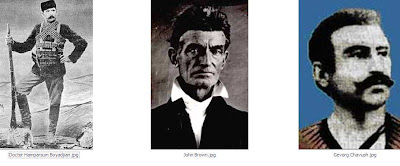
Doctor Hamparsum Boyadjian
The Sasun mutiny, which [took] place some time after the Kumkapi incident, was organized by the Hunchak Revolutionary Committee with the sole purpose of inviting foreign intervention, and was carried out according to a plan prepared by Murad (Hamparsum Boyadjian). On his way to Sasun, Murad passed through Caucasia, where he received help and support from the Dashnaktsutiun Committee. On arriving in Sasun he collected a number of Armenians around him and began to prepare his plans.
Before the actual incident, a letter in the name of the Hunchak Committee appeared in the third number of the Hunchak newspaper, dated 1894, which clearly heralded the storm that was about to break. This letter was written by Annenak from the village of Kizilagac in the province of Mus, who went by the alias of Hrair Tjokh and continued working in that region until the second Sasun mutiny of 1904. The letter was as follows: 12
"Brother Armenians,
At last the day we have been awaiting for centuries has arrived. The bells ring out from the hills of Sasun, red flags wave from the mountains, carried by a people whose humanity and Armenian soul have been trampled underfoot. The hour of vengeance has struck. The time has come for a decision to be made on the life or death of the oppressor.
Today the Armenian cause is entering its latest and most glorious phase. The resignation and submission of the destitute, the sighs and silence of the humiliated, the stifled complaints of the oppressed, will soon be replaced by the roaring of a lion."
According to Varandian: 13
"The Hunchak organization was in a weak position. They were anxious to do something as quickly as possible and to produce a stir.
The inhabitants of Sasun fought heroically, even with their fairly primitive weapons, against the Kurds, but they were unable to withstand the attack by regular troops. In August 1894 the Armenians annihilated the Kurds after a successful onslaught and were about to carry off their flocks when they were suddenly surrounded on all sides by troops. No one has ever been able to give even an approximate number of the Armenians killed. Some say six or seven thousand, others say around one thousand Probably the latter is nearer the truth."
This mutiny, which had been carried out with the sole aim of attracting the attention of foreign countries, was reported abroad by the Patriarchate and the revolutionary committees in the bloodiest and most sensational manner. Meetings were held in support of the Armenians in various European capitals and statements made in the various parliaments. Everywhere, references were made to the responsibility Britain had assumed in signing the Cyprus Convention.
Hallward, the British consul in Van, wished to go to Sasun to examine the situation but the Ottoman government, who regarded him as one of the instigators of the rebellion, refused to grant him the necessary permission.
The government set up a commission to carry out investigations on the spot and applied to the American government for a consul that would participate in the work. This appeal, however, was turned down by the American government.
The British Embassy at first wished to send Colonel Chermsidc, the Military Attache, to the spot, but later abandoned the idea. Mr. Shipley, Dragoman to the Embassy, was appointed assistant to the Consul in Erzurum, and was ordered to visit the site of the incident.
After a great deal of correspondence, the principle was finally accepted that the states with Consuls in Erzurum, namely, France. Great Britain and Russia, should participate in the work of the Ottoman investigation commission. These were to be present at the meetings as observers, and could, if necessary, ask questions.
The commission appointed by the government was to be presided over by Sefik Bey, head of the petition department of the Supreme Court of Appeal, Omer bey, the Director of the Emniyet Sandigi, Celalettin Bey, President of the Criminal Court of Appeal and Mecit Efendi, from the Ministry of the Interior. The consuls taking part as observers were Vilbert, the French Consul, the Russian Consul-General Jevalsky, and the British Consul, Shipley.
The commission carried out investigations for six months, from 4 January to 21 July 1895. It held 108 meetings and heard more than 190 witnesses. Omer Bey had to resign from the commission on 29 January on his appointment as deputy Governor in Bitlis. Murad was arrested on 23 August.
A certain amount of light is shed on the situation by the following rather more accurate passages of the reports of the Consuls, which tend on the whole, as is only to be expected, to be biased in favour of the Armenians:
"After those events, Hamparsum Boyadjian, a native of Adana who had studied medicine in Istanbul and Geneva and who employed the alias "Murad" to avoid recognition, arrived in the Talori region accompanied by an armed band, one of the members of which was Damadian, an old friend of his whom he had recently met.
He toured the villages in the Kavar region under the pretext of carrying out medical practice, inciting the Armenians to free themselves from Kurdish domination. But neither he nor the five companions whom he had supplied with arms and ammunition for their defence, could offer a convincing explanation of their presence in the mountains. One of them gave as a reason the wrongs he and his family had suffered at the hands of the Kurds. Practically all the Armenian witnesses said that they had never heard the name "Murad". On the other hand, the Kurds and the government witnesses said that they had heard the name. It was impossible, under these circumstances, for the Commission of Investigation to collect the information necessary for a true understanding of the event. It would appear from the evidence collected that he and his colleagues roamed around the Talori regions and the neighbouring villages and sometimes even the mountains giving, as he himself confirmed, advice on relations between the Armenians and the Kurds, persuading the former to engage in revolutionary struggle and the second to withhold government taxes in order to attract attention.
Furthermore, the notebook filled with patriotic poems that was discovered on his person and employed in his attempts at provocation, as well as notes forming the beginning of a letter written in pencil, which he admitted to be his own, describing the events of 1894, clearly prove that Murad, like Damadian, had arrived in the country on a secret mission with the aim of sowing discord between the Armenians and the Kurds."
Another passage from the reports runs as follows:
"It is impossible to deny the propaganda work, or the fact that Murad and his friends took part in the first armed conflicts."
The Armenians had set great hopes on the Sasun mutiny. They had hoped that the mutiny would lead to European intervention and the realization of Armenian aspirations. A great deal of money for the prosecution of the mutiny was collected by the Hunchaks in Istanbul and other provinces by the sale of tickets bearing the Hunchak emblem.
During the Sasun incidents the Russian Armenians appealed to the Catholicos Khrimian in Etchmiadzin to intervene in favour of the Armenians in Turkey. The Catholicos, in spite of his advanced age and the inclemency of the winter weather, immediately set out for St. Petersburg, where he told the Emperor "that the Armenians in Turkey looked upon him as their sole protector and were awaiting his help and protection. Khrimian's appeal produced an intense political reaction. The British Ambassador Sir Philip Currie told the Patriarch Izmirlian that he was amazed that the Catholicos should make such an appeal at a time when the Armenian Question was being discussed on the international forum.
Vte. des Coursons gives the following account of the Sasun mutiny:15
"Murad (Hamparsum Boyadjian) deceived the Armenians by hinting at British support for the Sasun mutiny. In March 1895 the text of a circular sent from London was published in the French newspapers. This circular had been sent to Vahabedian, the Marhasa of Adana, and the spiritual leaders of the Armenian church."
As for the incident itself, the best thing would be to quote the article in the New York Herald Tribune, a newspaper that could never be accused of partiality for the Turks.
"European observers are of the opinion that the Armenian revolt was instigated by Armenians from abroad. The rebels were armed with the most up - to - date weapons from England. After committing crimes of arson , murder and looting they resisted an attack carried out by regular troops and withdrew to the mountains. The investigating committee concluded that the Ottoman government was fully justified in dispatching troops against the rebels. These troops were able to defeat the rebels only after a bloody conflict. It takes more than persuasive words or newspaper articles to overcome a body of nearly three thousand well-armed rebels who have taken refuge in inaccessible mountains.
The Armenians ringleaders appeared in the Talori Mts. to the south of Sasun and Mus, between Bitlis and Gene. Here they were joined by a person by the name of Hamparsum who had already instigated disorders in the region under the alias of Murat, and placed their forces under his command. This Hamparsum had been born in Hachin and had studied medicine in Istanbul for eight years. After taking part in the Kumkapi demonstration he had fled first to Athens and then to Geneva, after which he returned to Bitlis via Iskenderun and Diyarbakir in disguise and under a false name. He there joined with five others in subsersive activities. Hamparsum tricked the simple people into believing that he had been sent by the European Powers to overthrow Turkish domination, and thus succceeded in realizing his murderous plans.
They first of all occupied the Talori region, which included the villages of Siner, Simai, Gulli-Giizat, Ahi, Hedenk, Sinank, Qekind, Effard, Musson, Etek, Akcesser. In 1894, leaving their wives, children and property in these inaccessible spots, the Armenians joined forces with other armed bands coming from the Silvan districts in the plain of Mus, after which the whole body of 3000 men gathered in the Andok Mt. Five or six hundred wished to surround Mus, and started off by attacking the Delican tribe to the south of the city. They slaughtered a number of the tribe and seized their goods. The religious beliefs of the Muslims who fell into their hands were derided and disparaged, and the Muslims themselves murdered in the most frightful manner. The rebels also attacked the regular troops in the vicinity of Mus, but the large numbers of the regular forces prevented them from occupying the city.
The rebels joined the bandits in the Andok Mts., carrying out the most frightful massacres and looting among the tribes of the neighbourhood. They burned Omer Agha's nephew alive. They raped a number of Turkish women at a spot three or four hours' distance from Gulli-Giizat and then strangled them.
At the beginning of August the rebels attacked the Faninar, Bekiran and Badikan tribes, perpetrating equally horrible atrocities. The rebels in the villages ofYermut and Ealigemuk in the nahiye of Cinan in the kaza of Cal attacked the Kurds in the neighbourhood, as well as the villages of Kaisser and Catcat.
Towards the end of August, the Armenians attacked the Kurds in the vicinity of Mus and burned down three or four villages, including Giilli-Giizat. As for the 3000 rebels in Talori. they continued to spread death and destruction among the Muslims and other Christian communities, refusing to lay down their arms. Regular troops were finally sent to force them to submit.
Hamparsum fled to the mountains with eleven other rebels. He was finally captured alive, but only after he had killed two soldiers and wounded six. By the end of August all the rebels had been crushed.
The women, the children, the aged and the lame were treated by the Turks in accordance with the charity and humanity characteristic of Islam. The rebels who died were those who refused to surrender and preferred to continue fighting against the legitimate government of the country."
This, then, is an objective and impartial account of an event that caused such a sensation in the European press.
For more information on these punitive expeditions one may turn to the account given by M. Ximenes, who remained in Biths throughout these incidents until November 1894.
"On the request of the governor of Bitlis, Zeki Pasha was given orders to send in troops for the restoration of order. Four battalions were mustered to disperse the rebels. The soldiers encountered a force of 3000 Armenian rebels on the slope of a mountain. They first of all hurled stones and insults at the troops. Then they opened fire, and the soldiers fired back. Later the rebels collected in a narrow valley. The soldiers marched on their position. The Turkish commanding officer tried to persuade the rebels to come to terms and disperse. Some of them accepted his advice, but most of them stood their ground patiently and stubbornly. The soldiers twice opened fire. Altogether three hundred rebels were killed.
This was the only real confrontation in the whole series of incidents. It is true that several prisoners were taken, but these were later freed."16
While investigations were continuing in Mus, another appeal for the implementation of reforms in the six provinces was made by Great Britain, Russia and France, who joined together to submit the well-known May reform project. It was while this project was being discussed that the Hunchaks arranged a demonstration at the Sublime Porte.
12. [To be provided]
13. M. Varandian, History of the Dashnaktsution, Paris, 1932, p. 146
14. This is the exact equivalent of the term used by Varandian.
15. R. des Coursons, La Rebellion Armenienne, Son Origine, Son But, p. 71-78.
16. [To be provided]
Holdwater:
It is unfortunate no footnote was provided for the incredible Herald Tribune account, which actually documents harm caused to Ottoman Muslims by Armenians. Perhaps the reporter was the refreshingly honest Sidney Whitman, who worked as a correspondent for the New York Herald (which was probably the same newspaper as the Herald Tribune), and who would go on to write Turkish Memories in 1914; Whitman performed his professional duty as a journalist by listening to all sides. Of course, those few Westerners who managed to put aside their prejudices to report on Armeno-Turkish affairs opened themselves to pay a price; at times, the familiar charge of Whitman's being an "agent of the Turkish government" followed him.
Hamparsum "Murad" Boyadjian was behind a great many murders, while inciting and leading Armenians to riot, and from the newspaper account, we are told he had killed two soldiers and wounded six. His punishment was only imprisonment. He escaped, only to serve as a parliamentarian in 1909 Adana, at least until he could wreak havoc anew during WWI. Similarly, the Dashnak Gevorg Chavush, who will be starring in the second Sassun rebellion (coming up below; he had served under Murad in earlier years), was captured and his punishment was also imprisonment. (He escaped, as well. There is a pattern; from footnote 46 below, we learn Antranik was put in prison for having killed a Turk; you guessed it, he escaped.) The Ottoman authorities (partly under European pressure) were awfully lenient with these mad dog killers; any other nation of the time would have executed murderous terrorists, at least for the crime of treason.
The Armenian force numbered 3,000! Can you imagine such a significant and armed force going around and massacring civilians, and standing up to the army, in your country? What do you think your government's response would be? Is it not astounding, regardless of anti-Turkish prejudice in the West, that the journalists of the day closed their eyes so completely to this other side of the coin? (Perhaps more correctly, when some of these thousands of rebels got killed, the Western journalists would report the deaths as "massacres.")
Lewy on the Second Sassun Rebellion
The following forms the beginning of "Chapter 4: The Young Turks Take Power," pp. 30-32:
After the massacres of 1895—96 Abdul Hamid's rule lasted another twelve years. Until the Young Turks' successful seizure of power in 1908, Armenian revolutionaries kept up their attacks and even came close to assassinating the hated autocrat. They also tried again to achieve the intervention of the European powers. None of this brought the Armenians closer to their goal of liberation from Turkish rule. Indeed, there are indications that these activities stiffened the back of the Turks and eventually led to a new rupture between Armenians and Turks with even more disastrous consequences than during the reign of Abdul Hamid.
Armenian Guerrilla Warfare
In late July of 1897, one year after the ill-fated raid upon the Ottoman Bank in Constantinople, a force of 250 Dashnaks left their base on the Persian border and attacked the encampment of the Mazrik Kurdish tribe in the plain of Khanasor near the city of Van. The attack is said to have been a revenge for the tribe having wiped out an Armenian village.1 Benefiting from the element of surprise, the Armenians scored a major victory described by Armenian writers in various ways: "a major part of the tribe was killed," "part of the menfolk were massacred outright," or "the entire tribe was annihilated.'^ According to Langer, the Armenians "killed or barbarously mutilated men, women and children." 3 The Khanasor raid was widely reported by the European press, but its major effect was on the Armenians. They experienced a sense of encouragement, and hope grew that they would able to attain their political freedom by themselves rather than having to rely on impotent European promises.4
Clashes between Armenian revolutionaries and Turks and Kurds continued in various parts of eastern Anatolia. A survivor recalls that hundreds of young men brought in arms and ammunition from Persia and Russia to be sold to Armenian peasants and city folks alike. 5 Innumerable epic encounters ensued, writes a historian of the Dashnaks: "It was an era of both glory and of heroic self-sacrifice."6
Twenty years after the first bloody fighting in the region of Sassun, a new battle broke out there in the spring of 1904. The Dashnaks had been distributing weapons and organizing fighting units for some time; according to a chronicler of the struggle, this was done "with a view to a general uprising in the future." 7 Led by some of their best- known commanders, such as Andranik (Ozanian) and Murad of Sebastia, the Armenians managed to fight off an attacking force of fifteen thousand Turkish troops for three weeks but finally had to withdraw into the mountains. Several attempts by Armenian fighters in the Russian Caucasus to provide relief failed when they were intercepted and killed by Russian border troops. During the summer of 1905, according to two English missionaries, some three hundred Dashnak fighters conducted guerrilla operations on a fairly large scale in the district of Mush and to the west of Lake Van that cost five thousand lives.8
The larger purpose of these and similar engagements fought by Armenian revolutionaries during these years was not always clear. Some Armenian writers, admirers of the Dashnaks, speak of "immortals" who fought "the Armenian battle of liberation."? They describe legendary heroes larger than life who managed to survive against heavy odds, sometimes through all kinds of miraculous escapes. The revolutionaries are referred to as avengers, who do not hesitate to risk their own lives or to kill those regarded as oppressors. One such fedayee, Kevork Chavoush, is called "the man with the dagger who was always ready to punish those who molested the defenseless people." After the defeat of the rebellion of Sassun in 1904 four of his men went after a particularly cruel Kurdish chief, "raided the Agha's mansion, dispatched the whole family of four," and got away.10 Another author calls such acts "terroristic retaliation" carried out as "self-defense."11 The arming of the population is sometimes described as preparation for an upris- ing; at other times it is called self-defense against marauding Kurds and other aggressors. During the period in question the propaganda of the revolutionaries accented the goal of national liberation, to be achieved through armed struggle, while information meant for foreign consumption stressed the defensive aims of the violence. It is tempting to conclude that the obfuscation was deliberate, and the Turkish authorities facing the attacks of the Armenian revolutionaries may be forgiven if they were not always able to determine exactly what they were dealing with.
1. James H. Tashjian, "The Armenian 'Dashnag' Party: A Brief Statement," Armenian Review 21, no. 4 (Winter 1968): 53.
2. Chalabian, Revolutionary Figures, p. 328; Vratzian, "The Armenian Revolution and the Armenian Revolutionary Federation," p. 27; Atamian, Armenian Community, p. 109.
3. Langer, Diplomacy of Imperialism, vol. I, p. 350.
4. Atamian, Armenian Community, p. 109.
5. Aprahamian, From Van to Detroit, p. 21.
6. Tashjian, "The Armenian 'Dashnag' Party," p. 53.
7. Chalabian, Revolutionary Figures, p. 215.
8. W. A. Wigram and E. T. A. Wigram, The Cradle of Mankind: Life in Eastern Kurdistan, pp. 247—50.
9. Chalabian, Revolutionary Figures, p. 265.
10. Mandalian, Armenian Freedom Fighters, p. 142.
11. Atamian, Armenian Community, p. 277.
Uras on the Second Sassun Rebellion
he following is from Uras's book, pp. 776-780:
The Second Sasun Uprising
After the Ottoman Bank incident, the Dashnaktsution Committee increased its activities in the country, stocked weapons and ammunition everywhere, and whenever an opportunity arose had its bands attack local government forces. The Persian frontier, which was not closely controlled, was the safest and most appropriate route for smuggling weapons into the country. The sole hindrance was the presence of the powerful Kurdish tribe of Mazrik settled in the Hanasor region on the Perso-Ottoman border.44
The Dashnaktsutiun Central Bureau had to choose between the alternatives of either eliminating this tribe or giving up the transportation of ammunition through this route. For this reason, preparations were made for a raid on Hanasor in July of 1894. A band was formed by the Committee composed of four hundred fighters. Volunteers from everywhere came to join them as well as another band armed and equipped by the Armenians of Karabagh. They were reinforced by a cavalry unit which protected their rear. Two priests, Krikor who came from Caucasia and Vartan, a native of Van, encouraged the fighters, holding the cross in one hand and brandishing a sword in the other. During the raid, which lasted for two days, a great part of the tribe of Mazrik, men, women and children were exterminated. They were stopped only by the coming of the regular troops, upon which the bands withdrew to Persian soil.
In the spring of 1895, a number of bands crossed to Turkey from the Caucasus and Persia under the command of well-known leaders such as Antranik, Hrair, Serop etc. Among them were Caucasian Armenians trained in the Russian army and teachers.
In 1897 some organizers authorized by the committee settled in the Sasun and Mus region and started to plan the uprising. In the Dashnaktsutiun Congress which took place in 1898 Sasun was chosen as the centre of activities and it was decided to stock arms and ammunition there. A sum of 300,000 [rubles] was set aside for the expenses; and significant amounts of weapons and ammunition, including 1500 rifles were transported to the area. The action was to be conducted by the notorious Serop Pasha from the village of Sohart in Ahlat. His main area of activity was the regions of Bitlis, Ahlat, Sasun and Mus. He later settled in Sasun and was poisoned by his rivals. Serop, who left his native land Ahlat after having killed someone, had escaped first to Istanbul and then to Romania in 1892. After a year, he had gone to Batum, entered the Dashnaktsutiun Committee and started his activities in Turkey with his powerful, well-disciplined, well armed and equipped band named Friends of Avengers.
Antranik, who succeeded Serop, commanded the band activities after his death. In 1901 the Ottoman Government attempted to reorganize the administration of Sasun, and proposed to build barracks on the hills of Taluri and Senik. However this attempt failed as Armenian women attacked and dispersed the workers.45 !n November 1901 Antranik, accompanied by his band, took refuge in a monastary in the vicinity of Mus. The Istanbul Government ordered Commander Bahri Pasha to destroy Antranik's band, but permission was withheld to storm the monastery. Most of Bahri Pasha's soldiers died from the severe cold, and taking advantage of the snowstorm. Antranik and his band escaped.
While under siege in the monastery, Antranik asked the Government to fulfill the following conditions: 46
1.That the May project be put in to practice at once.
2. That the political prisoners be released.
3. That those who had caused damage to some villages be punished.
While four members of the band were killed during the struggle, the Turkish forces lost 14 soldiers, 2 of whom were officers, and in addition to this, there were 20-30 deaths a day from typhoid.
It was toward the end of 1903 that the second Sasun uprising reached its last stage. At this time Russia embarked upon a policy of pressure on the Armenians. At the same time the Russian consul in Turkey assured the Armenians that they would be protected if they accepted Orthodoxy.
As Commander-General Antranik started his activities on the Sasun mountains, infantry and cavalry units from Transcaucasia also came to his help. Murat of Sivas's band was particularly known for its brutality.
As the revolts were spreading all over Sasun and bloody clashes with the soldiers took place, the Government sent Vartan, the Bishop of Mus, and the Bishop of Bitlis to the rebels to persuade them to put an end to these acts. By April 13,1914 [sic; 1904] the military operation started and the bands withdrew to Taluri. After Taluri the clashes continued on the plain of Mus. The bands were helped by Armenian villagers. The Government attempted to have the rebels who proceeded to the plain of Mus settle there in order to prevent them from returning to their headquarters. However, this project could not be put into effect because of the resistance shown by the foreign consuls. Consequently, 6000 Sasunites were sent back to their villages. This was how the uprising came to end but as usual the allegations of brutality went on. The Sasun uprising is related as follows in the book "The Battles of Antranik":47
"In April 1904 the Armenian revolts spread from the Sasun Hills and the plain of Mus to Van. The consuls who were acting as intermediaries suggested Antranik should come to terms with the Turkish Government. Among the revolutionary leaders were the well-known Dashnaktustiun activists of Mus and Sasun, Murat of Sivas, Sebuh, Keork Chavush, Mko, Gorun and Sempad of Mus, who was a new rebel leader.
Members of the Caucasian and Persian Dashnaktsutiun committees kept sending persons to help in the fighting and the supply of ammunition. The famous band leader Tuman of Karabagh managed to join the others in Sasun along with his cavalry units. Together with the representatives of the Dashnaktsutiun Bureau and Mus Central Committee, the commanders elected Antranik, who was already a popular hero, celebrated in marches and poems, as Commander-in-Chief.
Sebuh was severely wounded and Keork ofAkca was killed. Hrair, who was unwilling to abandon the wounded Sebuh to the enemy and tried to take him along, was shot dead. Hrair was buried next to Serop. Altogether 800-1000 people on the enemy's side were killed. The volunteers seized 53 rifles and 500 bullets. The battle lasted twelve hours.
On 14 April the battle extended to Merker Village, situated at two hours' distance from Keliygozan. Murat with a few fighters took part in the battle, which was planned and directed by Antranik. They fought against 600-700 Kurds and 300-400 Turkish soldiers.
On 16 April the Government soldiers cut the road to Isanzor, Sempad, who was at that time in Dalorik,managed to join Antranik's forces when the battle began. That day, five enemy soldiers were killed.
The Government had concentrated its forces in Sasun and gathered 10,000 soldiers in the vicinity of Sasun on 18 April. The Government had decided to completely destroy Sasun.
Antranik made his future plans. The battle continued until 22 April with eleven Armenians wounded.
The Kon Skirmish — In this battle 17 Turks were killed and 14 wounded. On the Armenian side there was one killed and one severely wounded, who died a few days later. Two men froze to death.
The Zovozar Skirmish — Our heroes remained on the hills from April 22 to May 1. On May 2 the fighting became intense and continued with sniping at the enemy.
The Apagana and Komer Skirmishes— Vahan and a friend of his fell in this battle. Many people on the enemy side were killed or wounded.
Gevorg Chavush
The Government had invaded Komer with regular soldiers and Kurdish bands. An Armenian woman who was carrying arms for Antranik was killed. Sergeant Keork came to Antranik's help. When darkness fell the warriors escaped to the mountains unscathed. A great number of the enemy were killed.
The Gurava Skirmish — Antranik and Keork Chavush came to Pertak Village from Sasun where 80 soldiers also joined them on 17 July. So many government" soldiers were killed in the fight against Sempad, Isu, Bogos an Asdur that their corpses covered a vast field near the cemetery. The regiment commander came to the village with 60-70 soldiers to subjugate the rebels. The shots fired by the rebels mingled with the tolling of the church bells. 40 enemy soldiers were killed. Only one person was killed on the Armenian side.
The Samiram Skirmish — On 17 July a new battle started in the village of Sheikh Yusuf. The village was defended by the heroic Armenians of Ahcan and the battle raged fiercely until noon. The enemy burst into the church and killed twelve of the defenders, who had run out of ammunition. Sebuh, Antranik, Keork Chavush, Murat and Sempad remained at their posts. The enemy met with fierce opposition. Two of Sempad's friends were killed. Towards night the enemy retreated from the battlefield with 70 dead.
At night Antranik went to Tatvanwith his band and from there he managed to sail to Ahtamar in two boats belonging to the Kurds.
The Lake Van voyage lasted for two days. They managed to get hold of one more boat and came to Ahtamar where they stayed for seven days. There, they set up a council of war and appointed one amongst them to represent the administration. Keork Chavush was chosen to perform this duty. On August 16 he returned to Ahlat.
Having been informed upon, Antranik was encircled and a battle of unequalled ferocity took place. Antranik escaped secretly to Van where he was spotted twice by the soldiers and a fight ensued. Finally, he escaped to Caucasia with a few friends and never returned to his home country."
44. The Regeneration of Armenia: The Fight for Freedom, Dashnaktsuition Publications, Istanbul, 1920.
45. Varandian, History of the Dashnaktsution, p. 268
46. Antranik was born in Shabin Karahisar in 1866. He joined the Dashnak Party as a young man and distinguished himself as an activist and ringleader. After escaping from prison in his native province where he was serving a sentence for having killed a Turk, he arrived in Istanbul and from there went to Batum. He became a popular hero among the Armenian rebels, and his exploits were celebrated in marches and poems.
47. Kudulian, The Battles of Antranik, Beirut, 1929 (in Armenian.)
Holdwater:
Did you catch how the murderous Dashnaks nearly exterminated the Kurdish tribe at Mazrik? Has anyone heard of this mini-genocide before? Not when the accent is solely on poor, innocent Armenians getting massacred. (Lewy wrote "he Khanasor raid was widely reported by the European press," and if that is the case one wonders how it was reported, and whether this story made it to the U.S. press. Having conducted a fair degree of newspaper archival research, I don't remember coming across word of this matter.)
Discrepancies: Uras has this taking place in July 1894, while Lewy has it at July 1897. Uras was wrong; perhaps the year was a misprint, as he begins by alluding to the event as taking place after the Ottoman Bank raid of 1896. In addition, Uras wrote the tribe was in the way, while Lewy's Armenian source reported the motive was revenge for the Mazrik Kurds having wiped out an Armenian village. This could well be another case of the old Armenian cover-up, coming up with any accusation, so that the precious Myth of Innocence may be upheld. (Kamuran Gurun wrote in The Armenian File, citing K. S. Papazian's 1934 book, Patriotism Perverted [p. 22]: "The Tashnak bands generally entered Turkey from Iran by way of Van. However, the Mazrik tribe which was on their way used to annoy them. In order the eliminate the tribe, they attacked the tribe's tents in Honasor in July 1897 [with a band of 250] as the sun was rising. However, they did not succeed and were forced to retreat and flee, having faced the danger of being surrounded." Papazian's reason for the attack, which he characterized as a "fiasco": the "result of the machinations of the Russian authorities, whose purpose was to encourage political unrest and turmoil along the eastern borders of Turkey'; see end-of-page article here. Papazian tells us this raid occurred in November, and not July.)
"Murat of Sivas" was likely the other Murad, the Dashnak referred to as "Mourad of Sebastia" in Armenian literature. The original Murad from Sivas, the Hunchak Hamparsum Boyadjian, was likely still in prison during the 1904 period. (Murad was arrested on August 1895, as we learned above, and an Armenian source claims he was imprisoned for eleven years, before escaping.)
As mentioned in the introduction, the most valuable segment of Uras's research derives from the Armenian-language book Uras extensively quoted. Note the numerous "skirmishes." Armenian rebellion was a serious matter, even in the "quiet years" of the early 1900s, before evolving into the full-scale strategy the Ottoman government had to contend with in WWI. Kamuran Gurun used Uras's reference as well, and summed up: "During the confrontations which occurred on 14,16, and 22 April, on 2 May and 17 July, 932-1,132 Turks were killed, as opposed to only 19 Armenians. These are figures provided by Armenians. But this rebellion, too, was included in the literature as a massacre."
Christopher Walker on Sassun
Let's take a quick look at what the famous genocide standard bearer, Christopher Walker, reported on Sassun. (From the 1990 version of his ARMENIA: The Survival of a Nation.)
After finding a monstrous Turkish villain in the form of the vali of Bitlis, Hassan Tahsin Pasha, on the say-so of British Vice-Consul C. M. Hallward (the one the Ottoman government regarded as one of the instigators of the rebellion, as Uras told us; this man was as unfriendly as a foreign consul could get. Since Hallward was serving in Van, how could he possibly have gotten to know the character of the Bitlis governor? In all likelihood, and as usual, from whatever the Armenians told him) Walker justifies the disrespect the Sassun Armenians displayed toward the pasha with: "Perhaps their disobedience was due to the presence in Sasun of two young Hunchak revolutionaries, who had for some years past been laying the groundwork of defiance there; though we should note that Sasun had been in a state of limited rebellion in 1889, before the appearance of revolutionaries." Perhaps? Do you get the feeling Walker was trying to somewhat excuse the two in question, Murad and Mihran Damadian? And as far as trying to get the Hunchaks off the hook by pointing to Sassun's pre-existing state of "limited rebellion in 1889," let's not forget the Hunchaks were formed in 1887, and it is certain the Hunchaks or other revolutionaries were hard at work, laying the seeds of discontent.
After informing us that Murad and Damadian organized a small guerrilla gang "In the summer of 1892" (Murad denied, three years later, of having instigated battles with the Kurds during this period; he blamed the government's "system of injustice," instead. Murad's whole idea was, of course, to incite the Kurds, in order to attract the attention of the European imperialists. Even Cyrus Hamlin became aware of this grand Hunchak scheme, which the Turk-despising missionary denounced as "atrocious and infernal beyond anything ever known.") Walker concedes "at least one casualty in 1892 as a result of their activities," and then explains, "They spent the latter part of 1892 trying to calm things over, and reduce tension between the communities." Yes, indeed, Murad and Damadian were such peaceful, nice guys!
In early 1893, Murad left to get funds from the Caucasus, in order to finance his mischief. "Damadian continued to keep relations with the Kurds level." (What a sweetheart!) "But while he was spreading revolutionary ideas," he was pursued and arrested, "taken to Bitlis and then to Constantinople, where he was granted a pardon." Why were the Ottoman authorities so kind to these revolutionaries? If we ask Walker, he will tell us where to lay the blame; Hallward again is cited for his prejudiced opinion: "I do not believe that the agitation amounted to much, or had much effect on the villagers. One thing seems clear, that shortly after his capture the fate of Sasun Armenians was sealed." (Let's understand the logic. The Ottomans let Damadian go, but they were going to make the Sasun Armenians pay for falling under the influence of their leader, Damadian.)
Soon after, "an unprovoked attack was launched by three to four thousand Kurds on the villages of the Talori parish. The Kurds attempted to lay siege to the Talori Armenians, but the latter withdrew into a stronghold they had prepared and successfully withstood their attacks. Several of their small villages were, however, sacked. The Kurds then gave up the attempt, to return to their winter quarters."
After Murad returned, "it appears that the villagers placed enormous trust in him, and his presence gave them strength." In other words, they fell under his spell as the charismatic cult leader that he, in effect, was, and would do anything he say; and what Murad wanted them to do was to rebel. Walker continues: in June 1894 the kaymakam came to collect arrears of taxes from the Talori Armenians, and as the British consul in Erzerum, R. W. Graves, described: "He proceeded to abuse and maltreat them. They then lost their temper, fell upon him, and, after administering a severe beating, drove him and his zaptiyes (gendarmes) from the district."
Walker explains: "To the official this was armed rebellion, and he reported it as such, adding that a large force would be needed to put it down." If an armed community treats legal officers in the described manner, what nation would not characterize such behavior as rebellious? And if this strong community was able to withstand an attack from 3-4,000 Kurds, you can bet a large force would have been needed to get them in line. Accordingly, the Armenians retreated to their stronghold, and the Ottoman force numbering 300 did not attack.
Meanwhile, a small Ottoman force went elsewhere "to try to compel the notables to present themselves before the governor of Bitlis so that he could extract money from them." Could it be the governor was trying to collect taxes, instead? "The troops arrested five Armenians — but were pursued by armed villagers, who managed to rescue four of the prisoners." It is fairly obvious that would fall under the definition of "rebellious," as well.
After Armenians killed a few Kurds for trying to steal livestock "in a punitive, extremist manner" (note how Walker always excuses his beloved Armenians; even when they commit murder, it must be their victims' fault.):
"For 12 days (probably 14-25 August) a ferocious battle was fought at Gelieguzan between the tribal Kurds and Armenian defenders." The Armenians held out, but then the Kurds, joined by government troops, succeeded in massacring them, as Walker tells us. British delegate H. S. Shipley, who was not personally there, called it "extermination."
Walker presents estimates of the dead from "a very conservative 900" to 3,000, yet even the propagandizing Dashnak historian, Varandian, gave credence to the "900," as we read above: "Some say six or seven thousand, others say around one thousand Probably the latter is nearer the truth." Remember, the Armenian population of Sassun was about 8,000. Is Christopher Walker vouching for nearly half having been massacred?
Later, Walker praises Graves and especially Hallward for "their tenacity and their bravery." These consuls worked hand in hand with the Armenians, received their information almost strictly from the Armenians (their interpreters were almost certainly Armenian) and had sympathy for none of the other peoples of the regions. Is Christopher Walker vouching for these British consuls, weaned on Gladstone's "hate the Turk" outlook, as honest and objective people?
Walker further writes:
"The Porte not only obstructed in the east, it also sent a propaganda agent to Erzerum (where the more senior consuls resided) to process the news and make it palatable to the consuls. This man was a certain Ximenes, a Spaniard who received a regular salary from the Palace, now masquerading as a journalist and ‘writer of distinction’... Certainly, Ximenes told the consuls, massacres have taken place, but the Armenians were rebels, and the perpetrators of the massacres were Kurdish irregulars; the government’s part was an honourable one, having attempted to restore order by calling in regular troops to restrain the Kurds.
We know the Armenians were rebels from the words of the Armenians themselves; note the Hunchak literature from above, published in Mush, and distributed to Armenians in Eastern Anatolia. We even know the Sassun Armenians were rebellious from Walker's own reportage! What matters is not where Ximenes' salary was coming from, but whether the testimony could be corroborated by honest sources that provided similar testimony. And where did Walker know how Ximenes earned his money? Perhaps Walker, himself a journalist, relied upon the rabidly anti-Turkish New York Times, whose February 5, 1895 issue told us that Professor Ximenes of the University of Madrid (which puts into question whether he was actually a "journalist") was accused by, evidently, "The Daily News's correspondent in Marseilles," that Ximenes' "Testimony Was Sold, It Is Said, to the Porte." This was, evidently — the full article was not available for the reading — based upon "Advices from Constantinople." In other words, hearsay. Very likely hearsay from Istanbul Armenians that Western publications immediately latched on to as credible.] Any Westerner who maintained objectivity was subjected to the charge of being an "agent of the Turkish government," a tactic still utilized today. But the fact is, the Ottomans, as even a great Armenian crusader conceded, were "almost ludicrously innocent of the propagandist’s art." If Sultan Abdul Hamit was such a master of propaganda, he certainly could have hired many such foreign "agents" in their own countries, to offset the awful anti-Turkish propaganda taking place in nations such as Britain and the USA. As far as the rest of Ximenes' testimony that Walker set up for ridicule, even Walker provided testimony that the Ottoman soldiers restrained the Kurds, after which Walker concluded the government soldiers joined the Kurds in the massacring process. It is possible this may have happened, but what is the proof? The word of British consuls who listened exclusively to sobbing Armenians? (The British officer Norman will negate this claim, as we'll see below.)
It should perhaps be noted that now and over the next 20 or 30 years, the Turkish government regularly ascribed the massacre of Armenians to the actions of wild, unsubdued Kurdish tribes, whereas in each case the 'thinning out' or straightforward extermination of Armenians was a matter of considered government policy. The 'Kurdish cover-up' is very frequently met, and only really ended when the Turkish government embarked on deporting and massacring the Kurds themselves, by which time there were, anyway, scarcely any Armenians left."
Sigh!
Without shame, Walker writes: "One man that had discussed the Armenian question with the sultan was that part scholar, part clown, part spy-manqué figure Arminius Vambéry." Vambéry was one who controlled his prejudices, so of course to Walker, anyone who sized up the Turks as short of beasts would be a "clown."
Walker did not get much into the second Sassun uprising; keep in mind that we know from the Armenians themselves (refer to the "Battles of Antranik" book, from above) that what took place was a major uprising between armed Armenians and Ottoman forces. Here is what Walker reported (the pertinent part is highlighted by Holdwater):
"Although matters remained deadlocked internationally for the Armenians, locally the fedayis' illicit arms were a guarantee for freedom from the government in some localities. The first outstanding leader in the mountains of Turkish Armenia was Serop 'pasha', whose Dashnak guerrilla bands neutralised the locust-like functionaries of the Ottoman government and established a degree of cherished autonomy for Armenians, instituting justice where before there had been none, and, by expelling the government, introducing those very institutions that we associate with government. Serop was killed by the ruse of a Kurd in 1900, and the leadership of fedayi forces fell to Andranik, without question the most famous Armenian guerrilla fighter,5 'a very able man, and implicitly obeyed', in the words of British vice-consul Hampson.6 Born in Shabin Karahisar in 1865, he had joined Dashnaktsutiun in 1892. During the killings of autumn 1895 he had defended the Sasun villages, and four years later had become the leader of the forces in Sasun. In November 1901 he effected a spectacular break-out from the besieged position at Arakelots Monastery, near Moush. His activities reached a climax in 1903-4, when much of the region of Van, Bitlis, Moush and Sasun was in a state of revolutionary turmoil.7 In the spring of 1904 the Turkish army attempted to break the link forged between the villagers and the guerrillas by bombarding the Sasun villages for eight days in mid-April; but the villagers escaped, most to higher ground, and a few to the villages near Diyarbekir. Andranik and his forces were, however, compelled to retreat to Persia, via Aghtamar and Van; thence they moved to the Caucasus, leaving little more than a heroic memory. (Andranik himself resigned from the Dashnak party in 1907, because the party was entering into negotiations with émigré Turkish groups opposed to the sultan.)"
Isn't it jaw-dropping? Christopher Walker is actually corroborating, at least indirectly, that the Armenians were in revolt during the period of the second Sassun uprising ("...in 1903-4, when much of the region of Van, Bitlis, Moush and Sasun was in a state of revolutionary turmoil"), and he is faulting the government forces from trying to establish law and order... which would be the duty of any government. (See next paragraph.) Is Walker under the delusion that there was an independent "Armenia" during those years? The Armenians actually enjoyed an "internal autonomy," according to Richard Hovannisian (1967); their contact with the Ottoman government was usually restricted to tax-collectors, and the forces the Ottomans would send in, when the Kurds got too rowdy; in other words, the Armenians were free to do whatever they wanted, much in opposition to their brethren in Russia. And note how he's presenting mass murderers as Serop and especially Antranik as heroes! Don't the many thousands of innocent villagers these men killed — Antranik (on record for personally raping a Turkish woman, before likely having her killed; no doubt one of many rapes and murders this criminal committed) in particular — mean anything to the bigoted Christopher Walker?
John Brown
In order to gain perspective, why don't we take a look at the fate of a 19th century American counterpart to these revolutionaries, the abolitionist John Brown? As opposed to these mad and greedy Armenians leading their people down the path of destruction, a people who didn't want anything to have to do with them at first, at least Brown had a genuinely noble purpose: he believed in armed insurrection as a means to abolish slavery. The raids Brown conducted led to the deaths of perhaps a dozen men, mostly soldiers (but civilians too), and the wounding of around a dozen more. Compare to the thousands and thousands of innocent villagers that Armenian mass murderers as Antranik were responsible for! Although Brown was regarded as a hero in a number of quarters, President Abraham Lincoln called Brown a "misguided fanatic," and author Ken Chowder, in a study from 2000, described him as "The Father of American Terrorism." Brown was not "murdered" as Walker tells us was the fate of poor, innocent Murad, but executed for the crime of treason. Of course! No matter how "noble" one's cause is, once one resorts to violence where innocents are subjected to harm, one becomes a "terrorist." And when one opposes one's government through armed rebellion, one becomes guilty of "treason." These are the universal rules of all nations, except, in bigoted minds as Christopher Walker, the Ottoman Empire.
Getting back to the non-Armenian lives Walker doesn't give a rat's gas for, from the previous paragraph's end, note how Walker handled the massacre of the Mazrik Kurds that we learned about from Lewy, Uras and the New York Herald Tribune; he confined this episode to the end of his book, buried within the "Biographical Notes" on notable Armenians:
"[Nikol Duman] Planned a punitive expedition against Kurds of the Mazrik tribe, who had served the sultan's ends in the Hamidiye regiments; this plan endorsed by Mikayelian in November 1896, and carried out at Khanasor, 24-5 July 1897."
That's it; in Christopher Walker's bigoted mind, he is making this "punitive expedition" (i.e., massacre) a perfectly justifiable affair, for you see, the Kurds were actually the villains.
Christopher Walker is an emotional partisan, and he has written an awfully one-sided, propagandistic book. (Yes, he is no different than so many other pro-Armenian authors, but this cannot excuse him.) He establishes his case by referring to thoroughly unreliable sources, as the British consuls who, like Christopher Walker, listened exclusively to the Armenian perspective. Who can argue with Esat Uras, as he put it so accurately above: "...The reports of the Consuls, which tend on the whole, as is only to be expected, to be biased in favour of the Armenians."
But when we have the reports of these sources that are usually hostile to the Turks who paint a different picture than what those as Walker would have us believe, then we must pay heed. (As much as those as Walker will try to convince us they are "agents of the Turkish government," without offering evidence, or, otherwise, "clowns.")
Salahi R. Sonyel points to one such source I have never run into before, from his 2000 book, "Falsification and disinformation : negative factors in Turco-Armenian relations":
"A British Member of Parliament, Sir Ellis Ashmeed Bartlett, in a pamphlet he published in February 1895, which he circulated to the British Parliament, observed that "most of the tales so widely circulated" in connection with the Turco-Armenian incidents were manufactured and directed by "the most imaginative and malevolent spirit". The "deliberate object" of the agitation "was not to obtain redress for the Armenian sufferings, but to excite public feeling in this country (UK) against Turkey and the Turks".
(The sources for the above, combined with a reference to Ximenes [described by Sonyel as "a Spanish geographer and man of science," as well as "an eye witness to the Sasun rebellion"] are: Sir Ellis Ashmeed Bartlett, MP, Armenian "Atrocity" Agitation, Its Genesis, Method, Truth and Consequences, London, February 1895, pp. 3, 5, 8 and 19; see also The Westminster Gazette, 15.12.1894 and 7.1.1895.)
Sonyel also brings up "Another British source, Captain Charles Boswell Norman, who was sent to the Ottoman state as an officer in the Royal Artillery, observed in a manuscript of 1895,[73] "only the Armenian version of the disturbances, embellished with hysterical utterances of their English collaborators" were heard of, whereas in reality "the disturbances in Asia Minor are the direct outcome of a widespread anarchist movement". He insisted that the Hintchakist committee was directly responsible for all the bloodshed in Anatolia. British journalists were duped by the Armenians.[74]" (Finally capping off with: "Many of the Armenian falsehoods were also revealed during the sessions of the Sasun Inquiry Commission, which the Ottoman government established in December 1894, consisting of British, French and Russian representatives, in addition to Muslim ones.[75]")
A more detailed look at Captain Norman is available here; the reader may wish to click that link, as rich details on Sassun are provided; the captain reported that the Armenian people of Sassun were "graded into rebellion" in the Autumn of 1894 by the inflammatory articles in the revolutionary newspapers published in London, Vienna and New York, just as Esat Uras provided a more local example of above; furthermore, Norman knew for a fact that two British journalists who reported on these events never went to Sassun, but received their information from the consul at Erzurum [that would be Graves himself, one of Walker's favorite sources!], allowing Norman to conclude that "It is certain that they were hopelessly duped by Armenian romancers." Norman also asserts that the report of the British delegate was suppressed, and the true mortality was half of Walker's "conservative" figure of 900, in reality less than 500! Norman also, significantly, clears the involvement of Ottoman troops; another British author vouched for the integrity of the commander in charge, Zeki Pasha, in a letter to the Times of London. (Regarding an earlier period.)
What the British officer stated was the absolute truth (and we need to pay particular attention to the well-phrased "'Only the Armenian version of the disturbances, embellished with hysterical utterances of their English collaborators' were heard of." Yet, those as Christopher Walker would have us believe the "hysterical utterances" of these "English collaborators," those as the vice-consul Hallward, whom Uras believably described as "one of the instigators of the rebellion" in the eyes of the Ottoman government. Why should we listen to Hallworth, even if he wasn't directly involved in the Armenians' rebellion, as charged? His sympathies were completely with the Armenians.
And again, by exactly the same token, why should we believe Christopher Walker? His sympathies are also completely with the Armenians. When one embarks upon a work of history, one commits a great transgression if one is unable to maintain an open mind; impressionable readers who buy into the version Christopher Walker describes will look upon Turks as monsters, and that perpetuates hatred and racism. Unfortunately, too often, that is the very intention of such bigoted authors to begin with.
© Holdwater
The source site of this article gets revised often, as better information comes along. For the most up-to-date version, links and the related photos, the reader may consider reviewing the direct link as follows:
www.tallarmeniantale.com/sassun.htm
Click On Image To Enlarge

 Read Full Post !


 Introduction


