Showing posts with label Court Cases. Show all posts

25.6.13

3407) United States Supreme Court Lets Stand Decision Respecting Us Federal Policy Not To Characterize The Armenian Case As Genocide


Decision of the United States Supreme Court in Movsesian et al v. Victoria Versicherung et al is not to review the unanimous 11-0 en banc decision of the U.S. Court of Appeals for the 9th Circuit, that invalidated a California law that characterized the Armenian tragedy of 1915 as genocide.


On February 23, 2012, the U.S. Court of Appeals for the 9th Circuit unanimously held by a vote of 11-0 that a California law that was facially an insurance regulation had a more than incidental effect on U.S. foreign affairs. The court said that the statute,

"at its heart, intended to send a political message on an issue of foreign affairs by providing relief and a friendly forum to a perceived class of foreign victims."

Read The Full Post by Clicking Here Read Full Post !

28.2.12

3340) Diaspora Armenians And Their Initiatives For Compensation ( Ref: Movsesian-Arzoumanian-Ayaltin-Khagerian-Khajerian) Blow To Armenian Diaspora


Updated at 01 Mar 2012


  1. Diaspora Armenians And Their Initiatives For Compensation: The Reflections Of The Movsesian Case
  2. California Armenian Genocide Law Overturned by By Bob Egelko
  3. Comments From The San Francisco Chronicle Readers
  4. The ruling: US Court Of Appeals For The Ninth Circuit Vazken Movsesian Harry Arzoumanian Garo Ayaltin Miran Khagerian Ara Khajerian
  5. Letter To The Court & Counter Comments By Sukru Aya
  6. Why California Armenian Genocide Law Overturned? By Saltzman & Evinch


. .

Read The Full Post by Clicking Here Read Full Post !

17.12.11

3333) Video: Movsesian v. Versicherung AG: Armenian Insurance Case In CA

Case Number: 07-56722
Case Panel: KOZINSKI, SCHROEDER, REINHARDT, THOMAS, SILVERMAN, GRABER, McKEOWN, FISHER, PAEZ, RAWLINSON, IKUTA
San Francisco, CA 12/14/2011


I have watched with interest, but have serious concerns about the neutrality of the court and their knowledge of basic truths, before getting tangled [whether the District Court of California, should or not use the term of "Armenian Genocide"] simply because this would "affect the political relations between Turkey and USA". Regardless of the impressive setting and solemn procedures, the absence of the following basic facts, and that no one informed them, creates the impression of a Kangaroo if not a Lynching Court, because:
. .

Read The Full Post by Clicking Here Read Full Post !

7.9.11

3315) Hampig Sassounian: An Archetypal Example of Contemporary Armenian Terrorism


© This content Mirrored From  http://armenians-1915.blogspot.com

By Maxime Gauin
JTW Columnist
6 September 2011


The congress of the Armenian Revolutionary Federation of 1972, organized in Vienna, Austria, decided the return to terrorist methods and the creation of a terrorist branch, the so-called “Justice Commandos Against Armenian Terrorism,” later renamed the “Armenian Revolutionary Army.” Among the main targets of the JCAG/ARA were Turkish diplomats, with a preference for ambassadors and consul generals. Initially, the assassinations were carried out with exceptional professionalism, as if the JCAG/ARA were actively assisted by a secret service of a state, for instance the Greek KYP [Minassian 2002, pp. 22-23, 28-29, 32-34 and 44-45]. After 1979, the terrorists were more frequently amateurs, and thus arrested in several cases.
. .

Read The Full Post by Clicking Here Read Full Post !

26.1.11

3208) People v. Armenian Terrorist Yanikian


COURT OF APPEAL OF CALIFORNIA, SECOND APPELLATE DISTRICT, DIVISION THREE

Crim. No. 24571

1974.CA.40553 ; 114 Cal. Rptr. 188; 39 Cal. App. 3d 366

May 22, 1974

THE PEOPLE, PLAINTIFF AND RESPONDENT,
v.
GOURGEN MKRTICH YANIKIAN (Kourken Mkrtich (Megerdich) Yanikian (Armenian: Գուրգեն Յանիկյան), DEFENDANT AND APPELLANT

Superior Court of Santa Barbara County, No. 98612, John A. Westwick, Judge.
Lindsey & Newman, James T. Lindsey and Vasken Minasian for Defendant and Appellant.
David D. Minier, District Attorney, for Plaintiff and Respondent.
Opinion by Potter, J., with Cobey, Acting P. J., and Allport, J., concurring.

Potter

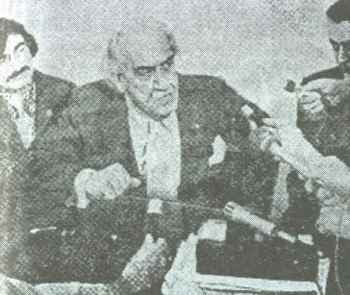
Defendant, Gourgen Mkrtich Yanikian, an Armenian by birth, was found guilty by a jury of the first degree murders (Pen. Code, §§ 187, 189) of two Turkish consular officials, which occurred on January 27, 1973, at the Santa Barbara Biltmore Hotel.

He appeals from the judgment of conviction on each of two counts of first degree murder committed while "armed with and using a deadly weapon -- namely, a firearm."
. . .

© This content Mirrored From  http://armenians-1915.blogspot.com

Defendant was tried on a plea of not guilty entered by the court when he remained mute at arraignment. Defendant was represented by at least two retained counsel throughout the proceedings. Such counsel were, on more than one occasion, urged by the Presiding Judge of the Superior Court of the County of Santa Barbara to enter a plea of not guilty by reason of insanity. They had been provided with a copy of three reports of Dr. Patterson, a psychiatrist who had examined the defendant in behalf of the prosecution, in which he had stated his impression that defendant had a mental disorder "of such a degree that it forms the motivation for the offense of homicide, and impairs his responsibility under M'Naughton." Despite such urging and the receipt of such information, the plea was not made.

At the trial defendant made no attempt to dispute the fact that he had committed the two homicides. His defense was based entirely on his claim of diminished capacity.

In support of this defense, defendant testified at great length in his own behalf. His testimony, which consumes over 600 pages of the trial transcript, detailed his entire personal history practically from his birth in 1895 of Armenian parents in Armenia. In such testimony defendant detailed the harrowing circumstances under which Armenians lived during his early years in light of the alleged official Turkish government policy of genocide against all Armenians. Defendant described numerous traumatic experiences involving alleged atrocities against various close members of his family, including the death of an older brother who was revered by him. Defendant recounted his participation in Armenian counter-activity as a member of a student volunteer group and described seeing gruesome evidence of wholesale massacres of Armenians in the course of those activities.

Defendant's narrative also included the history of his education in Russia, his becoming an engineer, and his later immigration to Persia where he became successful as proprietor of a large construction company engaged in government contracting. His contribution to the Allied war effort during World War II, in the form of the construction of a vital railroad link, and his donation of his land and water supply for use by the Allied military was related. According to defendant, his later immigration to the United States was facilitated by these contributions to the war effort. He told of his life in the United States, after his arrival in 1946, depicting himself as a person who made substantial contributions to the culture, education and well-being of mankind. His activities included producing and directing stage productions, speaking and writing on matters of public interest, and inventing emergency rescue equipment.

According to defendant, throughout all this period he retained a consuming interest in focusing world attention upon the great injustice which he believed had been committed against his people by the Turkish government. He read numerous histories presenting the matter from the Armenian point of view including one written by Ambassador Morgenthau. He wrote and spoke extensively on this subject and his burning ambition was to carry out a project to produce a film depicting the massacres, to be shown to world-wide audiences without charge. He was aware of the fact that a major studio had abandoned production of such a movie as a result of diplomatic pressure, so he resolved that he would use his own personal fortune for his purpose. His main reliance for financing this project was on a claim against the government of Iran , growing out of his construction of the railroad during World War II, in respect of which he had not received the final $1 million payment. He finally succeeded in obtaining a judgment in the courts of Iran only to have the Shah forbid satisfaction of the judgment. His further efforts to pressure the Shah, through the American Department of State, were finally cut off by the State Department terminating its consideration of the matter in April 1972.

According to defendant, this final destruction of his dream of producing the movie to leave a lasting historical imprint caused him to isolate himself for three days in his apartment during which time he went over in his mind the terrible events of his youth and the sufferings of his people caused by the massacre orders allegedly issued by the Turkish government. He came to the realization that he could not focus the light of world attention upon these injustices in the manner he had intended, and that he must seek an alternative method. His decision was to accomplish this by killing two Turkish government officials, thereby to "destroy two evils" and precipitate, through his trial, a public examination of the subject of the massacres of Armenians to the end that all people would benefit by the knowledge.

This plan, which was conceived in April 1972, was, according to defendant, meticulously implemented over the intervening months between that time and the date of the actual homicides on January 27, 1973. His final plan was to lure the two Turkish consular officials to a cottage at the Santa Barbara Biltmore on the pretext of presenting the Turkish government with some historic memorabilia. He abandoned an original plan under which he would carry out the homicides in the consular offices, on the ground that upon visiting such offices he observed the presence of numerous employees who "might try to be heroes and get hurt." To avoid the risk of harming anyone other than the government officials, defendant devised the plan of having the delivery occur at a Biltmore Hotel cottage in Santa Barbara. The arrangements were completed, the consular officials indicated their concurrence in the plan, and the stage was set for defendant to enact his role.

Defendant's preparations, as told by him, included disposing of substantially all of his personal effects, including his automobile, and taking with him to the Biltmore various personal items which he did not expect to be able to obtain in jail. He prepared a hollowed-out book to carry his Luger pistol, and took with him another small automatic pistol. The consular officials arrived and defendant carried out his plan. Each of them was felled by bullets from the Luger and while lying face down on the floor each was administered a fatal coup de grace in the head with the smaller pistol.

To generate maximum public attention, which was the purpose of his act, defendant carefully timed the distribution of a press release explaining his conduct, and of numerous letters to persons of Armenian parentage so that they were received at or about the time the homicides became publicly known. The letters spoke of his personal war against "the Turkish beasts and their government" which would be started by the time the letter was received. The press release expressed his determination to do everything in his power to publicize his act, stating in this connection, "I will ensure that they will arrest me and I will continue to defend my rights before a world court."

The purpose of all of defendant's testimony was made clear near its conclusion when he denied that he had "killed two men" in the hotel room and insisted that what he did was "destroy two evils" in order to have a symbol with which to focus world attention upon the Armenian massacres. According to defendant, the victims were "not human," and he had not killed, because "I cannot kill."

Defendant did not retain any expert witness to testify in his behalf with respect to his defense of diminished capacity. He relied upon his own testimony and upon the cross-examination of the psychiatrists employed by the prosecution.

Two expert witnesses, Drs. Patterson and Von Dedenroth, testified for the prosecution. Dr. Patterson testified on direct examination that defendant had the capacity both to harbor malice aforethought and to premeditate the homicides.

During cross-examination defendant was permitted to bring out Dr. Patterson's opinion that defendant was suffering from a "mental defect" of a "paranoid" type on the basis of which the witness "did not believe that Mr. Yanikian could truly appreciate the nature and quality of his acts or the consequences thereof," and that the doctor's impression was that defendant "expected to be recognized as some type of hero for his actions." When, however, defense counsel attempted to ask Dr. Patterson concerning his opinion whether defendant was "either sane or insane," the court sustained an objection. Further questions as to other statements on legal sanity included in the three reports Dr. Patterson had submitted were effectively prevented by the court's ruling on defendant's offer to prove, through Dr. Patterson, in respect of defendant's mental defect that "the area of the defect would be in the area of not being able to know right from wrong in the commission of the offense." The court's ruling was that though he would permit evidence of "impairment of his mentality . . . going to show a diminished capacity," he would not permit "any evidence of straight insanity."

© This content Mirrored From  http://armenians-1915.blogspot.com

The effect of the above ruling was to preclude defendant from developing Patterson's impressions, stated in each of these three reports, which bore on the question of legal sanity under the M'Naughton rule.

The prosecution also produced Dr. Thomas E. Von Dedenroth who gave psychiatric testimony to the effect that defendant was fully capable of both premeditation and malice aforethought. The cross-examination of Dr. Von Dedenroth developed the fact that he was of the opinion that defendant acted on the basis of a "misperception, a mistaken idea that normally would be clear to anyone else" that his acts of homicide "would benefit mankind" and on this basis the witness agreed that defendant did not consider them "simply bad acts." The cross-examination further developed that the doctor considered this a "paranoid reaction" but found no evidence of any disassociative reaction, since there was no indication of loss of understanding or of recall. Dr. Von Dedenroth stated his further opinion that the defendant was fully cognizant that he was killing "two fellow creatures" and not merely destroying two symbols of evil.

In view of the court's previously stated ruling that it would not permit inquiry into the issue of legal sanity or insanity, the defendant did not attempt to examine Dr. Von Dedenroth on this specific subject.

Two other matters occurred in the course of the trial which raised evidentiary questions. Defendant sought to verify the authenticity of his version of the massacres of Armenians by reading from Ambassador Henry Morgenthau's book on the subject. Defendant had already made references to reading the book and of acquiring from it some of his knowledge concerning the subject matter. When the prosecution objected to the reading of an excerpt, the court sustained the objection, on the ground that defendant would thereby be "getting this trial into a battle of history books on the cause of this controversy."

During cross-examination of defendant and in its rebuttal case the prosecution presented certain evidence suggesting sexual impropriety or prurient interest on the part of the defendant in connection with his publication of a collection of interviews with young people relating to their sex habits, entitled "Free Sexism," and an alleged attempt to seduce a cocktail waitress two nights previous to the homicides. The inference which might have been drawn from this evidence was that defendant's life was not entirely devoted to the high purposes which his direct testimony had suggested.

The prosecution also initiated an attempt to show, through an undercover policewoman, that a collateral purpose of defendant's interviews in the preparation of "Free Sexism" was to provide opportunities for attempted seduction. The court prevented this inquiry from proceeding to a point where the nature of the officer's testimony was apparent.

The trial court, at the request of both parties, instructed the jury fully on the issue of diminished capacity, including CALJIC instruction No. 8.77. The court also gave CALJIC instruction No. 8.41 on voluntary manslaughter due to diminished capacity, No. 8.48 on involuntary manslaughter due to diminished capacity, and Nos. 8.30 and 8.31 on second degree murder. In addition, at the request of the prosecution, the court gave a special instruction which, though it cited section 1026 of the Penal Code, was in fact based on section 1016 of the Penal Code. This instruction read as follows: "The defendant is conclusively presumed to have been sane at the time the offenses are alleged to have been committed."

No instruction was given explaining the relationship between such special instruction and the instructions on diminished capacity nor was there any instruction defining "sane" as used in said instruction.

Issues

The issues raised by this appeal are as follows:

1. Did the trial court properly exclude evidence on the issue of defendant's legal sanity?

2. Were the trial court's instructions on diminished capacity nullified by the special instruction that defendant was conclusively presumed sane?

3. Was the historical reference erroneously excluded?

4. Was defendant prejudiced by the reference to sexual matters?
© This content Mirrored From  http://armenians-1915.blogspot.com

Exclusion of Evidence of Legal Insanity

Defendant argues that though he designedly avoided pleading not guilty by reason of insanity, he should have been permitted to have in evidence Dr. Patterson's opinions, expressed in his written reports, casting doubt upon defendant's legal sanity under the M'Naughton rule because of his inability to appreciate the "wrongfulness" of his act. In his opening brief, defendant cites no authority in support of his position, and relies entirely upon an argument to the effect that "if insanity has any meaning at all, it would seem to include diminished capacity."

Despite the fact that the authorities supporting the trial court's ruling are cited in respondent's brief, defendant's reply brief states "appellant has been unable to find and thus offer case authority on the psychiatric issues."

The case authorities which are cited by the People are determinative. In People v. Nicolaus, 65 Cal. 2d 866 [56 Cal. Rptr. 635, 423 P.2d 787], the defendant, during the guilt phase of the trial, sought to rely upon diminished capacity as a defense. To rebut the defense psychiatrists' testimony, the prosecution produced a Dr. Rapaport who testified defendant had the capacity to premeditate and had killed his children (whom he loved) thinking it "was the best for the children" because he "feared in their environment with their mother they would grow up like " and they "were better off dead."

In cross-examination, defense counsel asked a question of Dr. Rapaport with results as follows: ". . . 'But if he believed that it was not evil, to that extent he didn't appreciate the distinction between right and wrong, did he?' The doctor stated, 'Well, I don't know whether you want to get into the issue of -- ' Here the court interposed the statement, 'We do not. The question is improper.' The trial court was correct. During the guilt phase of the trial the trial court should properly limit the medical testimony to the issue of mental capacity to commit murder in the first degree. Such rule is stated in People v. Wells, supra, 33 Cal. 2d 330, at page 351 [202 P.2d 53]: 'Evidence which tends to show legal insanity (likewise, sanity) is not admissible at the first stage of the trial because it is not pertinent to any issue then being litigated; but competent evidence, other than proof of sanity or insanity, which tends to show that a (then presumed) legally sane defendant either did or did not in fact possess the required specific intent or motive is admissible.'" (65 Cal. 2d at p. 881.)

There is no logical distinction between the guilt phase of a bifurcated trial where not guilty by reason of insanity is pleaded and a trial on a not guilty plea alone. In each case the law creates the conclusive presumption of legal sanity: in the first case, by section 1026 of the Penal Code; and in the latter case by section 1016.

Contrary to plaintiff's suggestion that legal logic cannot explain in any rational manner the rule excluding evidence of legal insanity in support of the defense of diminished capacity, such rule is entirely logical. If the issue is legal insanity of the defendant, the burden of proof is upon him to establish it by a preponderance of the evidence. (Evid. Code, §§ 522, 115.) When diminished capacity is the issue, the defendant need only create a reasonable doubt of his capacity to form the requisite intent to commit the crime or degree of crime of which he is charged. Moreover, the consequences of defendant sustaining his position are entirely different. If he is found to be legally insane, he has no criminal responsibility whatever but he may be restrained indefinitely in an institution for the criminally insane. (Pen. Code, § 1026a.) If he is found to have diminished capacity, the seriousness of his offense may be diminished but he is not so institutionalized. In a case of this character, it would be virtually impossible meaningfully to instruct a jury on both of these confusingly similar defenses in respect of which not only the burden but the degree of proof is different and the consequences are widely divergent. The wisdom of the legislation which forecloses placing the jury in this untenable posture can scarcely be questioned.

The Propriety of the Instructions

Substantially all of the court's instructions (a) defining the crimes of murder in the first and second degree, voluntary manslaughter and involuntary manslaughter, (b) defining the elements of "malice aforethought," "deliberate" and "premeditated," and (c) explaining diminished capacity in relation thereto were given as requested by both parties, and no question is raised as to their propriety. Defendant urges, however, that the special instruction, to the effect that defendant was conclusively presumed to have been "sane," nullified the instructions on diminished capacity and confused the jury, in the absence of any explanation reconciling defendant's presumed sanity with the possible "mental illness" or "mental defect" referred to in the diminished capacity instructions.

Neither party has cited any authority bearing on this question. The only case which has come to the attention of this court is People v. Williams, 22 Cal. App. 3d 34 [99 Cal. Rptr. 103]. In that case the defense of diminished capacity was based upon the claim that the defendant was undergoing a psychomotor epileptic attack which, as the court explained it, "would have made him legally insane as well as unconscious of his actions and diminished in capacity for the requisite specific intents." (P. 53.) Under these circumstances the giving of an instruction in substantially identical language as that given in this case, presuming the defendant to be "sane," was held erroneous. The trial court had also given CALJIC instruction No. 3.34 (not given in the case at bar) which was held to constitute "an affirmation by the trial court to be heeded by the jury that the defendant is of sound mind," (p. 51) thus greatly increasing the hazard that the jury would construe the word "sane" in the questioned special instruction as meaning "of sound mind," and have difficulty finding that he suffered from a "mental illness" or a "mental defect." In holding the instruction prejudicially erroneous, the court said at pages 53-54: "The trial court after having given its instruction explaining the two phases of the trial and advising that defendant was to be conclusively presumed sane in the first, then should have defined insanity and clarified the duty and task of the jurors as to their dealings with the concepts of diminished capacity for specific intent and unconsciousness of actions. It is vital that a jury be instructed in clear and unambiguous terms. (People v. Baker, supra, at p. 570.) Absent such an instruction, the danger of equation of soundness or normality of mind with the sanity, which the jurors were told defendant was presumed to have, was present; we cannot be satisfied that such equation was not carried out. [Fn. omitted.]"

Though there was not nearly so much danger of equating soundness of mind with sanity under the instructions given by the trial court in this case, there was some danger of such interpretation. The jurors' understanding of the word "sane" may have coincided with the dictionary definition which is "mentally sound." (Webster's New Internat. Dict. (2d ed.) p. 2213.) If the word "sane" in the special instruction were so interpreted it would be in conflict with the diminished capacity instructions permitting findings of reduced mental capacity, "caused by mental illness, mental defect or any other cause."

Under the circumstances the special instruction should have included a caveat to the effect that the presumption of defendant's sanity did not preclude the jury from finding that defendant had substantially diminished capacity caused by mental illness or mental defect in accordance with the instructions on that subject. This would have been a better solution to the matter than attempting to define legal sanity in the context of the evidence in this case.

It does not appear, however, that any error in this respect resulted in a miscarriage of justice.

The evidence bearing upon defendant's claim of diminished capacity was virtually uncontradicted, and it overwhelmingly demonstrated that defendant was not suffering from diminished capacity affecting either his ability to premeditate and deliberate or to harbor malice aforethought.

The essence of defendant's diminished capacity defense was stated by him in answer to a question put to him by his counsel. The question was: "Mr. Yanikian, did you kill two men in that room? A. I no kill anybody.

I destroy two evils for have symbol with which I want put light in the darkness that we can see what is going around. Why? For me they are not human. I take them from their nation. If I American sacrifice my life for mankind because I know if continue like this mankind would disappear same place when born."

Two concepts are included in this answer: (a) that as a result of the extreme trauma experienced in his youth and the frustration of his efforts to focus world attention upon the wrongs committed against the Armenian people, defendant considered himself justified in sacrificing both himself and the two representatives of the Turkish government, and (b) that his emotions in this respect so dominated and obscured his understanding that he saw them only as two symbols of evil and not as humans.

The first premise found ample support in all of the testimony from every source, including both psychiatrists produced by the prosecution. The belief on the part of defendant that his conduct was justified was, however, insufficient to constitute diminished capacity. The other premise that defendant did not see his victims as humans was totally without support in any credible testimony.

Defendant himself was the witness who most effectively destroyed the premise that he was unable to appreciate that his victims were humans. His testimony demonstrated that this premise was an afterthought conceived subsequent to his commission of the homicides in an attempt to escape responsibility for them. In his testimony respecting his planning of the homicides defendant was asked if "the initial thinking for the killing of two men" commenced in April 1972. Defendant responded as follows: "Mr. Lindsey, you defend me -- thank you very much. You are doing very good job. I am sorry -- remember, I ask you never use this word 'killing.' Despite the fact I did, please."

Later, in relating his conversation with the victims, immediately prior to the homicides, defendant testified that he said to them: "Now I will destroy you. I will kill you." And, shortly thereafter, describing his administration of a coup de grace to each of the two victims as they lay face down on the floor, defendant's testimony was: "I saw two body on the floor, I went put back this gun, I take other gun, small Browning, and approach. They lie down, and I shoot them two bullets each head. What I did this? I don't want they suffer. I don't want they no suffer. They did their job for their nation. They did job for mankind. I no want they suffer more."

Finally on the succeeding page of the transcript defendant related his immediately following conversation with the hotel telephone operator whom he asked to call the sheriff, and he testified in this respect: "I think I told, 'I killed two men in my room.'"

Defendant's own testimony thus clearly showed that he fully understood at the time that his victims were human beings who would suffer and die, even though he also saw them as symbols of an evil government.

Defendant's testimony in this respect is entirely consistent with that of several other witnesses who had occasion to discuss the homicides with him on the day they were committed. The testimony of each of these witnesses as to what he said stood totally uncontradicted by defendant, and each of them consistently reported that defendant calmly and logically told them that he had killed two men in his hotel room.

The only conclusion the jury could validly reach on the basis of this testimony was that defendant understood he was taking the lives of two human beings and that he did so because he considered it justified, in the same fashion in which his own personal "sacrifice" was justified. This left the jury no foundation upon which to find defendant was suffering from diminished capacity. His ability to deliberate and to premeditate his crime was demonstrated by his own testimony of the elaborate preparations pursuant to a plan which was executed with logic and precision. Defendant's testimony showed the plan was initiated many months prior to its execution and involved the use of a bait to lure the consular officials to the place chosen by defendant.

Defendant's malice aforethought was equally manifest. It was questioned solely on the basis of defendant's belief in the moral justification of his act. Such, however, is not a valid basis to question the existence of malice aforethought.

The relationship between malice aforethought and diminished capacity is clearly and authoritatively explained by Justice Traynor in People v. Conley, 64 Cal. 2d 310, 322 [49 Cal. Rptr. 815, 411 P.2d 911], as follows: "A person capable of achieving such a mental state [premeditation] is normally capable also of comprehending the duty society places on all persons to act within the law. If, despite such awareness, he does an act that is likely to cause serious injury or death to another, he exhibits that wanton disregard for human life or antisocial motivation that constitutes malice aforethought.

"An intentional act that is highly dangerous to human life, done in disregard of the actor's awareness that society requires him to conform his conduct to the law, is done with malice regardless of the fact that the actor acts without ill will toward his victim or believes that his conduct is justified. In this respect it is immaterial that he does not know that his specific conduct is unlawful, for all persons are presumed to know the law including that which prohibits causing injury or death to another. An awareness of the obligation to act within the general body of laws regulating society, however, is included in the statutory definition of implied malice in terms of an abandoned and malignant heart and in the definition of express malice as the deliberate intention unlawfully to take life.

"Thus, one who commits euthanasia bears no ill will toward his victim and believes his act is morally justified, but he nonetheless acts with malice if he is able to comprehend that society prohibits his act regardless of his personal belief." (Italics added.)

The application of this standard to the defendant's conduct in this case is clear. So long as defendant understood that homicide was conduct society did not expect of him, it is immaterial that he may have committed these particular homicides with the highest of motives firmly believing he was justified in doing so.

The decision of the Supreme Court in People v. Sirhan (1972) 7 Cal. 3d 710 [102 Cal. Rptr. 385, 497 P.2d 1121], in which the facts are strikingly similar to those with which we are dealing here, is an application of the same principle. In that case the court described the testimony of the prosecution's own psychiatrist as follows: ". . . In a report to the district attorney Dr. Pollack stated, 'Sirhan's mental illness was related to his act of assassination in that his paranoid convictions went beyond those of a normal personality in the average citizen . . . . This mental illness should be considered a substantial mitigating factor on the issue of penalty. . . .'

"Dr. Pollack also testified that defendant believed it was 'good' and 'right' to kill Senator Kennedy and had that belief when he made the entries in his notebooks. Defense counsel then asked, 'As a matter of fact, he felt it was his duty almost to do it, didn't he?', and Dr. Pollack replied, 'Almost, yes. As an Arab he felt that it was his duty, that he would be looked up to by the Arab world and that he would be considered a hero.' . . . Dr. Pollack further testified that defendant did not expect to be punished for his act because in his view Kennedy and others having the senator's views about the Arab-Israel conflict were murderers." (7 Cal. 3d at pp. 725-726.)

Yet Sirhan was held properly to have been found guilty of murder in the first degree.

Such application of the rule in Conley, supra, to the criminal conduct of fanatics is highly appropriate. Fanatics of all types, religious, racial and political, abound in the world today. Typically their conduct is characterized by some degree of mental illness by virtue of which they place some purpose or principle above the law and thereby justify disregard of the law. Repudiation of any such basis for excusing or extenuating crime is indispensable to the continuance of organized society under law.

The evidence overwhelmingly showed that defendant (despite his belief that his conduct was justified) understood that society expected him not to commit homicide. This evidence, which was likewise without conflict, consisted of his own testimony relating to putting his affairs in order in the expectation that he would have a long stay in custody, his press release disclosing his intent that he be arrested and tried, and his statements to the hotel employees upon reporting the homicide to the effect they should arrange to have his bill sent to the jail.

In light of the foregoing, it is clear that even if the jury had been properly instructed, it could not have reached any other verdict than that defendant was guilty of premeditated murder. The error, if any, in the instruction, therefore, did not result in a miscarriage of justice and the judgment should not be reversed on that ground. (See Cal. Const., art. VI, § 13.)

The Exclusion of the Historical References

The court's ruling, which excluded from evidence some 150 pages of Ambassador Morgenthau's historical work on the subject of the Armenian massacres, was not erroneous. It would have been wholly inappropriate to immerse the jury in a contest over the veracity of the various versions of these historical events. Defendant had already testified to what he had read in this reference which had influenced him, and it was his belief, not the facts, which was relevant. There was no error in this respect.

The Reference to Sexual Matters

The attempts of the prosecution to cast aspersions upon defendant's character in relation to his personal sexual morality were hardly commendable.

They were brought on, no doubt, by defendant's extensive excursion into his own great personal contributions to the entertainment, enlightenment and well-being of humanity. These matters do not, however, rise to any substantial violation of defendant's rights. The inquiry into his publication "Free Sexism" was conducted without any objection on defendant's part as was the cross-examination of defendant with respect to the alleged attempt to seduce a cocktail waitress a short time before the homicides occurred. The subsequent attempt to elicit testimony of improper advances to a policewoman, who called upon defendant in the course of undercover activities in relation to his publication "Free Sexism," was stopped by the court before the nature of defendant's alleged conduct in respect of the policewoman was in any respect disclosed to the jury. No misconduct which would justify disturbing the jury verdict occurred in this connection.

The judgment is affirmed.

Disposition

The judgment is affirmed.


© This content Mirrored From  http://armenians-1915.blogspot.com

http://www.iransuper.com/ProviderArticleDetail60428/Page1.htm

The People Of The State Of California No. 98612 Vs. Gourgen Mkrtich Yanikian - Defendant Updated 23 June 2013


Direct Link To The Document


Source : http://www.ataa.org/

.

Read The Full Post by Clicking Here Read Full Post !

5.12.10

3183) Documents Critical of Armenia

armenia © This content Mirrored From  http://armenians-1915.blogspot.com Country is accused of providing weapons to Iran that were later used to kill U.S. troops.

By Bill Kisliuk, bill.kisliuk@latimes.com,
December 3, 2010 Glendale News Press

Revelations that U.S. officials charged Armenia in 2008 with supplying Iran with weapons later used to kill U.S. troops in Iraq were "enormously troubling," said Rep. Adam Schiff, who has been a staunch supporter of Congress officially recognizing the Armenian Genocide.

The charges were described in a cable sent from the U.S. embassy in Yerevan that also showed Americans considered sanctions against Armenia and demanded that leaders there impose greater controls on the movement of weapons
. . .

Read The Full Post by Clicking Here Read Full Post !

30.9.10

3151) Southern Poverty Law Center Apologizes To Professor Guenter Lewy Over Armenian Genocide Charges

© This content Mirrored From  http://armenians-1915.blogspot.com


Related Posts
  • Meet David Holthouse, Premier Paid Liar At The Southern Preposterous Lie Center
  • Prof Guenter Lewy Sues Southern Poverty Law Center And David Holthouse...
  • Lewy Lawsuit Against Southern Poverty Law Center: Genocide Debate: Blood...
  • Labelling "Genocide Denial Websites"
  • An OPEN LETTER To Southern Poverty Law Center and in Particular Mr David Holthouse...


  • WASHINGTON — The storied Southern Poverty Law Center has agreed to formally apologize to a scholar it accused of being a Turkish agent because of his views on the long-ago slaughter of Armenians.

    The public apology by the civil rights group ends a multimillion-dollar libel lawsuit filed by historian Guenter Lewy, author of the book "The Armenian Massacres in Ottoman Turkey: A Disputed Genocide." The settlement does not, however, end a debate that still entangles lawmakers from regions with large Armenian-American populations. . .

    "I think it was a long time coming," Lewy said of the lawsuit settlement in an interview Wednesday. "It not only clears me of these malicious charges, it's a victory for free inquiry."

    The settlement of the 2-year-old lawsuit includes a confidential financial payment to Lewy as well as a three-paragraph apology and retraction that the Southern Poverty Law Center will be making public within a week.

    Lewy initially asked for $8 million from the law center.

    In its negotiated statement, the Alabama-based group said it "misunderstood" Lewy's scholarship and admitted it was "wrong to assume that any scholar who challenges the Armenian genocide narrative necessarily has been financially compromised by the government of Turkey."

    The organization further stated that it was "wrong to assert" that Lewy was part of a genocide-denying network financed by Turkey.

    "We're very pleased with this," David Saltzman, one of Lewy's attorneys, said in an interview Wednesday. "This shows it's possible for people like Guenter Lewy to research controversial topics and reach their conclusions."

    Saltzman and his co-counsel, Bruce Fein, lead the Turkish American Legal Defense Fund, which took up Lewy's case. Saltzman said he believes the libel action was the first of its kind in the United States involving allegations about a scholar. Other lawsuits, though, have revolved around how textbooks characterize Ottoman Empire events.

    A spokesperson for the Southern Poverty Law Center could not be reached to comment Wednesday.

    An 87-year-old emeritus political science professor from the University of Massachusetts, Lewy concluded through his research that the murders and deportations of Armenians between 1915 and 1923 did not amount to a genocide. Lewy said in his extensively footnoted book that while many died, the Ottoman Empire's actions were not a premeditated effort to wipe out the Armenians.

    Following 2005 publication of his book, Lewy was criticized sharply by Armenian-American activists. This was not unexpected. For years, questions of motivation and assertions of Turkish influence have shaped the Armenian genocide debate.

    More than a decade ago, for instance, Rep. George Radanovich, R-Mariposa, secured House but not Senate approval of an amendment that cut U.S. aid to Turkey by the same amount the country spent on lobbying. Lawmakers complain that Turkey's political clout blocks Congress from approving resolutions that use the phrase "Armenian genocide."

    "Turkey has an incredible lobbying effort and has historically spent millions of dollars a year keeping this resolution off the House floor," Radanovich declared in 2007.

    Founded in 1971 and subsequently made famous by its work researching hate groups, the Southern Poverty Law Center entered the debate in 2008 with its Intelligence Report magazine. An article titled "State of Denial" enumerated Turkish lobbying and investment in academic think tanks, among other efforts.

    "Lewy is one of the most active members of a network of American scholars, influence peddlers and website operators, financed by hundreds of thousands of dollars each year from the government of Turkey, who promote the denial of the Armenian genocide," the periodical stated.

    Lewy said the assertions distressed him.

    "A scholar doesn't have much more than his reputation," Lewy said Wednesday. "If that's questioned, you're in trouble."

    By Michael Doyle, McClatchy Newspapers, Sep. 29, 2010


    EXHIBIT A

    Retraction and Apology

    In the summer 2008 issue of its Intelligence Report, the Southern Poverty Law Center reported that Guenter Lewy, a professor emeritus at the University of Massachusetts, was part of a network of persons, ?nanced by the Government of Turkey, who dispute that the tragic events of World War I constituted an Armenian genocide. We now realize that we misunderstood Professor Lewy's scholarship, were wrong to assert that he was part of a network ?nanced by the Turkish Government, and were wrong to assume that any scholar who challenges the Armenian genocide narrative necessarily has been ?nancially compromised by the Government of Turkey. We hereby retract the assertion that Professor Lewy was or is on the Government of Turkey's payroll.

    To our knowledge, Professor Lewy has never sought to deny or minimize the deaths of Armenians in Ottoman Turkey; nor has he sought to minimize the Ottoman regime's grievous wartime miscalculations or indifference to human misery in a con?ict earmarked by widespread civilian suffering on all sides. What he has argued in his book, The Armenian Massacres in Ottoman Turkey: A Disputed Genocide, and elsewhere is that the present historical record does not substantiate a premeditated plan by the Ottoman regime to destroy because of ethnicity, religion ,or nationality, as opposed to deport for political-military reasons, the Armenian population. In this view, he is joined by such distinguished scholars as Professor Bernard Lewis of Princeton University. As additional troves of archival information come to light, Professor Lewy advocates greater study of this contentious subject. We deeply regret our errors and offer our sincerest apologies to Professor Lewy.

    Professor Lewy adds the following comment:

    The SPLC has made important contributions to the rule of law and the struggle against bigotry. Thus I took no pleasure in commencing legal action against it. But the stakes, both for my reputation as a scholar and for the free and unhindered discussion of controversial topics, were compelling.It must be possible to defend views that contradict conventional wisdom without being called the agent of a foreign government.


    FREE INQUIRY TRIUMPHS,
    PROFESSOR GUENTER LEWY’S REPUTATION RESTORED:
    Southern Poverty Law Center Retracts False Statements That Professor Lewy’s Scholarship Challenging the Armenian Thesis Was Compromised.

    September 30, 2010, Washington, DC - In the summer 2008 issue of its Intelligence Report magazine and companion website, the Southern Poverty Law Center (SPLC), one of America’s most venerable civil rights organizations, accused Professor Guenter Lewy of being part of a network of academicians financed by the Turkish government to dispute the Armenian allegation of genocide. The magazine even attempted to draw a crude parallel between Professor Lewy and Neo-Nazis, even though Professor Lewy had been roughed up by Nazi thugs on Kristallnacht in 1938 and later fought against the Nazis in the British Army’s Jewish Brigade in World War II. Lewy, emeritus Professor of Political Science at the University of Massachusetts, was taken to task by SPLC also for concluding in his 2005 book, The Armenian Massacres in Ottoman Turkey, A Disputed Genocide, that the historic record as presently known does not substantiate the charge of genocide against the Ottoman government of 1915.

    Represented by the Turkish American Legal Defense Fund (TALDF), Professor Lewy sued to restore his good name and freedom of inquiry. Yesterday SPLC published a retraction and apology admitting that they, "misunderstood Professor Lewy's scholarship, were wrong to assert that he was part of a network financed by the Turkish Government, and were wrong to assume that any scholar who challenges the Armenian genocide narrative necessarily has been financially compromised by the Government of Turkey.” Professor Lewy commented, "The SPLC has made important contributions to the rule of law and the struggle against bigotry. Thus I took no pleasure in commencing legal action against it. But the stakes, both for my reputation as a scholar and for the free and unhindered discussion of controversial topics, were compelling. It must be possible to defend views that contradict conventional wisdom without being called the agent of a foreign government.” David Saltzman, one of Lewy’s co-counsel from the TALDF added, "Academic freedom requires that scholars not work under a cloud of suspicion of their motives. Professor Lewy has been transparent and objective in his work.” "SPLC did the right thing,” said Bruce Fein, Lewy’s other co-counsel, "By admitting and correcting their errors they not only rescued Professor Lewy’s reputation, but advanced a common goal of free inquiry as the best method of discovering truths.”

    The TALDF is generously supported by the Turkish Coalition of America. Lincoln McCurdy, the organization’s President, observed, "Reconciliation between the Turkish and Armenian peoples will require a full accounting of history. TCA supports an open dialogue and unfettered academic inquiry into this controversial period of Ottoman-Armenian history and tragedy. We are proud of TALDF’s hard work which hopefully will contribute to this open debate and offer our congratulations to Professor Lewy."

    SPLC will also provide Professor Lewy, whose lawsuit had sought damages of $8 million, a monetary settlement.

    www.taldf.org/ProfessorLewysReputationRestored


    Civil Rights Center Apologizes To Scholar Over Armenian Genocide Charges

    The storied Southern Poverty Law Center has agreed to apologize formally to a scholar it accused of being a Turkish agent because of his views on the long-ago slaughter of Armenians.

    The public apology by the civil rights group ends a multimillion-dollar libel lawsuit filed by historian Guenter Lewy, author of the book "The Armenian Massacres in Ottoman Turkey: A Disputed Genocide." The settlement does not, however, end a debate that still entangles lawmakers from regions with large Armenian-American populations.

    "I think it was a long time coming," Lewy said of the lawsuit settlement in an interview Wednesday. "It not only clears me of these malicious charges, it's a victory for free inquiry."

    The settlement of the 2-year-old lawsuit includes a confidential financial payment to Lewy as well as a three-paragraph apology and retraction that the Southern Poverty Law Center will be making public within a week.

    Lewy initially asked for $8 million from the law center.

    In its negotiated statement, the Alabama-based group said it "misunderstood" Lewy's scholarship and admitted it was "wrong to assume that any scholar who challenges the Armenian genocide narrative necessarily has been financially compromised by the government of Turkey."

    The organization further stated that it was "wrong to assert" that Lewy was part of a genocide-denying network financed by Turkey.

    "We're very pleased with this," David Saltzman, one of Lewy's attorneys, said in an interview Wednesday. "This shows it's possible for people like Guenter Lewy to research controversial topics and reach their conclusions."

    Saltzman and his co-counsel, Bruce Fein, lead the Turkish American Legal Defense Fund, which took up Lewy's case. Saltzman said he believes the libel action was the first of its kind in the United States involving allegations about a scholar. Other lawsuits, though, have revolved around how textbooks characterize Ottoman Empire events.

    A representative for the Southern Poverty Law Center could not be reached to comment Wednesday.

    An 87-year-old emeritus political science professor from the University of Massachusetts, Lewy concluded through his research that the murders and deportations of Armenians between 1915 and 1923 did not amount to a genocide. Lewy said in his extensively footnoted book that while many died, the Ottoman Empire's actions were not a premeditated effort to wipe out the Armenians.

    After the 2005 publication of his book, Lewy was criticized sharply by Armenian-American activists. This was not unexpected. For years, questions of motivation and assertions of Turkish influence have shaped the Armenian genocide debate.

    More than a decade ago, for instance, Rep. George Radanovich, R-Calif., secured House but not Senate approval of an amendment that cut U.S. aid to Turkey by the same amount the country spent on lobbying. Lawmakers complain that Turkey's political clout blocks Congress from approving resolutions that use the phrase "Armenian genocide."

    "Turkey has an incredible lobbying effort and has historically spent millions of dollars a year keeping this resolution off the House floor," Radanovich declared in 2007.

    Founded in 1971 and subsequently made famous by its work researching hate groups, the Southern Poverty Law Center entered the debate in 2008 with its Intelligence Report magazine. An article titled "State of Denial" enumerated Turkish lobbying and investment in academic think tanks, among other efforts.

    "Lewy is one of the most active members of a network of American scholars, influence peddlers and website operators, financed by hundreds of thousands of dollars each year from the government of Turkey, who promote the denial of the Armenian genocide," the periodical stated.

    Lewy said the assertions distressed him.

    "A scholar doesn't have much more than his reputation," Lewy said Wednesday. "If that's questioned, you're in trouble."


    By Michael Doyle, McClatchy Newspapers / www.kansascity.com


    An Apology for Guenter Lewy
    September 29, 2010, firstthings.com
    Joseph Bottum

    Back in 2005, the now-emeritus scholar Guenter Lewy published The Armenian Massacres in Ottoman Turkey: A Disputed Genocide, a book that argued that there wasn’t much evidence that the massacre of Armenians during World War I was caused by a deliberate Turkish plan to destroy the Armenian people—and, thus, that the Armenian deaths didn’t qualify as a genocide.

    Whereupon the Southern Poverty Law Center declared that “Lewy is one of the most active members of a network of American scholars, influence peddlers and website operators, financed by hundreds of thousands of dollars each year from the government of Turkey, who promote the denial of the Armenian genocide.”

    Lewy sued, and it has now been announced that the Southern Poverty Law Center will, in settlement, entirely retract their claims, publishing the retraction is several prominent places.

    This is an important event to note. The bullying of scholars by political engines—the insistence that immediate and vicious attacks follow any deviation from a political useful account of science or history—has reached brutal proportions. Look at environmentalism, World War II, the Middle Ages, and much more.

    Guenter Lewy is no friend to this magazine’s projects, but he deserves real praise for standing up to the pack and forcing this retraction.
    -------------------
    21 Comments

    inch gitem
    September 29th, 2010 | 2:26 pm

    yeah, finally it is ok to deny the Armenian Genocide! Finally! Whew! Good on you First Things. So what about bullying of scholars by political smear machines that you are awfully quiet about.

    http://www.washingtonpost.com/wp-dyn/content/article/2008/07/04/AR2008070402408.html

    Take a read here and post your response if you dare.
    Kirlikovali
    September 29th, 2010 | 5:43 pm

    I am delighted that opinion thugs were given a simple lesson in law: stop slandering, intimidating and terrorizing dissenters.

    Together with 9th Circuit court’s ruling in August of 2009 that genocide resolutions have no basis and they seek to contravene executive and federal authority, therefore, illegal, gives a strong message to all those Armenian falsifiers, fanatic Turk-haters, and their allies that bullying and/or political pressure will no longer be accepted as replacements for scholarly research, debate, and review.
    Mary
    September 29th, 2010 | 8:21 pm

    Eh, the term “genocide” is insane in itself. Mass murder is a bad thing in itself.
    Phantom
    September 29th, 2010 | 11:49 pm

    It took the Southern Poverty Law Center a year to apologize for an accusation. Meanwhile, 95 years later the Armenian people are still waiting for an apology for the deliberate murder of their ancestors.
    M.Yakut
    September 30th, 2010 | 12:05 am

    I am glad to hear that the Southern Poverty Law Center retracted their political comments on Guenter Lewy’s views on the so-called Armenian genocide claims.

    No doubt and undeniable that Armenians were relocated, massacred and suffered greatly in Ottoman Empire in the events of 1915. It would be inhumane not to accept the Armenian’s sufferings without forgetting the other’s suffering as well.

    The so-called Armenian genocide claims were mainly built and maintained by major political, economical, social, territorial concerns.

    The so-called Armenian genocide claims miss the humanitarian aspect of the events and want to push the Armenian’s political, economical, social, territorial agenda for the dream of Greater Armenia.

    To accomplish this goal the Armenians want to shield their agenda behind the word of Genocide with which gain sympathy by exploiting human feeling.

    I am glad o hear that the Southern Poverty Law Center retracted their political comments on Guenter Lewy’s views.

    Now we are one step closer to the truth.
    Random Armenian
    September 30th, 2010 | 3:03 am

    Despite Yakut’s descriptions, what happened to the Armenian population went beyond consequences of war. The Armenian population, the vast majority of whom were unarmed and represented no threat, was deliberately targeted by the Ottoman government, regardless of how far away they were from any front lines of war. Marching 100s of thousands of people through 100s of miles into the Syrian desert will result in deaths. And that is what happened. And yet the orders for marches kept coming for months on end. This is in addition to the outright massacres by Turkish troops and some Kurdish tribes.

    Why were the Armenian’s being relocated from the lands they had lived on long before any Turks existed in Anatolia? There is characterization of the result of the marches and tragic and unfortunate, but why were there orders for deporting civilians to begin with?

    Genocide scholars and including Turkish scholars know why. Read their work.

    Kirlikovali, you should look into history of the Turkish Republic itself and see what bullying is.
    M.Yakut
    September 30th, 2010 | 8:09 am

    @Random Armenian

    “Why were the Armenian’s being relocated from the lands they had lived on long before any Turks existed in Anatolia?”

    Relocation was one of the official policies of the Ottoman Empire. Many people were relocated in Ottoman Empire as a result of this policy, and this can be seen in the centuries old lyrics of Anatolian Turks and Turkmen tribes of Anatolia.

    While Turks considered 3rd class citizen, suffered greatly by Ottoman policies and other ethnicities were relocated for centuries, the Armenians did do nothing to raise concerns. Why?

    The point is the relocation was nothing different than those done during the past.

    In Ottoman’s eyes, and the Ottoman parliament, with six Armenian members who also approved the relocation of Armenians was no different than previous ones.

    Technically, Syria was an Ottoman territory and again technically Ottomans’s were relocation the Armenians in the Ottoman territory, not out of the Ottoman Empire.

    Now, what went wrong during the relocation must be condemned collectively and inclusively for other races without labeling the events with a legal term Genocide to shield he Armenian’s political, economical, social, territorial agenda for the dream of Greater Armenia.

    Sincerity will bring sincerity, and understanding!
    john1915
    September 30th, 2010 | 1:40 pm

    What part of what the Southern Poverty Law Center said was not true? It is all true. 20 countries including 44 US States, all credible historians including the 126 members of the International Assoc of Genocide Scholars and even Rafael Lemkin, who invented the word “GENOCIDE”, already acknowledge the Armenian Genocide as fact.

    It should be equally noted that besides the 1.5 million Armenians that were systematically murdered by the Turks, there were 500k Pontiff Greeks and nearly 1 million Christians Assyrians who were also liquidated at the same campaign of race extermination. None belonged to any army and most all were women and children and the elderly.

    In fact The United States National Archives and
    Record Administration holds extensive and thorough documentation on the Armenian Genocide, especially in its holdings under Record Group 59 of the United States Department of State, files 867.00 and
    867.40, which are open and widely available to the public and interested institutions.

    The Armenian Genocide is not in doubt. The main reason for the Armenian Genocide was theft. Turks wanted the money and property of their victims. Turks need to come to terms with their genocidal past.
    john1915
    September 30th, 2010 | 2:07 pm

    One more thing, Turks want to invoke their “freedom of speech” whenever they peddle their historical revisionist stance about their genocidal past however they themselves have laws in Turkey, article, #301, that jails anyone and sometimes kills anyone who dares tell the truth. Apparently they have much to hide.
    Dike
    September 30th, 2010 | 5:40 pm

    it is a late apoligy..but at least some people will know they cannot just say anything about anyone they dont like! if you want to know what really happened in 1915 you can just read first armenian pm s confession about it. that confessions itself shows there wasnt a genocide took place.
    ‘… The war with us was inevitable… We had not done all that was necessary for us to have done to evade war. We ought to have used peaceful language with the Turks…We had no information about the real strength of the Turks and relied on ours. This was the fundamental error. We were not afraid of war because we thought we could win… Our army was well fed and well armed and [clothed] but it did not fight. The troops were constantly retreating and deserting their positions ; they threw away their arms and dispersed in the villages. …In spite of the fact that the Armenians had better material and better support, their armies lost. ….. the advancing Turks fought only against the regular soldiers ; they did not carry the battle to the civilian sector. ….the Turkish soldiers were well-disciplined and that there had not been any massacres…’

    Source: The 1923 Bucharest Manifesto of Hovhannes Katchaznouni, the first PM of the Independent Armenian Republic, published by the Armenian Information Service Suite 7D, 471 Park Ave., New York 22 – 1955.
    Dike
    September 30th, 2010 | 5:42 pm

    There was an Armenian problem for the Turks created by the advance of the Russians, and also there was a population with an anti-Turkish sentiment in the Ottoman Empire who sought independence, and they overtly sympathized with the Russians advancing from the Caucasus. Also, there were Armenian bands, the Armenians bragged about their heroic exploits in resistance, and the Turks had trouble to maintain order under the prevailing war conditions. For the Turks it was necessary to take the punitive and preventive measure against a hostile population in a region threatened by foreign invasion. For the Armenians it was liberating their land. However, both parties agree that the repression was geographically limited; for example, those measures did not affect the Armenians who lived in the other parts of the Ottoman Empire.http://www.armeniangenocidedebate.com/faq
    John1915
    September 30th, 2010 | 8:54 pm

    Sorry DIKE: The Turks were horrible occupiers and by WW1 most other races had been free from hundreds of years of Turkish misrule. The Armenians were not as fortunate as their ancient homeland was in Anatolia itself so in 1915 the Turks decided upon Genocide and carried it out. Also,there were many eye witnesses to the Genocide including our own U.S. Ambassador Henry Morgenthau who wrote extensively on “the Armenian race extermination”. He wrote specifically “And in my direct contact with Talaat he made no attempt to hide that fact”. The purpose of the deportations WAS THEFT BY DEATH and it came directly from the top of the government. It was state planned.. Henry Morgenthau knew what was happening. Talaat’s own memoirs, the Turkish genocidal mastermind, recently published by Turkish writer Murat Bardacki, accounts for accurate Armenian death tolls were Talaat wrote that between 1915-1916, one short year, 972,000 Armenians simply vanished from Ottoman records. The New York times published an article in 2009 on the memoirs. Also, just go to any official archival record of most modern countries and you will find the same actors, same circumstances and the same results all written in real time. Armenian Genocide is not in doubt. There is no question mark here. Only the Turks seem to hide from the Truth. Neither is the Pontiff Greek or the Christian Assyrian genocide in doubt either. Turks need and come to terms with their genocidal past. This will not go away.

    In fact and not Turkish paid propaganda just wikipedia@

    en.wikipedia.org/wiki/Armenian_Genocide
    Random Armenian
    October 1st, 2010 | 1:35 am

    M.Yakut,

    Your last post is nothing whitewashing of what happened. You did not answer why there was deportation to begin with. What happened starting in 1915 went beyond a deportation. Often the men were killed before the marches began, leaving mostly women, kids and old men in the caravans. Kurds and Turks were allowed to attack the caravans while under the guard Ottoman soldiers. In the north those rounded up were thrown into the Black Sea. These we know because of non-Armenian diplomatic sources as well survivor accounts. This was not a deportation but death marches. And we haven’t even talked about the outright in-situ massacres.

    In all sincerity, if you had the power and saw that the deportations were causing such horrible destruction on a people, would you have not stopped it rather than have it continue for 2 years or more?

    Of course the deportations did not go outside of the Ottoman boundaries because that would mean Ottoman soldiers marching into another country. Crossing the border is irrelevant, they were marched through desert conditions with no regard for safety, food or water.

    “While Turks considered 3rd class citizen, suffered greatly by Ottoman policies and other ethnicities were relocated for centuries, the Armenians did do nothing to raise concerns. Why?”

    This sentence is not clear and makes no sense. Please elaborate.
    Random Armenian
    October 1st, 2010 | 9:15 am

    john1915,

    I believe the issue regarding this lawsuit and judgment has to do with the SPLC accusing Lewy of being financed by the Turkish side for publishing his book but not being able to back it up with evidence. There is an active and financed effort by Turkey and Turkish groups against genocide recognition, but SPLC probably did not have the evidence to make that connection with Lewy. It’s a very strong accusation to make and SPLC should have left that to Armenians to make ;)

    This decision and the 9th circuit ruling from 2009 don’t have anything to do with the scholarly and historical merits of the Armenian genocide. The 2009 decision had to do with California doing something what the court saw as going against the current foreign policy of the US government.

    Here’s another recent court case:

    http://english.aljazeera.net/news/americas/2010/08/201081234955257668.html
    Mark
    October 1st, 2010 | 9:33 am

    Bernard Lewis Speaking on Armenian Allegations

    http://www.youtube.com/watch?v=qG70UWESfu4
    Ctan
    October 1st, 2010 | 10:01 am

    This discussion should not be open to opinion, but knowledge. This below link is the diary of a Russian Lieutenant that was stationed in the eastern Ottoman Empire during the Russian invasion. It is in Turkish, English, and French. It also has the scanned version of the actual diary in Russian at the end.

    http://www.tsk.tr/eng/ermeni_sorunu_salonu/arsiv_belgeleriyle_ermeni_faaliyetleri/pdf/yarbay_tverdohlebov.pdf
    john1915
    October 1st, 2010 | 12:06 pm

    Why were the Assyrians and the Pontiff Greeks liquidated? Did they have armies? Did they side with the enemy? Hardly. They were Ottoman occupied citizens as well and should have been protected but instead were singled out en mass for their land and wealth and most were either murdered, raped, burned, drowned, sufficated, bludgeoned, beaten, thrown off cliffs, anything that the Turks could think of..

    Lets be Clear: Only the Turks and a hand full of “paid scholars” disagree on the facts of the Armenian genocide. That is not opinion but fact. Also, one day the US State Department is not going to be able to purposely go counter to our well documented US archives in order to help the Turks distort the truth here in the US anymore. Those day are slowly coming to an end. The big 95 years Turkish amnesia is there to avoid an apology, compensation and return of land stolen. The theft after all was the whole purpose of the genocide and the Turks are not about to give it back. That is why the Turks have laws in Turkey banning anyone from speaking the truth of the Armenian Greek and Assyrian Genocide. They have much to hide.
    vildan
    October 1st, 2010 | 1:42 pm

    someone asks, why the armenians population relocated? the reason is simple, there were uprising during WW1 and some Armenians sided with the Russians, and attacked Ottomans, No one, not even armenians can deny this, just google it. If mexicans sides with Germany, what would USA do during ww2? look at Japanese americans, even though they have not even sided or used any violence!!
    google dashnak, tasnak, etc…

    “In early 1915, a number of Armenian nationalist groups, such as the Armenakan, Dashnak and Hunchak organizations, joined the Russian forces”

    “The army corps of Armenian volunteer units realigned under the command of General Tovmas Nazarbekian, with Dro as a civilian commissioner of the Administration for Western Armenia. The front line had three main divisions commanded by Movses Silikyan, Andranik, and Mikhail Areshian. Another regular unit was under Colonel Korganian. More than 40,000 men in Armenian partisan guerrilla detachments accompanied the main units.[66?
    vildan
    October 1st, 2010 | 1:49 pm

    well John1915 asks why Greeks were deported, Turks of Greece were also deported, why not mention them?? dont be one sided, be objective. have empathy even towards your enemies. Who attacked and occupied who? Greece attacked and occupied Turkey in 1919!! and stayed there till 1922 and killed thousands of civilians, and burned villages! just google and find a objective historian. It is so unbelievable, that people who attack your country then turn the tables and say, they were killed, or deported!! simple question, who started the war in 1919? Greece!

    “During the past nine months parties of regular Greek soldiers with
    officers marched at intervals into villages in the neighbourhood of
    Bozalfat (Eser Koy) near Aghva. The Greek brigand Katsaros had been a
    visitor and behaved badly. Both Greek regular officers and men had
    raped women and committed robberies and acts of violence.
    Greek soldiers took everything of value such as money, cattle and
    effects, having tortured the people. There were cases of murder and
    rape. Some villages were totally or partly destroyed. The villages of
    Mehter Koy, Lazlar Koyu, Armak Koy, Omer Aga Koyu and Aga Koy were
    totally destroyed.
    Everywhere the Greek soldiers behaved savagely, killing men and raping
    women. They hung some peopler by their feet over straw fires. In the
    Beykoz area many massacres took place at Cubuklu and bodies were
    exhumed. They were buried fully clothed and shod, thrown together.
    The historian Arnold J. Toynbee and his wife personally witnessed
    these atrocities.29
    Meanwhile, the Greek authorities, who were embarrassed (!) by these
    excesses, were trying to turn the tables against the Turks by accusing
    them of counter-atrocities. “
    john1915
    October 1st, 2010 | 6:24 pm

    Vildan you have a million and one excuses anything but the truth. The truth is Turkey wanted the lands and the wealth of their victims including over one million Assyrians murdered. Who did they side with?Turkey also occupied other races for hundreds of years. By ww1 most all broke free of the horrible Turkish occupation however the GREEKS, Assyrians and the Armenians were not so lucky. Their lands were right in ANATOLIA SO IN 1915 THE TURKS DECIDED UPON GENOCIDE AND CARRIED IT OUT. It was a planned liquidation. ALL CALL IT GENOCIDE.

    Also ALL those lands were either Greek or Armenian that you call Turkey today. All was stolen through murder. PS Why is it against the law to to confirm the Armenian genocide in Turkey today? You have much to hide?
    Hagop Hagopian
    October 1st, 2010 | 11:32 pm

    I am hopeful that one day everyone will recognize the ASALA murders of Turkish Diplomats who were killed during their duties as Genocide. We did not forget it and we will never forget it.


    Apology for Vilifying One Man, Yet no Apology for Killing 1.5 Million By Harut Sassounian

    In 2008, the Southern Poverty Law Center (SPLC), an Alabama-based non-profit civil rights organization, published an article titled, “State of Denial: Turkey Spends Millions to Cover Up Armenian Genocide.” It was a hard-hitting exposé of the Turkish government’s elaborate and sinister efforts to pressure U.S. politicians and entice academics to deny the facts of the Armenian Genocide.

    According to the SPLC article, “Turkey exerts political leverage and spends millions of dollars in the United States to obfuscate the Armenian genocide…. Revisionist historians who conjure doubt about the Armenian genocide…are paid by the Turkish government.”

    Going beyond such general statements, SPLC specifically referred to Guenter Lewy as “one of the most active members of a network of American scholars, influence peddlers and website operators, financed by hundreds of thousands of dollars each year from the government of Turkey, who promote the denial of the Armenian genocide….”

    Lewy, professor emeritus of political science at the University of Massachusetts, had qualified the Armenian Genocide in his lectures and writings as a “bungling misrule” rather than a deliberately planned and executed mass murder. He had made similar claims in his controversial book published by the University of Utah Press in 2005: “The Armenian Massacres in Ottoman Turkey: A Disputed Genocide.”

    Shortly after publication of SPLC’s article, an $8 million defamation lawsuit was filed against the civil rights group on behalf of Prof. Lewy by attorneys David Saltzman and Bruce Fein from the Turkish American Legal Defense Fund (TALDF), which is “generously supported by the Turkish Coalition of America,” according to TALDF’s website.

    Before a jury could judge the merits of the charges in court, however, SPLC agreed to settle the case by issuing “a retraction and apology” and promising to pay an undisclosed sum to Prof. Lewy. Had SPLC not settled the case, TALDF would have had a difficult task proving in court that Prof. Lewy was actually libeled. In order to win the lawsuit, TALDF had to prove that SPLC had made those accusations “with malicious intent” and “reckless disregard for the truth.” Furthermore, TALDF lawyers would have to show that the long-retired 87-year-old professor had suffered actual financial loss, such as getting fired from his job or having a contract canceled as a direct result of the article.

    Some SPLC supporters have wondered why it chose to settle the lawsuit when its chances of losing in court were minimal. A knowledgeable source told this writer that SPLC may have settled the case in order to reduce its exposure to mounting attorney fees, combined with the likelihood that Prof. Lewy may have agreed to settle for far less than the $8 million he had originally demanded. With the lawsuit behind it, SPLC could once again dedicate itself to its actual mission of defending civil rights.

    In its retraction, SPLC stated: “We now realize that we misunderstood Prof. Lewy’s scholarship, were wrong to assert that he was part of a network financed by the Turkish Government, and were wrong to assume that any scholar who challenges the Armenian genocide narrative necessarily has been financially compromised by the Government of Turkey. We hereby retract the assertion that Prof. Lewy was or is on the Government of Turkey’s payroll…. We deeply regret our errors and offer our sincerest apologies to Professor Lewy.”

    In response to complaints from SPLC supporters opposing the settlement, however, Penny Weaver, a public affairs spokesman, stated: “Our settlement of this matter does not mean we are endorsing Mr. Lewy’s views or taking his side. But we are acknowledging that we mischaracterized his views and wrongly said that he was taking money from the Turkish government. It was an error, and we apologize for that.” The original article which precipitated the lawsuit is still posted on the SPLC’s website.

    Needless to say, no one should be defamed because of his or her views on the Armenian Genocide, no matter how wrong or offensive they are. Unless one possesses evidence to the contrary, one cannot simply assume that those making distorted statements on the Armenian Genocide are motivated by greed or are paid agents of the Turkish government.

    It is both commendable and ironic that lawyers for a Turkish interest group are eager to file a multi-million dollar lawsuit in the United States ostensibly to defend the civil rights of a client. In Turkey, however, anyone who dares to talk about the Armenian Genocide risks being charged for telling the truth and thrown into prison for years under the infamous Article 301 of the Turkish Penal Code which bans “insulting Turkishness!”

    If TALDF were truly interested in protecting civil rights, it would allocate its considerable resources to abolish Article 301, which would considerably lessen financial support from generous donors and bring its operations to an end.


    ANOTHER LEGAL VICTORY FOR FREEDOM OF SPEECH

    by Ergun KIRLIKOVALI

    ergun at turkla dot com

    The tables are slowly but surely turning and Armenians are in visible panic. All this because of a recent legal defeat. Prof. Guenter Lewy is cleared of all defamations dished out by Southern Poverty Law Center (SPLC), perhaps a hapless tool in the Armenian propaganda. If this intrigues you, then fasten your seatbelt for what follows.

    Southern Poverty Law Center (SPLC), one of America’s revered civil rights organizations, accused in 2008 Professor Guenter Lewy of being part of a network of academicians financed by the Turkish government, based on input from SPLC, we now understand that an Armenian employee misled SPLC with falsified information (what else is new?)

    SPLC even compared Prof. Lewy and Neo-Nazis, even though Prof. Lewy had been harassed by Nazi thugs on Kristallnacht in 1938 and later joined the British Army’s Jewish Brigade in World War II to fight Nazis. Armenian fanaticism, deception, and misrepresentations know no ends, in the true tradition of the master falsifier Aram Andonian of fake Tallat telegrams, and the above article is no exception.

    The court battle forced the SPLC to publish an embarrassing apology and retraction, perhaps a first in their history, as a small price for trusting Armenian falsifiers and Turk haters in matters relating to the Turkish Armenian conflict. Reportedly, SPLC will also provide Prof. Lewy a monetary settlement.

    Prof. Lewy was still kind when he commented, "The SPLC has made important contributions to the rule of law and the struggle against bigotry. Thus I took no pleasure in commencing legal action against it. But the stakes, both for my reputation as a scholar and for the free and unhindered discussion of controversial topics, were compelling. It must be possible to defend views that contradict conventional wisdom without being called the agent of a foreign government.”

    David Saltzman, one of Lewy’s co-counsel from the TALDF was more to the point when he said, "Academic freedom requires that scholars not work under a cloud of suspicion of their motives. Professor Lewy has been transparent and objective in his work.”

    Bruce Fein, Lewy’s other co-counsel reinforced this by stating, “SPLC did the right thing by admitting and correcting their errors” whereby they rescued Professor Lewy’s reputation and “… advanced a common goal of free inquiry as the best method of discovering truths.”

    Lincoln McCurdy, president of Turkish Coalition of America, perhaps put it best when he observed, "Reconciliation between the Turkish and Armenian peoples will require a full accounting of history. TCA supports an open dialogue and unfettered academic inquiry into this controversial period of Ottoman-Armenian history and tragedy. We are proud of TALDF’s hard work which hopefully will contribute to this open debate and offer our congratulations to Professor Lewy."

    THE FACTS ARE CLEAR FOR THOSE WHO WISH TO KNOW THE TRUTH

    Jewish Holocaust is supported by due process and a court verdict by a competent tribunal (Nuremberg, 1945.) What due process and court verdict support Armenian claims of genocide? The answer might surprise you: none!

    Armenian claims are based on a racist and dishonest version of history, not law or the truth. They are racist because they ignore the Turkish victims at the hands of Armenian revolutionaries (120,000 in the year 1914 alone, according to the dictionary of World War One, by Stephen Pope and Elizabeth-Anne Wheal, 2003, page 34.) And they are dishonest because they simply dismiss the six T’s of the Turkish-Armenian conflict. The “poor, starving Armenians myth” needs to be reconciled with these photos of the Armenian ultra-nationalists armed to the teeth (www.ethocide.com .)

    Whereas the picture is crystal clear: Armenians took up arms against their own government. After a millennium of harmonious cohabitation, Armenians, thus chose to resort to revolts, terrorism, supreme treason, and territorial demands, causing countless Muslim/Turkish casualties, all of which triggered the TERESET (temporary resettlement of 1915). These are the plain facts.

    Armenians must face up to their own unspeakable crimes against humanity before any closure can occur. If you are still in doubt, let me refer you to an Armenian source to see photos of Armenian murderers, gun-toting Armenian clergy, their Muslim, mostly Turkish, victims: Houshamatyan of the Armenian Revolutionary Federation, Centennial, Album-Atlas, Volume I, Epic Battles, 1890-1914 (The Next Day Color Printing, Inc., Glendale, CA, U.S.A., 2006)

    These facts contradict with the embellished and falsified Armenian narrative, which in turn, creates "cognitive dissonance" in Armenian people. Modern psychology informs us that this trauma can be resolved in two ways:

    1) accept the new facts and change your attitude accordingly, or

    2) ignore/dismiss the new facts and demonize all dissenters.

    Most Armenians, unfortunately, seem to still choose the latter, hence no closure after a century.

    12/10/10

    www.Turkla.com


    A continuing war of words
    Nearly a century on, the Armenian genocide still provokes controversy, tempers — and lawsuits
    By Alex Beam
    Globe Columnist / January 4, 2011

    I have a prurient interest in libel law, because defamation suits are an occasional — and unpleasant — cost of doing business in the newspaper industry. So I was quite astonished to see the monster retraction-cum-apology issued by the Southern Poverty Law Center a few weeks ago in response to a defamation suit filed by Guenter Lewy, 87, a professor emeritus from the University of Massachusetts-Amherst.

    In the course of a lengthy philippic titled “Turkey Spends Millions to Cover Up Armenian Genocide,’’ SPLC author David Holthouse stated, inaccurately:

    “[Guenter] Lewy is one of the most active members of a network of American scholars, influence peddlers and website operators, financed by hundreds of thousands of dollars each year from the government of Turkey, who promote the denial of the Armenian genocide.’’

    Lewy sued the SPLC, and after some back and forth in Alabama and District of Columbia courts, he forced the center to publish an embarrassing climb-down, in its own publication and also as advertisements in the Chronicle of Higher Education and the New York Review of Books. In its retraction, the Center acknowledged:

    “[We] were wrong to assert that [Lewy] was part of a network financed by the Turkish Government, and were wrong to assume that any scholar who challenges the Armenian genocide narrative necessarily has been financially compromised by the Government of Turkey . . .

    “To our knowledge, Professor Lewy has never sought to deny or minimize the deaths of Armenians in Ottoman Turkey; nor has he sought to minimize the Ottoman regime’s grievous wartime miscalculations or indifference to human misery in a conflict earmarked by widespread civilian suffering on all sides.’’

    Reached at home, Lewy said, “I was not happy about bringing the lawsuit, because the SPLC has done some very good work. But their article attacked my personal reputation and at the same time raised the larger issue of free inquiry. Armenians have engaged in this kind of name-calling to intimidate people, and it frequently works, especially with younger scholars.’’

    “I think we would have won the case on summary judgment,’’ center president Richard Cohen said. “We had a defense: Lewy is a public figure and we didn’t act with actual malice. On the other hand, it was clear to me that we had made a mistake. He is a proper guy, he has a sense of honor, and he felt we had defamed him. My main goal was to end litigation without further expense.’’

    Although it might be a stretch to call Lewy and Cohen friends, the center president did bring a copy of Lewy’s 2005 book, “The Armenian Massacres in Ottoman Turkey: A Disputed Genocide,’’ to the final settlement meeting. There, Lewy inscribed the book, “For Richard Cohen, a memorable day.’’

    The story doesn’t end there. The center’s retraction prompted a quick retort from past presidents of the International Association of Genocide Scholars, including Helen Fein of Harvard’s Kennedy School. The genocide scholars accused Cohen of striking a legal deal “congruent with the Turkish government’s tactics of denying the Armenian genocide in order to falsify history for the purpose of its nationalist agenda.’’

    “We understand that the weight of the historical evidence is in favor of characterizing the World War I-era slaughter of Armenians as genocide,’’ Cohen told me. “We haven’t changed our opinion about that. But we were still wrong to imply that Lewy was on the payroll of the Turkish government, which he wasn’t. The better part of valor was to settle the dispute.’’

    Lewy’s work is cited in another piece of litigation, Harvey Silverglate’s long-running lawsuit against the state’s Department of Education. Silverglate’s clients, who include public school students and teachers, accuse Massachusetts of deleting “contra-genocide’’ views, i.e., views aligned with the Turkish account of the mass slaughter, from an advisory curriculum guide in 1999. Silverglate lost in Mark Wolf’s court, and more recently a panel of three appeals court judges, including retired Supreme Court justice David Souter, ruled against him.

    To be fair, Silverglate has an interesting argument. He insists that the online curriculum materials are like a school library, which the Supreme Court ruled should be protected from political meddling in a famous 1982 decision.

    Silverglate has asked for a hearing before the Supreme Court and expects his case to be accepted or rejected within the next few weeks.

    Alex Beam is a Globe columnist. His e-dress is beam@globe.com

    .

    Read The Full Post by Clicking Here Read Full Post !